Understanding veterans day flag etiquette matters more than most people realize — because the single most common flag mistake Americans make happens every November 11. Should the flag be at half-staff on Veterans Day? (No.) When should you raise and lower it? Can you fly it in the rain? What do you do with a worn-out flag? This complete guide to veterans day flag etiquette answers all of it, grounded in the U.S. Flag Code, so you can display the Stars and Stripes on November 11 with confidence and respect.
Flying the flag on Veterans Day is one of the simplest, most visible ways to honor those who served. If you’re planning your observance, start with what Veterans Day means, then use this guide to get every detail of your display exactly right.
The #1 Rule of Veterans Day Flag Etiquette: Full Staff, All Day
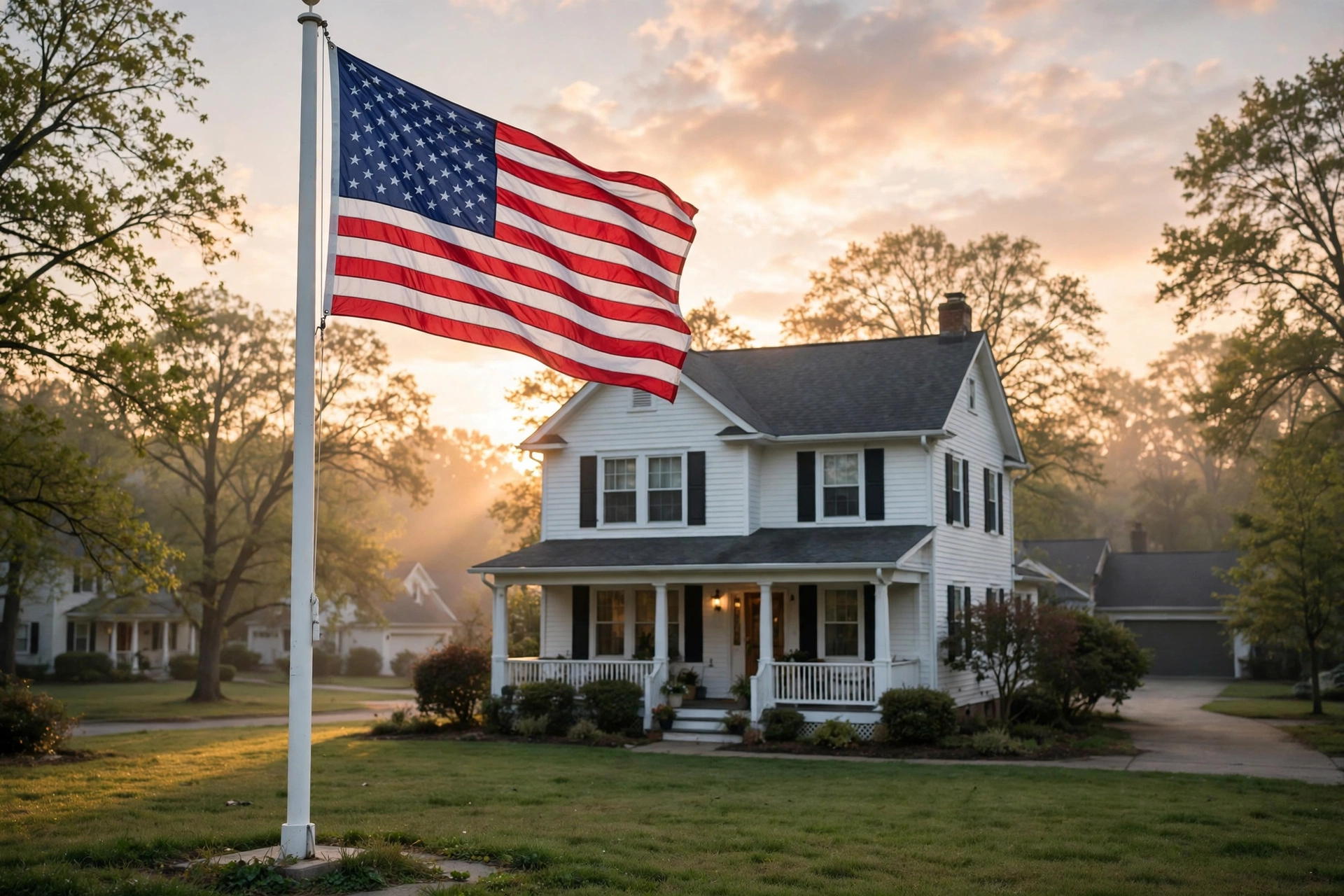
Let’s settle the biggest question first: on Veterans Day, the American flag flies at full staff — raised to the very top of the pole — for the entire day.
This is where confusion strikes. On Memorial Day, the flag flies at half-staff until noon, then is raised to full staff for the rest of the day. Many people assume Veterans Day follows the same pattern. It does not. The two holidays carry different symbolism:
- Memorial Day (last Monday in May): honors those who died in military service — hence mourning at half-staff until noon, then the “rise” to full staff symbolizing the nation’s resolve to continue.
- Veterans Day (November 11): honors all who served, with emphasis on the living — hence the flag flies proudly at full staff all day, a symbol of honor rather than mourning.
If you see a flag at half-staff on November 11, it is either a mistake or the result of a separate presidential or gubernatorial proclamation ordering half-staff to mourn a specific death or tragedy. Absent such an order, full staff is correct. Getting this right is the cornerstone of veterans day flag etiquette.
When to Raise and Lower the Flag on Veterans Day
The U.S. Flag Code (4 U.S.C. §§ 5–10) sets the standard customs for display:
- Raise at sunrise, lower at sunset. The traditional display day runs from sunrise to sunset. If you don’t know exact local times, raising the flag in the morning and taking it down in the evening is the correct custom.
- Night display requires light. You may fly the flag 24 hours a day — including overnight on Veterans Day — but only if it is properly illuminated during darkness. A spotlight, porch light, or dedicated flagpole light all qualify. An unlit flag at night violates the Code.
- All-weather flags in bad weather. The Code says the flag should not be displayed in inclement weather unless it is an all-weather flag (nylon, polyester, or another weather-resistant material). Most modern outdoor flags qualify. Traditional cotton flags should come inside if rain threatens.
- November 11 specifically. The Flag Code lists Veterans Day, November 11, among the days on which the flag should be displayed — it’s one of the core flag holidays, alongside Memorial Day, Independence Day, and others.
How to Properly Display the Flag: Position and Placement
On a flagpole
Hoist the flag briskly to the top of the staff. Lower it slowly and ceremoniously. When displayed with other flags on separate poles, the American flag goes in the position of honor — to its own right (the observer’s left) — and should be raised first and lowered last. No other flag should fly above the American flag on the same pole.
On a house or building (staff projecting from wall)
When the flag hangs from a staff projecting horizontally or at an angle from a windowsill, balcony, or building front, the union (the blue field of stars) should be at the peak of the staff — the farthest point from the building — unless the flag is at half-staff.
Flat against a wall
When displayed flat on a wall — a common Veterans Day decoration in schools and offices — the union should be at the observer’s upper left. Whether hung vertically or horizontally, the stars go top-left from the viewer’s perspective.
In a window
The same rule applies: union at the upper left as seen by someone outside looking in. Many Americans display a flag in a front window on Veterans Day — an easy, respectful option for apartments and homes without a pole.
On a vehicle
The flag should not be draped over a car, truck, or boat. It may be affixed to a staff attached to the vehicle (like the small flags on parade cars), but the staff should be fixed firmly to the chassis or clamped to the right fender. Decal-style flags on vehicles are generally considered acceptable as patriotic displays rather than formal flag displays.
With other flags
| Scenario | Correct Placement |
|---|---|
| U.S. flag with state or organizational flags on separate poles | U.S. flag in the position of honor (its own right / observer’s left), at the same height or higher; raised first, lowered last. |
| U.S. flag with flags of other nations | All flags at the same height on separate staffs of equal height; in peacetime, no nation’s flag flies above another’s. |
| U.S. flag with POW/MIA flag | The POW/MIA flag flies directly below the U.S. flag on the same pole — a common and appropriate Veterans Day pairing. |
| Multiple flags on one pole (halyard) | U.S. flag at the peak; no other flag above it. |
Veterans Day Flag Etiquette: The Rules Most People Break
The Flag Code contains customs that are widely ignored. On Veterans Day — of all days — it’s worth getting them right:
The flag should never touch the ground
The flag should never touch anything beneath it — the ground, floor, water, or merchandise. When lowering, have someone ready to catch and fold it. This is the most widely known rule and the most visibly broken.
Never use the flag as decoration or clothing (technically)
The Code states the flag should not be used as wearing apparel, bedding, or drapery, nor used for advertising purposes. In practice, flag-patterned clothing and decorations are everywhere, and courts have protected such expression. But for a formal Veterans Day display, treat an actual flag with full dignity: no cutting it into bunting, no printing logos across it.
Bunting is not the flag
Red-white-and-blue bunting — the pleated fabric swags on porches and parade routes — is not the American flag and is perfectly fine as decoration. Bunting should be arranged with blue at the top, then white, then red. Don’t confuse bunting rules with flag rules.
Don’t fly a tattered flag
A faded, frayed, or torn flag should be retired, not flown. Flying a damaged flag on Veterans Day undermines the honor you’re trying to show. Inspect your flag before November 11; if it’s worn, replace it and retire the old one properly (see below).
Don’t fly it in the dark without light
An unlit flag left up overnight is one of the most common violations. Either illuminate it or take it down at sunset.
Fold it correctly for storage
The traditional triangular fold — ending with only the blue star field visible — is the proper way to store a flag. The familiar 13-fold ceremony, with symbolic meanings assigned to each fold, is a beloved tradition at military funerals and Veterans Day events, though historians note the specific meanings are customary rather than codified.
How to Retire a Worn American Flag
When a flag is too worn to display, the Flag Code prescribes that it should be destroyed “in a dignified way, preferably by burning.” Here’s how to do it properly:
- Find a retirement ceremony. The American Legion, Veterans of Foreign Wars (VFW), and Boy Scouts of America posts regularly hold formal flag retirement ceremonies — many specifically on or around Veterans Day. This is the ideal option.
- Drop it off. Most American Legion and VFW posts, and many municipal buildings, maintain collection boxes for worn flags year-round. Simply fold the flag and drop it off; they handle the ceremony.
- DIY dignified retirement. If no ceremony is available: cut the flag along its seams, separating the blue star field from the stripes (once cut apart, it is no longer formally a flag). Burn the pieces completely in a safe fire, then bury the ashes. Conduct the moment with respect — it need not be elaborate to be dignified.
- Never throw a flag in the trash. This is the single most disrespectful disposal method and the one to avoid absolutely.
Veterans Day Flag Etiquette for Special Situations
At parades
When the American flag passes in a Veterans Day parade, all present should stand, face the flag, and render the appropriate salute — military members in uniform salute; civilians place the right hand over the heart. Men should remove hats. This applies whether you’re a participant or a spectator on the curb.
During the national anthem at ceremonies
Face the flag, stand at attention, right hand over the heart. Military personnel in uniform give the military salute. The same applies during the Pledge of Allegiance at Veterans Day school assemblies and events.
At veterans’ funerals near Veterans Day
Military funeral honors include the flag-draped casket (union at the head, over the left shoulder of the deceased), the ceremonial folding, and presentation of the flag to the next of kin. If you attend, follow the lead of the honor guard and remain solemn and still throughout.
In classrooms
Schools displaying the flag on Veterans Day should ensure it’s properly mounted (union upper-left as viewed), undamaged, and appropriately sized for the space. A classroom flag is a teaching tool — use it to explain the symbolism: 13 stripes for the original colonies, 50 stars for the states, and the colors’ traditional meanings of valor, purity, and justice.
Digital and printed displays
Using flag imagery in Veterans Day social media posts, flyers, or presentations is fine and encouraged. Just avoid altering the flag’s design in disrespectful ways (no superimposed text across the stars, no distorted proportions in formal contexts). And spell the holiday correctly in your captions: “Veterans Day,” no apostrophe.
Half-Staff Rules: The Complete Picture
Because half-staff confusion drives so much veterans day flag etiquette search traffic, here’s the full reference:
| Occasion | Flag Position |
|---|---|
| Veterans Day (November 11) | Full staff all day |
| Memorial Day (last Monday in May) | Half-staff until noon, then full staff |
| Death of a president or former president | Half-staff for 30 days (presidential proclamation) |
| Death of a vice president, chief justice, or House speaker | Half-staff for 10 days |
| Death of a member of Congress | Half-staff on day of death and following day |
| Death of a state governor or other officials | Half-staff per presidential or gubernatorial proclamation |
| National tragedies | Half-staff per presidential proclamation (e.g., 9/11 Patriot Day) |
Key point: only the President (for federal facilities) or a state governor (for state facilities) can order half-staff. Private citizens and businesses may follow suit during national mourning periods, but should not lower the flag on personal initiative for other reasons. On Veterans Day itself, absent a specific mourning proclamation, the flag stays at full staff.
How to properly fly at half-staff (when ordered)
Hoist the flag briskly to the peak first, then lower it ceremoniously to the half-staff position (halfway between top and bottom). When taking it down, raise it to the peak again before lowering fully. Never simply run it up halfway — the trip to the peak first is part of the ritual.
Veterans Day Flag Display Checklist
Use this quick checklist on the morning of November 11:
- ☐ Flag is clean, undamaged, and proper size for the pole or space
- ☐ Flying at full staff (not half-staff)
- ☐ Raised at or after sunrise; plan to lower at sunset (or illuminate for night display)
- ☐ Union (stars) positioned correctly for the display type
- ☐ No other flag above the U.S. flag; POW/MIA flag below if displayed
- ☐ All-weather material if rain is forecast (otherwise bring cotton flags inside)
- ☐ Flag does not touch the ground, plants, or structures
- ☐ Night lighting arranged if flying after dark
- ☐ Worn spare flags set aside for dignified retirement, not flown
Frequently Asked Questions About Veterans Day Flag Etiquette
Is the flag at half-staff on Veterans Day?
No. On Veterans Day the American flag flies at full staff all day. Half-staff until noon is the Memorial Day custom. The only exception would be a separate presidential or gubernatorial proclamation ordering half-staff to mourn a specific death.
What time should I put the flag out on Veterans Day?
Traditional custom is sunrise to sunset. If you fly it overnight, it must be illuminated. Many people raise it first thing in the morning on November 11 and lower it at dusk.
Can the flag get wet on Veterans Day?
Modern all-weather flags (nylon or polyester) are designed to fly in rain. Traditional cotton flags should be brought inside during inclement weather per the Flag Code.
Where does the POW/MIA flag go on Veterans Day?
Directly below the American flag on the same pole. Flying the POW/MIA flag on Veterans Day is common, appropriate, and encouraged at ceremonies honoring all who served.
Can I fly the flag from my apartment balcony or window?
Yes. On a projecting staff, the union goes at the far end from the building. In a window or flat on a wall, the union goes at the upper left as seen by an outside observer.
What do I do with a torn flag?
Retire it dignified — preferably through a formal ceremony at an American Legion or VFW post, many of which hold retirement ceremonies around Veterans Day. Never throw a flag in the trash.
Do I have to be a veteran to fly the flag on Veterans Day?
Not at all. The Flag Code encourages all Americans to display the flag on Veterans Day. Flying it is a civilian’s salute to those who served — no military service required.
Fly It Right, Honor Them Well
Veterans day flag etiquette boils down to one simple principle: display the flag the way the people it honors would want to see it — at full staff, well kept, properly positioned, and flown with intention. Get the details right and your flag becomes more than decoration; it becomes a statement of gratitude visible to the whole neighborhood.
Pair your display with the rest of the day’s observance: learn the meaning and history of Veterans Day, attend a parade or ceremony near you, and check the freebies honoring veterans. Fly it at full staff — and mean it.
The History Behind Veterans Day Flag Customs
Today’s veterans day flag etiquette didn’t appear from nowhere — it grew out of the holiday’s own history. When President Wilson proclaimed the first Armistice Day in 1919, flags across the country flew to mark both celebration and remembrance: celebration that the war was over, remembrance of those who didn’t come home. That dual spirit is why the flag flies at full staff on Veterans Day — it’s a day of honor, not mourning.
The full-staff custom was effectively settled when Congress renamed Armistice Day to Veterans Day in 1954. The renaming shifted the holiday’s emphasis from the war’s end to the people who served — especially the living. A flag at full staff, flying high and proud, symbolizes a nation standing tall in gratitude rather than bowed in grief. That’s the visual distinction the Flag Code preserves: Memorial Day’s half-staff morning acknowledges death; Veterans Day’s full-staff day celebrates service.
The POW/MIA flag’s place below the Stars and Stripes on Veterans Day also has a history. The black-and-white POW/MIA flag was created in the early 1970s during the Vietnam War by the National League of Families. Congress later mandated its display at federal facilities on specific days — including Veterans Day — making the pairing of the two flags on November 11 one of the most recognizable sights of the holiday.
Teaching Kids Veterans Day Flag Etiquette
Veterans Day is a perfect occasion to teach children flag respect. Keep it concrete and hands-on:
- Let them help raise and lower the flag. Show them how to hoist briskly and lower slowly — kids remember rituals they participate in.
- Teach the “never touch the ground” rule first. It’s simple, visual, and memorable — the foundation of all flag respect.
- Practice the Pledge properly. Right hand over heart, facing the flag, hats off. Explain what the words mean in age-appropriate language.
- Quiz them on full staff vs. half-staff. “Is the flag up high or halfway today? Why?” — connecting the position to the holiday’s meaning makes it stick.
- Fold a flag together. The triangular fold is like origami with meaning; older kids can learn the full 13-fold sequence.
- Visit a flag retirement drop box. Showing kids where worn flags go — and explaining the dignified retirement ceremony — teaches that respect extends to the end of a flag’s life.