Valentine’s Day in Bangladesh comes with a bonus that no other country can claim: it arrives hand-in-hand with Pohela Falgun, the Bengali festival of spring. Every year, February 13 brings the first day of the Bengali month of Falgun — a riot of yellow saris, marigold garlands, and open-air music — and February 14 follows with Bhalobasha Dibosh, the Day of Love. For young Bangladeshis, the two days blur into a single 48-hour celebration of color, romance, and renewal, unlike anything else in the world. If you want to understand how Bangladesh does Valentine’s season, you have to understand both halves of the weekend.
This guide covers everything: the history and customs of Pohela Falgun, how Valentine’s Day took root in Bangladeshi cities, the perfect two-day itinerary for celebrating both, and practical tips for visitors and locals alike. Whether you are planning a trip to Dhaka in February or simply curious about the world’s most colorful Valentine’s season, start here.
Two Festivals, One Weekend: Why Bangladesh’s Valentine’s Season Is Unique
Most countries get one day of love. Bangladesh gets a season. Pohela Falgun — literally “the first of Falgun” — is the Bengali New Year of spring, a celebration of nature’s renewal that predates Valentine’s Day in Bangladesh by centuries. Bhalobasha Dibosh (Valentine’s Day) is the global import, embraced by urban youth over recent decades. That they fall on consecutive days is a calendrical coincidence — and a cultural gift.
The pairing works because the two festivals rhyme emotionally. Pohela Falgun is about collective joy: crowds, music, color, the end of winter’s “shivery chill.” Valentine’s Day is about private devotion: couples, gifts, whispered promises. Together they form a complete emotional arc — celebrate with everyone on the 13th, celebrate with your someone on the 14th. Young Dhaka has refined this into an art form: the yellow sari of Pohela Falgun gives way to the red-and-black of Valentine’s evening, and the flower crowns of the spring festival are joined by the red roses of the day of love.
For visitors, the timing is unbeatable. February is among the most pleasant months in Bangladesh — cool, dry, clear-skied — and Dhaka in mid-February is at its most festive. If you can only visit Bangladesh once, the Pohela Falgun–Valentine’s weekend is a strong candidate for when.
Pohela Falgun: The First Day of Spring
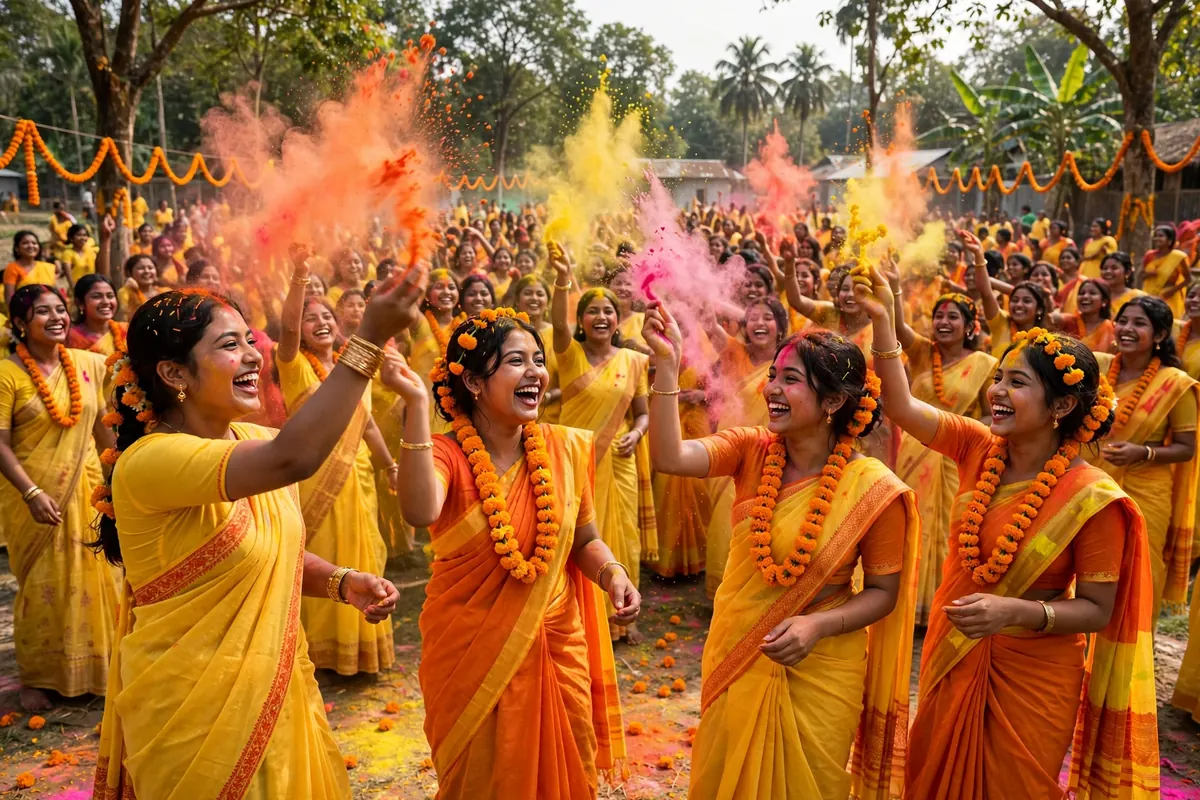
To feel Pohela Falgun, go to Dhaka on the morning of February 13. Tens of thousands of people pour into the parks and green spaces of the capital — above all the Dhaka University campus — dressed in the festival’s signature colors. Women and girls wear bashonti (yellow or orange) saris adorned with floral ornaments in their hair; men and boys wear colorful panjabis. The air fills with the smell of marigolds and the sound of music, and the winter is officially, joyfully over.
What actually happens
The centerpiece is the day-long cultural program organized by the Jatiya Bosonto Utsab Udjapon Parishad (National Spring Festival Celebration Council) at Dhaka University — a marathon of music, dance, poetry recitation, and elocution performances on open-air stages. Troupes of artists dance through the crowds, splashing red and yellow colored powder. Beyond the university, the celebrations spill across the city: chorus singing, folk dance, and open-air poetry readings in parks and public spaces, with celebrations reported across the country.
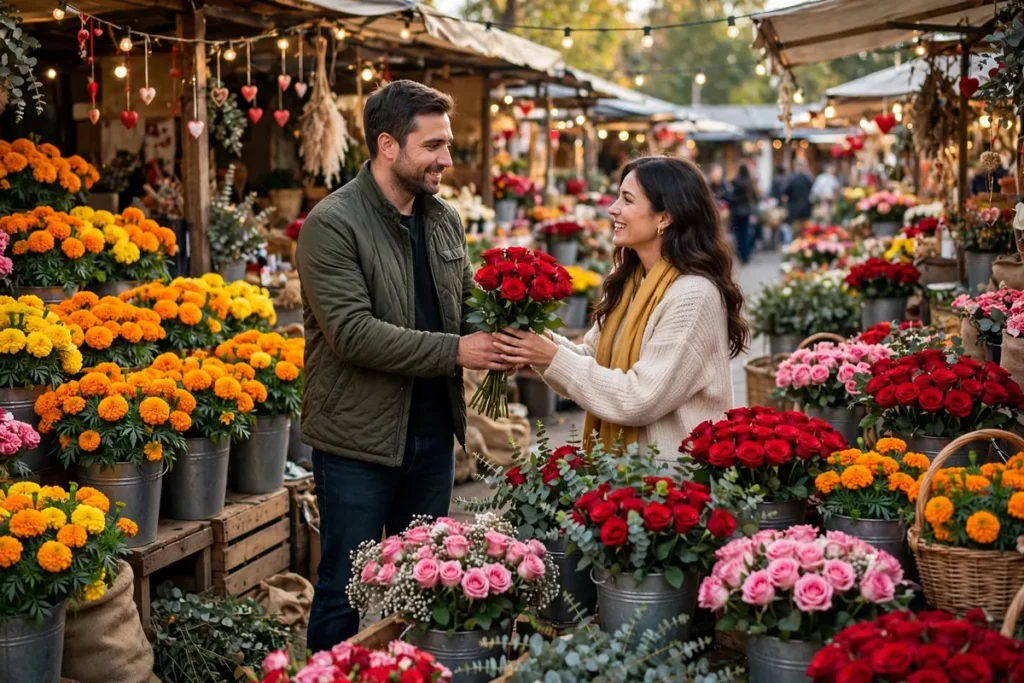
The festival’s aesthetic is its message. Yellow and red — the colors of mustard flowers and the spring sun — dominate everything: clothing, flower garlands, stage decorations, even the colored powder. Florists do some of their best business of the year, sorting bunches of roses alongside tuberose, gladiolus, marigold, gerbera, and daisies. Mobile hawkers set up stalls across the capital, and flower prices soar with demand. For couples, the festival doubles as a romantic occasion: young pairs mark their togetherness in the festival’s blazing colors, exchanging flowers, chocolates, and candy.
Where it comes from
Pohela Falgun’s roots run deep into Bengali culture. The Bengali calendar’s six seasons (ritu) give spring — Bosonto — pride of place in literature and music; Tagore’s spring songs are the festival’s unofficial soundtrack. The modern public celebration, centered on Dhaka University, grew as an expression of Bengali cultural identity — a festival that is unmistakably, defiantly Bengali, open to everyone regardless of faith or background. In a country where cultural identity has been hard-won, that openness is part of the point.
One practical note on dates: under the revised Bengali calendar, Pohela Falgun falls on February 13 (it occasionally lands on the 14th in calculations using the traditional calendar). Either way, it sits cheek-by-jowl with Valentine’s Day — which is precisely the magic.
Bhalobasha Dibosh: Valentine’s Day, Bangladeshi Style
If Pohela Falgun belongs to everyone, February 14 belongs to couples. Bhalobasha Dibosh — the Day of Love — is Valentine’s Day in its Bangladeshi incarnation: red roses, gift exchanges, restaurant dinners, and a great deal of color coordination. It is primarily an urban phenomenon, concentrated in Dhaka, Chittagong, Sylhet, and other cities, and driven by students and young professionals.
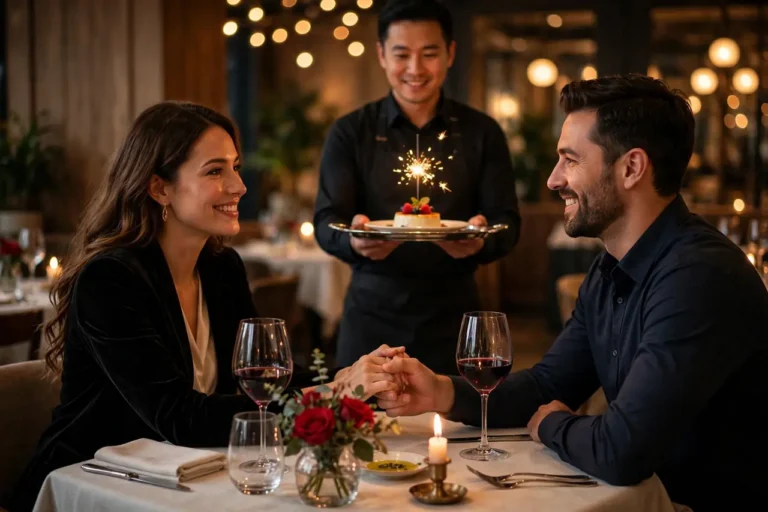
The day’s texture is familiar but inflected locally. University campuses and city parks fill with couples; restaurants in Dhaka’s Banani, Gulshan, and Dhanmondi neighborhoods run Valentine’s promotions; bakeries produce heart-shaped cakes; and gift shops sell the familiar global inventory — teddy bears, chocolates, greeting cards — alongside local touches. Social media fills with couple photos, often taken against the previous day’s still-fresh spring decorations.
What distinguishes the Bangladeshi Valentine’s is its seamless continuity with Pohela Falgun. Couples do not switch off the spring festival and switch on Valentine’s — they layer them. The marigold garland from the 13th sits beside the red roses of the 14th. The yellow sari gives way to red, but the flowers stay in the hair. It is less two separate celebrations than one long celebration with two movements, and Bangladeshis navigate the transition with an ease that visitors find enchanting.
The day is not without its critics — conservative voices occasionally question Valentine’s Day as a Western import, a debate familiar across South Asia (our guide to Valentine’s Day in Pakistan explores the region’s most intense version of that debate). But in Bangladesh, the criticism has gained little traction against the sheer cultural momentum of the Pohela Falgun weekend: when the whole country is already celebrating love, spring, and beauty, one more day of it feels less like an import and more like a natural extension.
The Perfect Two-Day Itinerary: February 13–14 in Dhaka
Here is how to do the weekend properly, whether you are a local couple or a visitor.
February 13 — Pohela Falgun
Morning: Head to the Dhaka University campus area early — the crowds build fast. Dress the part: a yellow or orange sari or panjabi, flowers in your hair or a marigold garland. Join the open-air cultural programs: music, dance, poetry. Let yourself be splashed with colored powder; it washes out, and the photos are worth it.
Afternoon: Wander the book fair — February is also the month of Dhaka’s famous Ekushey Book Fair, and the two events overlap gloriously. Browse the stalls, buy a book of poetry for your Valentine (a Bangladeshi romantic gesture with real weight), and soak in the festival atmosphere.
Evening: As the spring celebrations wind down, transition: dinner at a favorite restaurant, flowers for tomorrow secured from a florist before they close. Rest up — tomorrow is for romance.
February 14 — Bhalobasha Dibosh
Morning: Exchange gifts privately — flowers, chocolates, the book from yesterday’s fair. Many couples revisit the university area or a favorite park for photos in Valentine’s colors.
Afternoon: A quiet interlude: a café in Dhanmondi or Banani, a boat ride on Hatirjheel lake, or simply time together away from the crowds.
Evening: The Valentine’s dinner — book ahead, as Dhaka’s popular restaurants fill up. End the night the Bangladeshi way: with the city’s lights, a final exchange of flowers, and the memory of two festivals in two days.
Watch: Pohela Falgun and Valentine’s Day in Dhaka
Television coverage from Dhaka captures the extraordinary sight of the two festivals side by side — the spring colors of Pohela Falgun flowing into Valentine’s Day celebrations across the capital. This report from ATN News shows the crowds, the colors, and the couples.
The Weekend at a Glance
| Detail | Pohela Falgun (Feb 13) | Valentine’s Day (Feb 14) |
|---|---|---|
| Bengali name | Pohela Falgun — first day of spring | Bhalobasha Dibosh — Day of Love |
| Colors | Yellow and orange (bashonti), with red accents | Red, pink, and romantic evening tones |
| Signature flowers | Marigolds, garlands, floral hair ornaments | Red roses, tuberose, gladiolus, gerbera |
| Main venue | Dhaka University campus cultural programs | Restaurants, parks, and private celebrations citywide |
| Who celebrates | Everyone — all ages, all backgrounds | Primarily couples, students, young professionals |
| What to wear | Yellow/orange sari or colorful panjabi | Valentine’s colors — red is the classic choice |
| Don’t miss | Open-air music and dance; colored powder | Valentine’s dinner — book restaurants ahead |
Gifts for the Two-Day Celebration
The double festival calls for double the thoughtfulness — but the two days’ gifts can harmonize beautifully. For Pohela Falgun, traditional and poetic gifts shine: a marigold garland, a book of Tagore’s spring songs or Jibanananda Das’s poetry, a handloom sari or panjabi in bashonti yellow. For Valentine’s Day, the classic repertoire applies: red roses, chocolates, jewelry, and the personal gifts that say you — browse thoughtful Valentine’s gifts for her and gifts for him for inspiration, then add the Bangladeshi twist.
The most romantic move of the weekend? A gift that bridges both days: the poetry book bought at the book fair on the 13th, inscribed and given on the 14th. Or flowers on both days — marigolds for spring, roses for love — marking the transition from festival to romance. Couples who plan a full romantic day together will find Dhaka’s February weather the perfect accomplice: cool, dry, and made for being outdoors.
Practical tip: buy flowers early on the 13th. Florists are at their busiest of the year across the two days, prices climb daily, and the best blooms go first. A single well-timed purchase on the morning of Pohela Falgun can supply both days’ flowers if you choose hardy varieties.
For Visitors: Etiquette, Timing, and Making the Most of the Weekend
The Pohela Falgun–Valentine’s weekend is one of Bangladesh’s most visitor-friendly festivals — participatory, joyful, and welcoming. A few notes make the experience smoother.
Timing your trip. Aim to arrive by February 12. Pohela Falgun’s main events start early on the 13th, and you will want a day to acclimatize, buy festival clothing, and get your bearings. Dhaka’s hotels fill during festival weekends — book accommodation early, and consider staying near the university area or Dhanmondi for easy access to the action. February weather is reliably pleasant: cool mornings, warm afternoons, minimal rain.
Dressing for it. This is a dress-up festival, and visitors are expected — delightedly — to join in. Buy a bashonti-colored sari or panjabi from New Market or a local boutique; add a marigold garland from any flower stall. On the 14th, switch to Valentine’s colors. Changing outfits between the two days is not vanity — it is participation, and Bangladeshis will love you for it.
Photography etiquette. The crowds, colors, and costumes make irresistible photographs, and most celebrants are happy to be photographed — but ask first, especially for close-ups of individuals and couples. A smile and a gesture with the camera is universally understood. During the colored-powder moments, protect your gear; the powder is festive but not electronics-friendly.
Food and the festival. February 13th’s street food scene is part of the celebration: fuchka, jhalmuri, fresh juices, and sweets from the stalls around the university and book fair. Eat where the crowds eat, drink bottled water, and save appetite for the Valentine’s dinner on the 14th — Dhaka’s restaurant scene, from traditional Bengali to international, rises to the occasion.
The book fair bonus. Do not skip the Ekushey Book Fair — it runs through February, and its overlap with the festival weekend is a gift. Even non-Bengali readers will enjoy the atmosphere: the crowds, the author events, the sheer scale of Bangladesh’s literary culture. Buy a translated Tagore or Jibanananda Das as a Valentine’s gift with unbeatable provenance: purchased at the book fair on Pohela Falgun, given on Valentine’s Day.
Pohela Falgun Beyond Dhaka
Dhaka hosts the flagship celebrations, but the spring festival belongs to the whole country. In Chittagong, the port city’s cultural organizations stage music and dance programs; in Sylhet, the tea-garden region celebrates with its own flavor; in Rajshahi, the “education city,” university campuses mirror Dhaka’s festivities on a smaller scale. Rural Bangladesh marks the day more quietly — with seasonal foods, family gatherings, and the agricultural rhythms of late winter — a reminder that Pohela Falgun began as a people’s festival long before it became an urban spectacle.
For couples, the regional celebrations offer something Dhaka cannot: intimacy. A Pohela Falgun in a smaller city — fewer crowds, the same colors, the same music — can feel more personal than the capital’s magnificent crush. And wherever you are, the festival’s core is identical: yellow against the winter’s end, flowers against the gloom, and the collective decision that spring deserves a party.
The Language of Flowers: What to Give and What It Means
Across the two-day weekend, flowers do the talking — and in Bangladesh, each bloom carries meaning. Marigolds (gada phool) are the flowers of Pohela Falgun: garlands of orange and yellow marigolds adorn hair, wrists, and doorways, symbolizing the sun and the harvest. Giving marigolds on the 13th says welcome spring; they are festive, not romantic, which makes them perfect for friends, family, and new acquaintances.
Roses take over on the 14th, and color matters: red for romantic love, pink for admiration, white for respect, yellow for friendship. The savvy celebrant uses the full palette across the weekend — marigolds for the festival crowd, yellow roses for friends, red roses for the beloved. Tuberose (rajnigandha), with its intoxicating evening fragrance, is the connoisseur’s addition: a single stem tucked into a bouquet adds a sensory dimension roses alone cannot provide. Gladiolus brings drama and height to arrangements; gerberas bring cheerful color at friendly prices.
The presentation custom: flowers are given in person, never merely delivered, when the giver can help it. The handover — the slight bow, the eye contact, the shared smile — is the real gift; the flowers are its evidence. For the 14th’s grand gesture, combine the dozen red roses with one perfect marigold from the day before: spring and love, in a single bouquet.
The colors, decoded
Bangladesh’s festival palette is a language. Yellow (bashonti) is spring itself — mustard flowers, sunshine, renewal — and wearing it on Pohela Falgun is a declaration of participation. Red is love and vitality, bridging both days. Orange sits between them: festive and warm. Green, occasionally seen, nods to the countryside’s new growth. White is avoided on festival days (it carries funereal associations in Bengali culture) — save it for formal occasions. Dressing in the right colors is not trivial fashion; it is fluency in the weekend’s mother tongue. Get the colors right, and you will find strangers smiling at you like family — because for these two days, in this shared language of yellow and red, you are.
Frequently Asked Questions
What is Pohela Falgun?
Pohela Falgun is the first day of Falgun, the eleventh month of the Bengali calendar and the start of spring (Bosonto). Celebrated on February 13, it is a major cultural festival in Bangladesh marked by wearing yellow and orange, exchanging flowers, and attending open-air music, dance, and poetry programs — most famously on the Dhaka University campus.
Why do Pohela Falgun and Valentine’s Day fall together?
It is a calendrical coincidence: the Bengali calendar places the first of Falgun on February 13, the day before the global February 14 Valentine’s Day. Bangladeshis have embraced the pairing, treating the two days as a continuous 48-hour celebration of spring and love.
What should visitors wear for Pohela Falgun?
Join in: women traditionally wear yellow or orange (bashonti) saris with flowers in their hair, and men wear colorful panjabis. Visitors are warmly welcomed to dress in the festival colors — it is a participatory celebration, and dressing the part is half the fun.
Is Valentine’s Day controversial in Bangladesh?
Far less so than in some neighboring countries. While conservative voices occasionally criticize it as a Western import, the day enjoys broad acceptance among urban youth, and its adjacency to the beloved Pohela Falgun festival gives it a natural cultural anchor. The debate is muted compared to, for example, Valentine’s Day in Pakistan, where a court order restricts public celebrations.
Where is the best place to experience the weekend in Dhaka?
The Dhaka University campus (TSC area) is the heart of Pohela Falgun’s public celebrations. For Valentine’s Day, the restaurant districts of Banani, Gulshan, and Dhanmondi, the parks, and Hatirjheel lake are popular. February also brings Dhaka’s Ekushey Book Fair — combine all three for the ultimate cultural weekend.
What flowers should I give across the two days?
Marigolds and floral garlands for Pohela Falgun; red roses (plus tuberose, gladiolus, or gerbera) for Valentine’s Day. Buying early on the 13th gets you the best selection before prices peak.
The Bottom Line
Valentine’s Day in Bangladesh is really two celebrations wearing one season’s clothes: Pohela Falgun’s exuberant, democratic spring festival and Bhalobasha Dibosh’s intimate day of love, back to back, each making the other richer. Nowhere else in the world does February 14 arrive on the heels of a flower-strewn spring carnival — and nowhere else do couples get to celebrate love twice, in two different keys, in 48 hours.
Come for the colors of the 13th, stay for the romance of the 14th, and leave understanding why Bangladeshis consider mid-February the most beautiful weekend of the year. For how the rest of the world marks the day of love, explore our guide to Valentine’s Day traditions around the world.