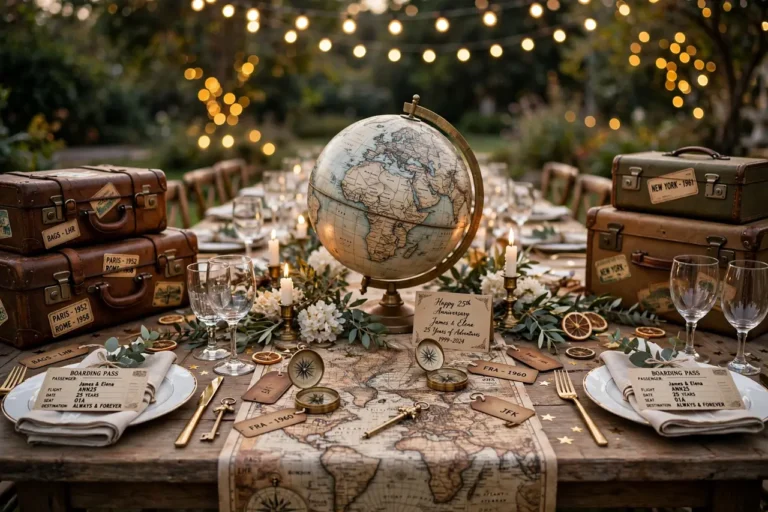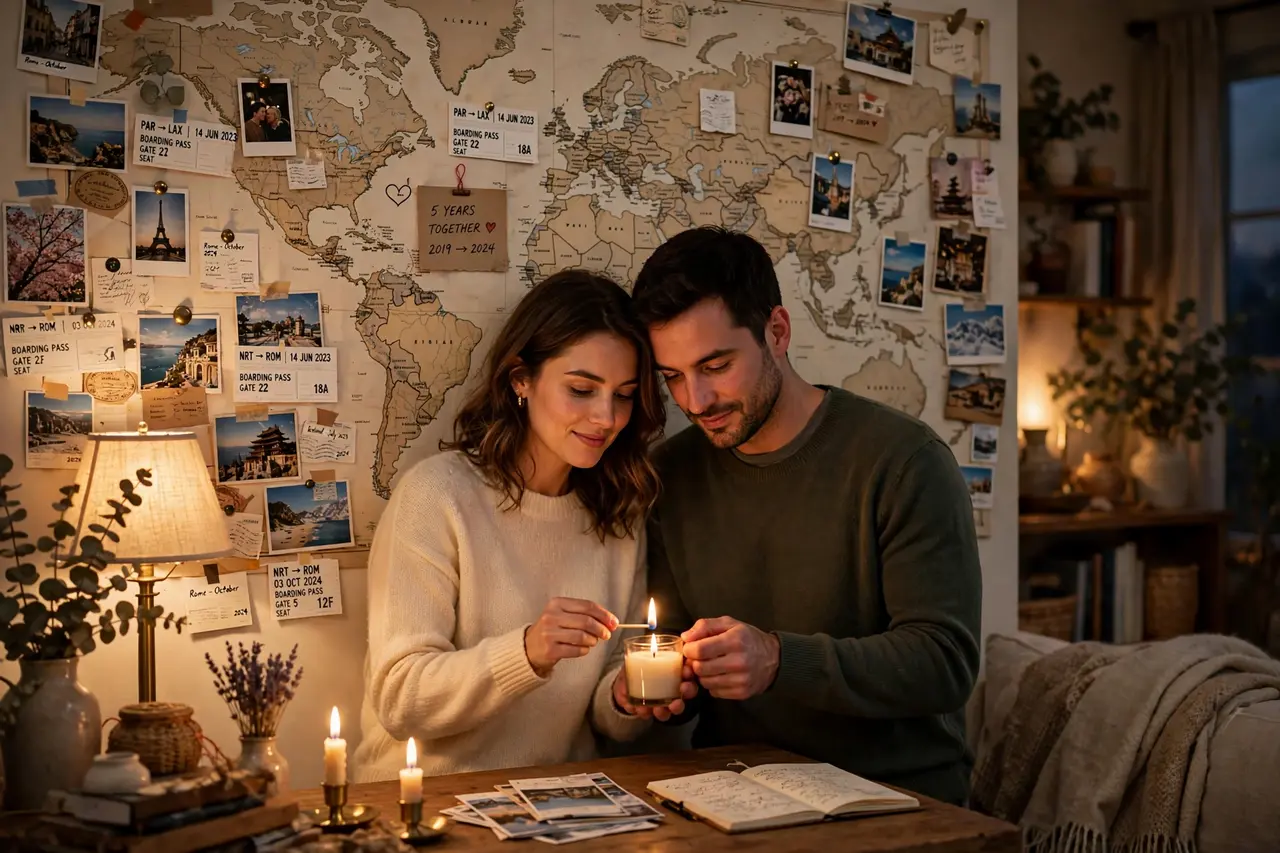
Every year on their anniversary, Elena and Marcus do the same thing. They order takeout from the first restaurant they ever visited together — a tiny Thai place in Chicago — spread a blanket on the living room floor, and watch the shaky phone video Marcus took on their honeymoon in Greece. It is not fancy. It has never once been photographed for social media. But when Elena talks about her marriage, she talks about that night. “It is our little ceremony,” she says. “The world can be chaos, but that evening is always ours.”
That is what a tradition is: a ritual that turns a date on the calendar into a pillar your relationship leans on. Travel anniversary traditions for couples are especially powerful, because they weave together the two great loves of an adventurous marriage — each other, and the world you explore together. This guide collects beloved travel traditions from around the globe, modern rituals couples invented themselves, and a simple framework for building a tradition that is unmistakably yours.
Why Anniversary Traditions Matter More Than Anniversary Gifts
Gifts are lovely, but they depreciate — emotionally, if not financially. Traditions appreciate. Psychologists who study relationships consistently find that couples with shared rituals report higher satisfaction and resilience during hard seasons. A ritual gives you something to look forward to, something that is “yours” in a way no object can be, and a built-in moment each year to pause and notice the life you are building.
Travel traditions add one more layer: they turn your marriage into an ongoing story with chapters. The ornament from each trip, the photo in the same spot every year, the restaurant you return to — these are plot points. Ten years in, you do not just have memories; you have a mythology, a shared narrative that belongs to no one else on earth. And when life gets genuinely hard — illness, loss, distance — the tradition becomes an anchor. Elena and Marcus did their blanket-and-takeout night the year Marcus’s father died, the year money was tight, and the year Elena was on bed rest. Especially those years.
Old-World Travel Traditions Couples Still Keep
Some anniversary rituals are centuries old, carried across oceans by the couples who invented them. These six come from different corners of the world — and each one is easy to adopt wherever you live.
1. The German Polterabend Spirit (Germany)
In Germany, the night before a wedding brings the Polterabend — friends smash porcelain for luck (shards mean happiness, never glass). Anniversary couples adapted it: each year, they deliberately break one inexpensive plate together and keep a shard in a jar, labeled with the year. The growing jar becomes a sculpture of survived years. It is loud, cathartic, and weirdly moving — a physical reminder that broken things, kept with love, become beautiful.
2. The Love-Lock Ritual (France, and Now Everywhere)
Parisians made it famous on the Pont des Arts: engrave your initials on a padlock, lock it to the bridge, throw the key in the Seine. For anniversaries, couples do a yearly lock — same bridge if you can return, or a “lock tree” or decorative chain at home. Each anniversary adds a lock dated with the year. Some cities removed the bridge locks for structural reasons, so check locally — or start your own tradition at home, which is arguably more personal anyway.
3. Renewing by Water (Hindu Tradition, India)
In parts of India, couples mark anniversaries with rituals near water — rivers, the sea, even a home fountain — offering flowers and renewing their promises as the water carries the old year away. The symbolism is potent: love, like water, must keep moving to stay alive. An at-home version: each anniversary, float flowers or lit candles in a bowl of water while you speak your hopes for the coming year. Simple, ancient, and quietly profound.

4. The Anniversary Trip to the Same Place (Japan’s “Kinenbi” Culture)
Many Japanese couples honor kinenbi (memorial days, including anniversaries) by returning to meaningful places — the restaurant of the first date, the shrine where they prayed together. The power is in repetition: the same table, the same walk, noticing what has changed and what has not. Adopt it by choosing one place — it can be as humble as a park bench — and returning every single year, cameras ready for the annual photo in the same spot.
5. The Italian “La Serenata” Echo (Italy)
The serenata — a suitor singing beneath a beloved’s window — evolved into an anniversary custom in parts of southern Italy, where one partner surprises the other with music: a hired guitarist, a playlist of “your songs,” or (bravest of all) singing yourself. The modern take: every anniversary, dedicate one song to each other — the song that defined your year. Keep a running anniversary playlist; a decade in, it is the soundtrack of your marriage.
6. The Celtic Handfasting Renewal (Ireland and Scotland)
Handfasting — binding couples’ hands with cords or ribbons — is an ancient Celtic rite that modern couples revive each anniversary, adding a new ribbon each year in the year’s color. The bundle of ribbons becomes a tangible timeline. It takes five minutes, costs almost nothing, and feels surprisingly solemn. Many couples do it privately on the morning of their anniversary, before the day’s celebrations begin.
Modern Traditions Couples Invented Themselves
The best traditions are not always ancient — sometimes they are just two people deciding that this, this specific thing, is theirs. These six were born in ordinary living rooms, and each one is easy to start tonight.
7. The Annual Ornament (or Magnet, or Shot Glass)
The rule: every trip together, you bring home one specific souvenir — an ornament, a magnet, a pin. Every anniversary, you hang or display the year’s addition together and retell the story of the trip it came from. Within a decade you have a Christmas tree (or fridge, or map board) that is a museum of your marriage. The constraint — one item, one type — is what makes it a tradition rather than clutter.
8. The Restaurant Pilgrimage
Like Elena and Marcus: pick one restaurant — the first-date spot, the honeymoon favorite, the place where you got engaged — and eat there every anniversary, no matter what. Order the same dish if you can. Restaurants close and cities change, which only makes the ritual more precious; couples who have kept this up for decades describe the annual meal as a homecoming. If the original place is gone, nominate a successor and keep the chain unbroken.
9. The Anniversary Interview
Once a year, interview each other with the same five questions: What was the best moment of our year? What trip do we still talk about? What did we learn about each other? What are we hoping for next year? Where should we go? Record it — audio or video. The questions stay the same; the answers become a time-lapse of your marriage. Couples who have done this for ten-plus years say listening back is one of the most emotional experiences of their lives.
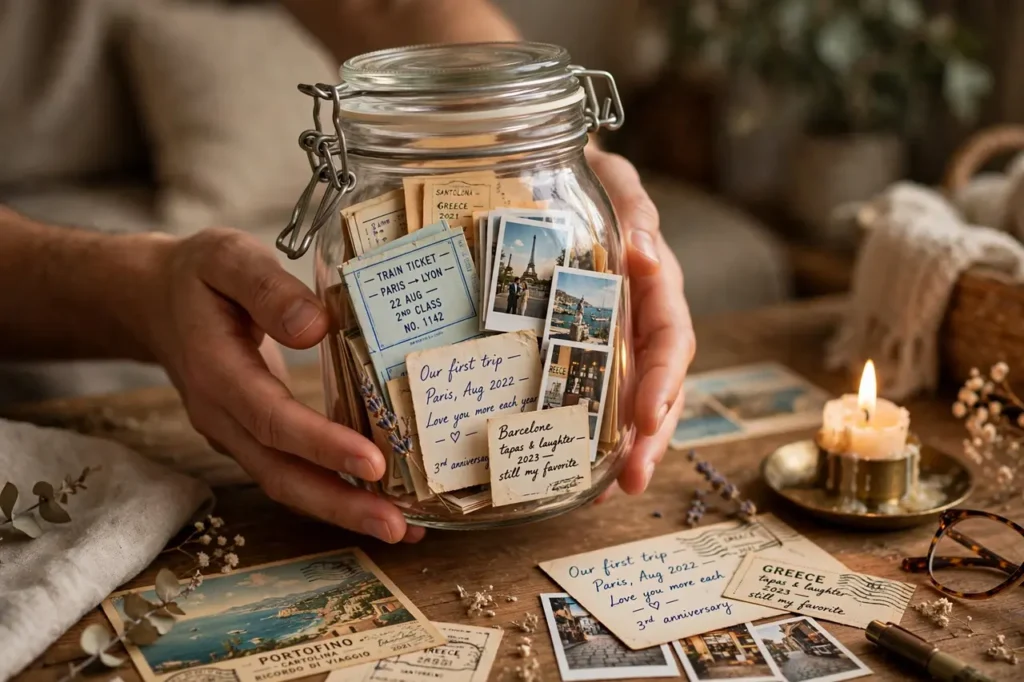
10. The Map-Pin Ceremony
Hang a large world map where you will see it daily. Every anniversary, pin the places you visited that year — together — with dated pins, and trace the route between them in red thread. Add a small tag with one memory per destination. The map fills in year by year, and the red threads start to look like a constellation. It is decor, diary, and dream board in one, and guests always ask about it.
11. The Vow-Letter Exchange
Each anniversary, write each other a letter — not a card, a real letter — about the year: what you admired, what you forgave, what you are excited for. Read them aloud after dinner, then seal them in dated envelopes and keep them in a box. Unlike spoken vows, which evaporate, these accumulate. On a hard anniversary, reading back through the box reminds you exactly why the tradition exists. For couples who want to go deeper with written words, our anniversary wishes for wives and anniversary wishes for husbands offer starting lines when the blank page feels intimidating.
12. The “First Night” Recreation
Once a year, recreate your wedding night or first date as faithfully as you can: the same restaurant (or the same takeout), the same movie, the same ridiculous playlist. Wear something approximating what you wore. It is funny, nostalgic, and — according to every couple who does it — strangely romantic. The gaps between memory and reality become the best part: “we definitely did not look this tired on our wedding night.”
Traditions at a Glance: Find Yours
| Tradition | Origin | Cost | Effort | Best For |
|---|---|---|---|---|
| Plate-smashing jar | Germany | $5/year | Low | Couples who love symbolism |
| Yearly love lock | France | $10/year | Low | Romantics, travelers |
| Water renewal ritual | India | Free | Low | Spiritual couples |
| Same-place return | Japan | Varies | Medium | Nostalgic couples |
| Anniversary song dedication | Italy | Free | Low | Music lovers |
| Handfasting renewal | Celtic | $5/year | Low | Couples wanting ceremony |
| Annual souvenir | Modern | $10–$30/year | Low | Frequent travelers |
| Restaurant pilgrimage | Modern | $50–$150/year | Low | Food-loving couples |
| Anniversary interview | Modern | Free | Low | Reflective couples |
| Map-pin ceremony | Modern | $20 once | Low | Visual, travel-obsessed couples |
| Vow-letter exchange | Modern | Free | Medium | Writers and deep feelers |
| “First night” recreation | Modern | $30–$80/year | Medium | Playful nostalgics |
Build Your Own Tradition in Five Steps
Adopting a tradition is wonderful; inventing one is even better. Here is how to build a ritual that lasts.
Step 1: Find your anchor moment. Look at your relationship for a moment that already feels ceremonial — the restaurant, the song, the walk, the silly thing you always do. Traditions work best when they formalize something you already love, rather than importing something foreign.
Step 2: Make it repeatable. A tradition you cannot repeat is just a nice memory. It should be simple enough to do when you are tired, broke, or busy — because those are the years it matters most. If it requires a plane ticket, build a home version as backup.
Step 3: Add one sensory detail. The same candle scent, the same playlist, the same dish. Sensory repetition is what tells your brain “this is the ritual” — it is why the smell of the Thai takeout will, years from now, instantly feel like your anniversary.
Step 4: Build in reflection. Every strong tradition includes a moment of looking back or forward — the interview questions, the letter, the toast. Without reflection, a ritual is just a habit. With it, it becomes a pillar.
Step 5: Protect it fiercely. The first year something threatens the tradition — a work trip, a sick kid, sheer exhaustion — is the year that decides whether it survives. Do the simplified version rather than skipping. Elena and Marcus once did their blanket night over video call from different cities. It counted. It always counts. And tell people about it: traditions gain strength when they are witnessed. Mention yours in your anniversary toast, write it in your holiday card, let friends ask about it. A ritual the world knows about is a ritual you will keep.
For more inspiration on the rituals couples keep worldwide, explore our guide to anniversary traditions around the world — it pairs beautifully with the travel-focused rituals above.
Watch: A Couple’s Cozy Anniversary Tradition
Traditions do not need to be grand to be meaningful — sometimes they are as simple as baking a cake together and sharing a quiet dinner at home, year after year. This video captures that spirit beautifully: a couple celebrating eleven years with a homemade anniversary cake and a cozy dinner, a ritual anyone could adopt. Notice how the repetition is the point — the same cake, the same togetherness, made special precisely because it happens every single year.
Traditions for Every Decade of Marriage
Traditions should fit the season of marriage you are in. Years 1–5 are for building: start the interview recordings, the ornament collection, the map. Everything is new, so document aggressively — you will thank yourselves later. Keep rituals light and fun; the “first night” recreation and the restaurant pilgrimage shine here. Years 5–15 are often the busiest — careers, young kids, mortgages. This is when simplicity saves traditions: the letters, the song dedication, the blanket night. Choose rituals that survive exhaustion, because these are the years most traditions die. Years 15–30 bring depth: reread the old letters together, revisit the map and marvel at the red threads, return to the same place for the tenth time. The accumulation becomes the point. Years 30+ are for legacy: share the interview recordings with your children, teach the grandkids the rituals, write the story down. The tradition outgrows the two of you and becomes family culture — which is, arguably, what it was always becoming.
When Traditions Need to Change
Here is something the glossy articles rarely say: sometimes traditions need to evolve, and that is healthy. The restaurant closes. A tradition tied to travel becomes impossible during illness or tight finances. A ritual that once felt romantic starts to feel rote. When that happens, do not abandon the tradition — adapt it. The restaurant pilgrimage becomes a takeout pilgrimage. The travel ornament becomes a “year ornament” from anywhere, even the grocery store, as long as the story is good. The trip you cannot take becomes the trip you plan in exquisite detail.
And be gentle with traditions during grief. The first anniversary after losing a parent, a child, or even the family dog can make rituals feel hollow or painful. It is okay to do the simplified version, or to sit with the absence as part of the ritual. Many couples report that keeping the tradition through grief — lighting the candle, writing the letter even through tears — eventually becomes one of the most meaningful iterations. The ritual holds you when you cannot hold yourselves.
Quick Start: Launch Your First Tradition This Weekend
Do not wait for the “perfect” anniversary. This weekend, do three things. First, buy a large world map and a pack of pins (total cost: about twenty dollars). Second, hang it somewhere you will see it every day — the hallway, the bedroom, the kitchen. Third, sit down together with a glass of something and pin every place you have traveled as a couple, telling one story per pin. Congratulations: you have just performed your first map-pin ceremony. Next anniversary, add the year’s new pins and read this paragraph again. Traditions do not require perfect planning; they require a beginning — and the willingness to repeat it, year after year, until it becomes the story you tell about yourselves. You just made yours.
Real Couples, Real Traditions
Priya and David — the boarding-pass book. Every anniversary, they design boarding passes for a fictional flight — “Flight 12, Gate Love, Destination: Year Thirteen” — and tuck them into a scrapbook with that year’s photos. Twelve years in, the book is thick, and their kids fight over who gets to add the latest passes. “It started as a joke,” Priya says. “Now it is the most important book in our house.”
Rosa and Tom — the wrong-turn dinner. On their third anniversary, they got gloriously lost driving to a restaurant and ended up eating gas-station tacos, laughing harder than they had in months. Now, every anniversary, they intentionally drive somewhere they have never been and eat wherever they end up. “The rule is no maps, no reservations,” Tom says. “We have had terrible meals and perfect ones. The getting lost is the tradition.”
Aisha and Ken — the question jar. They keep a jar of anniversary questions — some deep (“what did I do this year that made you proud?”), some silly (“which of our trips would make the worst reality show?”). Every anniversary they pull five and answer them over dessert, then add five new ones. “We have 80 questions now,” Aisha says. “Some years we cry. Every year we learn something.”
The Science Bit: Why Rituals Bond Couples
This is not just sentiment — researchers have studied it. Relationship psychologists distinguish between routines (functional, like who does the dishes) and rituals (meaningful, like the anniversary letters), and find that rituals uniquely predict relationship satisfaction. The mechanism is straightforward: rituals create shared meaning, and shared meaning is the bedrock of lasting intimacy. They also provide what psychologists call “positive illusions” — the sense that your relationship is special and set apart — which turns out to be genuinely protective during conflict. Perhaps most practically, rituals reduce decision fatigue: when the anniversary rolls around, you are not anxiously wondering how to make it special. You already know. You just do the thing, and the thing does the rest. So the science agrees with Elena and Marcus and every couple on this list: pick a ritual, repeat it, and let repetition do the quiet work of holding you together.
Frequently Asked Questions
What are some simple travel anniversary traditions for couples just starting out?
Start with the lowest-friction rituals: the annual souvenir (one ornament per trip), the map-pin ceremony (one evening to set up, minutes per year), or the restaurant pilgrimage. The key for beginners is choosing something you will actually repeat — simple beats impressive every time. You can always add layers in later years.
How do we choose a tradition that fits us?
Look backward first: what do you already do every anniversary without planning to? That accidental ritual is your tradition trying to be born — formalize it. Then consider your constraints honestly: budget, energy, travel frequency. The five-step framework above walks you through turning that instinct into a lasting ritual.
What if we missed a year? Is the tradition ruined?
Not even slightly. Traditions are resilient by design — what matters is the pattern, not perfection. Do a catch-up version (two locks this year, a double letter), or simply resume without apology. Couples who stress about “breaking the streak” miss the point; the tradition serves the marriage, not the other way around.
Can we have more than one anniversary tradition?
Yes, but start with one and let others accrete naturally. Many long-married couples end up with a small constellation: a morning ritual (handfasting), an evening ritual (the letters), and a travel ritual (the ornament). Each serves a different emotional need. Just avoid launching five traditions in year one — that is how rituals become chores.
What are good anniversary traditions for couples who cannot travel?
Most traditions on this list are home-based: the plate jar, the water ritual, the letters, the interview, the song dedication, the “first night” recreation. Travel traditions are about the spirit of journey, not the logistics — a map-pin ceremony for past trips and a bucket-list draft for future ones keep the travel flame alive without leaving home.
How do cultural traditions blend in mixed-background couples?
Beautifully — and it is one of the richest sources of new rituals. Take one tradition from each background (a water renewal from one side, a handfasting from the other) and practice both, or fuse them into something new. The blending itself becomes part of your story. Just approach each tradition with respect for its origins, and let both families teach you the real thing when possible.
Should our tradition involve our kids?
Some should, some should not. The map-pin ceremony and ornament hanging are wonderful with kids — they become family mythology. The vow letters and the interview are better kept private, at least until kids are older. Many couples keep one couple-only tradition sacred and let the rest be family affairs; that balance protects both the marriage and the family culture.
What is the most meaningful anniversary tradition you have seen?
The anniversary interview, recorded yearly, consistently moves people most — hearing your younger selves answer the same questions a decade later is profoundly emotional. A close second is the vow-letter box, especially read back during hard years. Both share the same magic: they turn time itself into the gift.
How do we keep a tradition alive for decades?
Three rules: keep it simple enough to do when life is hard, allow it to evolve (the restaurant can change; the ritual of returning cannot), and let it accumulate — the growing jar of shards, the thickening bundle of ribbons, the filling map. Accumulation is what transforms a repeated action into a legacy. And protect the date: put it on the calendar like the important appointment it is.
Is it too late to start a tradition on our 10th or 20th anniversary?
It is never too late — in fact, milestone years are ideal launching points because the occasion already feels significant. Start the interview with “question one: what do we wish we had asked each other ten years ago?” Backfill the ornament collection with one piece per past trip. A tradition started at year twenty still gives you decades of accumulation. The best time to start was year one; the second-best time is this anniversary.
Elena and Marcus are coming up on year fifteen. The blanket is threadbare, the Thai place has new owners, and the phone video is now backed up in three places. None of that matters. What matters is that every year, without fail, they sit on that floor and remember — and in the remembering, they choose each other all over again. Your tradition does not need to be elaborate or photogenic. It needs to be yours, repeated with love, especially in the years when love feels like work. That is what a tradition does. Start yours this year — and protect it like the treasure it will become.