Every October 31st, hundreds of millions of people dress in costume, carve glowing pumpkins, and hand candy to costumed children — but almost no one celebrating knows they are participating in a tradition more than 2,000 years old. The complete history of Halloween stretches from ancient Celtic bonfires to Roman harvest rites, from medieval Christian soul-cakes to Irish immigrant neighborhoods, from a single Minnesota town’s parade to a global celebration worth billions. This is the full story, era by era.
Halloween is not one tradition but many, layered like sediment: pagan, Roman, Christian, folk, and commercial, with distinct chapters written in Ireland, Scotland, Mexico, and America. Understanding those layers does not just make you the most interesting person at the Halloween party — it reveals how holidays evolve, absorbing every culture they touch. Let us begin at the beginning.
Samhain: The Celtic New Year (c. 500 BCE – 43 CE)
Halloween’s oldest ancestor is Samhain (pronounced “sow-win”), the most important of the four great fire festivals in the ancient Celtic calendar. Celebrated from sunset on October 31st to sunset on November 1st, Samhain marked the end of the harvest season and the beginning of winter — the “darker half” of the year. For the Celts of Ireland, Scotland, and the Isle of Man, this was a liminal time: the boundary between the world of the living and the world of the dead grew thin, and spirits, fairies, and the souls of ancestors could cross over.
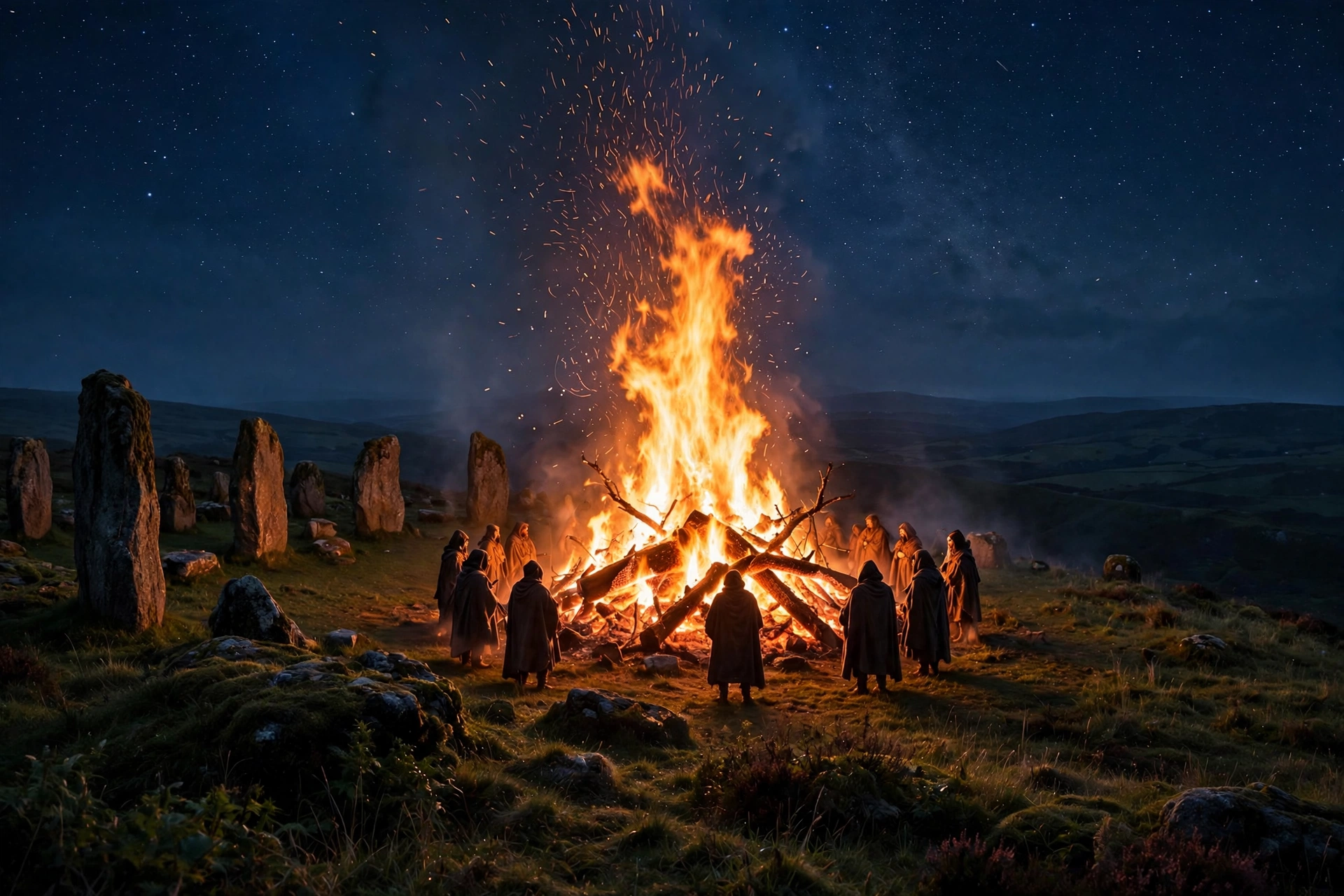
The festival’s rituals were designed to manage that dangerous permeability. Communities extinguished their hearth fires and gathered at great communal bonfires — the word “bonfire” itself derives from “bone fire,” the fires where the bones of sacrificed livestock were burned. Druids are said to have lit these fires on sacred hilltops, including the Hill of Tlachtga in County Meath, Ireland, where archaeologists have found evidence of massive ancient fire rituals. Families would relight their home hearths from the communal flame, carrying protection into the dark months.
People also wore disguises — animal skins and heads — a practice scholars believe was meant to confuse or ward off malevolent spirits roaming abroad. Others left offerings of food and drink outside their doors for ancestral spirits, a gesture of hospitality toward the dead that would echo, two millennia later, in bowls of candy left on porches. Divination was central too: because the veil between worlds was thinnest at Samhain, it was considered the best night of the year to glimpse the future, particularly regarding death and marriage — themes that survive today in apple-bobbing and other Halloween fortune games.
It is worth noting what Samhain was not. Popular writing sometimes claims it was a festival of the dead presided over by a Celtic “lord of death” named Samhain — there is no historical evidence for such a deity; the name simply means “summer’s end” in Old Irish. And while 19th-century writers romanticized tales of human sacrifice, the archaeological record supports animal sacrifice and harvest ritual, not the lurid fantasies of later centuries. The real Samhain needs no embellishment: it was a profound seasonal turning point for a farming people facing the genuine dangers of winter.
Rome Meets the Celts: Feralia and Pomona (43 – 410 CE)
When Rome conquered Celtic Britain beginning in 43 CE, two cultures’ autumn festivals began to blend — the first great fusion in Halloween’s history. The Romans brought Feralia, a late-October day honoring the dead with offerings and remembrance, which mapped neatly onto Samhain’s communion with ancestral spirits. They also brought a festival honoring Pomona, the goddess of fruit and trees, whose symbol was the apple.
Pomona’s apple is the reason we bob for apples on Halloween. The Roman integration of apple symbolism into the Celtic harvest festival created a tradition of apple-based divination games that survived for two thousand years: young people bobbing for apples to learn who they would marry, peeling an apple in one strip to reveal a future spouse’s initial. When you watch children dunking for apples at a kids’ Halloween event today, you are watching a Roman goddess’s festival, filtered through Celtic and Christian centuries, still going strong.
The Christian Transformation: All Saints and All Souls (609 – 1000s)
As Christianity spread through the Celtic world, the Church faced a strategic choice: suppress Samhain or absorb it. It chose absorption — a pattern repeated with Christmas (built over winter solstice festivals) and Easter (named for a spring goddess). The result was one of history’s most successful religious rebrandings.
In 609 CE, Pope Boniface IV dedicated the Pantheon in Rome to all Christian martyrs, establishing a feast of All Saints. Initially celebrated in May, the feast was moved to November 1st in the 8th century by Pope Gregory III, and extended to the whole Church by Pope Gregory IV in 835 CE. The date was no accident: placing All Hallows’ Day — “hallow” meaning saint — on November 1st deliberately overlaid the Church’s celebration onto Samhain’s territory. October 31st became All Hallows’ Eve. Say it quickly, and you get “Hallowe’en.” Say it for a thousand years, and you get Halloween.
A second layer followed in 998 CE, when Odilo, the Abbot of Cluny in France, established November 2nd as All Souls’ Day — a day to pray for all the faithful dead. The three-day observance of Allhallowtide (October 31 – November 2) now mirrored Samhain’s three-day window almost exactly, and the old Celtic sense that the dead walk among the living found a new Christian expression: on All Souls’ Day, the living prayed for souls in purgatory, and the poor went door to door offering prayers for the dead in exchange for “soul cakes.”
Medieval Mischief: Souling, Guising, and Mumming (1000s – 1500s)
The medieval centuries gave Halloween its most direct ancestors. “Souling” — recorded in England, Ireland, and parts of Wales — saw the poor, often children, going door to door on All Souls’ Day singing songs and offering prayers for householders’ dead relatives in return for soul cakes: small spiced cakes marked with a cross. Shakespeare himself referenced the practice in The Two Gentlemen of Verona (“like a beggar at Hallowmas”), proving how deeply embedded it was in English culture.
In Scotland and Ireland, a parallel tradition called “guising” developed: young people dressed in disguise — the old Samhain impulse — and went door to door performing songs, poems, or tricks in exchange for food, coins, or ale. Unlike souling’s prayers, guising was playful and theatrical, and participants who performed well were rewarded. The disguises served the ancient purpose of confusing evil spirits, now blended with Christian folk practice. Mischief was part of the bargain: households that refused hospitality might find their gates unhinged or their gardens rearranged overnight.
These medieval customs are the direct, documented ancestors of trick-or-treating — not vague inspirations but the same practice, evolving across centuries. The costumes, the door-to-door rounds, the exchange of treats for performance, even the mild menace of “trick or treat”: all of it was already present in souling and guising five hundred years before the first American suburb.
Reformation and the Bonfire Rival: Guy Fawkes Night (1500s – 1800s)
The Protestant Reformation disrupted Halloween in England. Reformers rejected the Catholic doctrines of saints and purgatory that underpinned All Saints’ and All Souls’ Days, and in strongly Protestant regions the old observances withered. But England found a replacement autumn fire festival: Guy Fawkes Night, every November 5th, commemorating the foiled 1605 Gunpowder Plot with bonfires, fireworks, and the burning of effigies.
Guy Fawkes Night absorbed many of Halloween’s folk energies in England — the bonfires, the mischief, the seasonal excitement — which is one reason Halloween itself faded in England while thriving in Catholic Ireland and Scotland, where souling and guising continued uninterrupted. This divergence would prove crucial: when Irish and Scottish immigrants later carried Halloween to North America, they carried the strongest, most intact version of the tradition. England would not fully reimport Halloween until the late 20th century, when American pop culture carried it back across the Atlantic.
The Irish Exodus: Turnips Become Pumpkins (1840s – 1900)
The single most important event in Halloween’s journey to global dominance was a tragedy: the Irish Potato Famine of 1845–1852, which killed a million people and drove roughly two million Irish emigrants to North America. They brought their Halloween customs with them — and America, with its abundance, transformed them.
In Ireland and Scotland, the carved lantern of Halloween was the turnip: families hollowed out large turnips or beets, carved grotesque faces, and set candles inside to ward off evil spirits, a practice tied to the legend of Stingy Jack. But American pumpkins — native to North America, enormous, soft-fleshed, and easy to carve — were a revelation. Immigrants quickly adopted the pumpkin, and the jack-o’-lantern as we know it was born: bigger, brighter, and more expressive than any turnip could be. Washington Irving’s 1820 story The Legend of Sleepy Hollow, with its pumpkin-headed Headless Horseman, had already planted the pumpkin in the American imagination; the Irish carved lantern gave it a face.
The immigrants also brought their party games and divinations. Nineteenth-century American Halloween became primarily a community and domestic celebration: harvest parties, apple-bobbing, fortune-telling games predicting marriage and death, ghost stories told around the fire. It was romantic, communal, and slightly spooky — and it was about to be organized on a scale no one had imagined.
Anoka and the Invention of Modern Halloween (1900 – 1950)
By the early 1900s, Halloween in America had a problem: mischief. The old guising tradition’s prank element had escalated in American cities into genuine vandalism — soaped windows, tipped wagons, and worse. Civic leaders began organizing community Halloween events to channel the chaos, and the small Minnesota city of Anoka is credited with the breakthrough: in 1920, Anoka staged what is recognized as the first citywide Halloween celebration in the United States, with a parade, bonfire, and community festivities explicitly designed to divert young people from pranks. Anoka still calls itself the “Halloween Capital of the World,” and its 1920 celebration is the direct ancestor of every municipal Halloween event today — including the hundreds of free Halloween events across the USA that cities now host each October.
The phrase “trick or treat” itself entered the record in 1927, when a newspaper in Blackie, Alberta, Canada reported on young pranksters demanding treats. Through the 1930s, the term spread across North America; by the late 1930s, American Home magazine was running features on organized neighborhood trick-or-treating. The “trick” was largely ceremonial by then — a ritual echo of guising’s old mischief — but the structure was set: costumes, door-to-door rounds, candy.
World War II interrupted the tradition (sugar rationing made candy scarce), but the postwar suburban boom supercharged it. New suburbs full of young families, the baby boom, and the rise of mass-produced candy and costumes turned trick-or-treating into a national ritual. In 1950, the first UNICEF Trick-or-Treat campaign had children collecting coins for disadvantaged children alongside candy — “kids helping kids” — a program that continues today and has raised hundreds of millions of dollars. Television cemented it all: the 1966 broadcast of It’s the Great Pumpkin, Charlie Brown gave America a shared Halloween mythology, and horror films gave teenagers a scarier version of the holiday to claim as their own.
Mexico’s Parallel Celebration: Día de los Muertos
No history of Halloween is complete without Mexico’s Día de los Muertos — the Day of the Dead, observed November 1st and 2nd. It is not “Mexican Halloween,” and Mexicans will tell you so: it is a distinct tradition with its own 3,000-year-old roots in Aztec rituals honoring the goddess Mictecacihuatl, the “Lady of Death,” fused with the Spanish Catholic All Saints’ and All Souls’ Days brought by colonizers in the 1500s.
Where Halloween flirts with fear of the dead, Día de los Muertos celebrates reunion with them. Families build elaborate ofrendas (altars) decorated with marigolds (cempasúchil), whose scent is said to guide spirits home; they lay out the favorite foods and drinks of deceased loved ones, sugar skulls (calaveras) inscribed with names, candles, and photographs. On November 1st (Día de los Angelitos), the souls of children are welcomed; on November 2nd, adults. Far from morbid, the holiday is joyful, colorful, and deeply communal — recognized by UNESCO as Intangible Cultural Heritage of Humanity in 2008.
The two holidays increasingly converse: Mexican-American communities blend ofrendas with jack-o’-lanterns, and the 2017 Pixar film Coco introduced Día de los Muertos to a global audience. Together, Halloween and Día de los Muertos represent humanity’s two great responses to mortality in the autumn season — one playful and spooky, one tender and celebratory — and both trace back to the same ancient human need to face the dark half of the year with ritual, community, and light.
Halloween Goes Global (1950 – 2026)
The second half of the 20th century exported American Halloween worldwide through film, television, and eventually the internet. Canada adopted it earliest and most completely. The United Kingdom, which had let Halloween fade in favor of Guy Fawkes Night, reimported it enthusiastically from the 1980s onward — British supermarkets now devote entire aisles to Halloween, and trick-or-treating is commonplace, though the old November 5th bonfires remain.
Ireland never lost it: Halloween is still a public holiday there in all but name, with the ancient bonfire traditions of Samhain revived in places like Derry’s massive Halloween festival, one of Europe’s largest. Scotland’s guising traditions persist alongside American-style trick-or-treating. In Germany, Halloween arrived in the 1990s via US military bases and pop culture, and is now a major retail event. Japan embraced it with characteristic creativity: Kawasaki’s Halloween parade draws thousands in elaborate cosplay-level costumes, and Tokyo’s Shibuya district sees enormous (and famously rowdy) street celebrations each October 31st.
Even where the full holiday has not taken root, its symbols have: jack-o’-lanterns glow in shop windows from São Paulo to Seoul. The Halloween industry in the United States alone now generates over $10 billion annually in costumes, candy, and decorations. From a Celtic fire festival to a global commercial phenomenon, Halloween’s 2,000-year journey is a case study in cultural resilience: every era tried to reshape it, and every era ended up celebrating it.
The Language of the Season: Words Halloween Left Behind
Halloween’s long history is fossilized in our vocabulary. The word “hallow” itself — meaning holy or sacred — survives almost nowhere else in modern English except in “Halloween” and “hallowed ground.” “Spook” comes from the Dutch spooc (ghost), brought by Dutch settlers to New York’s Hudson Valley, where Washington Irving used it in his tales. “Witch” descends from the Old English wicce, and its journey from a neutral term for a wise practitioner to a figure of evil tracks the medieval witch trials that color so much Halloween imagery.
Even “trick or treat” has linguistic cousins: Scotland’s “guising” (from disguise), England’s “souling,” and the American South’s “begging” for treats. The jack-o’-lantern’s name preserves Stingy Jack’s story in everyday speech. And “bonfire” — from “bone fire,” the Samhain fires where livestock bones were burned — is a Celtic ritual hiding in a word children use without a second thought. Every October, we speak a 2,000-year-old language. Most of us just never noticed.
In Pictures: The Complete History of Halloween, From Samhain to Trick-or-Treat
About two thousand years from a Celtic harvest festival to a $12-billion industry — the same night, reinvented by every century that touched it.

A misty Celtic hillside bonfire at dusk by an ancient stone circle, the full moon rising — Samhain, where Halloween began.
Watch: The Complete History of Halloween, From Samhain to Trick-or-Treat
A documentary tracing Halloween’s evolution — Celtic Samhain, All Saints’ Day, turnip lanterns, Irish immigration, and the candy revolution.
At a Glance: The Complete History of Halloween, From Samhain to Trick-or-Treat
The timeline from this guide (dates are the guide’s; early dates are approximate).
| Era | Period | What changed |
|---|---|---|
| Samhain | c. 500 BCE – 43 CE | Celtic new year and harvest festival |
| Roman Britain | 43 – 410 CE | Feralia and Pomona customs blended in |
| Christian transformation | 609 – 1000s | All Saints’ and All Souls’ Day absorb the season |
| Medieval mischief | 1000s – 1500s | Souling, guising, and mumming |
| Irish exodus | 1840s – 1900 | Immigrants bring Halloween to America; turnips become pumpkins |
| Modern Halloween invented | 1900 – 1950 | Anoka, MN (1920) and civic parties; trick-or-treat standardizes |
Frequently Asked Questions
How old is Halloween really?
Halloween’s oldest roots go back more than 2,000 years to the Celtic festival of Samhain, celebrated around 500 BCE. The name “Halloween” itself is about a thousand years younger, deriving from the Christian “All Hallows’ Eve” of the medieval period. The modern American version — trick-or-treating, jack-o’-lanterns, costume parties — took shape between roughly 1840 and 1950.
Is Halloween pagan or Christian?
It is both, layered together. The date and many folk customs (bonfires, disguises, divination) come from the pagan Celtic Samhain; the name and the early-November structure come from the Christian feasts of All Saints’ and All Souls’ Days; and the modern celebration is largely secular and commercial. Historians describe it as a syncretic holiday — one built from many traditions fused over centuries.
Why is Halloween on October 31st?
October 31st was the eve of the Celtic Samhain (November 1st), the turning point between the harvest season and winter. When the Christian Church moved All Saints’ Day to November 1st in the 8th century, October 31st became All Hallows’ Eve — Halloween — inheriting the older festival’s date and much of its folk character.
What is the difference between Halloween and Día de los Muertos?
Halloween (October 31st) is a Celtic-origin celebration of spooky fun, costumes, and trick-or-treating. Día de los Muertos (November 1st–2nd) is a Mexican tradition with Aztec and Catholic roots focused on joyfully honoring and reuniting with deceased loved ones through ofrendas, marigolds, and family gatherings. They share a season and some imagery but have distinct origins, meanings, and moods.
When did trick-or-treating become popular?
The phrase “trick or treat” first appeared in print in 1927 in Alberta, Canada, and the practice spread across North America through the 1930s. It was interrupted by World War II sugar rationing, then exploded in the postwar suburban boom of the late 1940s and 1950s, becoming the defining American Halloween ritual. Its ancestors — souling and guising — date back to the Middle Ages.
Is Halloween celebrated outside the United States?
Yes — widely. Ireland and Scotland never stopped celebrating it; Canada adopted it early; the UK reimported it in the late 20th century; and it is now popular in Germany, Japan, Australia, and many other countries, each adding local flavor. For a taste of Halloween’s spiritual home, Salem, Massachusetts and the family events of Salem’s Haunted Happenings draw visitors from around the world every October.
From Samhain’s bonfires to the glow of a million jack-o’-lanterns, the complete history of Halloween is the story of a holiday that refused to die — adapting, absorbing, and delighting every culture it touched. When you carve a pumpkin or hand out candy this October 31st, you are the latest participant in a tradition two thousand years in the making. That is worth celebrating.