Every June, as Dia dos Namorados approaches, single women across Brazil turn to a higher power for help with their love lives — and to a set of folk practices as old as the devotion itself. They are called simpatias: from the Portuguese for “sympathies,” these are folk rituals performed to obtain the sympathy — the favor — of Saint Anthony of Padua, Brazil’s matchmaker saint, in the quest to find a good husband, boyfriend, or partner. Part prayer, part folk magic, part girls’-night tradition, simpatias are Brazil’s most charming contribution to the world’s literature of love rituals.
This guide explains what simpatias are, how the most famous ones are said to work, when to perform them (the eve of Saint Anthony’s feast is prime time), and what they reveal about Brazilian folk Catholicism — where the sacred and the superstitious have never been enemies. For the holiday that frames these rituals, see our Dia dos Namorados explainer; for what couples do once the rituals work, our gift guide.
What Are Simpatias?
A simpatia (plural simpatias) is a Brazilian folk ritual — a small, prescribed set of actions, words, and objects believed to produce a desired outcome through spiritual sympathy. Simpatias exist for everything: health, money, protection, safe travel. But the most famous by far are the simpatias de amor — love simpatias — and their patron is Santo Antônio.
The logic is pure folk Catholicism. Saint Anthony is the marriage saint, the finder of lost things (including, by extension, lost loves and not-yet-found partners). A simpatia is how you get his attention: you perform a ritual that demonstrates faith, focus, and a certain theatrical sincerity, and the saint — tradition holds — intercedes. The rituals blend Catholic elements (prayers, saint statues, feast days) with older folk-magic structures (hidden objects, symbolic actions, auspicious timing). The Church has always kept a certain diplomatic distance from the more magical variants; Brazilian grandmothers have always ignored the distance.
Timing matters enormously. The high season for love simpatias is June 12–13 — the eve and feast of Saint Anthony — when the saint’s attention is understood to be at its peak. Performing a simpatia on the eve, often at night, often with friends, is itself part of the tradition: the ritual is social as well as spiritual.
The Famous Rituals: A How-To
What follows are the most widely reported love simpatias associated with Saint Anthony. They’re presented as tradition holds them — folk practices, not guarantees — and described the way Brazilian families pass them down.
1. The Love Letter in the Basil Pot
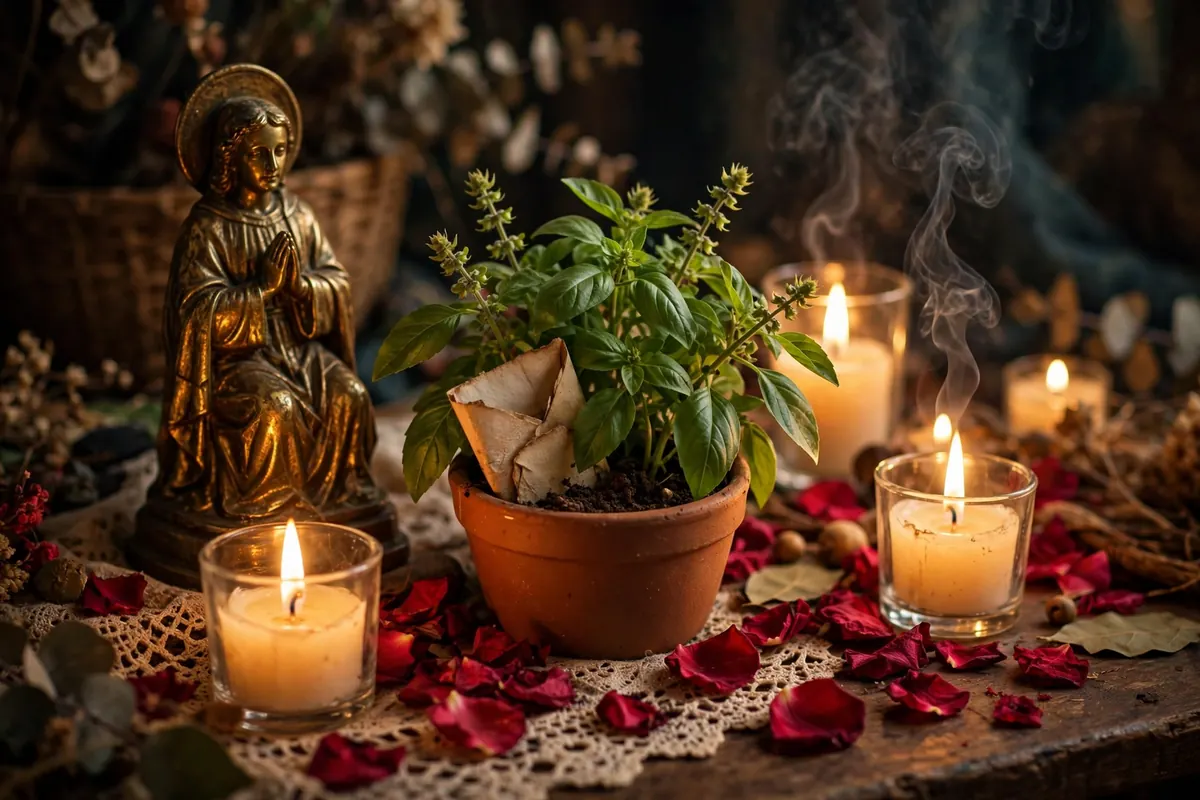
The most poetic of the simpatias, and the one most consistently described in accounts of the tradition: on the eve of Saint Anthony’s day, write a love letter — to a specific hoped-for suitor, or to the unknown future partner — and conceal it in a pot of basil (manjericão), a plant associated with Saint Anthony. The basil pot sits in the home, tended and watered; tradition holds that as the plant thrives, so will your love life, and the hidden letter carries your intention to the saint. Some versions add that the letter should be written by hand, at night, with full sincerity — no irony allowed.
2. Turning the Saint Upside Down
The most mischievous simpatia: take a small statue of Saint Anthony and turn it upside down — or, in some tellings, remove the Christ child from the saint’s arms — and leave him that way until he “delivers” a boyfriend or husband. It’s a ritualized scolding: the saint is put in the corner, as it were, until he does his job. Once the partner appears, the statue is restored to honor — often with flowers, candles, and a thank-you. The humor is the point: the relationship with the saint is intimate enough for teasing.

3. The Eve Prayer and Vigil
The most devout variant is also the simplest: prayer on the eve of June 13 — a dedicated prayer to Saint Anthony asking for a good partner, said with a lit candle, often at a home altar or before the saint’s image. Many families combine this with attending Mass or a trezena (the thirteen-day devotion to Saint Anthony) leading up to the feast. The simpatia here is less magic than focused faith: thirteen days of intention, culminating on the saint’s night.
4. The Name Under the Pillow
Write the name of the desired person — or, if the partner is unknown, a description of the desired qualities — on paper, fold it, and sleep with it under your pillow on the night of June 12, after praying to Saint Anthony. Tradition holds that the saint may send a sign in dreams. It’s the gentlest of the simpatias: no statues harmed, no letters buried, just intention tucked under your head.
5. The Blessed Bread
On Saint Anthony’s feast day, churches distribute pãozinho de Santo Antônio — little blessed loaves. Tradition holds that keeping one at home brings the saint’s blessing on the household, including its romantic prospects. Some simpatias instruct the single woman to keep the bread near her bed or in her kitchen through the year — a slow-release blessing rather than a one-night ritual.
| Ritual | What you need | When | Tone |
|---|---|---|---|
| Love letter in basil pot | Handwritten letter, potted basil | Eve of June 13 (June 12) | Poetic, hopeful |
| Upside-down saint | Small Saint Anthony statue | Until a partner appears | Mischievous, teasing |
| Eve prayer & vigil | Candle, prayer, saint’s image | Night of June 12; optionally the 13-day trezena | Devout, focused |
| Name under the pillow | Paper with a name or description | Night of June 12 | Gentle, dream-oriented |
| Blessed bread | Pãozinho from Saint Anthony’s feast | June 13; kept through the year | Protective, domestic |
A Regional Tour: Simpatias Across Brazil
Simpatias are national, but their flavor is regional. In the Northeast — the heartland of the Festas Juninas — love simpatias are woven into the June festival fabric: performed between quadrilha dances and bonfire gatherings, with the full cast of June saints (Anthony, John, Peter) invoked across the month. The Northeastern simpatia tradition is the most exuberant, the most communal, and the most likely to involve the whole extended family weighing in on technique.
In Bahia, where African and Catholic traditions have intermingled for centuries, love rituals carry additional layers — the simpatia tradition overlaps with Afro-Brazilian spiritual practices, and the June 13 devotion to Saint Anthony (syncretized in some traditions) is especially fervent. In Minas Gerais, with its baroque churches and deep Catholic roots, the devotional side dominates: the trezena, the blessed bread, the home altar. In São Paulo and Rio, the urban version thrives among young women as a girls’-night ritual — half sincere, half ironic, fully enjoyed — and increasingly as social-media content, with simpatia tutorials circulating on YouTube and TikTok every June.
The through-line across regions: simpatias are passed down, not learned from books. Grandmother to mother to daughter, aunt to niece, friend to friend — the transmission is oral, female, and affectionate. Ask a Brazilian woman about simpatias and you’ll likely get a family story: the aunt who turned the saint upside down and married within the year, the cousin whose basil plant flourished suspiciously fast. Whether or not you believe in the mechanism, the stories are the tradition’s real product.
The Social Side: Ritual as Girls’ Night
It’s easy to file simpatias under “superstition” and miss their social function. Performed on the eve of Saint Anthony’s day, often in groups, they’re a ritual of female solidarity: friends gathering to name what they want in love, to laugh, to hope out loud. The upside-down saint is funnier with an audience. The love letter is braver when your best friend is writing one too.
This communal dimension is why simpatias survive in secular, urban, app-dating Brazil. They do something dating apps don’t: they turn the search for love into a shared, intentional, slightly magical event — a night when wanting love is the point, not something to be casual about. In that sense, the modern simpatia circle and the modern Galentine’s gathering are cousins: different continents, same human need. (See our Galentine’s Day ideas for the American version.)
Simpatias in the Digital Age
Tradition adapts. Today’s simpatias circulate as YouTube tutorials and TikTok rituals, complete with step-by-step demonstrations, candle recommendations, and comment sections full of testimonials (“it worked for me!”). The digital transmission has standardized some rituals and invented new ones, but the core grammar — saint, intention, symbolic action, June timing — holds steady. If anything, the internet has expanded the tradition’s reach: young Brazilians who might never have learned their grandmother’s rituals encounter them online, try them half-ironically, and find themselves oddly moved.
The commercial side has noticed too: June sees saint statues, candles, basil pots, and “simpatia kits” marketed to the ritual season. Folk tradition and retail have made their peace — in Brazil, they usually do.
A Visitor’s Guide: Participating Respectfully
Non-Brazilian visitors are welcome to observe — and, with the right spirit, to participate. The etiquette: take it seriously enough. Simpatias performed with mockery offend; performed with sincere curiosity and respect, they’re usually met with delight and coaching. If a Brazilian friend invites you to a June 12 simpatia night, say yes, follow instructions, write the letter honestly, and don’t joke about the upside-down saint until the host does. Learn the context: understanding that these are expressions of real devotion — not party games — is the whole of the etiquette. And mind the sacred: in churches and religious settings, the devotional frame (trezena, blessed bread, Mass) deserves full reverence.
Watch: A Saint Anthony Love Ritual
A traditional simpatia de Santo Antônio for finding new love — the prayer, the ritual, and what practitioners say follows:
Beyond Santo Antônio: Brazil’s Wider World of Love Magic
Saint Anthony’s love simpatias are the famous tip of a much larger iceberg. Brazil’s folk-spiritual landscape is dense with love-directed practices, and the simpatia tradition extends well beyond June 13.
The benzedeiras. Central to understanding simpatias are the benzedeiras (and benzedores) — folk healers, usually older women, who bless (benzer) against illness, evil eye, and misfortune using prayers, herbs, and ritual gestures. The benzedeira tradition, recognized as intangible cultural heritage in several Brazilian states, is the institutional home of the simpatia: many love simpatias were traditionally learned from or performed with a benzedeira’s guidance. The blessing might involve specific prayers to Saint Anthony, the use of rue or rosemary, and instructions for the days that follow. In a culture that has always blurred the line between the clinic and the chapel, the benzedeira is the pharmacist of the spiritual — and love is among the most common prescriptions sought.
Simpatias for keeping love. The tradition isn’t only for the partnerless. There are simpatias for protecting a relationship (candles for the couple, prayers for fidelity), for reconciliation (sweetening rituals — adoçamentos — meant to soften conflict and restore affection), and for marriage blessings (couples seeking Saint Anthony’s favor for the wedding itself). The adoçamento family of rituals — symbolic sweetening with honey, sugar, or sweet herbs — is among the most widespread in Brazilian folk practice, applied to love, family harmony, and even professional relationships. As with all simpatias, they’re presented here as tradition holds them: folk practices of intention and faith.
The Afro-Brazilian layer. Brazil’s African heritage contributes its own rich stratum of love-directed spiritual practice, particularly within Umbanda and Candomblé traditions — where entities and orixás associated with love and relationships (such as Oxum, often syncretized with Our Lady and associated with beauty, fertility, and sweet waters) receive offerings and petitions. These are living religions with their own theologies, not “simpatias” in the folk-Catholic sense, and they deserve to be understood on their own terms — but in everyday Brazilian life, the boundaries blur: a woman might light a candle to Saint Anthony on June 12 and leave flowers for Oxum on another day, moving between traditions with the ease of someone addressing different members of a large spiritual family. Visitors should approach these practices with the respect due any religion: observe, don’t appropriate, and never treat sacred ritual as content.
The June saints beyond Anthony. Love simpatias cluster around Saint Anthony, but the June calendar offers more: Saint John’s night (June 23–24) carries its own folk-magic traditions — bonfire divinations, in some regions, for glimpsing one’s future spouse — and Saint Peter’s (June 28–29) closes the season. The whole month is, in folk terms, a spiritually “open” period for matters of the heart.
The modern spiritual-but-not-religious simpatia. Among younger, secular Brazilians, simpatias have been translated into the language of intention-setting and manifestation: the basil-pot letter becomes a journaling ritual, the eve vigil becomes a mindfulness practice, the upside-down saint becomes a playful symbol of taking action. The forms persist even where the theology has thinned — evidence that the ritual’s psychological function (naming desire, marking intention, sharing hope) was always doing half the work.
What unites all these layers — Catholic, Afro-Brazilian, folk, modern — is a distinctively Brazilian premise: that love is not merely a private emotion or a market transaction, but a spiritual matter, worthy of ritual, community, and the occasional upside-down saint. In a world that increasingly treats dating as an optimization problem, there’s something quietly radical about insisting that it deserves a candle, a prayer, and a pot of basil.
The Saint Anthony Devotion, Year-Round
June gets the spotlight, but Santo Antônio’s devotees keep the relationship going all year — and the year-round devotion illuminates what the June simpatias are really about.
Tuesdays with Anthony. In Brazilian folk Catholicism, Tuesday is Saint Anthony’s day — the weekday devoted to him, when the faithful light candles, say his prayers, and visit his altars. A single woman serious about her intentions might dedicate thirteen consecutive Tuesdays (treze terças-feiras) to the saint — a slow-burn simpatia measured in weeks, not one night. The June 12–13 rituals are the festival climax of a devotion practiced quietly year-round.
The saint in the home. The home altar (oratório) with its Saint Anthony statue is a fixture in devout households — and the statue’s treatment tracks the devotee’s romantic fortunes in real time: upright and flowered in gratitude, upside-down in strategic protest. Visitors to Brazilian homes shouldn’t be surprised to find the saint’s position is news — family members read it like a relationship status.
Anthony beyond love. The matchmaker portfolio is only part of the devotion. Santo Antônio is also the finder of lost things (the prayer “Santo Antônio, me ajuda a achar” is murmured over misplaced keys across Brazil), the patron of the poor (the blessed bread tradition feeds the hungry on his feast day), and a general-purpose miracle worker. The love simpatias work, in folk logic, because the saint is approachable — a helper saint for everyday problems, romance included.
The feast day itself. June 13 — the actual feast — belongs to the devout: Masses, processions, the distribution of pãozinho, street parties in Anthony-dedicated parishes. In many towns, the 13th outshines the 12th for sheer religious fervor; the lovers’ eve gives way to the saint’s day proper. Attending a June 13 celebration — the music, the food, the blessed bread — is the essential companion experience to any June 12 simpatia.
What year-round devotion teaches: the simpatias aren’t superstition slapped onto a saint — they’re the romantic dialect of a living relationship between devotees and their patron, conducted in candles, Tuesdays, basil pots, and the occasional upside-down statue. It’s a relationship with its own grammar: petition, patience, protest, gratitude. Learn the grammar, and June makes perfect sense.
Frequently Asked Questions
What are simpatias?
Simpatias are Brazilian folk rituals — “sympathies” performed to obtain a saint’s favor. The most famous are love simpatias dedicated to Saint Anthony of Padua, Brazil’s marriage saint, performed especially around his feast day (June 13) by single women seeking a partner.
What is the most famous love simpatia?
Two contend for the title: hiding a handwritten love letter in a pot of basil on Saint Anthony’s eve, and turning a Saint Anthony statue upside down (sometimes removing the Christ child from his arms) until the saint “delivers” a boyfriend. Both are widely reported traditions, performed with a mix of devotion and humor.
When should you perform a love simpatia?
The prime time is the night of June 12 — the eve of Saint Anthony’s feast (June 13), which is also Dia dos Namorados, Brazil’s Valentine’s Day. Some traditions extend through the thirteen-day trezena devotion leading up to the feast.
Do simpatias actually work?
That depends what you mean by “work.” As mechanisms of supernatural intervention, they’re matters of faith. As rituals of intention, community, and hope — a dedicated night for naming what you want in love, shared with friends — their psychological and social effects are very real. Brazilian tradition, sensibly, doesn’t insist on the distinction.
Are simpatias part of Catholicism?
They live at the border. Simpatias use Catholic materials — saints, prayers, feast days, blessed objects — but their ritual logic is folk magic, and the Church has always kept a careful distance from the more magical variants. In practice, Brazilian folk Catholicism holds both: the Mass in the morning, the upside-down saint at night.
Can non-Brazilians perform simpatias?
There’s no formal barrier — the rituals are folk practices, not restricted rites. The key is respectful sincerity: understand the devotional context, follow the traditional forms, and don’t treat them as jokes. Performed with genuine intention on Saint Anthony’s eve, a simpatia is a lovely way to connect with Brazilian culture. For the holiday they orbit, see our Dia dos Namorados guide.
Simpatias endure because they answer a need no app has satisfied: the need to make wanting love feel sacred, shared, and a little bit magical. A letter hidden in basil, a saint gently scolded, a name tucked under a pillow — these are small, human technologies of hope, passed from grandmother to granddaughter on the warmest nights of the Brazilian winter. Santo Antônio, tradition holds, is listening. The basil, at least, is thriving.