
A poem does what prose cannot: it says the big thing in a small space, with rhythm doing half the emotional work. That is why short siblings day poems are perfect for cards, texts, toasts, and social posts — four to eight lines can carry more feeling than a full page of prose, and they look beautiful on paper. This collection gives you 30 original short poems organized by mood — tender, playful, nostalgic, grateful, and for hard times — plus a mini-workshop for writing your own, a guide to simple poem forms, and tips for presenting a poem so it shines.
Every poem below is original and free to use in your card, text, or toast — just add your sibling’s name or nickname where it fits. Each poem comes with a one-line note on when to use it.
How to Use a Poem: Occasion Guide
| Occasion | Best poem length | Tip |
|---|---|---|
| Inside a greeting card | 4–8 lines | Handwrite it — handwriting turns a poem into a keepsake |
| Text message | 2–4 lines | Send as one message, not line-by-line, so the rhythm survives |
| Social media post | 4–6 lines | Pair with a photo; put the poem in the caption, not on the image |
| Toast at dinner | 4 lines, memorized | Short enough to recite without notes; pause before the last line |
| Engraved on a gift | 1–2 lines | Pick the single strongest couplet — engraving rewards brevity |
| Letter | 8–12 lines | Open or close the letter with the poem; let prose carry the middle |
Tender Poems (8)
For the sibling you love deeply and say it to rarely. Use in cards and letters.
1. “First Friend”
Before the world knew my name,
you knew my laugh, my fears, my game.
Through every year, through joy and strife,
my first friend, my friend for life.
2. “Home Base”
Home was never bricks or stone,
it was never feeling alone.
Home was you, in the next room,
laughing loud, dispelling gloom.
3. “The Keeper”
You keep the stories I forget,
the ones I owe my biggest debt.
Half my memories live with you —
thank goodness they are safe and true.
4. “Steady”
When life grew loud and days grew long,
you were my quiet, steady song.
No fanfare and no grand display —
just you, beside me, come what may.
5. “Built-In”
Some friends are chosen, some are found,
but you were simply always around.
Built-in, lifelong, tried and true —
the best of me began with you.
6. “The Long Thread”
A single thread from then to now,
through every storm and every vow.
It never broke, it never thinned —
the tie of kin, through thick and thin.
7. “What I Owe”
For every ride, for every call,
for catching me before the fall,
for laughter in the darkest night —
thank you, sibling. You were right.
8. “Always”
Seasons turn and years will fly,
we will grow older, you and I.
But one thing time can never do:
make me love you less. Love you — true.
Playful Poems (8)
For the sibling whose love language is laughter. Use in cards, texts, and toasts.
9. “The Lease”
I did not choose you, it is true —
the universe assigned me you.
No returns and no exchange,
but honestly? I would not change.
10. “DNA Audit”
We share our genes, our face, our name,
yet somehow you are not the same.
I got the looks, you got the height —
let us agree I won that fight.
11. “The Witness”
You saw me at my absolute worst —
the haircut curse, the fashion first.
You never told, you never ran.
You are my vault. You are my fan.
12. “Fry Tax”
Since childhood you have taxed my fries,
with those big innocent eyes.
The debt is vast, the interest high —
pay up in hugs. Do not ask why.
13. “Partners”
Partners in crime since way back when,
we will do it all again and again.
The statute of limitations passed,
our legend, though, will ever last.
14. “The Favorite”
Mom says she has no favorite child —
her poker face is running wild.
We both know who she loves best.
(Hint: it is me. You are second-best.)
15. “Tech Support”
You fix my phone, you fix my car,
you have rescued me near and far.
One day I will return it all —
right after this one phone call.
16. “The Roast (Light)”
You snore, you steal the blanket too,
you eat the last slice — yes, you.
And yet, of all the siblings made,
you are my favorite. Well played.

Nostalgic Poems (6)
For the sibling who treasures the old days. Pair with a childhood photo.
17. “The Old House”
The old house holds our laughter still,
in every room, on every hill
we climbed and claimed as ours alone —
those golden days, forever known.
18. “Summer, 1999”
Barefoot summers, endless light,
fireflies at the edge of night.
We ruled the block till dinner’s call —
we had it all. We had it all.
19. “The Fort”
Blanket fort and flashlight beams,
we built a kingdom out of dreams.
The blankets fell, the fort came down,
but we are still the talk of town.
20. “Back Seat”
Back seat battles, window wars,
“do not touch me” slamming doors.
Now we would pay to ride once more —
back when the world was at our door.
21. “The Recipe”
Grandma’s kitchen, flour and song,
we have carried it along.
Every batch we bake today
tastes of those far yesterdays.
22. “Photographs”
In faded prints we find our youth,
each crooked grin a simple truth:
that love was in the everyday,
and never really went away.
Grateful Poems (4)
For saying thank you in verse. Use when words of gratitude deserve elevation.
23. “Ledger”
I keep a ledger in my mind
of every time that you were kind.
The pages overflow, it is true —
I am forever in debt to you.
24. “The Call”
At 2 a.m. you picked up the phone,
and never let me feel alone.
No questions asked, just being there —
that is a love beyond compare.
25. “Unseen”
For all the things you did unseen,
the spaces kept, the slates wiped clean,
for shielding me from strife and storm —
thank you for keeping my world warm.
26. “Enough”
You never asked for thanks or praise,
through all our wild and winding days.
So let this poem finally say:
thank you — today and every day.
Poems for Hard Times (4)
Gentle verses for difficult years. No jokes here — just steady warmth.
27. “The Anchor”
When waters rise and skies turn gray,
I will not let you drift away.
Hold fast to me, as I to you —
we will see this tempest through.
28. “Borrowed Strength”
If your strength is running low,
take some of mine — I have plenty to show.
That is what siblings are for:
an open heart, an open door.
29. “The Long Night”
The longest night will turn to day,
the clouds of sorrow drift away.
Until that dawn, I will stay near —
your sibling, always, ever dear.
30. “Still Here”
No fixing and no grand advice,
just sitting with you — that suffices.
I am not going anywhere.
Still here. Still yours. Still care.
Workshop: Write Your Own 4-Line Poem in 15 Minutes
The poems above are ready to use — but a poem in your words, however imperfect, will always hit harder. Here is a 15-minute method that works even if you have never written a line of verse.
Minutes 1–3: Pick your memory. Choose one specific shared moment — the smaller the better. A burnt dinner, a wrong turn, a 2 a.m. talk. Write it in one plain sentence: “We got lost driving to the lake and found the diner.” This sentence is your poem’s raw material.
Minutes 4–6: Extract two images. From that memory, pull two sensory details: what you saw, heard, tasted. “Bottomless fries” and “laughing till it hurt.” Images are what make poems feel real; abstractions (“it was fun”) are what make them feel generic.
Minutes 7–10: Draft four lines. Aim for an AABB rhyme (lines 1–2 rhyme, lines 3–4 rhyme) — it is the most forgiving pattern. Do not chase perfect meter; chase true details. Example from the raw material above:
We missed the lake and found the fries,
beneath those wide and starry skies.
We laughed until our stomachs hurt —
the best wrong turn on this whole earth.
Minutes 11–13: Cut ruthlessly. Remove every word that is not pulling weight. “Very,” “really,” “just” — cut them all. If a line works without a word, the word goes. Poems are strong because they are lean.
Minutes 14–15: Read it aloud. Your ear catches what your eye misses. If you stumble on a line, it needs fewer syllables. If it makes you smile or ache, it is done. Sign it. It is a poem now.
Simple Poem Forms Cheat Sheet
| Form | Structure | Best for | Example use |
|---|---|---|---|
| Couplet | 2 rhyming lines | Engraving, gift tags | “Partners in crime since ’99 / glad this sibling is mine.” |
| Quatrain | 4 lines, AABB or ABAB rhyme | Cards, texts, toasts | Most poems in this collection |
| Haiku | 3 lines, 5-7-5 syllables | Minimalist cards | “Old photographs fade / your laughter does not — instead / it warms every room” |
| Limerick | 5 lines, AABBA, bouncy rhythm | Funny cards | Best for the family comedian |
| Free verse | No rhyme or meter rules | Heartfelt letters | When emotion outruns structure |
| Acrostic | First letters spell a name | Personalized gifts | Spell their name down the margin |
Presenting Your Poem So It Shines
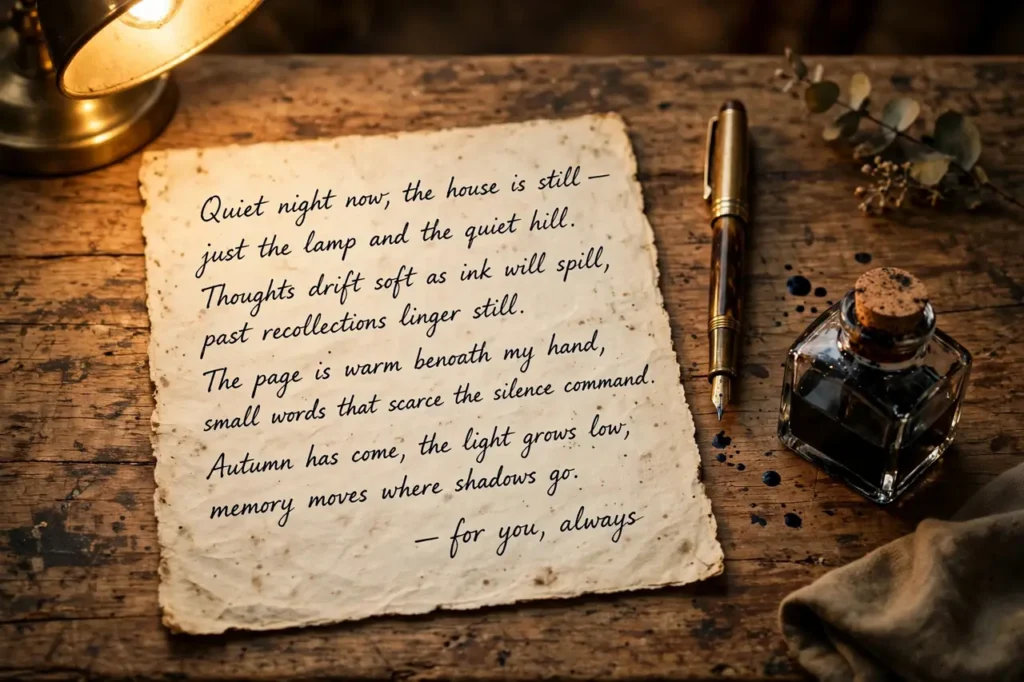
Handwrite it. A printed poem is content; a handwritten poem is an artifact. Use your best pen, take your time, and do not stress about perfect penmanship — character beats calligraphy.
Give it a title. Even a simple one (“For [nickname], on Siblings Day”) frames the poem as intentional art rather than a nice paragraph. Titles signal this is a poem, which changes how it is read.
Pair it with the right moment. Read it aloud as a toast, tuck it into the card, or text it at midnight. A poem delivered with ceremony — even a small one — lands twice as hard.
Dedicate it. End with a dedication line: “For my sister, who taught me everything” or “For [name], partner in crime since 1999.” The dedication is the bow on the package.
Poems for Every Sibling Type: Matching Guide
Not every poem fits every sibling. Match the poem’s energy to the recipient:
| Sibling type | Best poem moods | Recommended poems | Delivery tip |
|---|---|---|---|
| The sentimental sister | Tender, Grateful | #1–8, #23–26 | Handwrite in the card; she will keep it for years |
| The jokester brother | Playful | #9–16 | Read aloud as a toast — commit to the performance |
| The nostalgic one | Nostalgic | #17–22 | Pair with a childhood photo for maximum impact |
| The new parent | Tender, Grateful | #5, #8, #26 | Frame it — new parents treasure keepsakes |
| The distant sibling | Tender, Hard Times | #6, #27–30 | Mail it; a real envelope bridges miles |
| The tough year | Hard Times, Grateful | #24, #27–30 | No jokes; let the steadiness speak |
10 Micro-Poems (Couplets) for Engraving, Tags & Texts
Two lines each — perfect for engraving on jewelry, writing on gift tags, or texting at midnight. Each includes a note on where it shines.
31. Built-in best friend since day one, / my favorite race, already won. — Engrave on a bracelet; short enough for most jewelers.
32. Through every storm and every sun, / you are my favorite one. — Gift tag classic; works for any sibling.
33. We laughed, we fought, we found our way — / happy Siblings Day! — Text it at midnight; the em-dash pause reads beautifully.
34. Same roots and wings, both given free — / thanks for sharing them with me. — Lovely on a framed print with a childhood photo.
35. Partners in crime, my alibi — / beneath these stars, just you and I. — For the partner-in-crime sibling; nostalgic and warm.
36. You are the calm within my storm, / the place where I am safe and warm. — For the protector sibling; deeply felt.
37. Roses are red, violets are blue, / no one roasts me quite like you. — Funny card topper; sets the tone instantly.
38. Miles apart but close in heart, / we were never far apart. — Long-distance sibling; mail it with a photo.
39. Thank you for the laughs and light / — my sibling, my delight. — Grateful and bright; good toast closer.
40. Here is to us, the [family name] crew — / there is no one I would rather be me with than you. — Family-event toast; swap in your surname.
The Art of the Dedication: 10 Lines That Frame Any Poem
A dedication line before or after the poem tells the reader how to receive it. Pick one, personalize the bracketed part, and your poem feels published:
1. “For [nickname], who taught me everything worth knowing.”
2. “For my sister/brother — my first friend, my forever co-conspirator.”
3. “For [name], on Siblings Day, with all my love.”
4. “For the one who [did something specific] — this one is yours.”
5. “For my sibling, who knows all my stories because they lived half of them.”
6. “For [nickname]: proof that I can be sincere for at least eight lines.”
7. “For the [family name] legend — happy Siblings Day.”
8. “For my emergency contact, in every sense of the phrase.”
9. “For [name], [X] miles away but never far.”
10. “For us — the [childhood place] kids, all grown up.”
From Poem to Keepsake: 5 Ways to Preserve It
A poem on a card is lovely; a poem preserved becomes an heirloom. Five ideas, from simplest to most ambitious:
1. Frame the handwritten original. After they read the card, frame your handwritten poem in a simple frame. Handwriting + frame = instant art with infinite sentimental value. Cost: one frame.
2. Print it as a photo book page. Add the poem as the dedication page of a photo book of the two of you. The poem becomes the book’s thesis statement — every photo after it reads differently.
3. Engrave the best couplet. Two lines on a bracelet, keychain, or the back of a watch. They will carry your words daily. Choose the couplet with the strongest standalone meaning (#31, #36, and #38 engrave beautifully).
4. Record it as audio. Read the poem aloud and send the voice note — or save it. Years from now, hearing your voice read those words will undo them completely. Audio is the most underused keepsake format.
5. Start a poem exchange. Challenge your sibling to answer with a poem of their own next Siblings Day. Terrible poems welcome — the tradition matters more than the talent. In ten years you will have a chapbook of your relationship.
Poems for Two Voices: 5 Call-and-Response Pieces
Some poems are better shared. These five are written for two readers — perfect for siblings to perform together at a family gathering, record as a duet, or trade lines over the phone. Mark who reads which lines, rehearse once, and enjoy the moment.
41. “The Ledger” (for two siblings settling scores lovingly)
Reader 1: You owe me for the fries of ’99,
Reader 2: you owe me for the time you stole my bike.
Reader 1: You owe me for the lamp we broke,
Reader 2: you owe me — okay, this is a joke.
Both: We are even. We always were.
The love was never in the ledger.
42. “Then and Now” (nostalgic duet)
Reader 1: Then we were small and the world was wide,
Reader 2: with you forever by my side.
Reader 1: Now we are grown, the world is small,
Reader 2: but you still answer when I call.
Both: Then, now, and all the years between —
the best of what our lives have seen.
43. “The Defense” (playful, for the jokesters)
Reader 1: I plead the Fifth on every crime,
Reader 2: and I will too — it saves us time.
Reader 1: The evidence is circumstantial,
Reader 2: our alibis are substantial.
Both: We did nothing. We confess nothing.
Happy Siblings Day — we did everything.
44. “The Promise” (tender, for close pairs)
Reader 1: I promise you my steady hand,
Reader 2: I promise you will understand.
Reader 1: Through every high and every low,
Reader 2: there is one thing I want you to know:
Both: whatever comes, come what may,
I am your sibling, come what may — always.
45. “The Toast” (for performing at dinner)
Reader 1: Raise your glass to the early years,
Reader 2: to laughter, chaos, joy, and tears.
Reader 1: To every story we still tell,
Reader 2: to secrets that we guard so well.
Both: To siblings — the first friends we knew.
This one is for me and you.
Performance tip: the “Both” lines should be read together, slightly slower, with eye contact. That shared ending is what makes the room go quiet — in the best way.
Watch: A Poem for a Sister
Sometimes hearing a poem read aloud unlocks ideas for your own. This heartfelt video poem dedicated to a sister is a lovely watch before you write — notice how simple, specific images carry the emotion.
Your Poem Checklist: 7 Questions Before You Share It
Run your chosen (or written) poem through this checklist before it goes in the card:
1. Is there one specific detail? A name, a place, a year, an incident — specificity is what makes a poem theirs.
2. Does it sound like you? If you would never say “whence” in real life, do not write it in a poem. Your voice, elevated slightly, is the right register.
3. Have you read it aloud? Poems live in the ear. If you stumble, simplify.
4. Is the ending the strongest line? The last line is what lingers — make it the emotional or comic peak, not an afterthought.
5. Does the length fit the medium? Card: 4–8 lines. Text: 2–4. Toast: 4, memorized. Engraving: 2.
6. Did you add the dedication? “For [nickname]” takes five seconds and frames everything.
7. Would it make them feel known? The ultimate test. A poem that proves you pay attention beats a technically perfect poem every time.
Frequently Asked Questions About Short Siblings Day Poems
Can I use these poems in my Siblings Day card?
Yes — every poem in this collection is original and free for personal use in cards, letters, texts, toasts, and social posts. Personalize by adding your sibling’s name or nickname, and consider handwriting it for extra impact.
How long should a poem in a greeting card be?
Four to eight lines is ideal for a standard card — long enough to feel substantial, short enough to fit with your signature and a personal line or two. For small cards or gift tags, use a single couplet (two lines).
What if I have never written a poem before?
Use the 15-minute workshop above — it is designed for total beginners. Or simply use one of the 30 poems here and add a personal dedication line. Borrowing a poem and adding one true sentence of your own is a completely legitimate card.
Should the poem rhyme?
Rhyming quatrains (AABB) are the safest choice for cards — they sound intentional and are easy to read aloud. But free verse works beautifully for deeply emotional messages where rhyme might feel forced. Match the form to the feeling.
Can I put a poem in a text message?
Absolutely — send 2–4 line poems as a single message so the line breaks survive. Short poems are actually ideal for texts: they stand out dramatically in a thread of “happy siblings day!!” messages.
What is a good poem for a funny Siblings Day card?
Use the Playful section (#9–16) or try a limerick for maximum comedy. Funny poems work best when they reference a real shared incident — swap in your details and the laugh doubles.
How do I read a poem as a toast without being nervous?
Pick a 4-line poem, memorize it (four lines is very doable), and pause before the last line — the pause creates anticipation and makes the ending land. Speak slowly; nerves make everyone rush. You have got this.
Can I engrave a poem on a gift?
Yes — choose a single couplet (two lines) for engraving, since space is limited. The Tender and Grateful poems have several couplets that work standalone. Keep it under about 60 characters including spaces for most engravable items.
More Poems, Messages, and Wishes
For more verse inspiration, our wedding day wishes for sister collection includes lyrical lines that adapt to poetry. If your poem accompanies a gift, browse Christmas gifts for siblings for ideas, learn toast delivery from wedding toast examples, and plan a poetry-worthy celebration with our family event planning guide.