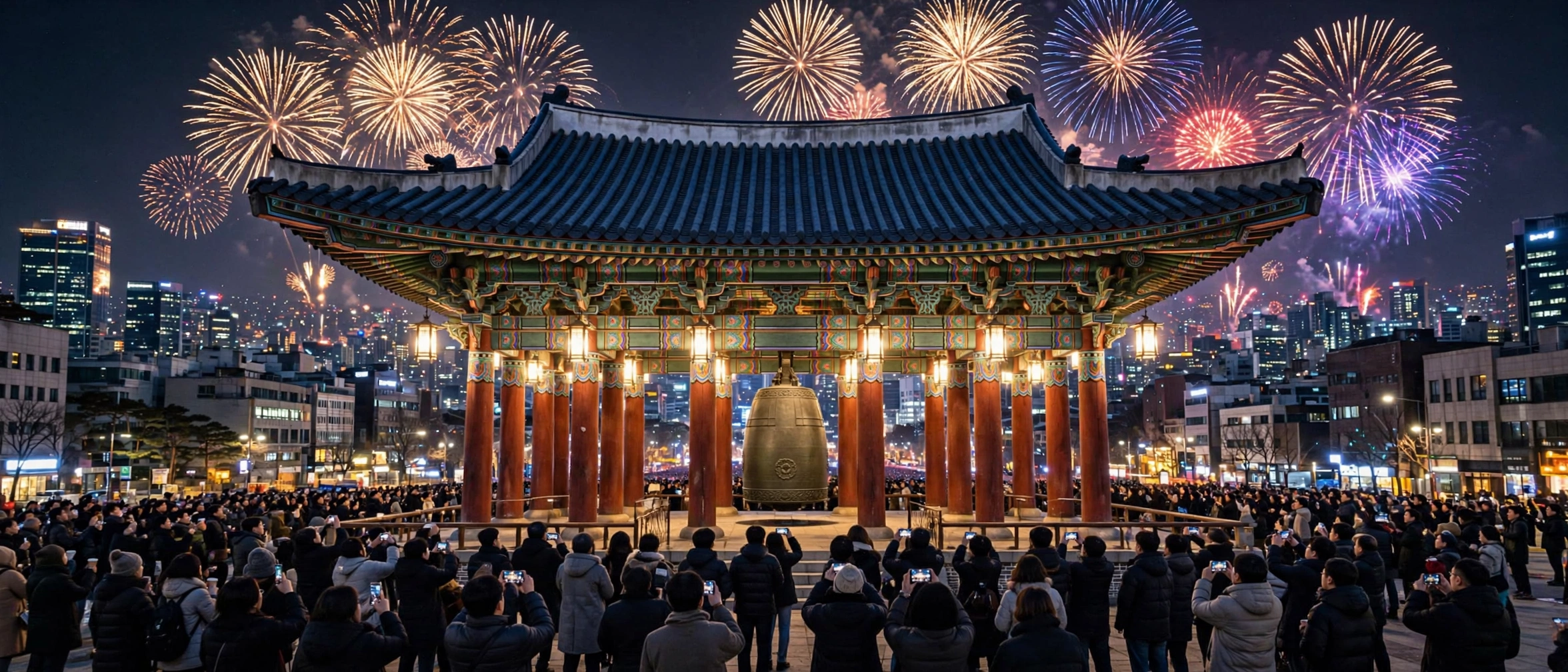
At midnight on December 31, in the heart of one of the world’s most futuristic cities, a 600-year-old bronze bell rings out 33 times. The Bosingak bell-ringing ceremony — a tradition dating back to the Joseon Dynasty — is the soul of Seoul’s New Year’s Eve: tens of thousands of people gather in Jongno in the winter cold to hear each resonant strike mark the passing of the old year. Around this ancient ritual, modern Seoul layers K-pop countdown concerts, drone shows over the Han River, temple ceremonies, and a nightlife scene that does not sleep.
This guide covers Seoul New Year’s Eve in full: the Bosingak bell-ringing ceremony and how to attend, the city’s countdown concerts and fireworks, temple and traditional celebrations, the best party districts, where to eat and stay, and practical tips for winter in Seoul.
The Bosingak Bell-Ringing Ceremony: Korea’s Midnight Tradition
The Bosingak Pavilion in Jongno has marked time in Seoul for centuries — its great bell once signaled the opening and closing of the city gates. Today, the Boseongak New Year’s Eve bell-ringing ceremony (often called Jeyaya Jong) is Korea’s most symbolic New Year ritual: at midnight, civic leaders and invited citizens strike the bell 33 times, each ring echoing through the downtown canyon as the crowd counts down.
How to Attend
- Where: Bosingak Pavilion, Jongno (Jongno-gu), central Seoul — easily reached by subway (Jonggak Station, Line 1).
- When: crowds gather from the early evening; the ceremony culminates at midnight with the 33 strikes.
- Cost: free and open to the public — it is a civic ceremony, not a ticketed event.
- What to expect: a large, orderly crowd, performances leading up to midnight, and a profoundly moving moment when the bell sounds. Dress very warmly — you will be standing outdoors in sub-zero temperatures.
- Broadcast: the ceremony is televised nationally, so arriving is about being present, not about getting the “best view” — the sound carries everywhere.
The 33 strikes are said to represent the 33 heavens of Buddhist cosmology — a detail that captures how Korea’s New Year blends Confucian, Buddhist, and modern civic traditions. For many Koreans, hearing the bell is the true start of the new year, more meaningful than any fireworks display.
Countdown Concerts, Drone Shows, and Fireworks
Around the bell ceremony, Seoul stages thoroughly modern celebrations:
- Yeouido Hangang Park: the Han River parks have hosted major NYE festivals with K-pop performances, and in recent years spectacular drone light shows over the river. Check Seoul’s official tourism announcements each December for the current year’s program.
- Lotte World Tower area: the Jamsil district around Korea’s tallest building draws crowds for its illuminated skyline countdown; the tower’s LED facade displays are a highlight.
- COEX and Gangnam: the COEX artium’s massive outdoor screen traditionally hosts a public countdown viewing, surrounded by Gangnam’s nightlife.
- Temple bell ceremonies: major Buddhist temples — including Jogyesa in Jongno and Bongeunsa in Gangnam — hold New Year’s Eve ceremonies with their own bell-striking rituals, chanting, and lantern-lit courtyards. Visitors are welcome; arrive early and dress warmly.
Note: Seoul does not stage one single official municipal fireworks show every year in the way some cities do — the celebration is distributed across districts, riverside events, and private displays. Verify the current year’s event lineup through Visit Seoul’s official channels before finalizing plans.
Traditional Ways to Mark the New Year
Tteokguk and First-Day Customs
Koreans traditionally eat tteokguk (rice cake soup) on New Year’s Day — “gaining a year” with each bowl. Many restaurants serve it on January 1, and sharing a bowl is a lovely way to start the year like a local. The traditional sebae (New Year’s bow) to elders is a family custom, but the spirit — greeting the year with respect and intention — is something visitors can adopt. Our New Year reset guide explores how to build meaningful rituals of your own.
Sunrise on January 1
Watching the first sunrise of the year (haedoji) is a beloved Korean tradition. Popular spots near Seoul include Naksan Park and the N Seoul Tower area for city sunrises; the truly dedicated travel to the east coast (Jeongdongjin, Homigot) where crowds gather on the beach at dawn. Seoul’s palaces opening for a quiet January 1 morning walk offer a serene alternative.
Party Districts: Where Seoul Celebrates After Midnight
- Hongdae: the university district’s clubs and bars host the city’s biggest NYE club nights — young, loud, and packed.
- Itaewon: Seoul’s international district; diverse crowd, bars open late, easy for visitors to navigate.
- Gangnam: upscale clubs and lounges with premium NYE packages.
- Jongno/Euljiro: the retro “hipjiro” bar scene around Euljiro offers a more local, speakeasy-style NYE.
Where to Eat on New Year’s Eve
- Korean BBQ: the quintessential celebratory dinner — book popular spots (like those in Mapo or Gangnam) ahead.
- Gwangjang Market: eat your way through bindaetteok (mung bean pancakes) and mayak gimbap in the afternoon before the night’s events.
- Temple food: for a reflective NYE dinner, Buddhist temple-cuisine restaurants offer serene set menus.
- Post-midnight: tteokbokki stalls, 24-hour restaurants, and convenience-store snacks fuel the Jongno crowds after the bell.
- January 1: find tteokguk — many traditional restaurants serve it; hotel restaurants offer New Year brunch specials.
Where to Stay
| Area | Best for | Notes |
|---|---|---|
| Jongno/Insadong | Bosingak ceremony | Walk to the bell; traditional guesthouses |
| Myeongdong | Shopping, central | Tourist hub; easy subway access |
| Hongdae | Nightlife | Young, loud, late-night |
| Gangnam | Upscale, concerts | Premium hotels; COEX countdown |
| Yeouido | Han River events | Business hotels; riverside festivals |
Practical Tips
- Weather: bitterly cold — typically -10 to 0°C (14–32°F), often with wind. Thermal base layers, a heavy coat, hat, gloves, and insulated footwear are essential. Heat packs (sold everywhere) are a lifesaver.
- Transport: Seoul’s subway runs extended hours on NYE; Jonggak Station area gets extremely crowded — consider exiting one stop away and walking.
- Language: English signage is good in tourist areas; translation apps handle the rest.
- Currency: South Korean won (KRW); cards widely accepted, T-money card for transit.
- Safety: Seoul is very safe; the main NYE risks are the cold and crowd density around Bosingak.
- January 1: public holiday — palaces and parks are lovely; many shops open as normal in tourist districts.
Seollal vs. Solar New Year: Korea’s Two New Years
Visitors are often surprised to learn that January 1 is only one of Korea’s two new years. Seollal — the lunar new year, falling in late January or February — is the bigger traditional holiday: a three-day national celebration of ancestral rites (charye), sebae bows, and family gatherings. The solar New Year (December 31–January 1) is the modern, civic, fireworks-and-parties celebration.
What this means for your trip: NYE in Seoul is outward-facing and festive (bell ceremonies, concerts, clubs), while Seollal is intimate and family-centered — many businesses close and the city quiets. Experiencing the solar NYE gives you Korea’s modern celebration; if your travels extend into late January/February, Seollal offers the traditional one. Both begin, fittingly, with a bowl of tteokguk.
Winter in Seoul: What to Do Around NYE
Palaces in the Snow
Seoul’s five grand palaces — Gyeongbokgung, Changdeokgung (with its Secret Garden), Deoksugung, Changgyeonggung, and Gyeonghuigung — are at their most atmospheric in winter light, especially after snow. The changing-of-the-guard ceremony at Gyeongbokgung runs through winter (check the schedule). Deoksugung’s evening illumination is a lovely NYE-week stroll.
Winter-Only Experiences
- Ice skating: the outdoor rinks at Seoul Plaza and Gwanghwamun are beloved winter institutions — cheap, cheerful, and very Korean.
- Hot springs (jjimjilbang): Korea’s 24-hour sauna culture is the ultimate winter refuge — and several jjimjilbang stay open through NYE night for those who want warmth over fireworks.
- N Seoul Tower: the cable car and observatory offer winter panoramas; the tower’s lighting displays are festive through the holidays.
- Hongdae and Myeongdong street food: hotteok (sweet pancakes), bungeoppang (fish-shaped pastries), and odeng (fish cake skewers) from street stalls — winter eating at its best.
- Ski day trips: resorts like Yongpyong and Vivaldi Park are 1–2 hours from Seoul — book shuttle packages in advance.
Shopping Districts
Myeongdong (cosmetics and street food), Hongdae (youth fashion), Gangnam’s COEX (mall + aquarium + library), and the traditional Namdaemun and Dongdaemun markets all run year-end sales — excellent for souvenir hunting on January 1–2.
Seoul’s NYE Districts: A Deep Dive
Hongdae — The Big Night Out
Seoul’s university district is the city’s NYE headquarters for the under-30 crowd. Dozens of clubs within walking distance run special NYE lineups — hip-hop at some, EDM at others, K-pop remixes everywhere. The streets themselves become a party, with convenience-store gatherings and street food stalls fueling the crowds. Tips: buy club tickets in advance (door prices spike), use the Hapjeong/Hongik Univ. station exits to avoid the worst crush, and eat before you go — the area’s restaurants have long NYE waits.
Itaewon — The International Party
The most foreigner-friendly NYE in Seoul: English-speaking bars, diverse crowds, and parties that cater to visitors. The main strip gets extremely crowded — arrive early, pick one venue as your base, and enjoy the multicultural countdown. The district’s rooftop bars offer N Seoul Tower views as a bonus.
Gangnam — The Upscale Countdown
Premium clubs (the Octagon/Arena lineage venues), champagne lounges, and hotel parties. Dress codes are enforced — no sneakers, no shorts. Table packages are the norm for groups; book through the venue. The COEX countdown screening draws a big public crowd for the midnight moment.
Euljiro (Hipjiro) — The Local’s Night
The retro-chic bar district locals actually prefer: vinyl bars, speakeasies, craft beer pubs, and pocha (street tents) in atmospheric old-town alleys. No cover charges, no dress codes, just Seoul’s creative class celebrating. A superb choice for a more authentic, conversation-friendly NYE.
Jongno — The Traditional Night
For the Bosingak ceremony itself: arrive by 9–10 PM, find a spot with a view of the pavilion, and soak in the performances. After the 33rd strike, the surrounding pocha tents and 24-hour restaurants fill with the dispersing crowd — join them for tteokbokki and hot tea.
Essential Korean for NYE Night
- Saehae bok mani badeuseyo (sah-heh bohk mah-nee bah-deu-seh-yo) — “Happy New Year” (literally “receive many new year blessings”) — say it to everyone after midnight.
- Geonbae! (gun-beh) — “Cheers!”
- Eolmayeyo? (uhl-mah-eh-yo) — “How much is it?”
- Hwjangsil eodiyeyo? (hwah-jahng-shil uh-dee-eh-yo) — “Where is the bathroom?”
- Gamsahamnida — “Thank you” (formal).
4 Days in Seoul Around NYE: The Itinerary
| Day | Morning | Afternoon | Evening |
|---|---|---|---|
| Dec 30 | Gyeongbokgung Palace + guard ceremony | Bukchon Hanok Village; Insadong tea houses | Gwangjang Market food tour |
| Dec 31 | Jogyesa Temple; Cheonggyecheon stream walk | Rest; Myeongdong shopping | Bosingak bell ceremony at midnight |
| Jan 1 | Sleep in; tteokguk lunch | N Seoul Tower; Namdaemun Market | Hongdae or Itaewon nightlife |
| Jan 2 | DMZ tour or ski day trip | Return; jjimjilbang sauna session | Gangnam dinner; farewell |
Korean Drinking Culture: What to Know
Alcohol is woven into Korean social life, and NYE is no exception:
- Soju and maekju (beer): the classic combination — soju-beer mixes (somaek) are the standard group drink.
- Pouring etiquette: pour for others with two hands; receive with two hands; turn away from elders when drinking — small gestures that earn big respect.
- Anju (drinking food): Koreans always eat while drinking — fried chicken, tteokbokki, and grilled intestines (gopchang) are classic anju.
- Hof culture: the beer halls (hof) of Hongdae and university districts are the social heart of the night.
- Pace yourself: Korean drinking sessions are marathons — the infamous “one-shot” culture is real. Eat, hydrate, and know your limits.
- Haejang (hangover) food: January 1 calls for haejangguk (hangover soup) — the restorative tradition. Every local has a favorite spot.
Seoul’s Winter Café Culture
Korea’s café scene is world-class and winter is its season:
- Themed cafés: from raccoon cafés to 2D cartoon cafés (Yeonnam-dong’s famous illustrated interior), Seoul’s novelty cafés are worth an afternoon.
- Traditional tea houses: Insadong’s hanok tea houses serve jujube and ginger teas in serene wooden interiors — the antidote to NYE chaos.
- Rooftop cafés: winterized rooftop cafés in Ikseon-dong and Seongsu offer heated views over the old and new city.
- 24-hour cafés: many stay open through NYE night — warm refuges between the bell ceremony and the clubs.
Day Trips from Seoul in Winter
- DMZ (Demilitarized Zone): the most extraordinary day trip on earth — the Joint Security Area, Dora Observatory, and the Third Tunnel. Book through authorized tour operators only; tours run year-round except Mondays and national holidays. Passport required; strict rules apply.
- Suwon Hwaseong Fortress: the UNESCO-listed 18th-century fortress walls — spectacular in winter, 30 minutes by train. Walk the full wall circuit for panoramic views.
- Incheon: the port city’s Chinatown, Songdo’s futuristic skyline, and Wolmido’s retro amusement strip — an easy half-day.
- Yongpyong / Vivaldi Park ski resorts: full-day ski packages with shuttle buses from Seoul — book ahead for the NYE week.
- Nami Island: the famous tree-lined island — beautiful in snow, 90 minutes northeast. Combine with the Garden of Morning Calm’s winter lighting festival.
- Jeonju Hanok Village: the best-preserved traditional village in Korea — bibimbap’s birthplace, 90 minutes by KTX. Worth an overnight.
Korean Winter Essentials: What to Buy in Seoul
- Heat packs (hot packs): sold at every convenience store and pharmacy — the single most important winter survival item. Stock up.
- Thermal underwear: Uniqlo Heattech and Korean equivalents are cheap and excellent — buy on arrival if you underpacked.
- Korean skincare: Myeongdong’s shops are the global capital of affordable skincare — winter sheet masks make ideal souvenirs.
- Insulated tumblers: Koreans carry hot drinks everywhere in winter — join them.
- Hand cream and lip balm: the dry winter air is brutal — buy local brands, which are formulated for it.
Seoul Winter Packing List
- Thermal base layers: top and bottom — non-negotiable for midnight outdoors.
- Heavy winter coat: down or equivalent; windproof outer shell is ideal.
- Insulated, waterproof boots: with good grip — icy sidewalks are common.
- Hat, scarf, gloves: covering ears and neck makes a 10-degree difference in comfort.
- Heat packs: buy in bulk on arrival — pockets, gloves, boots.
- Lip balm and moisturizer: the dry cold is harsh on skin.
- Portable charger: cold drains phone batteries fast — keep it warm in an inside pocket.
- One smart outfit: Gangnam clubs enforce dress codes; pack accordingly.
- Small daypack: for shedding layers when you go indoors (Korean interiors are very warm).
Seoul’s Palace Night Tours: Winter Illuminations
Several of Seoul’s palaces run special night openings in winter — and the NYE week is the perfect time to experience them:
- Gyeongbokgung night tours: the palace’s winter night openings (ticketed, limited capacity — book through the official site the moment dates are announced) transform the courtyards with illumination. The hanbok-wearing visitors add to the spectacle; rental shops near the palace stay open late.
- Deoksugung Stonewall Walkway: the palace’s evening lighting and the famous stonewall path are free and open — a beloved winter date-night stroll, especially with light snow.
- Changgyeonggung greenhouse: the palace’s grand greenhouse offers tropical warmth in the winter cold — a surreal and lovely refuge.
- Bukchon at night: the hanok village’s lanes glow with warm light after dark — respectful quiet is expected in this residential area.
These night programs are among Seoul’s most popular winter tickets — check the Cultural Heritage Administration’s announcements in late autumn and book immediately.
Seoul Souvenirs: What to Bring Home
- K-beauty sets: Myeongdong and Olive Young stores — sheet masks, serums, and cushion compacts at unbeatable prices.
- Traditional crafts: mother-of-pearl lacquerware and hanji paper goods from Insadong.
- Korean snacks: Honey Butter Chips, Market O brownies, and banana milk kits for the flight home.
- Soju glasses and ceramics: Icheon’s pottery is world-famous; small cups make perfect gifts.
- K-pop merchandise: official goods from the entertainment companies’ stores — Myeongdong and COEX.
Shopping tip: bring your passport when shopping — many stores offer on-the-spot tax refunds for tourists spending over the minimum threshold. Myeongdong’s flagship beauty stores (Olive Young, Innisfree, Etude) have dedicated tax-refund counters; the process takes minutes. For traditional crafts, Insadong’s Ssamziegil complex packs dozens of artisan shops into one winding building — ideal for a January 2nd souvenir run.
In Pictures: New Year’s Eve in Seoul
Seoul’s New Year begins with the deep toll of the Bosingak bell — 33 ceremonial chimes at midnight in the heart of Jongno.
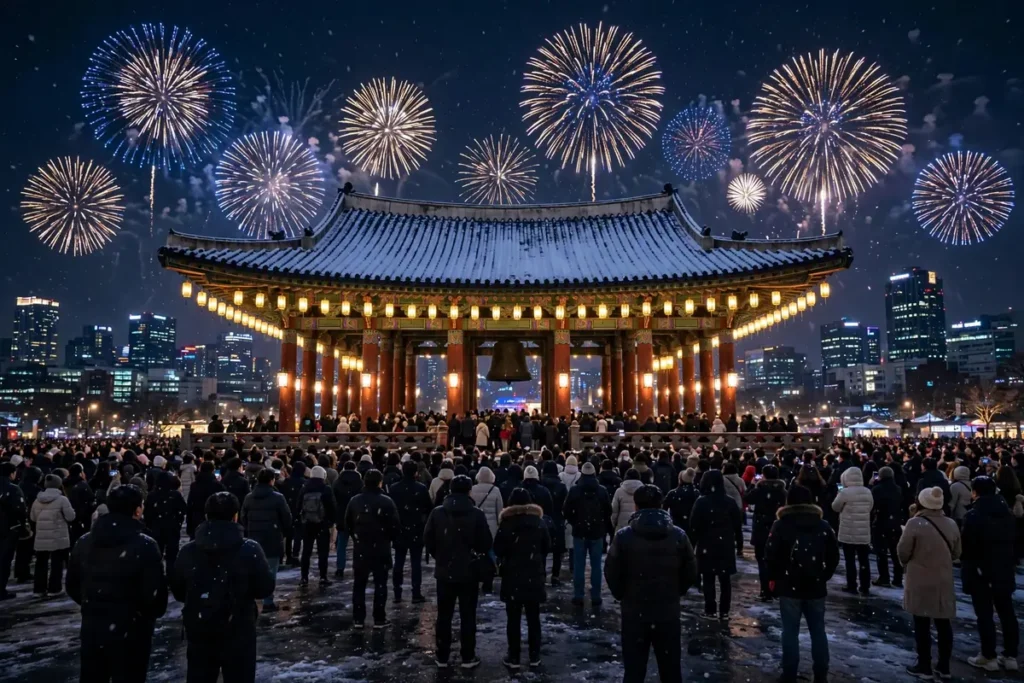
Crowds gathered at Bosingak Pavilion in Jongno as the historic bell tolls 33 times at midnight.
Watch: New Year’s Eve in Seoul
Watch the Bosingak bell-ringing ceremony — Seoul’s most symbolic New Year’s Eve tradition.
At a Glance: New Year’s Eve in Seoul
Seoul’s New Year traditions, from the bell ceremony to sunrise wishes.
| Tradition | Detail | Meaning |
|---|---|---|
| Bosingak bell-ringing | 31 December, midnight, Jongno | The historic bell is struck 33 times at midnight; the modern ceremony dates to 1953 and draws crowds of around 100,000 |
| 33 chimes | Buddhist symbolism | The number 33 refers to the 33 heavens of Buddhist cosmology, expressing wishes for peace and the nation’s well-being |
| Bosingak history | Joseon Dynasty | The pavilion’s bell once signaled the opening and closing of Seoul’s city gates; the current bell is a replica of the 15th-century original |
| New Year’s Day sunrise | 1 January, dawn | Many Koreans head east — to beaches like Gyeongpo or Seongsan Ilchulbong on Jeju — to watch the year’s first sunrise and make wishes |
| Seollal (Lunar New Year) | Separate holiday | Korea also celebrates the lunar new year with family rites, sebae bows, and tteokguk rice-cake soup |
Frequently Asked Questions
What is the Bosingak bell-ringing ceremony?
It is Seoul’s official New Year’s Eve ceremony at the historic Bosingak Pavilion in Jongno: at midnight, the great bronze bell is struck 33 times to mark the new year, in a tradition dating back to the Joseon Dynasty. It is free, open to the public, and attended by tens of thousands.
Do I need tickets for the Bosingak ceremony?
No — it is a free civic event. Arrive early in the evening to secure a comfortable spot, dress for sub-zero temperatures, and expect large, orderly crowds around Jongno.
Are there fireworks in Seoul on New Year’s Eve?
Seoul’s celebration is distributed rather than centered on one official show: expect riverside festivals with drone shows at Yeouido Hangang Park, illuminated countdowns at Lotte World Tower and COEX, temple ceremonies, and private displays. Check Visit Seoul’s December announcements for the current year’s lineup.
What do Koreans eat on New Year’s Day?
Tteokguk (rice cake soup) — eating it is said to make you a year older. Many traditional restaurants serve it on January 1, and it is a delicious way to start the year like a local.
How cold is Seoul on New Year’s Eve?
Very cold: typically -10 to 0°C (14–32°F) with wind chill. Thermal layers, a heavy winter coat, hat, gloves, and heat packs are essential for standing outdoors at midnight.
Where is the best nightlife on NYE in Seoul?
Hongdae for big club nights, Itaewon for an international crowd, Gangnam for upscale lounges, and Euljiro’s retro bar scene for something more local. Club tickets for NYE sell in December — book ahead.
Seoul’s New Year’s Eve is a study in contrasts: a 600-year-old bell ringing in the shadow of skyscrapers, ancient temple chants beside K-pop countdowns, and a city that honors its past while sprinting into the future. Stand in the cold at Jongno, hear the 33rd strike fade, and feel the year turn. For another Asian capital’s midnight tradition, see Kuala Lumpur’s Petronas Towers fireworks — or start the year with intention using our 100 New Year wishes for 2027.