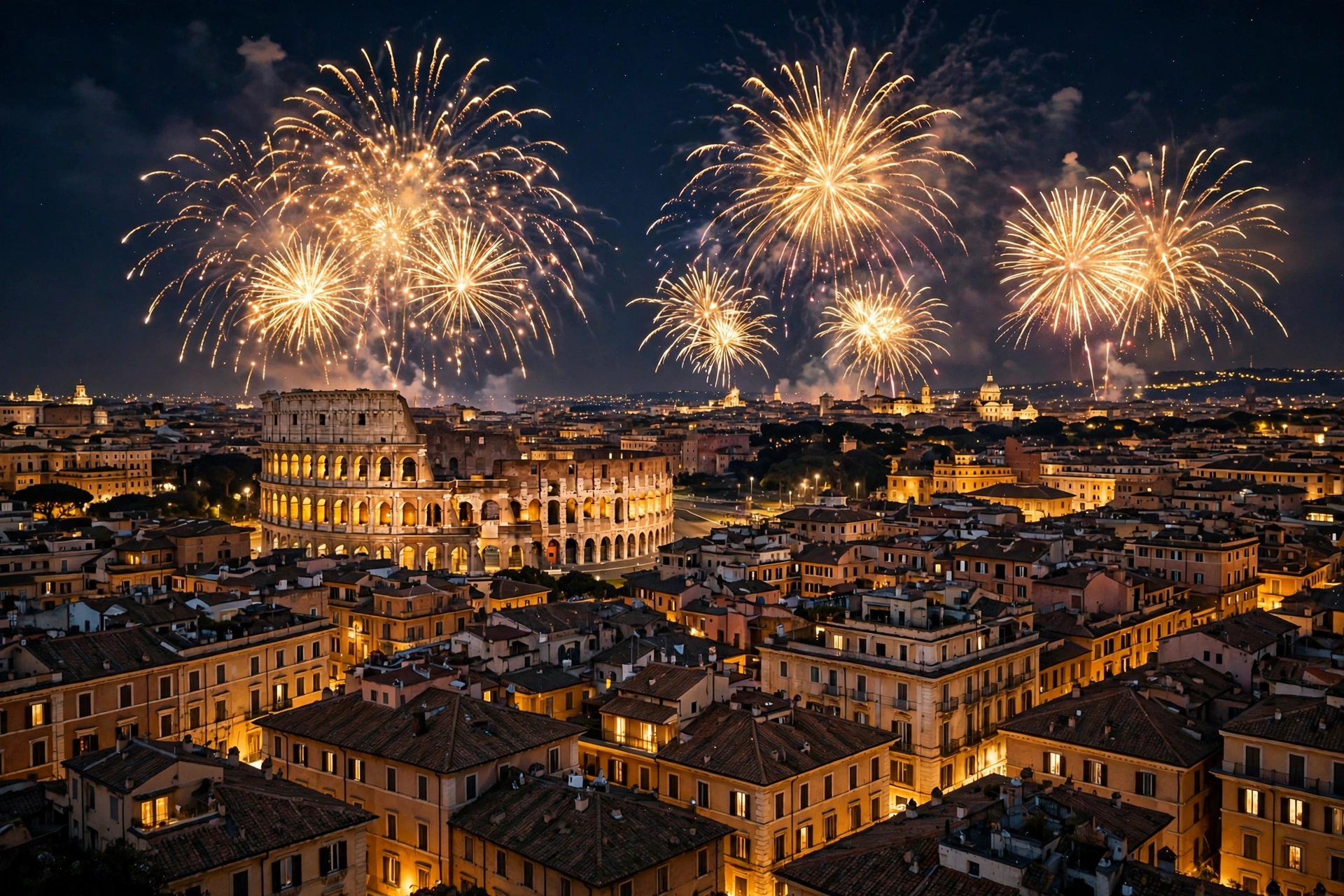
Rome greets the new year the way it does everything: with history, drama, and excellent food. New Year’s Eve in the Eternal City means open-air concerts in ancient settings, fireworks over the Tiber and the rooftops of the centro storico, late dinners that stretch toward midnight, and traditions — red underwear, lentils, the midnight toast — that Romans take as seriously as their espresso. It is Italy’s most atmospheric countdown.
This guide covers Rome’s New Year’s Eve concerts and fireworks, the best viewing spots, where to eat, Italian midnight traditions, where to stay, and the practical details for the night.
Why Rome on New Year’s Eve
Rome’s New Year’s Eve is less about a single headline fireworks barge and more about the city itself as the celebration. In recent years the city has staged major free open-air concerts — the Concertone di Capodanno tradition has seen headline acts perform at venues like the Circo Massimo (Circus Maximus) — alongside fireworks displays over the city at midnight. The combination of live music in a 2,000-year-old setting and fireworks above the domes and bell towers is pure Rome.
The night is also deeply social and food-centred. Romans dine late and long; the cenone di Capodanno (the big New Year’s Eve dinner) is the centrepiece of the evening for many, with midnight arriving in the middle of dessert and digestivi. Add mild winter weather by northern standards, and you have a countdown that is as much about the table as the sky.
Concerts and Fireworks: What to Expect
Rome’s official New Year’s Eve programming typically includes a large free concert in the evening — in recent editions staged at the Circo Massimo with major Italian artists — building toward the midnight fireworks. The fireworks are launched from locations around the city, visible from the hills and riverside vantage points.
A typical evening:
- Evening: The cenone begins in restaurants and homes across the city. The concert venue fills from the early evening.
- Before midnight: Crowds gather at the concert and at viewpoints across the city. Church bells begin to ring as midnight approaches.
- Midnight: Fireworks over the city, toasts with spumante, and the traditional wishes of Buon anno!
- After midnight: The clubs and bars of Testaccio, Trastevere, and the centro storico party until dawn.
Check the city’s official announcements for each year’s concert lineup and fireworks locations — the programme is usually confirmed in December.
Best Places to Watch the Midnight Fireworks
The Circo Massimo concert
If the year’s concert is at the Circo Massimo, this is the heart of the night: live music, a massive crowd, and fireworks visible above. Arrive early — the venue fills to capacity. It is free, festive, and the most Roman way to do midnight.
Gianicolo (Janiculum Hill)
The terrace of the Gianicolo offers one of Rome’s great panoramas — the entire centro storico spread below, domes and bell towers in every direction. At midnight the fireworks rise from multiple points across the city. It is a local favourite and gloriously atmospheric, though you will want to arrive well before midnight.
Pincio Terrace (Villa Borghese)
The Pincian Hill terrace above Piazza del Popolo gives you the classic view down over the piazza and the rooftops beyond. Elegant, central, and excellent for photographs.
Aventine Hill and the Orange Garden
The Giardino degli Aranci (Orange Garden) on the Aventine offers a romantic, slightly quieter viewpoint over the city and the Tiber. A lovely spot for couples.
Lungotevere (the Tiber embankments)
Walking the Tiber embankments at midnight — fireworks above, the river below, the bridges lit — is wonderfully Roman. The riverside paths give you long sightlines in both directions.
Piazza del Popolo and Piazza Venezia
The big piazzas fill with revellers at midnight. Piazza del Popolo is the classic gathering point — festive, crowded, and central. Expect a party atmosphere rather than a curated viewpoint.
Italian New Year Traditions
Red underwear (biancheria rossa)
The most famous Italian New Year’s tradition: wearing red underwear on New Year’s Eve for luck and love in the coming year. The markets and shops of Rome overflow with red lingerie in December — buy a set as a souvenir even if you are sceptical. It is worn on the night and, traditionally, thrown away afterwards.
Lentils and cotechino (or zampone)
The essential midnight dish: cotechino con lenticchie — rich pork sausage with lentils, the lentils symbolising coins and prosperity. It is served at midnight in homes and restaurants across Italy, often as part of the cenone. Many Roman restaurants include it in their New Year’s Eve menus. Eating lentils at midnight is non-negotiable if you want the full experience.
The cenone di Capodanno
The big dinner is the evening’s anchor: multiple courses, flowing wine, and a table that stays full until well past midnight. Roman restaurants offer special cenone menus — book early, as the best fill weeks ahead. Expect to eat late: the midnight toast often interrupts dessert.
Spumante at midnight
Italy’s sparkling wine — prosecco or the sweeter spumante — is the midnight toast. Buon anno! all round, then back to the table.
Throwing old things out the window
An old southern Italian tradition (less common in modern Rome but still talked about): throwing old pots, pans, or objects out of the window at midnight to symbolise letting go of the past. Do not try this yourself — but you may hear it referenced.
Where to Eat
The cenone: booking your New Year’s Eve dinner
Your cenone defines the night. Options range from traditional trattorias in Trastevere and Monti (carbonara, amatriciana, cacio e pepe, then cotechino at midnight) to upscale restaurants with tasting menus. Whatever you choose, book early and confirm the seating time — you want to be at the table, not in transit, at midnight.
Trastevere
The atmospheric neighbourhood across the Tiber is packed with trattorias and wine bars — ideal for a long, lively dinner within stumbling distance of the Gianicolo viewpoint.
Testaccio
Rome’s foodie heart: authentic Roman cuisine, the old market, and the clubs that keep the after-midnight party going. Dinner here flows naturally into the night’s second act.
Centro storico
The historic centre’s restaurants put you near the piazzas and the river for midnight. Pricier, but the location is unbeatable.
Parties and Nightlife
After the fireworks, Rome parties late. Testaccio is the clubbing district — big rooms, international DJs, dawn finishes. Trastevere’s bars stay lively until the small hours. The rooftop bars of the centro storico offer midnight views with a drink in hand (book ahead). Many clubs run ticketed New Year’s Eve events — buy tickets in advance.
Where to Stay
- Centro storico (Pantheon / Piazza Navona): Walk to the piazzas, the river, and the viewpoints. The most atmospheric — and priciest — base.
- Trastevere: Lively, authentic, great restaurants; near the Gianicolo.
- Monti: Trendy, central, excellent food; a short walk to the Colosseum area.
- Testaccio / Ostiense: Near the clubs; good value and well-connected.
- Prati (near the Vatican): Elegant and slightly quieter; easy metro access to the centre.
New Year’s Eve is a busy night in Rome — book accommodation early, especially in the centro storico and Trastevere.
Practical Tips
Weather
Rome’s winters are mild: evenings around 5–8°C (41–46°F). You will want a warm coat for hours outdoors at viewpoints, but it is nothing like northern Europe. Rain is possible — bring a compact umbrella.
Transport
Rome’s metro and buses run on holiday schedules with extra night services typically added for New Year’s Eve. The centro storico is best navigated on foot on the night — streets around the main piazzas and the concert venue close to traffic. Taxis are scarce after midnight; walking is often fastest.
Crowds and safety
The piazzas and the concert venue get very crowded. Pickpockets work the crush — keep valuables secure, especially on public transport and in Piazza del Popolo. The atmosphere is celebratory, but stay alert in dense crowds.
Budget
The concert and street celebrations are free. The cenone is the main expense — special menus run higher than usual, typically in the range of a proper festive dinner out. Club tickets are the other splurge. Rome remains reasonable by Western European capital standards: a pizza and a glass of wine in Trastevere costs a fraction of the equivalent evening in Paris, and the city’s greatest assets — the piazzas, the river, the views from the hills — are free. Walk everywhere on the night itself and you will barely spend on transport.
New Year’s Day in Rome
January 1 is a public holiday. Romans recover slowly — many restaurants open late. The traditional New Year’s Day concert season begins, and the city’s museums (check holiday hours) offer a calm start to the year. A walk through the empty morning streets of the centro storico, followed by a long lunch, is the perfect January 1. If you are staying on, the Epiphany (January 6) brings the Befana traditions and the end of the festive season.
If the new year inspires new habits, our New Year reset guide offers a structured 30-day fresh-start plan.
A First-Timer’s Itinerary for New Year’s Eve
Morning: the Colosseum and the Forum
Start at the Colosseum — book the first entry slot of the day — then walk through the Roman Forum and up to the Capitoline Hill. Ancient Rome in the morning light, before the festive crowds build, is the essential first chapter.
Midday: the centro storico
The Pantheon, Piazza Navona, the Trevi Fountain — the greatest-hits walk of the historic centre. Lunch on carbonara or cacio e pepe in a trattoria off the main drag. Throw your coin in the Trevi Fountain — you will be back.
Afternoon: rest
Back to the hotel. Rest, dress for dinner, and — if you are observing the tradition — put on the red underwear.
Evening: the cenone
Your cenone di Capodanno: antipasti, primi, secondi, and the table groaning toward midnight. Pace yourself — the cotechino and lentils arrive at midnight, and dessert follows.
Midnight: fireworks and Buon anno
Either stay at the table for the midnight toast (the most traditional option) or be at your viewpoint — the Gianicolo, the Circo Massimo concert, or the Tiber embankments — for the fireworks. Buon anno!
After midnight: Testaccio
The clubs of Testaccio for the full Roman night, or the bars of Trastevere for something more intimate. Dawn is optional; the cenone was the main event.
Day Trips from Rome
Ostia Antica
Rome’s ancient port — a remarkably preserved Roman town of streets, houses, mosaics, and a theatre, 40 minutes by train. A Pompeii-like experience without the journey south, and wonderfully uncrowded in winter.
Tivoli: Villa d’Este and Hadrian’s Villa
An hour east: the Renaissance Villa d’Este with its extraordinary fountains, and Hadrian’s Villa, the vast imperial retreat. A perfect January 2 excursion.
Orvieto
The clifftop Umbrian town with its striped cathedral — just over an hour by train, dramatic and delicious, famous for its white wine and slow pace.
Christmas in Rome: The Season Around New Year
Rome’s New Year’s Eve is the midpoint of a festive season that runs from Christmas to Epiphany — and the season’s traditions enrich the countdown.
The Vatican and St. Peter’s
Rome at Christmas means the Vatican: the great Christmas tree and nativity scene in St. Peter’s Square, the Pope’s Christmas and New Year addresses, and midnight Mass (ticketed, book far ahead). Even for non-Catholics, St. Peter’s Square in the festive season is profoundly atmospheric.
Nativity scenes (presepi)
The presepe (nativity scene) is a Neapolitan art form that Rome embraces fully — churches across the city stage elaborate scenes, from the traditional to the avant-garde. The church of Santa Maria in Aracoeli on the Capitoline Hill hosts a beloved historic presepe.
Via dei Condotti lights
Rome’s Christmas street lights — the elegant illuminations along Via dei Condotti, Via del Corso, and the Spanish Steps area — stay up through Epiphany, so the city glitters for your New Year’s visit.
La Befana (January 6)
The festive season ends with Epiphany and the Befana — the witch who brings gifts (or coal) to children on the night of January 5. The Piazza Navona Christmas market traditionally runs through Epiphany, with Befana dolls everywhere. If you stay into January, it is a charming coda.
Roman Winter: More to Do
The Borghese Gallery
The Galleria Borghese — Bernini’s sculptures, Caravaggio’s paintings, in a villa in the park — is Rome’s essential museum. Tickets are timed and limited; book well ahead.
The Appian Way
A winter walk or bike ride along the Via Appia Antica — the ancient road lined with tombs, aqueducts, and umbrella pines — is magical in the low winter light and blissfully uncrowded.
Thermal baths
The Romans invented the spa — honour them with a visit to a modern terme. The thermal baths near the city are a wonderful New Year’s Day recovery.
Money, Transport & Practical Essentials
- Currency: Euro (EUR). Cards are widely accepted; carry cash for small trattorias and market stalls.
- Tipping: A coperto (cover charge) is standard in restaurants; extra tipping is optional — rounding up for good service is appreciated.
- SIM cards: Prepaid Italian SIMs with data are available at the airport and phone shops.
- Metro and buses: Rome’s metro has three lines; buses and trams fill the gaps. Buy integrated tickets via apps or tobacconists. On New Year’s Eve, expect holiday schedules with extra night services — and walk the centro storico, which is largely pedestrian-friendly.
- Emergency number: 112.
- Language: Italian; English is spoken in tourist areas and restaurants, less so off the beaten path. Key phrases: Buon anno (Happy New Year), il conto, per favore (the bill, please).
- Water: Rome’s tap water is excellent — refill at the nasoni drinking fountains across the city.
- ZTL zones: The historic centre is a limited-traffic zone — do not drive into it without authorization.
When to Book: A Timeline
- 3–5 months ahead: Flights and centro storico or Trastevere accommodation.
- 2 months ahead: Cenone dinner reservations — the best restaurants fill early.
- 1 month ahead: Club tickets and Borghese Gallery timed entry.
- 1 week ahead: Check the city’s announcements for the concert lineup and fireworks locations.
Rome’s Piazzas After Dark
On New Year’s Eve, Rome’s piazzas become open-air living rooms — and they are worth exploring before the midnight hour.
Piazza Navona
Bernini’s fountains, street artists, and the festive market stalls (running through Epiphany) — Piazza Navona is Rome’s most beautiful square and a natural evening gathering point.
Campo de’ Fiori
By day a market, by night a bar scene — the campo fills with a young, international crowd. A good early-evening stop for an aperitivo before dinner.
Piazza di Spagna
The Spanish Steps, beautifully lit, with the Trinità dei Monti church above — romantic and iconic, though crowded. The surrounding streets hold Rome’s best shopping.
Piazza del Popolo
The midnight gathering point: the great oval piazza with its obelisk, twin churches, and the Pincio terrace above. If you want to be in the thick of the city’s collective countdown, this is where.
Trastevere’s Piazza di Santa Maria
The golden-mosaicked church, the fountain, the late-night bars — Trastevere’s main square is the neighbourhood’s beating heart and a lovely, slightly more local alternative to the big central piazzas.
The Bells of Rome at Midnight
One of Rome’s most moving New Year’s Eve experiences has nothing to do with fireworks: the bells. As midnight approaches, churches across the city begin to ring — hundreds of bells, from the great basilicas to tiny neighbourhood chapels, pealing together over the rooftops. The tradition of scampanio (bell-ringing) at midnight is ancient, and on a still winter night the sound carries for miles. The best place to hear it is somewhere elevated and relatively quiet — the Aventine Hill, the Gianicolo, or the Pincio — where the fireworks’ crackle gives way to the deeper, older music of the bells. Stand still for it. It is Rome at its most timeless: the same sound that has marked the new year here for a thousand years.
In Pictures: New Year’s Eve in Rome
Rome’s Capodanno blends ancient spectacle with Italian ritual — fireworks over the Colosseum and feasts that run past midnight.
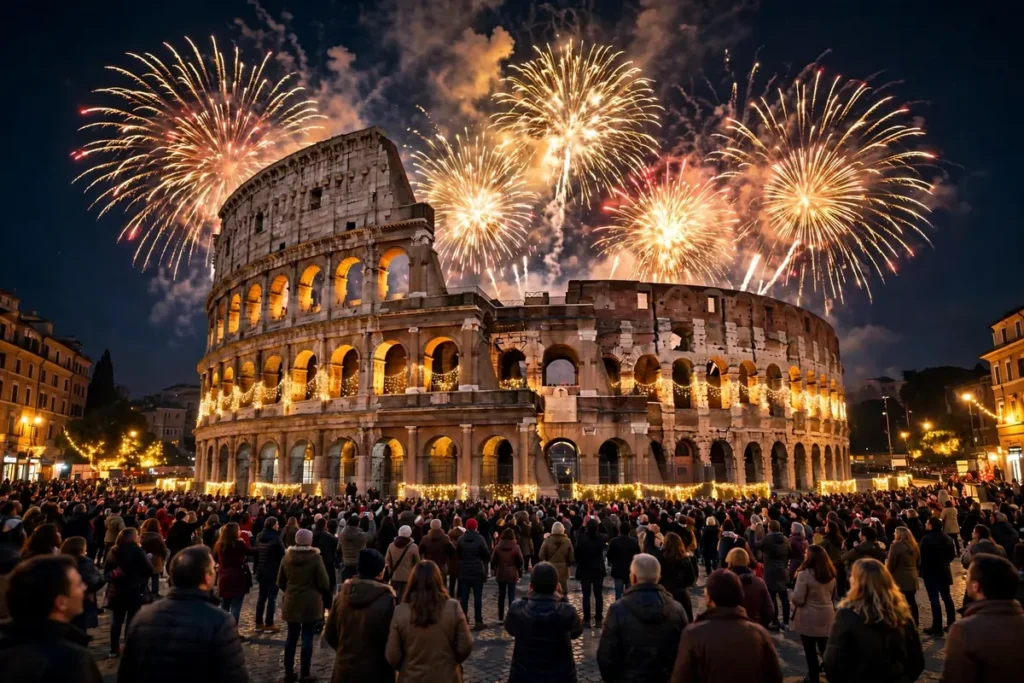
Fireworks over the Colosseum as Rome celebrates the arrival of the new year.
Watch: New Year’s Eve in Rome
Firstpost’s coverage of Italy’s 2026 New Year’s Eve — fireworks over Rome.
At a Glance: New Year’s Eve in Rome
Rome’s Capodanno.
| Element | Detail | What to know |
|---|---|---|
| Colosseum fireworks | Midnight | Fireworks light up the sky over the ancient amphitheater — one of the world’s most iconic NYE backdrops |
| Cenone dinner | 31 December evening | The lavish traditional New Year’s Eve feast; reservations are essential |
| We Run Rome | 31 December afternoon | The annual New Year’s Eve run through the city’s streets |
| Cotechino e lenticchie | New Year’s Day | The traditional pork-and-lentil dish eaten for prosperity |
| Red underwear | 31 December | Wearing red is a widespread Italian custom for good luck in the new year |
| New Year’s Day parade | 1 January | A festive parade through Rome’s historic streets kicks off the year |
Frequently Asked Questions
What time are the Rome New Year’s Eve fireworks?
The fireworks take place at midnight on December 31, launched from locations around the city. Check the official announcements for each year’s details — and remember that Rome’s church bells, ringing out across the rooftops at the same moment, are half the music of the night.
Where is the best place to watch the fireworks in Rome?
The Gianicolo terrace offers the finest panorama; the Circo Massimo concert is the heart of the night; the Pincio Terrace and the Tiber embankments are excellent alternatives. All are free.
What is the red underwear tradition?
Italians wear red underwear on New Year’s Eve for luck and love in the coming year. Shops across Rome sell it throughout December — it is the essential (and fun) souvenir.
What do Italians eat at midnight on New Year’s Eve?
Cotechino con lenticchie — pork sausage with lentils, symbolising prosperity. It is served at midnight as part of the cenone (the big New Year’s Eve dinner).
How cold is Rome on New Year’s Eve?
Mild — evenings around 5–8°C (41–46°F). A warm coat is enough; no arctic gear required.
Is Rome good for families on New Year’s Eve?
Yes — the concert is free and family-friendly, the piazzas are festive, and the restaurant cenone is a family affair by tradition. Keep children close in the midnight crowds.
Rome’s New Year’s Eve is history, music, fireworks, and a table full of cotechino at midnight — the Eternal City doing what it does best. Book your cenone, buy the red underwear, and find your hilltop for midnight. For more European celebrations, see our guides to Venice New Year’s Eve and Paris New Year’s Eve, and for the words to share the night, our New Year wishes and captions for 2027. Prefer a quiet evening? Our New Year’s Eve at home plan is there too.