Of every room in your home, the living room is where life happens — movie nights, lazy Sundays, the couch with your shared dent in it. Which is exactly why it is the perfect place to propose. These romantic proposal setup ideas for your living room will gently help you transform the single most familiar room in your entire home into the single most unforgettable one.
The living room proposal works because of contrast: the ordinary made extraordinary. Your partner walks into a room they have seen ten thousand times and finds it glowing, scented, and waiting — and the shock of transformation in a familiar space is more powerful than any exotic location on earth. No travel, no reservations, no audience, no distractions. Just your couch, your walls, your shared history — deliberately, lovingly elevated into pure magic.
This guide is the complete, detailed living room playbook: choosing your proposal spot within the room, furniture arrangements that frame the moment, lighting designs from simple to spectacular, five complete setup styles with shopping lists, a layout diagram guide, budget tiers, the all-important surprise logistics (how to decorate with someone living there), photo and video tips, and answers to every practical question. By the end, your familiar everyday living room will be completely ready for its unforgettable close-up.

Choosing Your Proposal Spot: Reading the Room
Every living room has a natural focal point — the spot the eye goes to. That is your proposal spot. Walk into your living room right now and notice where you look first: the fireplace, the big window, the feature wall, the space in front of the bookshelf. That gravitational center is where the question should happen, because it is where attention already wants to go.
Consider sightlines from the entrance. The ideal setup creates a reveal: your partner enters, sees the transformed room, and their eyes travel naturally to the decorated spot where you are waiting. Avoid placing the proposal spot where it is visible from the front door through a window — the surprise dies if they see it from the sidewalk. If your living room is open-plan, use furniture or fabric draping to create a defined “stage” area within the larger space.
Think about the background of your photos. The proposal spot’s backdrop is what appears in every picture: make it beautiful and uncluttered. A decorated wall, a window with fairy lights, a fireplace with candles on the mantel — all excellent. The TV (even turned off, it is a black rectangle), the cluttered bookshelf, the laundry pile: all terrible. You are designing a stage set; the camera only sees what you let it see.
Finally, consider kneeling logistics. You need clear floor space — at least a four-foot circle — free of furniture legs, cables, and pet toys. If you are doing a petal circle or rug marker, center it on this spot. Test it: kneel there yourself during setup. If your knee lands on a Lego, you will be glad you checked.
Furniture Arrangement: Staging the Scene
The Theater Layout
Push seating to face the proposal spot like an audience: couch and chairs angled inward, coffee table moved aside. This creates a natural stage and ensures any hidden photographer has clear sightlines. Best for: proposals with a few witnesses (family hiding in the kitchen) or videography. The formality of the arrangement signals “something is happening” the moment your partner walks in.
The Intimate Nook
Instead of using the whole room, create a defined nook: two chairs or floor cushions facing each other within a canopy of draped fabric and lights, a small table between them with champagne. The rest of the room stays dim. This concentrates all the magic into one glowing pocket — incredibly romantic and perfect for small living rooms. The nook says: the whole world has shrunk to just us.
The Pathway Design
Arrange the room as a journey: entry → photo timeline along one wall → petal path → proposal spot → celebration table. Furniture edges the path rather than blocking it. This layout builds anticipation with every step and works beautifully in long or L-shaped living rooms. The pathway turns the room itself into part of the proposal narrative.
The 360° Reveal
For open-plan spaces: decorate all around, with the proposal spot in the center of the room. Your partner enters to a full surround of lights, candles, and flowers — no single focal wall, just immersive magic. This requires the most decoration (every angle is a camera angle) but delivers the most dramatic entrance. Spin slowly when they walk in; let them take it all in.
Lighting Designs: From Simple Glow to Spectacular
Level 1: The Candle Constellation (30 minutes, ~$25)
Turn off all overheads. Place 30–50 LED tea lights in clusters around the room — on the mantel, the coffee table (moved aside), window sills, bookshelves, floor corners. Add two or three real pillar candles on high stable surfaces for scent and authenticity. The room glows like embers. This alone, with nothing else, is enough for a proposal — light is the whole trick.
Level 2: The Fairy Light Canopy (1 hour, ~$40)
String warm-white fairy lights across the ceiling in swooping lines from a central point (a ceiling hook or curtain rod), creating a tent of light over the proposal area. Add the candle constellation at floor level. The canopy overhead plus glow below wraps the room in light — your partner walks into a galaxy. Battery-operated copper wire lights are ideal; they are light enough to hang with removable adhesive hooks.
Level 3: The Full Production (2–3 hours, ~$100+)
Canopy lights + candles + a “MARRY ME” light sign or letter balloons as the centerpiece + uplighting (cheap LED par lights aimed at walls create dramatic color washes) + a projector showing photos on one wall. This is the setup that looks like a professional did it. The projector is the secret weapon — a slideshow of your photos ten feet tall turns any blank wall into a monument to your relationship.
Lighting rules that matter
- Warm white only (2700K). Cool white reads hospital; warm white reads romance. Check the packaging — “daylight” bulbs will ruin the mood.
- Layer three heights: something glowing near the floor (tea lights), something at eye level (candles, lamps), something overhead (fairy lights). Single-height lighting looks flat.
- Dim, do not darken. The room should glow, not go black — your partner needs to see your face, and the camera needs light to work with.
- Test after dark. Daylight lies. Do your lighting test at the same time of day as the proposal.
Five Complete Living Room Setup Styles
1. The Classic Romance
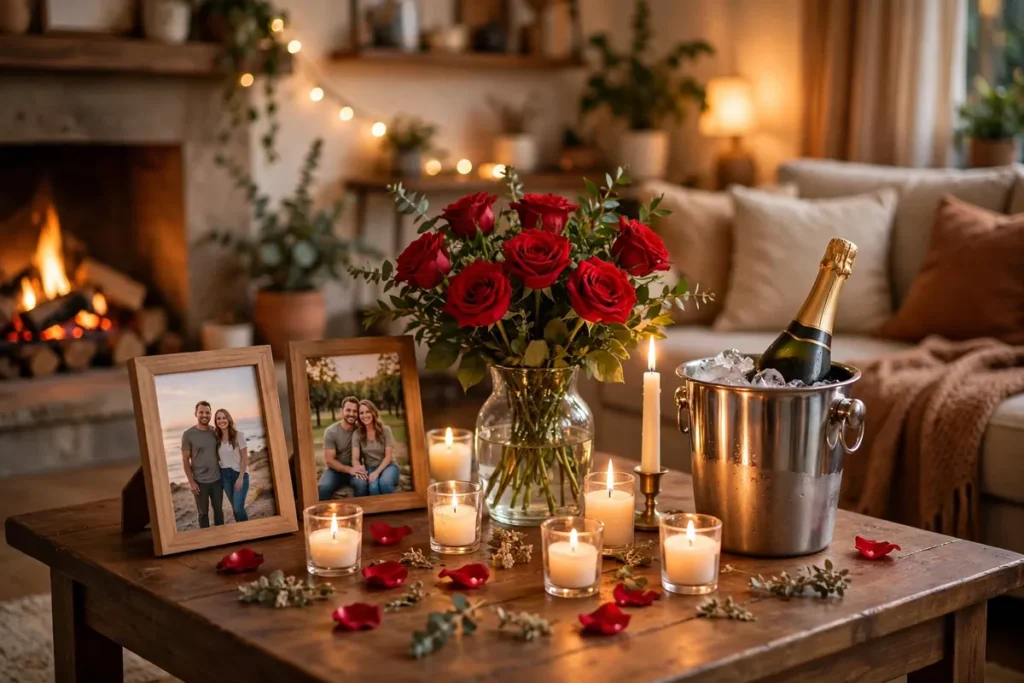
Palette: red, gold, cream. Elements: red rose petals trailing from the door to a heart-shaped petal arrangement at the proposal spot; gold “MARRY ME” balloons on the focal wall; clusters of red and cream candles; a dozen red roses in a vase at the celebration table. Music: jazz standards or acoustic love songs. Best for: the partner who has dreamed of this moment since childhood and wants the full fairy tale. Shopping list: 2000 silk petals, “MARRY ME” balloon kit, 40 LED tea lights, 6 pillar candles, 1 dozen roses, 1 bottle of champagne.
2. The Modern Minimalist
Palette: white, warm wood, one accent (sage, terracotta, or dusty blue). Elements: a single dramatic floral installation (pampas grass and white blooms in a tall vase) at the proposal spot; a neon-style LED sign with your names or “will you marry me” in script; architectural candle clusters; everything else cleared and clean. Music: lo-fi or soft indie. Best for: design-conscious partners who find maximalism stressful. Shopping list: 1 statement floral arrangement, 1 custom neon sign, 20 LED candles, eucalyptus garland for the mantel.
3. The Memory Lane
Palette: warm neutrals, your photos providing the color. Elements: 50–100 printed photos strung on fairy lights across every wall; a timeline of your relationship along the longest wall with dates; “reasons I love you” notes covering the focal wall; the proposal spot marked by a rug with your wedding-date-to-be written on it (optimistic and adorable). Music: “your songs” playlist — the songs from your first date, road trips, all of it. Best for: sentimental partners; long relationships with rich history. Shopping list: 75 photo prints, 4 sets of photo-clip fairy lights, cardstock and markers for notes, 1 cozy rug.
4. The Cozy Luxe
Palette: champagne, cream, soft gold. Elements: floor cushions and faux-fur throws creating a low lounge at the proposal spot; hundreds of candles at varying heights (mostly LED); mirrored trays reflecting the light; orchids or white roses; champagne and chocolate-covered strawberries waiting on a low table. Music: bossa nova or French café jazz. Best for: the partner who loves hotels, spas, and being pampered. Shopping list: 60 LED candles (mixed sizes), 2 faux-fur throws, floor cushions, mirrored trays, white orchid plants, champagne + strawberries.
5. The Playful Adventure
Palette: your favorite bright colors. Elements: a scavenger hunt through the living room — clues hidden in cushions, behind frames, under the rug — each clue a memory or reason; balloons with notes inside to pop; a “quiz wall” of questions about your relationship; the final clue leads to the proposal spot. Music: upbeat, fun — the playlist from your best nights out. Best for: couples who laugh constantly and would find a solemn setup out of character. Shopping list: balloons, clue cards and envelopes, markers, small prizes for each clue, 1 ring box (the real prize).
Setup Styles Compared
| Style | Budget | Setup time | Best for | Keepsake potential |
|---|---|---|---|---|
| Classic Romance | $80–150 | 2–3 hours | Traditional romantics | Photos, dried roses |
| Modern Minimalist | $100–250 | 1–2 hours | Design lovers | Neon sign (permanent!) |
| Memory Lane | $40–80 | 3–4 hours | Sentimental types | The entire photo display |
| Cozy Luxe | $100–200 | 2 hours | Comfort seekers | Throws, candles |
| Playful Adventure | $40–70 | 2–3 hours | Fun-loving couples | Clue cards, quiz wall |
The Surprise Logistics: Decorating With Someone Living There
This is the living room proposal’s unique challenge: your partner lives here. The operation requires tradecraft.
- The extraction plan. Your partner needs to be gone for 3–4 hours. The reliable methods: a friend’s “emergency” that requires their help across town, a spa day you gifted them (with a strict return time), a work event, or a family member’s planned outing. The friend running interference is the MVP of proposal logistics — brief them thoroughly.
- The staging area. Keep all decor supplies in one room with the door closed (a bedroom, the car trunk, a neighbor’s apartment). Nothing kills surprise like a “MARRY ME” balloon box sitting in the hallway.
- The rapid-decorate drill. With supplies staged and a plan, two people can transform a living room in 90 minutes. Do a practice run mentally: lights first (they take longest), then large elements (draping, balloons), then details (petals, candles), then the celebration table, then yourself.
- The digital blackout. Tell your helper and any witnesses: no social media, no “good luck!” texts to the wrong person, no location-tagged posts. One screenshot in the wrong group chat ends the surprise.
- The contingency. If your partner comes home early: the cover story (“I am setting up for [friend]’s birthday thing — do NOT come in yet!”) buys you either completion time or an impromptu early proposal. Keep the ring on your person at all times during setup day.
Sound and Scent: The Invisible Decor
The best setups engage all senses. Sound: build a playlist in three acts — soft background for the entrance (acoustic, instrumental), “your songs” for the proposal moment itself, celebratory for afterward. Start the music before they walk in; silence feels like something is wrong. A Bluetooth speaker hidden behind furniture beats a visible one. Scent: the room should smell like an occasion. Simmer citrus, cinnamon, and vanilla on the stove for an hour before (turn it off before they arrive); or use a reed diffuser started that morning. Avoid strong floral sprays — they read artificial. The goal is “this room smells amazing” not “this room smells like a candle store exploded.”
Photo and Video: Capturing the Living Room Moment
- The hidden photographer position: behind draped fabric, in a closet with the door cracked, or simply posed as “helping with setup” in the corner. Brief them on the exact proposal spot and the likely sequence.
- The tripod backup: even with a photographer, set a phone on a tripod capturing the wide shot. Photographers miss moments; tripods do not.
- Light for faces: make sure the proposal spot has warm light at face height — a floor lamp with a warm bulb just out of frame, or candles on a nearby surface. Overhead-only lighting creates unflattering shadows.
- The reveal shot: the most powerful photo is often not the kneeling — it is your partner’s face in the doorway, seeing the room for the first time. Make sure someone captures the entrance.
- After the yes: take five minutes for posed photos in the setup before celebrating. The decor is at its peak, the emotion is real, and these become the announcement photos.
After the living room has worked its magic, keep the night going — romantic dinner ideas after getting engaged for the celebration meal, proposal decoration ideas for the whole home if you want to extend the magic beyond one room, and messages for your new fiancé for the morning after.
Small Living Room? Even Better
A compact living room is not a limitation — it is an advantage. Less space means less decoration needed, more intimacy, and light that wraps around instead of dissipating. The tricks:
- Go vertical. When floor space is tight, decorate upward: ceiling-hung fairy lights, wall-mounted photo strings, floating balloons with ribbon trails. The eye travels up and the room feels bigger and more magical.
- One wall, done perfectly. Choose the best wall and make it the entire show — draped fabric, lights, photos, the “MARRY ME” sign. Everything else stays dim. A single perfect wall photographs better than a large room decorated thinly.
- Mirrors are magic. A mirror opposite your lights doubles the glow and the apparent space. Angle it to reflect the proposal spot, and it also gives your hidden photographer a second camera angle.
- Furniture Tetris. Temporarily relocate the coffee table to the bedroom and push the couch against the wall. You need floor space more than you need furniture on proposal night. It all goes back tomorrow.
- Embrace the cozy. A small room glowing with candles, two people close together, the city outside the window — that is not a compromise. That is the most romantic version. Do not apologize for square footage; lean into the intimacy.
Seven Mistakes That Ruin Living Room Proposals
- Leaving the TV on (or visible). A glowing TV destroys every photo and screams “regular Tuesday.” Turn it off, and if possible, drape fabric over it or turn it to face the wall. The black rectangle is the enemy of romance.
- Forgetting the smell. You lit a hundred candles but the room smells like last night’s fish tacos. Air the room out hours before, then layer in a pleasant scent. Noses remember.
- Overhead lighting left on. One forgotten ceiling light flattens all your beautiful candle glow. Do a full lights check in the final walkthrough — every switch, every lamp.
- No clear path. Your partner trips over the coffee table you forgot to move, or the dog’s toy sends a candle skittering. Clear the walking path completely; romance should not require agility.
- The ring is in the other room. In the excitement, proposers have left the ring box on the bedroom dresser, in the car, in a jacket pocket. From the moment setup begins, the ring lives on your person. No exceptions.
- Too many witnesses, too little privacy. Six friends hiding in the kitchen turns an intimate moment into a performance. Keep witnesses to one or two (plus photographer), and make sure everyone knows to stay silent and invisible until after the answer.
- No plan for after. The proposal ends; then what? Awkward standing around kills the afterglow. Have the champagne ready, the dinner timed, the playlist cued to celebratory. The proposal is the peak, but the evening needs a slope, not a cliff.
Watch: A Surprise At-Home Proposal Setup
Watch a real surprise proposal come together at home — the room transformation, the setup details, and the emotional moment — for ideas on pacing your own living room reveal.
FAQs About Romantic Living Room Proposal Setups
How long does it take to set up a living room proposal?
Plan 2–3 hours for a full setup with one helper, 90 minutes for a simpler candle-and-lights design. Add an hour buffer before your partner’s arrival for yourself — to get ready, calm down, and do a final walkthrough. Rushing the last 30 minutes is where mistakes happen.
How do I propose in the living room without my partner finding out?
Get them out of the house for 3–4 hours with a planned activity (friend outing, spa appointment, family event), stage all supplies in a closed room, and decorate with a helper. The friend running interference is essential — brief them on timing and give them a “delay if needed” signal.
What is the best lighting for a living room proposal?
Warm-white (2700K) layered at three heights: fairy lights overhead, candles or lamps at eye level, tea lights near the floor. Turn off cool overheads. Test after dark at the actual proposal time — daylight rehearsals lie about how lighting looks.
How much should I spend on a living room proposal setup?
$40–150 covers a spectacular setup: lights, candles, petals, photos, and one statement piece. The $200+ tier adds a custom neon sign or abundant fresh flowers. Light and personal touches (photos, handwritten notes) matter far more than budget — a $60 memory-lane setup routinely outshines a $300 generic one.
Where exactly should I kneel in the living room?
At the room’s natural focal point — facing the decorated backdrop, with clear floor space and good light on both your faces. Mark the spot with a petal circle or small rug during setup, and test-kneel to check for furniture legs, cables, or toys. Face the main camera/photographer position.
Should the proposal spot face the door or face away?
Face away from the door for the reveal: your partner enters, sees the room, then discovers you waiting at the far spot — the walk toward you becomes part of the moment. Facing the door works only if you want the immediate shock of seeing you kneeling the second they enter (dramatic, but it rushes the reveal).
What do I do with the living room the morning after?
Blow out candles before bed (non-negotiable). In the morning, photograph the setup in daylight — you will want the memory. Save keepsakes (notes, photos, the sign), recycle what is done, and consider leaving the fairy lights up for a week. There is no rule that says the magic has to end on schedule.
Can I do a living room proposal if we have kids?
Yes — and kids make wonderful co-conspirators. Frame it as a surprise party setup and give them age-appropriate jobs: scattering silk petals, holding the “will you marry me” sign, or leading mom/dad into the room. For the proposal moment itself, decide whether kids are present (sweet, chaotic, unforgettable) or with a sitter (intimate, focused). There is no wrong choice — only the one that fits your family. Just keep small parts, lit candles, and the ring box away from little hands.
What music should play during a living room proposal?
Build a three-act playlist: soft and ambient for the entrance (acoustic covers, instrumental), meaningful for the moment itself (“your song” or the song from your first date, cued to start as they walk in), and celebratory for after the yes. Start the music before they arrive — walking into silence feels wrong, walking into your song feels like fate. Keep the volume low enough to talk over; this is a soundtrack, not a concert.
The Room Where It Happened
Every couple has a “room where it happened” — and for a living room proposal, that room is the one where you already live your life. The couch where you binge shows becomes the couch where you got engaged. The window you stare out of becomes the window in your proposal photos. The transformation is temporary; the association is permanent.
So clear the coffee table, string the lights, scatter the petals, and wait in the glow for the sound of the key in the door. When they walk in and stop — and they will stop, mid-step, hand over mouth — you will know the living room did its job. It took the most ordinary room in your home and made it the glowing, perfect setting for the most extraordinary question you will ever ask. Ask it well — slowly, honestly, looking into their eyes. The room is ready. The lights are lit. All that is left is the question, and the beautiful yes you already know is coming.
And when the answer is yes, the words keep coming — romantic quotes for her, romantic quotes for him, and sweet messages for couples will carry you from the living room to the altar and beyond.