
Responding to Negative Reviews: Turn Critics Into Customers (2026)
A negative review feels personal — but it is actually an opportunity wearing ugly clothes. Research consistently shows that businesses responding thoughtfully to negative reviews earn MORE trust than businesses with only positive reviews: prospects know perfection is impossible, and they judge you by how you handle imperfection. The response is not for the reviewer (who may never return); it is for the hundreds of prospects reading over their shoulder.
Yet most businesses respond badly or not at all: defensive arguments, corporate non-apologies, silence that reads as guilt, or (worst) fake positive reviews to bury the bad ones. This guide gives you the response framework, templates for every scenario, the fake-review playbook, and the operational feedback loop that turns criticism into improvement.
Below: the psychology, the HEARD framework, templates, special scenarios, flagging fakes, and learning from patterns.
Why This Matters for Your Business
Review responses are public customer service: 90%+ of prospects read responses (or their absence) as evidence of how you will treat THEM. A graceful response to a harsh review persuades more effectively than ten five-star reviews — it demonstrates accountability, care, and professionalism under pressure. The negative review you handle beautifully becomes a trust asset outperforming the positives you did not have to work for.
The operational dividend: negative reviews are free consulting — patterns in complaints reveal the exact improvements that prevent future complaints and earn future praise. Businesses that mine criticism systematically improve faster than those that only celebrate praise. The review you learn from pays dividends in every review that follows.
Step-by-Step Guide
Respond fast, cool down first
The 24-48 hour rule: respond promptly (speed signals care) but never in anger (write the draft, wait an hour, edit with cool head — or have a trusted person review). The response is permanent and public; the emotion is temporary. Internal process: acknowledge receipt immediately if needed (‘we’re looking into this’), then craft the real response deliberately. Speed matters; composure matters more.
Use the HEARD framework
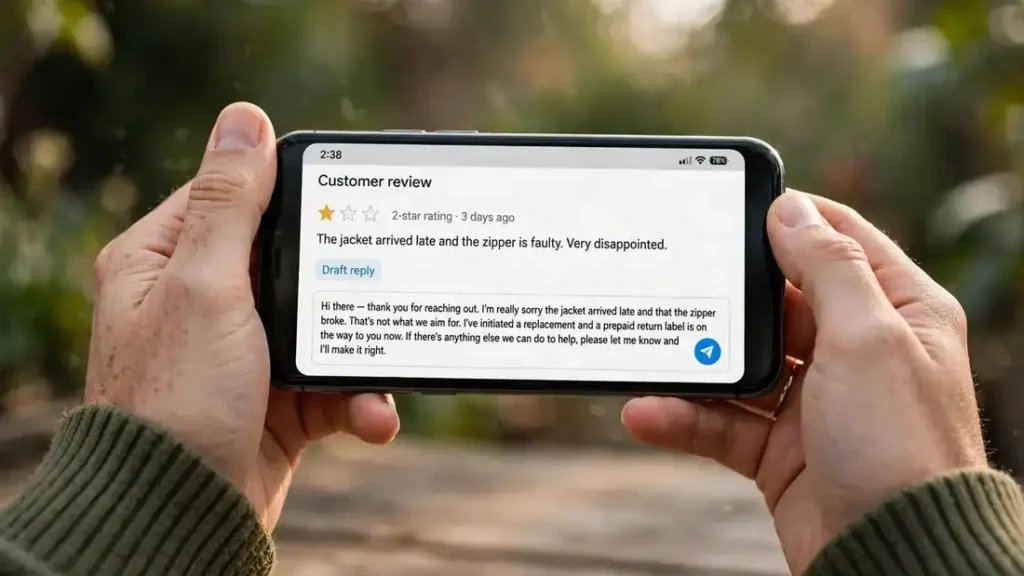
Hear (acknowledge their experience specifically — ‘I understand the wait was frustrating’), Empathize (‘we know your time is valuable’), Apologize sincerely (for THEIR experience — ‘I’m sorry we fell short’ — without necessarily admitting fault on disputed facts), Resolve (state what you are doing: ‘we’ve retrained…’, ‘please contact us so we can make it right’), Diagnose (internally — what failed? fix the system, not just the review). HEARD structures every response: human, accountable, forward-looking. Never skip to Resolve without Hear — unheard complainants do not hear solutions.
Take it offline quickly
Public response: brief, professional, empathetic — then move the conversation private: ‘Please call us at [number] / email [address] so we can make this right personally.’ Reasons: details do not belong in public, resolution negotiations need privacy, and the public thread should end on your professionalism, not spiral into debate. Never argue facts publicly beyond a brief correction — the audience judges tone, not truth.
Handle the special scenarios
The unfair review (facts wrong): brief polite correction + offline invitation — ‘Our records show… but we’d love to discuss; please contact us.’ The fake review (never a customer): flag for removal AND respond briefly (‘we have no record of this visit; we’ve reported it’). The emotional rant (profanity, irrational): stay unfailingly professional — your composure against their chaos wins every reader. The legitimate complaint: own it fully, fix visibly, follow up publicly if resolved (‘update: we’ve implemented X’). The competitor attack: report + brief professional response; never accuse publicly.
Flag genuine fakes properly
Google removes reviews violating policy: spam/fake content, conflicts of interest (competitors, ex-employees), off-topic rants, illegal content. Process: flag via GBP dashboard with specific policy citation, be patient (days to weeks), escalate via GBP support/forum for clear violations if denied. What does NOT get removed: negative opinions, true experiences, low ratings without text — these are legitimate speech. Focus energy on responding to the removable-in-spirit (legitimate) ones; removal is for genuine policy violations only.
Mine patterns, fix systems
Monthly review audit: categorize complaints (service? product? wait times? specific staff? policies?), identify repeats (3+ similar complaints = systemic issue, not bad luck), prioritize fixes by frequency × severity, implement visibly, and where appropriate, update old reviews (‘based on feedback like yours, we’ve changed X’). The businesses that improve from reviews earn progressively better reviews — the feedback loop compounds. Share patterns with the team (blamelessly — systems fail, then people) and celebrate fixes.
Recommended Tools and Resources
The HEARD framework — Free
Hear, Empathize, Apologize, Resolve, Diagnose — the structure for every negative response. Memorizable, trainable, repeatable: the difference between reactive defensiveness and professional grace. Teach it to everyone who touches reviews.
Response templates (scenario-based) — Free
Frameworks (not scripts) for: legitimate complaints, factual disputes, fake reviews, emotional rants — each with the HEARD structure and offline-invitation close. Templates ensure speed and consistency; personalization ensures sincerity. Build once, adapt always.
The offline invitation — Free
‘Please call/email us directly so we can make this right’ — the sentence ending every public response. Moves resolution private, demonstrates accountability publicly, and prevents thread spirals. The highest-leverage sentence in review management.
GBP flagging process — Free
Report genuine policy violations (spam, fakes, conflicts, off-topic) with specific citations; escalate clear cases via support. Know what qualifies (policy violations) vs what does not (negative opinions) — focused flagging works, blanket flagging wastes effort.
Monthly complaint audit — Free (30 min)
Categorize, find patterns, fix systems: the operational loop turning criticism into improvement. Three similar complaints = systemic issue demanding a fix, not three isolated incidents. The audit is where reviews pay their highest dividend.
The public update — Free
‘Update: based on feedback, we’ve [changed X]’ — posted on old negative reviews after genuine fixes. Transforms historical criticism into current proof of responsiveness. Prospects reading old complaints see a business that listens — the most persuasive possible arc.
At a Glance: Comparison Table
| Scenario | Public Response | Private Action | Never Do |
|---|---|---|---|
| Legitimate complaint | HEARD + offline invite | Resolve generously | Argue or minimize |
| Factual dispute | Brief correction + invite | Discuss facts privately | Public fact-war |
| Fake review | Brief note + flag | Report violation | Accuse publicly |
| Emotional rant | Professional calm + invite | Offer resolution | Match their tone |
| Competitor attack | Professional + report | Document evidence | Name the competitor |
| Resolved complaint | Public update on fix | Confirm satisfaction | Leave thread hanging |
Putting It Into Practice
Start smaller than you think you should. Pick the single step from the guide above that would relieve the most pressure right now, and execute just that one this week. Momentum beats perfection: one completed improvement teaches you more about your business than five half-started initiatives, and each small win funds the confidence for the next one.
Document everything as you go. When you complete each step, write down what you did, what it cost, and what changed — a simple running log in a notebook or document. Six months from now this log becomes your playbook, your training manual for new hires, and your evidence of progress. Owners who document build businesses that run without them; owners who keep it all in their heads build jobs they cannot leave.
Measure one number that reflects Responding To Negative Reviews working well, and check it weekly. It does not need to be sophisticated — revenue collected on time, hours saved, error rates, customer feedback scores. What gets measured gets managed, and a single visible metric will guide dozens of small decisions better than any amount of gut feeling. Review the number every Monday morning and let it set the week’s priorities.
Get a second pair of eyes before you finalize anything important. That might be your accountant, a mentor, a fellow owner, or a paid professional for an hour of review — the cost is trivial compared to the cost of a preventable mistake. Every successful owner has a small circle of advisors they consult before big moves; build yours deliberately, starting with one relationship this month.
The biggest mistake owners make with Responding To Negative Reviews is treating it as a one-time project instead of an ongoing discipline. Block ninety minutes this week to work through the steps above in order, and put a recurring monthly appointment on your calendar to revisit them. Businesses that review Responding To Negative Reviews on a schedule improve steadily; businesses that address it only in emergencies pay the emergency premium every time.
Budgeting and ROI for Responding To Negative Reviews
Build a simple return-on-investment check into your plan: define what success looks like in numbers before you spend the first dollar. That might be hours saved monthly, revenue protected, penalties avoided, or customers gained. Write the target down, measure against it quarterly, and double down on what works while cutting what does not. Owners who track ROI make calmer, better decisions than owners who spend on hope.
Keep a contingency buffer of ten to fifteen percent above your estimated budget for Responding To Negative Reviews. Surprises are not a matter of if but when — a filing fee you missed, a tool that needs the paid tier, a professional who spots something you did not. The buffer turns surprises into footnotes instead of crises, and whatever you do not spend becomes next quarter’s head start.
Budget for Responding To Negative Reviews as an investment with a return, not as an expense to minimize. Add up the realistic costs from the options above — including your own time valued honestly — and compare that against the cost of inaction: the revenue lost, the penalties risked, or the hours wasted by doing nothing. In almost every case the math favors acting deliberately now over reacting expensively later.
The DIY-versus-hire decision comes down to three questions: do you have the skill, do you have the time, and what does your hour earn elsewhere? Tasks that are learnable, infrequent, and low-risk are good DIY candidates; tasks that are technical, recurring, or high-consequence usually pay for professional help many times over. Be honest about which category each step falls into rather than defaulting to whichever feels cheaper today.
Common Mistakes to Avoid
- Responding in anger: The defensive reply, written hot and posted fast, lives forever as evidence of your character. Draft, wait, cool down, edit — or delegate. The permanent public record deserves temporary patience.
- Arguing publicly: Fact-wars in review threads repel every reader regardless of who is right. Brief correction maximum, then offline — the audience rewards composure, not victory.
- Silence: Unanswered negatives accumulate into a narrative of indifference. Every review deserves the 24-48 hour HEARD response — silence is the only universally wrong answer.
- Fake positives to bury: Review manipulation violates policy and insults reader intelligence (patterns are obvious). Earn genuine positives through the response quality and operational fixes — never manufacture.
- No pattern learning: Treating each complaint as isolated while the same issue generates monthly negatives. The audit-to-fix loop is where reviews compound — without it, you are just performing customer service theater.
A Real-World Walkthrough
The turning point came at her quarterly review, when Maya compared the numbers before and after. The investment — a few hundred dollars in tools and one focused weekend — had returned itself several times over in saved time, avoided penalties, and one retained client who specifically mentioned how professional the process felt. She now reviews the system for thirty minutes each quarter, and Responding To Negative Reviews has gone from a source of dread to a quiet competitive advantage.
Maya’s story is unremarkable, and that is the point. There was no brilliant insight and no expensive consultant — just a good guide, a blocked calendar, and the discipline to follow through. The businesses that pull ahead are rarely the ones with the cleverest strategies; they are the ones that execute the fundamentals consistently while competitors keep postponing them.
Picture a typical owner — let us call her Maya — running a growing service business with twelve employees. For two years she handled Responding To Negative Reviews reactively, squeezing it between client work and wondering why it always felt chaotic. When a preventable mistake cost her a client and a penalty in the same month, she finally blocked two full days to work through a guide like this one step by step.
Maya started with the foundation steps: getting the paperwork right, choosing the right tools, and setting up the accounts and systems the guide recommended. Nothing fancy — just the unglamorous basics, done properly, in the right order. Within three weeks the chaos subsided; within two months she realized she was spending roughly six fewer hours a month on Responding To Negative Reviews than before, and the quality of the outcomes had visibly improved.
Expert Tips for Responding To Negative Reviews
- Join one community of owners dealing with the same topics — a local chamber, an industry group, or even a focused online forum. The collective experience will save you from mistakes you did not know existed.
- Review your bank and card statements line by line once a quarter. You will always find at least one subscription you forgot, one fee you can dispute, and one spending pattern worth changing.
- Teach what you learn to someone on your team, even briefly. Teaching forces clarity, and a team that understands the why makes fewer expensive mistakes than a team just following orders.
- Keep a ‘lessons learned’ note and add one line every time something in this area surprises you. In a year you will have a personalized operations manual no consultant could have written for you.
- Benchmark yourself against one competitor or peer you respect, not against the entire internet. One realistic comparison teaches more than a hundred aspirational ones.
- Automate the repetitive parts before you delegate them. Automation is cheaper than labor and more reliable than memory — delegate only the judgment calls that remain.
- Revisit this guide in ninety days and re-score yourself on each step. Progress you can see motivates the next round of improvements more than any pep talk.
- When choosing between two good options, pick the one with the better support and community. The product matters less than the help you get when something goes wrong at the worst possible time.
- Document your numbers monthly in one simple dashboard — even a spreadsheet with five rows. Trends visible over months guide strategy; numbers glimpsed occasionally guide nothing.
- Protect your time like inventory: every hour spent on low-value tasks is an hour not spent growing the business. If Responding To Negative Reviews can be systematized, systematize it; if it can be delegated, delegate it.
- Calendar it: whatever the guide recommends doing monthly or quarterly, create the recurring calendar event right now while you are thinking about it. Future-you will not remember; the calendar will.
- Start a dedicated folder — digital or physical — for everything related to Responding To Negative Reviews. Scattered documents are where deductions get missed, deadlines get blown, and audits get painful. One folder, everything in it, from today forward.
Frequently Asked Questions
Should I respond to negative reviews?
Yes — every one, within 24-48 hours. Responses are read by prospects as evidence of your character; unanswered negatives read as indifference or guilt. The response is for the audience, not just the reviewer — hundreds of future customers judge you by how you handle criticism.
What should I say in response to a bad review?
HEARD: hear their experience specifically, empathize, apologize for their experience sincerely, resolve (state actions + invite offline), diagnose internally. Keep it brief publicly, move details private. Never argue, never be defensive, never fake — professionalism under pressure is the entire message.
How do I get a fake review removed?
Flag via Google Business Profile citing the specific policy violated (spam/fake, conflict of interest, off-topic); allow days to weeks; escalate clear violations via GBP support if denied. Respond briefly in the meantime (professional + note you have no record). Note: negative OPINIONS are not removable — only genuine policy violations qualify.
Should I offer compensation in review responses?
Never promise specific compensation publicly (invites extortion reviews); DO invite offline (‘contact us so we can make this right’) and resolve generously in private. Public generosity signals are fine (‘we’d like to make this right’); public negotiations are not.
What if the review is unfair or untrue?
Brief, polite factual correction + offline invitation — one round, no spiraling. ‘Our records indicate X, but we take your experience seriously; please contact us directly.’ The audience judges your composure, not the factual dispute. Save detailed rebuttals for private conversation.
Can negative reviews help my business?
Yes — thoughtfully handled negatives build MORE trust than perfect ratings (authenticity signal), and complaint patterns are free operational consulting. Businesses mining criticism improve systematically; the review you learn from prevents ten future ones. Handled well, a negative review becomes a trust asset.

Your 30-Day Action Plan
Week 1: Foundations
Work through the first two steps of this guide for Responding To Negative Reviews. Gather every document, account, and piece of information the steps require, and set up the basic tools. Do not aim for perfection — aim for a complete first pass so you can see the full picture.
Week 2: Core Implementation
Tackle steps three and four: the operational heart of Responding To Negative Reviews. This is where most of the value lives, so give it your best hours — mornings, before the day’s urgencies consume your attention. Document decisions as you make them.
Week 3: Review and Refine
Complete the remaining steps, then review the whole system end to end for gaps. Ask your accountant, mentor, or a trusted peer to sanity-check what you built — a one-hour review now prevents expensive corrections later.
Week 4: Systematize
Turn everything into a repeatable routine: calendar the recurring tasks, file the documents where they belong, and write the one-page summary of your system. Schedule your 90-day review today, while the details are fresh.
Negative reviews are trust opportunities in disguise: respond within 48 hours using HEARD (hear, empathize, apologize, resolve, diagnose), move conversations offline gracefully, handle special scenarios with composure, flag genuine fakes properly, and — most importantly — mine complaint patterns to fix the systems that caused them. Prospects do not expect perfection; they expect accountability. Give them that, publicly and consistently, and your worst reviews become your best advertising.
Thirty days from now, Responding To Negative Reviews can be a finished system instead of an open worry. Start week one today — the businesses that act on guides like this one are the businesses still thriving five years from now.
Going Further
Write your future self a letter about what you decided today and why. In six months, when you are tempted to change course or cannot remember the reasoning, the letter restores context instantly. Decision journals are the cheapest consulting you will ever get — from the person who knows your business best.
The eighty-twenty rule applies ruthlessly to Responding To Negative Reviews: a small number of actions will produce most of the results. Identify them by asking which step, if done excellently, would make the others easier or unnecessary — then do that step first and give it your best energy.
Sleep on big decisions in this area whenever the timeline allows. The choice that looks urgent at 11 PM usually looks clearer at 9 AM, and the cost of a day’s delay is almost always smaller than the cost of a hasty commitment. Urgency is often manufactured; discernment is always valuable.
Build redundancy into anything critical: a backup payment method on file, a second admin on every account, copies of key documents in two places. Redundancy feels wasteful until the day it saves you — and that day always comes eventually.
Negotiate everything that recurs. Rent, software, insurance, supplier terms — anything you pay regularly can usually be improved with one polite conversation per year. The savings are permanent; the awkwardness lasts five minutes.
Keep your personal and business finances separated with religious discipline in every aspect of Responding To Negative Reviews. Commingling is the root of tax headaches, liability exposure, and bookkeeping chaos. Separate accounts, separate cards, documented transfers — no exceptions, ever.
Ask for help earlier than feels necessary. Owners wait until problems are crises before consulting professionals, which is exactly when help is most expensive and least effective. A one-hour consultation at the first sign of confusion is the cheapest problem-solving you can buy.
Review your pricing power annually in light of everything Responding To Negative Reviews costs you. If your costs rise and your prices do not, your margin is silently donating itself away. A confident, well-communicated annual price review is standard professional practice, not greed.
Document your wins, not just your tasks. When something in this area works well — a negotiation, a system, a hire — write down why it worked. Success leaves clues, but only for owners who bother to collect them.
The best time to fix a small problem in Responding To Negative Reviews is the moment you notice it; the second-best time is today. Small problems grow at compound interest while attention is elsewhere. A fifteen-minute fix now beats a fifteen-hour crisis later, every single time.