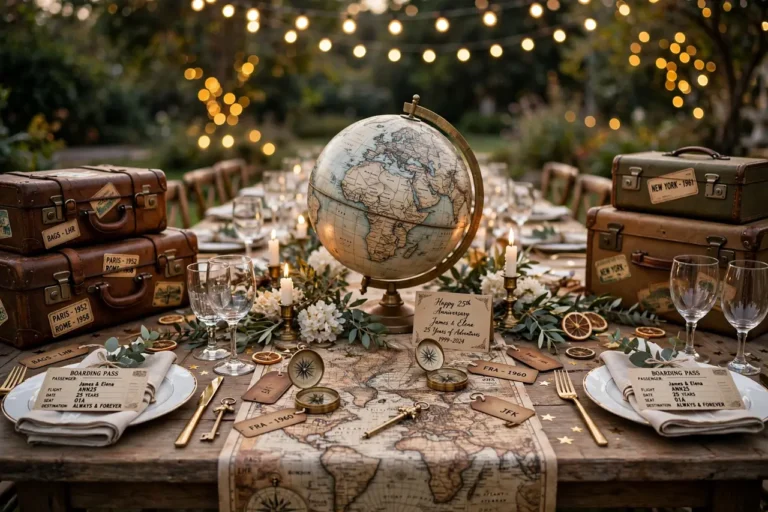
Someone hands you a glass, the room goes quiet, and all eyes turn to you. Giving the toast at your parents’ anniversary is an honor — and, for most people, a nerve-wracking one. What do you say? How long should it be? How do you avoid rambling, crying too early, or accidentally roasting Dad a little too hard? These parents anniversary toast ideas give you everything: a proven structure, fifteen ready-to-customize toast scripts, delivery techniques, and the etiquette rules that keep toasts warm rather than awkward.
Whether you are the eldest child, the designated family speaker, or someone who just got volunteered, this guide will take you from blank page to confident delivery. The goal is simple: two to four minutes of words your parents will remember forever.
The Anatomy of a Perfect Anniversary Toast
Every great toast follows the same five-part architecture. Memorize this framework and you can build a toast for any occasion:
1. The opening line (15 seconds). Get attention and set the tone. “For those who don’t know me, I’m David, the eldest — which means I’ve had the longest time to gather material.” Humor, warmth, or a striking statement — pick one lane and commit.
2. The connection (30 seconds). Establish your relationship to the couple and your credibility as a witness to their marriage. “I’ve had a front-row seat to this marriage for thirty-two years, and I want to tell you what I’ve seen.”
3. The story or stories (60–90 seconds). One or two specific, vivid anecdotes that illustrate something true about their love. Specificity is everything — “the time Dad drove six hours through a snowstorm to get to Mom’s surgery” beats “they’ve always been there for each other.”
4. The meaning (30 seconds). Connect the stories to a larger truth: what their marriage taught you, what it means to the family, why it matters. This is the emotional thesis of your toast.
5. The raise (15 seconds). The actual toast: lift your glass, deliver the closing line, invite everyone to drink. “So please join me — to Mom and Dad: may the next thirty years be as full of love as the last thirty. Cheers!”
Total: two to four minutes. Time yourself when practicing — almost everyone underestimates their length, and a toast that runs long loses the room. For additional toast examples in a wedding context that adapt well, see these wedding toast examples.
15 Parents Anniversary Toast Ideas (Ready to Customize)
Each toast below is a complete template — fill in the bracketed details with your family’s specifics. They are written to be spoken aloud, so read them out loud as you customize; the ear catches what the eye misses.
Heartfelt Toasts
1. The Front-Row Seat. “I’ve had a front-row seat to this marriage for [number] years, and here’s what I’ve learned: love isn’t the grand gestures — though there have been plenty — it’s [Dad] making coffee exactly the way [Mom] likes it, every morning, for [number] years. It’s showing up. Day after day, year after year, they chose each other. And in choosing each other, they built this — all of us, in this room. So raise your glasses to [Mom] and [Dad]: thank you for showing us what love looks like when it’s real. Cheers!”
2. The Definition. “They say you can’t define love, but I think I’ve seen the definition. It’s [Mom] laughing at [Dad]’s jokes — even the ones she’s heard a hundred times. It’s [Dad] still getting nervous before their anniversary dinner after [number] years. It’s two people who became better, kinder, funnier versions of themselves because they had each other. To [Mom] and [Dad] — the living definition. Cheers!”
3. The Gratitude Toast. “I want to thank two people tonight. Thank you, [Mom], for [specific thing — ‘teaching me that kindness is a daily practice’]. Thank you, [Dad], for [specific thing — ‘showing me that strength means gentleness’]. And thank you both for the greatest gift parents can give their children: not money, not things, but the daily example of two people who love each other well. Everything good in my life started with the two of you. To [Mom] and [Dad] — cheers!”
4. The Milestone Toast. “[Number] years. Let that sink in. [Number] years of mornings and midnights, of celebrations and crises, of ordinary Tuesdays made extraordinary by companionship. Most people don’t get [number] years of anything — let alone [number] years of love. [Mom], [Dad], you’ve done something remarkable, and we’re all here because we wanted you to know we noticed. To [number] years — and to all the years still to come. Cheers!”
5. The Legacy Toast. “Look around this room. Every person here is part of the story [Mom] and [Dad] started [number] years ago. The marriages in this room, the friendships, the children, the grandchildren — all of it traces back to two people who said ‘I do’ and meant it, every day since. That’s not just a marriage; that’s a legacy. To the founders of this family — cheers!”
Funny Toasts (Warm, Never Mean)
6. The Survival Guide. “After [number] years of marriage, [Mom] and [Dad] have earned the right to write a survival guide. Chapter one: [Dad], how to pretend you’re listening while watching the game — a skill perfected over three decades. Chapter two: [Mom], how to say ‘fine’ in seventeen different tones. Chapter three, the most important: how to love someone through every chapter, including the ones you’d rather skip. They’ve mastered it. To the authors of the greatest survival guide ever written — cheers!”
7. The Evidence. “As their child, I’ve spent [number] years collecting evidence about this marriage. Exhibit A: [Dad] still can’t load the dishwasher correctly, and [Mom] still hasn’t divorced him over it — that’s love. Exhibit B: they’ve had the same argument about [thermostat/directions/TV remote] for twenty years and neither has won — that’s commitment. Exhibit C: after all that, they still hold hands. Case closed — this is the real thing. Cheers to [Mom] and [Dad]!”
8. The Instruction Manual. “If marriage came with an instruction manual, [Mom] and [Dad] would have worn theirs out by now — then rewritten it better. Their edition would include: ‘Section 1: Apologize first, even when you’re right.’ ‘Section 2: Never go to bed angry — stay up and eat ice cream instead.’ ‘Section 3: After [number] years, you’ll still find new reasons to laugh together.’ To the co-authors of the only manual that matters — cheers!”

Short and Sweet Toasts
9. The Thirty-Second Toast. “To [Mom] and [Dad]: [number] years, [number] children, [countless] memories, and one extraordinary love. Everything I know about commitment, I learned from watching you. Cheers!”
10. The Single Image. “I’ll always remember [one vivid image — ‘the two of you dancing in the kitchen to no music at all’]. That’s their marriage in one frame: joyful, unselfconscious, and completely their own. To [number] more years of kitchen dancing — cheers!”
11. The Wish. “My wish for every couple in this room: find what [Mom] and [Dad] found. Not perfection — they’ve never claimed that — but the real thing: partnership, laughter, forgiveness, and love that deepens instead of fading. To [Mom] and [Dad], who found it — cheers!”
Toasts for Specific Speakers
12. From the youngest child. “Being the youngest means I got the experienced-parents version — the relaxed, wise, slightly more fun Mom and Dad. But I also got to watch something my older siblings saw first: a marriage that got better with time, like it was aging in reverse. Thank you for saving the best version for me — and for showing all of us that the best years aren’t behind you. To [Mom] and [Dad] — cheers!”
13. From all the children together. “We rehearsed this, we argued about who’d speak, and we finally agreed: we’d all speak, briefly. [Sibling 1: one line.] [Sibling 2: one line.] [Sibling 3: one line.] And I’ll close: separately we’re grateful, but together we want you to know — you didn’t just raise a family, you built one, on the foundation of your love. Cheers to [Mom] and [Dad]!”
14. From a grandchild. “Grandma and Grandpa, I’m [age] years old, and I already know what I want my life to look like — because I’ve been watching you. I want to laugh like you laugh. I want to love like you love. Thank you for being my favorite love story. Cheers!” (Note: for young grandchildren, keep it to three or four sentences — short is powerful.)
15. From an old friend. “I’ve known [Mom] and [Dad] since [year], which means I remember when [funny early-marriage anecdote]. I watched two [young/idealistic/broke] kids become the couple everyone in this room admires. Some things changed — the hair, the house, the waistlines, let’s be honest. But the essential thing never changed: the way they look at each other. To [number] years of that look — cheers!”
Toast Delivery: How to Say It Well
Great words poorly delivered lose half their power. Follow these delivery rules:
Write it down and practice aloud. At least three times, out loud, standing up. Time yourself. Mark where to pause, where to look at your parents, where the laugh line lands. Reading from notes is perfectly fine — even preferable to rambling from memory — but practice enough that you are glancing at notes, not reading verbatim.
Slow down. Nerves accelerate speech; consciously speak slower than feels natural. Pause after the funny lines (let people laugh) and before the emotional lines (let the moment land). Silence is a speaker’s most powerful tool.
Make eye contact with your parents. Not the room — your parents. The toast is for them; the room is overhearing. Look at them during the emotional parts. If you cry, pause, breathe, and continue — genuine emotion moves people; apologizing for it breaks the spell.
Hold the glass correctly. Pick it up at the start (so you are not fumbling later), hold it at chest height during the toast, raise it high for the closing line, and actually drink. Do not toast with an empty glass — have it filled before you stand.
Stand up. Always stand for a toast, even at an intimate dinner. It signals that something important is happening and focuses the room. If there is a microphone, use it — even if you think you are loud enough.
Toast Etiquette: The Do’s and Don’ts
| Do | Don’t |
|---|---|
| Keep it to 2–4 minutes | Ramble past 5 minutes — you lose the room |
| Speak about both parents equally | Focus on one parent and forget the other |
| Use specific stories and details | Traffic in generic platitudes |
| Be warm and sincere | Be sarcastic or edgy — it reads as mean |
| Include gentle humor | Tell embarrassing stories they’d hate shared |
| Practice aloud beforehand | Wing it — nerves destroy improvisation |
| End with a clear toast and “cheers” | Trail off without a closing line |
| Thank the hosts if you’re a guest speaker | Thank a long list of people — it’s not an awards speech |

Conquering Nerves: A Practical Guide
Nearly everyone is nervous before toasting. The goal is not to eliminate nerves — it is to prevent them from running the show. Eat lightly beforehand (not on an empty stomach, not a heavy meal). Limit alcohol to one drink before your toast; liquid courage becomes slurred sentiment fast. Arrive early and get comfortable in the room. Right before you speak, take three slow breaths — physiologically, this activates your parasympathetic nervous system and genuinely calms you.
Reframe the moment: you are not performing; you are giving a gift. The audience is not judging; they are rooting for you. Nobody remembers a slightly shaky voice; everybody remembers heartfelt words. And have a recovery plan for the two things people fear most: if you lose your place, pause, glance at your notes, and continue — the pause feels eternal to you and invisible to them. If you cry, stop, smile, breathe, and go on — the room will love you more, not less. For longer-form speaking that builds on toast skills, these speech examples show how to structure extended remarks.
Coordinating Multiple Toasts
At larger celebrations, several people will want to speak. Unmanaged, this becomes a 45-minute endurance test. The solution: appoint a toastmaster (often the host or eldest sibling) who schedules speakers in advance, sets the order, enforces the 2–4 minute guideline privately beforehand, and introduces each speaker with warmth. Cap the formal toasts at four or five; invite everyone else to share briefly during an open-mic window or to write their thoughts in a memory book.
Order matters: start with the most confident speaker (sets the tone), place the emotional centerpiece (usually a child) in the middle, and end with someone warm and brief. Never put two criers back-to-back — the room needs recovery time between emotional peaks. And always, always end toasts before the energy dips; it is better to leave the audience wanting one more than to have them checking their watches.
Toast Ideas for Milestone Years
For the 25th (silver): Lean into the symbolism of silver — refined by time, stronger for the polishing. “Twenty-five years ago, two people made a promise. Since then, life has tested that promise in every way promises get tested — and like silver, their love didn’t tarnish; it shone brighter. To a quarter-century of proof that forever is real — cheers!” Mention specific silvers: “silver hair they’re both rocking beautifully” gets a laugh while honoring the years.
For the 40th (ruby): Ruby’s deep red suggests passion that endured. “Forty years. They’ve seen trends come and go, kids grow up and move out, and through it all, the constant was each other. Rubies are formed under pressure — and this marriage, pressure-tested by four decades of real life, has emerged precious. To forty years of the real thing — cheers!”
For the 50th (gold): This deserves gravity. Slow down, speak deliberately, and let the weight of fifty years fill the room. “Fifty years ago, [Mom] and [Dad] stood up and promised forever — before most of us in this room were born, before the world looked anything like today. And then they did it. Day by day, year by year, through everything, they did it. We are the proof — this family, this room, this love multiplied across generations. There is nothing more to say except the most important thing: thank you. To fifty years — cheers!” For a golden anniversary, shorter and more solemn beats longer and jokier; let the number do the work.
Writing Your Own Toast from Scratch: A Worksheet
If the templates do not quite fit, build your own with this five-minute worksheet. Answer each prompt in one or two sentences, then assemble the answers in order:
1. How are you related to the couple, and how long have you witnessed their marriage? 2. What is your earliest vivid memory of them together? 3. What is the funniest thing you have seen them do as a couple? 4. When did you realize their marriage was special — was there a moment? 5. What is one specific thing each of them does that shows love? 6. What did their marriage teach you about love, commitment, or family? 7. If you could give them one wish for the years ahead, what would it be?
Now assemble: use answer 1 as your opening, answers 2–5 as your stories (pick the best two), answer 6 as your meaning section, and answer 7 as your closing toast line. Read it aloud, trim anything that does not serve the emotional arc, and practice three times. You have just written a completely original toast in under an hour — one that no template could match, because only you have your memories.
Watch: What to Say in an Anniversary Toast
This video explores what to say — and how long to speak — when giving an anniversary toast, with examples and guidance on striking the right tone for the couple and the occasion.
The Private Toast: Just You and Them
Not every toast needs an audience. Some of the most powerful parents anniversary toast ideas are private — a quiet moment with just you and your parents, perhaps the morning after the party or during a calm moment in the celebration. No performance, no notes, no raised glass required (though a coffee mug works fine). Just look at them and say what you feel: what you noticed growing up, what you understand now that you did not then, what you hope for them.
Private toasts have a freedom public ones lack — you can be more vulnerable, more specific, even weepy, without any self-consciousness. Many adult children report that the private conversation meant more to their parents than the public speech, precisely because it was unguarded. If public speaking terrifies you, consider making the private toast your main tribute and keeping any public words to a sentence or two. The audience gets the gesture; your parents get the truth.
Parents Anniversary Toast Ideas: Frequently Asked Questions
How long should an anniversary toast for parents be?
Two to four minutes — roughly 250 to 500 words. This is long enough to tell a story and express real feeling, short enough to hold the room’s attention. Time yourself during practice; almost everyone speaks longer than they think. If multiple people are toasting, stay closer to two minutes out of respect for the program.
What should I say in a toast for my parents’ anniversary?
Follow the five-part structure: a warm opening, your connection to the couple, one or two specific stories, what their marriage means or taught you, and a closing toast line with raised glass. Specificity is the key — concrete memories and details move people; generic praise does not. Speak to your parents, not to the room.
Is it okay to be funny in an anniversary toast?
Yes — gentle humor is wonderful — but keep it warm and affectionate, never embarrassing or edgy. The test: would your parents laugh if they heard it, or would they wince? Funny stories about quirks and habits are great; stories about fights, exes, or sensitive topics are not. When in doubt, run the joke past a sibling first.
Should I memorize my toast or read it?
Use notes. Memorizing creates panic if you blank; reading verbatim sounds stiff. The sweet spot is a printed page or note cards with your key points and exact wording for the opening and closing lines — glance down as needed while mostly looking at your parents. Nobody judges notes; everybody judges rambling.
What if I cry during the toast?
Let it happen. Pause, breathe, smile, and continue — genuine emotion is the most moving thing a speaker can offer, and audiences respond with warmth, not judgment. Do not apologize for crying; it breaks the emotional spell. If you are worried about being overwhelmed, practice the emotional sections repeatedly until you can get through them, and keep water nearby.
Who should give the toast at a parents’ anniversary party?
Traditionally the children — often the eldest or whoever is most comfortable speaking — but anyone meaningful works: siblings together, grandchildren, old friends, even the couple themselves responding at the end. Coordinate in advance so toasts do not duplicate each other and the program flows. Quality matters more than hierarchy.
When during the celebration should toasts happen?
After the main course but before dessert is the classic slot — guests are relaxed, fed, and attentive. For the emotional peak, schedule the most heartfelt toast here. Avoid toasting before food is served (hungry audiences are restless) or very late in the evening (energy has faded). Announce the toast moment so the room quiets naturally.
Can I propose a toast if I’m not a confident public speaker?
Absolutely — some of the best toasts come from reluctant speakers because their sincerity shines through. Keep it short (even 60 seconds of heartfelt words is powerful), use notes, practice aloud, and remember the audience is entirely on your side. A brief, genuine toast beats a polished but hollow one every time. For inspiration on finding the right words, these anniversary wishes for parents can seed your toast’s language.
Raise Your Glass with Confidence
The parents anniversary toast ideas in this guide all come down to one truth: the best toast is not the wittiest or the most polished — it is the most honest. Your parents do not need a performance; they need to hear, in your voice, what their love has meant.
So pick a template, fill in your family’s details, practice it out loud, and then stand up and speak from the heart. Two to four minutes. Specific stories. Eye contact with Mom and Dad. A raised glass at the end. That is all it takes to give them a moment they will carry forever — and to give yourself the lifelong memory of having said it well. Cheers — you have got this.