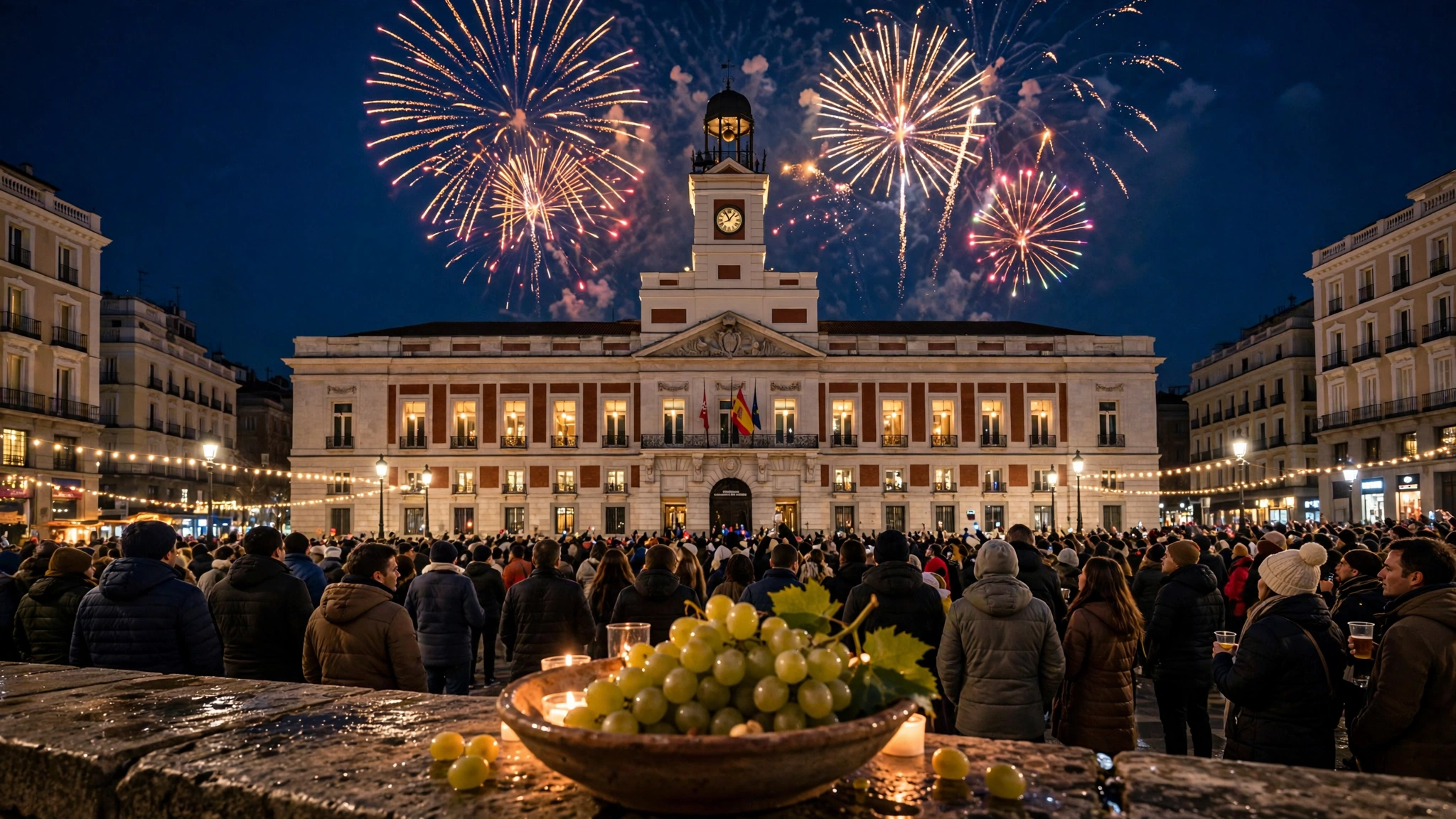
When the clock strikes midnight on December 31st in Spain, the entire country holds its breath — and fills its mouth. From the packed Puerta del Sol square in Madrid to family kitchens in tiny Galician villages, millions of Spaniards simultaneously attempt one of the most charmingly chaotic traditions on Earth: eating twelve grapes, one per chime of the midnight clock, to secure twelve months of luck in the coming year. Known as las doce uvas de la suerte — the twelve grapes of luck — this is not just a cute party trick. It is a genuine national ritual, broadcast live to the nation, rehearsed by families, and taken seriously enough that supermarkets sell special sealed tins of exactly twelve grapes every December. This guide explains the tradition in full: where it came from, exactly how the ritual works, the superstitions around it, how different regions of Spain observe it, and how you can take part from anywhere in the world.
What Are the Twelve Grapes of Luck?
The concept is beautifully simple. As midnight arrives on New Year’s Eve — Nochevieja, literally “old night” — you eat one grape with each of the twelve chimes (or campanadas) of the clock. Each grape represents one month of the coming year, and eating all twelve in time is believed to bring good fortune, health, and prosperity for those twelve months. Finishing all the grapes before the last chime fades is the real challenge: the chimes are spaced only a few seconds apart, so you have roughly half a minute to chew and swallow twelve grapes while half-laughing. Spaniards will cheerfully tell you that the laughter is half the point.
The ritual is synchronized nationwide by television. The great clock of the Royal House of the Post Office (Real Casa de Correos) in Madrid’s Puerta del Sol — the building whose time ball and clock tower define the official Spanish New Year — is broadcast live on all major national television networks and radio stations, a practice that began in 1962 on Televisión Española. Families gather around the television after their Nochevieja dinner, grapes at the ready, and eat along with the broadcast chimes. Tens of thousands of people also gather in person in Puerta del Sol itself, where the tradition arguably began, turning the square into a giant synchronized grape-eating party in the winter cold.
The twelve-grape ritual is the undisputed centerpiece of Spanish New Year’s Eve, but it sits inside a broader constellation of Spanish New Year customs. Spaniards typically sit down to a late, leisurely Nochevieja dinner with family, then watch the broadcast, eat the grapes, toast with a glass of cava (Spain’s sparkling wine), and often head out afterward to celebrate until dawn. Many people also wear red underwear for luck on New Year’s Eve — a custom Spain shares with Italy — and some drop a gold ring or coin into their cava glass before drinking, a small act meant to attract wealth in the year ahead.
The Origin Story: Bourgeois Imitation, Grape Surplus, and National Television
Like many beloved traditions, the twelve grapes have more than one origin story, and historians have verified at least parts of each. What is certain is that the custom is far older than the marketing campaign that made it famous nationwide.
The earliest documented references to eating grapes at midnight date back to at least 1895 in Madrid. One widely cited version holds that the city’s bourgeoisie had adopted the French custom of eating grapes and drinking champagne on New Year’s Eve — the French were the fashionable reference point for Spain’s upper classes — and that ordinary Madrileños began gathering in Puerta del Sol to mockingly imitate the wealthy, eating grapes at midnight in a playful parody. The joke, essentially, became the tradition.
The tradition’s great popularization, however, came from a business decision. In December 1909, vine growers in the Alicante region faced an exceptional harvest and a worrying surplus of grapes. In a move of marketing genius, they promoted the idea that eating twelve grapes — one for each clock chime at midnight — would bring good luck for the year ahead. The campaign spread quickly from Madrid across the entire country, and within a few years the twelve grapes were firmly established as the national New Year’s Eve ritual. The Alicantese growers had, whether they fully realized it or not, created one of the most successful product tie-ins in cultural history: a surplus harvest turned into a century-long tradition.
The ritual’s final transformation into a truly synchronized national event came with television. When TVE began broadcasting the Puerta del Sol clock live in 1962, the whole country could eat their grapes together, guided by the same twelve chimes. Today the broadcast is a fixed ritual of its own, with beloved presenters fronting the countdown, and the square below the clock filling with thousands of celebrants who treat the grape-eating as a communal sport.
There is an older symbolic layer worth knowing, too. Some historical accounts note that in certain areas, the practice was once believed to ward off witches and evil in general — eating the grapes was a protective act as much as a lucky one. Today it is followed mainly as a joyful celebration, but that older thread of protection-through-ritual helps explain why the custom feels so weighty to so many families: this is not party food, it is a small annual spell cast together.
How the Ritual Works: A Step-by-Step Midnight Guide
Eating twelve grapes in about thirty seconds sounds easy until you try it. Here is how Spaniards actually do it, refined over generations of practice.
Step 1: Choose the right grapes
Experienced grape-eaters overwhelmingly choose small, seedless green grapes. Large, seeded red grapes are the classic rookie mistake — they are harder to chew quickly and the seeds slow you down. The traditional variety associated with the custom is the Aledo grape from the Vinalopó valley in Alicante, the very region whose growers popularized the tradition. In December, Spanish supermarkets sell small tins containing exactly twelve peeled and seeded grapes, marketed specifically for Nochevieja — a product that exists for no other occasion.
Step 2: Prepare in advance
Many families peel their grapes beforehand and remove the seeds, which makes them slip down much more easily during the frantic chimes. Some grandmothers take this preparation as a labor of love, presenting a little dish of twelve perfectly peeled grapes for each person at the table. If you are celebrating at home, prepare one dish or small bowl per person before dinner ends — you will not have time to count grapes out at 11:59.
Step 3: Gather for the broadcast
After dinner, everyone assembles around the television for the Puerta del Sol broadcast. There is a traditional preamble: just before midnight, the clock’s time ball drops and four quarter-chimes (los cuartos) sound. These are not the twelve chimes — a classic beginner error is starting to eat during the quarter-chimes and finishing the grapes too early. Wait for the deep, slow tolling of the twelve campanadas.
Step 4: Eat one grape per chime
As each chime sounds, pop one grape into your mouth and chew and swallow before the next. The chimes are spaced a few seconds apart, giving you just enough time — barely. Many people find that a rhythm helps: bite, chew twice, swallow, reach for the next. Laughter is inevitable, and veteran participants will tell you that choking back laughter while chewing is genuinely the hardest part of the ritual.
Step 5: The cava toast
The moment the twelfth chime fades, glasses of cava are raised — often with the gold-ring-in-the-glass custom for those seeking wealth — and the new year is toasted. Many families then make their wishes for the year, and in some households each grape is paired with a silent wish for its corresponding month. Then the party truly begins: in Spain, New Year’s Eve celebrations routinely continue until the early hours of the morning, often ending with the traditional dawn serving of chocolate con churros.
Pro tips from seasoned participants
- Smaller is better: choose the smallest grapes you can find; they are dramatically easier to eat quickly.
- Peel and seed: peeled, seedless grapes go down in a fraction of the time.
- Keep water or cava nearby: a sip between grapes can help things along, though purists wait until the twelfth chime.
- Don’t start during the quarter-chimes: wait for the twelve deep tolls, or you will finish your grapes before midnight and miss the actual ritual.
- Practice is legitimate: some families genuinely do a practice run earlier in the evening, especially with children.
The Rules, Superstitions, and What the Grapes Mean
For a tradition that takes thirty seconds, the twelve grapes carry a surprising amount of folklore.
The twelve months: The core belief is that each grape stands for one month of the coming year — the first grape for January, the second for February, and so on. Eating all twelve in time secures twelve months of good luck. If you fail to finish them all, the folk reading is that you may have bad luck in the months corresponding to the uneaten grapes — though most Spaniards treat a failure with laughter rather than dread.
Sweet versus sour: A widespread piece of grape lore holds that the taste of each grape predicts the character of its month: a sweet grape means a sweet, fortunate month, while a sour grape warns of a difficult one. This is why grape selection is taken so seriously — nobody wants a mouthful of sour grapes standing in for March.
A wish per grape: Many people make a silent wish with each grape, effectively compressing twelve New Year’s resolutions into twelve bites. Some families go around the table afterward sharing what they wished for, turning the ritual into a moment of genuine intimacy.
The warding-off-evil thread: As noted, older versions of the custom framed the grapes as protection against witches and evil spirits. You can still see echoes of this in rural celebrations where the ritual is performed with unusual solemnity, and in the broader Spanish New Year instinct to perform small protective acts at midnight.
Regional Variations Across Spain
Spain’s regions observe the same midnight ritual, but the flavor around it changes from place to place.
Madrid: Puerta del Sol is the spiritual home of the grapes, and being in the square at midnight is the bucket-list version of the tradition. The crowd eats along with the same clock whose chimes are broadcast nationwide, and the atmosphere — thousands of people simultaneously stuffing grapes into their mouths — is unforgettable. Arrive early; the square fills up hours before midnight.
Catalonia (Barcelona): Catalans observe the grapes faithfully, but the region’s big New Year’s gathering point is Plaça de Catalunya or the Magic Fountain of Montjuïc, where fireworks and music accompany the countdown. Catalonia also has its own end-of-year folk figure, the Caganer of nativity scenes, though that belongs to Christmas rather than New Year’s Eve.
Valencia and Alicante: The birthplace of the commercial popularization takes understandable pride in the tradition. The Aledo grape — the variety most associated with the custom — comes from the Vinalopó valley here, and local celebrations lean into that heritage.
The Canary Islands: Because the islands run one hour behind peninsular Spain, Canarians face an annual choice: eat the grapes at 1:00 AM local time, in sync with the Madrid broadcast that most of the country follows, or eat them at local midnight with a regional broadcast. Many families do both — one set of grapes for the peninsula’s midnight, one for their own — which doubles both the luck and the digestive challenge.
The Basque Country and Galicia: In these regions the grape ritual is fully observed, but it sits alongside strong local New Year’s food traditions — elaborate seafood dinners in Galicia, and in the Basque Country the characteristically festive, communal style of celebration that defines the region’s approach to every holiday.
Andalusia: Southern Spain celebrates the grapes with the region’s characteristic exuberance, and in cities like Seville the post-midnight street party is legendary. The warm winter nights of the south mean the grapes are often eaten outdoors on terraces and in plazas.
The Grapes Beyond Spain: A Worldwide Tradition
One of the most remarkable things about las doce uvas is how far it has traveled. Spanish emigration and Latin American cultural exchange carried the ritual across the Atlantic, and today the twelve grapes are eaten at midnight in Mexico, Colombia, Venezuela, Peru, Ecuador, Bolivia, and the Philippines, as well as by Hispanic communities in the United States. In several of these countries the tradition has blended with local customs — in Mexico, for instance, the grapes are often eaten alongside other midnight rituals like sweeping the house or carrying a suitcase around the block for travel luck, a combination explored in our guide to New Year traditions in Mexico.
The Latin American versions keep the essential structure — twelve grapes, twelve chimes, twelve months — but each country adds its own seasoning. In Colombia and Venezuela the grapes share midnight with the yellow-underwear custom and the suitcase walk. In the Philippines, a legacy of Spanish colonial history, round fruits of all kinds join the grapes on the New Year’s table, since round shapes symbolize coins and prosperity. If you are curious about how Spain’s grape ritual compares to its closest European cousin, Portugal’s tradition of eating twelve raisins — and in some regions leaping off chairs at midnight — makes a fascinating contrast: see our guide to New Year traditions in Portugal.
How to Join In From Anywhere in the World
You do not need to be in Spain to eat the twelve grapes — the tradition is one of the most accessible New Year rituals on the planet. Here is how to do it properly from home.
What you need: Twelve small, seedless grapes per person (buy a few extra; someone always drops one), a clock or a livestream of the Puerta del Sol countdown, and glasses of cava, champagne, or sparkling cider for the toast afterward. Peeled and seeded grapes in a small bowl per person is the gold standard.
Timing: You can follow the actual Spanish broadcast — midnight Central European Time — or simply perform the ritual at your own local midnight. Either is authentic; the tradition is about the act, not the timezone. Many international celebrants stream the Puerta del Sol countdown online to eat along with Spain.
Make it an event: Turn the ritual into the centerpiece of your evening. Serve a Spanish-inspired late dinner (tapas, jamón, manchego, seafood), brief your guests on the rules, do the quarter-chime warning, and film the grape-eating — the footage is always hilarious. After the twelfth chime, toast with cava, share your twelve wishes, and if you want to go full Spanish, keep the party going until dawn and serve chocolate con churros at sunrise.
Pair it with intention: The grape ritual pairs beautifully with a proper New Year reset. Before the evening begins, take time to reflect on the year behind you — our New Year reset guide offers a structured way to do it — and prepare your twelve wishes in advance so each grape carries a real intention. After midnight, capture the moment in words with 100 New Year wishes, messages, and captions to share with friends and family.
In Pictures: New Year in Spain: The 12 Grapes of Luck
At the stroke of midnight on New Year’s Eve, Spaniards gather around the clock of the Casa de Correos in Madrid’s Puerta del Sol to eat one grape per bell chime.
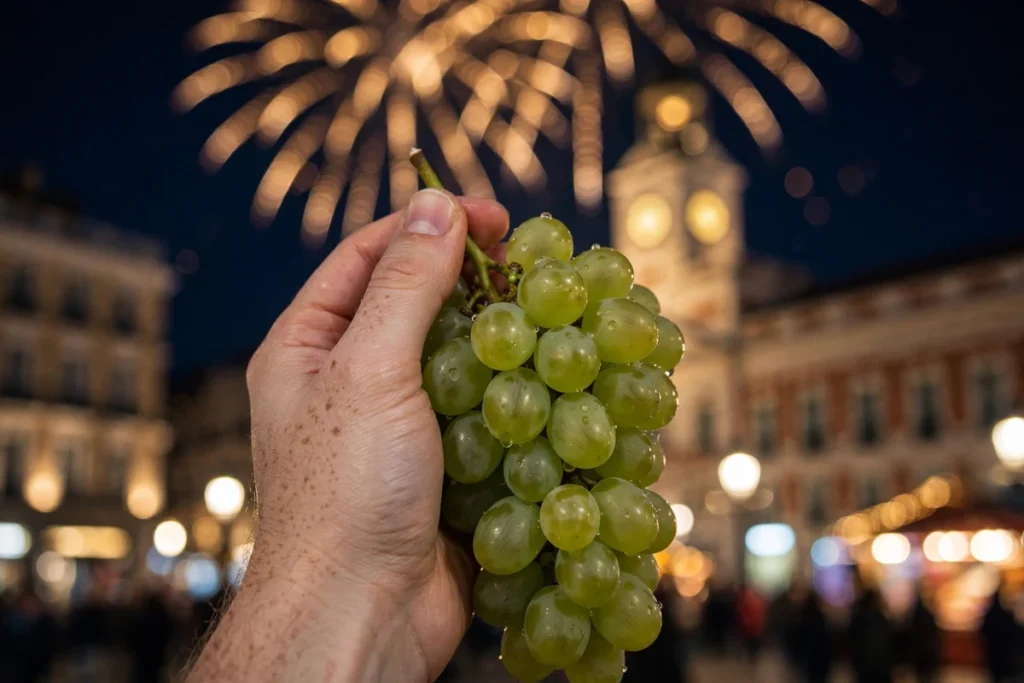
A hand holding twelve green grapes beneath the Puerta del Sol clock tower as fireworks light up the Madrid sky.
Watch: New Year in Spain: The 12 Grapes of Luck
See how the twelve-grapes tradition plays out at Puerta del Sol in this overview of Spanish New Year customs.
At a Glance: New Year in Spain: The 12 Grapes of Luck
Spain’s essential New Year facts — the grapes, the clock and the midnight toast.
| Fact | Detail |
|---|---|
| Las doce uvas de la suerte | Eating one grape per clock chime at midnight — twelve grapes for twelve months of luck |
| The venue | Puerta del Sol, Madrid — the Casa de Correos clock whose bell strikes (campanadas) set the pace |
| Origin story | Tradition says the custom took off after 1909, when Alicante grape growers sold a bumper harvest as ‘lucky grapes’ |
| The challenge | Swallowing twelve grapes in twelve seconds is famously difficult — small seedless grapes are the insider’s tip |
| After midnight | A toast with cava or champagne typically follows the grapes |
Frequently Asked Questions
Why do Spaniards eat 12 grapes on New Year’s Eve?
Spaniards eat one grape with each of the twelve midnight clock chimes because each grape represents one month of the coming year — finishing all twelve in time is believed to bring twelve months of good luck, health, and prosperity. The tradition dates back to at least 1895 and was popularized nationwide in 1909 by Alicante grape growers with a bumper harvest to sell.
What kind of grapes should you use for the twelve grapes tradition?
Small, seedless green grapes are ideal because they are easiest to eat quickly. The traditional variety is the Aledo grape from Alicante’s Vinalopó valley. Many people peel the grapes and remove the seeds in advance, and Spanish supermarkets sell special tins of exactly twelve prepared grapes every December.
Do you have to eat the grapes exactly on the chimes?
Traditionally yes — one grape per chime of the midnight clock, finishing as the twelfth chime sounds. The chimes are a few seconds apart, so you have roughly half a minute for all twelve. A common mistake is starting during the four quarter-chimes that precede the twelve main tolls; wait for the deep, slow campanadas.
What happens if you can’t finish all twelve grapes?
According to the folk belief, the months corresponding to the uneaten grapes may bring bad luck — but in practice, almost everyone treats a failure as funny rather than ominous. The ritual is meant to be joyful, and seasoned participants will tell you that laughing while chewing is the real challenge.
What do Spaniards drink after the grapes?
Cava, Spain’s sparkling wine, is the traditional toast immediately after the twelfth chime. Some people drop a gold ring or coin into the glass before drinking to attract wealth in the new year. Champagne and other sparkling wines are also common.
Is the twelve grapes tradition only Spanish?
It originated in Spain, but it is now observed across Latin America — including Mexico, Colombia, Venezuela, Peru, and Ecuador — as well as in the Philippines and by Hispanic communities in the United States. Each country keeps the twelve-grape structure while adding its own local customs.
Las doce uvas de la suerte endures because it is the rare tradition that is simultaneously silly and sincere: thirty seconds of frantic chewing that somehow contains hope, family, national identity, and a century of history. Whether you eat your grapes in the freezing crowd of Puerta del Sol or at your own kitchen table with a livestream on your phone, the rules are the same — twelve grapes, twelve chimes, twelve wishes. Feliz Año Nuevo.
However you celebrate, the grapes remind us that luck favors those who show up prepared — peeled grapes, steady nerves, and the people you love gathered close when the bells begin.