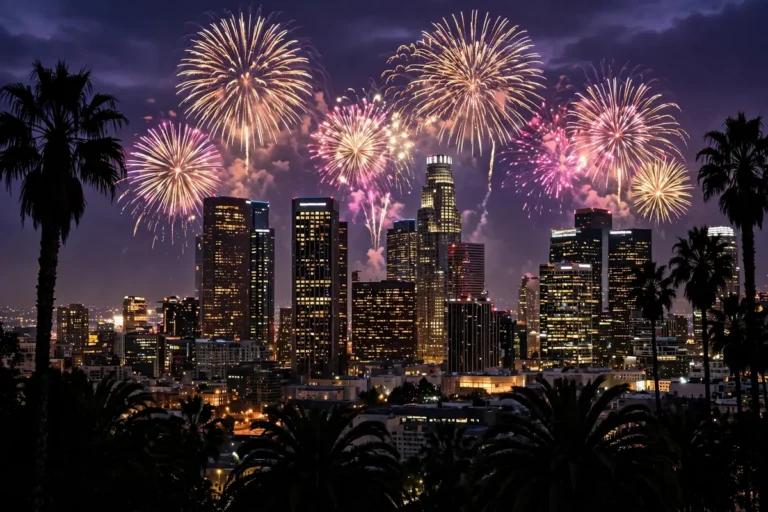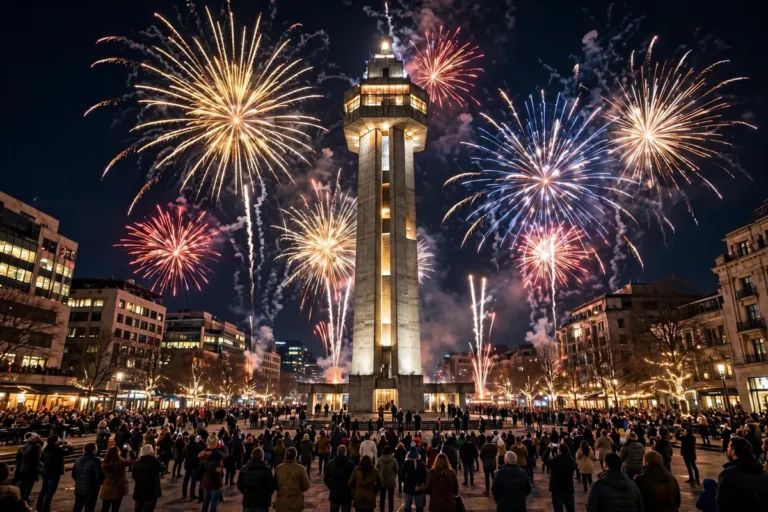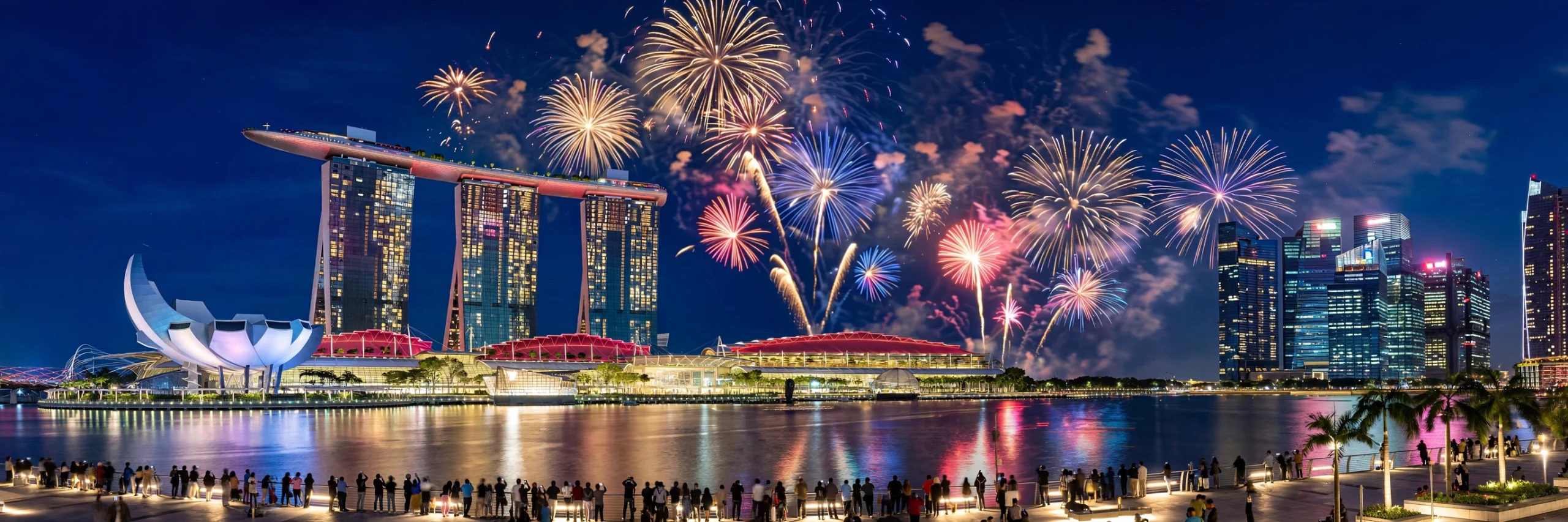
Every December 31, Singapore turns its most famous postcard into its biggest party. The Marina Bay Singapore Countdown — the city-state’s official New Year’s Eve celebration — draws hundreds of thousands of people to the waterfront for an evening that has become one of Asia’s signature ways to end the year: a choreographed fireworks ballet over the bay, light projections washing across heritage facades, and a month of festivities building to a single midnight moment.
But the fireworks are only half the story. New Year traditions in Singapore also live in the quieter hours: the family dinners on New Year’s Eve, the temple and mosque and church visits on New Year’s Day, and the remarkable fact that this small island keeps four major festive calendars at once — Chinese, Malay, Indian, and Western — each with its own New Year. This guide covers both Singapores: the Marina Bay spectacle, with a local’s playbook for doing it right, and the family customs that make January 1 meaningful long after the last firework fades.
The Marina Bay Singapore Countdown: The Main Event
The Marina Bay Singapore Countdown is the city-state’s flagship New Year’s Eve celebration, presented by the Urban Redevelopment Authority (URA) and supported by the Singapore Tourism Board — and it shows in the production values. This isn’t a single fireworks show; it’s a season. In recent years the program has spanned much of December, building toward December 31 with light projections, art installations, markets, and concerts, before climaxing in the midnight fireworks.
The fireworks: ELYSIUM and beyond. The centerpiece is the midnight fireworks musical — in the most recent edition, a 30-minute spectacle titled ELYSIUM that unfolded in four thematic chapters set to a curated musical score, culminating in a grand finale of rainbow-hued blooms symbolizing Singapore’s identity as a city thriving in harmony with nature. The display plays out in 360 degrees around the bay, so the skyline itself becomes the canvas — the ArtScience Museum, the Marina Bay Sands towers, and the Fullerton silhouetted against cascading light.
The light projections. In the weeks before New Year’s Eve, Marina Bay’s landmarks become projection screens with genuine artistic ambition. Recent programs have included Brightening Lives — works by artists with disabilities projected onto the historic Fullerton Hotel facade under themes of perseverance and inclusivity — and Sharing Joy, featuring ASEAN artists’ works on UOB Plaza 1. Both build to a shared countdown sequence on the night itself. These projections give the Countdown a cultural depth that pure pyrotechnics can’t match, and they’re free to view from anywhere around the bay.
The surrounding festival. The Countdown month typically includes a Christmas-market-style event at the Bayfront Event Space (recently Togetherland, running mid-December into early January, with food stalls, installations, and attractions), free concerts by local musicians at the Esplanade’s Come Together series, and commissioned public artworks around the bay. There’s also usually a ticketed premium option — in past years, the STAR ISLAND event at The Float offered a multisensory fireworks-and-performance experience for those willing to pay for the best seats in the house.
The through-line of all of it is characteristically Singaporean: impeccably organized, genuinely multicultural in its programming, and designed so that a family with grandparents and toddlers can enjoy it alongside party-bound twenty-somethings. It’s the rare mega-event that feels civic rather than commercial.
Doing Marina Bay Like a Local: The Practical Playbook
Pick your vantage point. The classic free spots: Merlion Park (the postcard view, but the most crowded), the Esplanade waterfront (great sightlines, concert atmosphere), the Jubilee Bridge (central, panoramic), and Marina Barrage (further out, breezier, popular with families who bring picnics). For the full 360-degree effect, anywhere with an open view of the bay works — the fireworks are designed to be seen from all sides. Hotel rooftop bars and restaurants with bay views sell ticketed New Year’s Eve packages; book weeks ahead.
Arrive early — much earlier than you think. The bayfront fills from late afternoon. Crowd-management measures are a fixture of the event: MRT exits near the bay may have controlled entry, certain areas reach capacity and close, and the police announce closures in real time. Seasoned locals arrive by 6–7 PM, claim a spot, and settle in with takeaway dinner. Trying to arrive at 11 PM is a recipe for watching the fireworks from a very long way away.
Take the MRT; don’t even think about driving. Road closures around Marina Bay begin in the evening, parking is essentially nonexistent, and ride-hailing surge pricing after midnight is brutal. The MRT is the only sane option: City Hall, Raffles Place, Bayfront, and Esplanade stations all serve the bay. Note that some exits operate one-way or close during peak crowd-control periods — follow station staff directions. After midnight, expect long queues; many locals simply linger at the bay for an hour, enjoying the dispersing crowds and the lit-up skyline, rather than fighting for the first train.
Pack like a local. December in Singapore means roughly 75–88°F with high humidity and a real chance of a tropical downpour — bring a compact poncho or umbrella (umbrellas double as sun/rain shields). Bring water, snacks, a picnic mat for the grassy areas, and a portable charger. Note Singapore’s famously strict public-space rules: no littering (fines are real), no outside alcohol in certain controlled zones, and smoking only in designated areas.
Eat before you go. The bayfront food options on the night are crowded and pricey. Locals eat properly beforehand — at the hawker centers of the CBD (Amoy Street, Maxwell, Lau Pa Sat) — and snack through the evening. After midnight, the 24-hour prata shops and supper spots of Little India and Geylang do a roaring trade with the dispersing crowds.
Family Customs: How Singaporeans Actually Spend the Holiday
For all the spectacle at the bay, most Singaporeans’ New Year is a family affair — and January 1 itself is notably quieter than the night before.
New Year’s Eve dinner. Many families gather for a special dinner on December 31 — at home or at a restaurant — before the younger members head to the countdown and the older ones head to bed. It’s less ritualized than the Chinese New Year reunion dinner, but the impulse is the same: end the year together. Steamboat (hotpot) is a perennial favorite, its communal bubbling pot a symbol of warmth and togetherness.
New Year’s Day visiting. January 1 is a public holiday, and the day belongs to visiting: dropping by parents’ and grandparents’ homes, exchanging New Year wishes, catching up with relatives. There’s no single prescribed ritual — the visiting is the ritual. Greetings are multilingual by default: “Happy New Year,” Xin nian kuai le (新年快乐), “Selamat Tahun Baru” — often all three in a single household.
The religious start. Many Singaporeans begin January 1 with worship: morning services at churches, prayers at mosques, temple visits for blessings. The first-day visit to a temple — to offer incense, draw a fortune stick, or simply sit in the year’s first quiet — is a meaningful custom across the Chinese Buddhist and Taoist community, echoing the Japanese hatsumode tradition of the first shrine visit.
Brunch and recovery. Singapore’s cafe culture claims January 1 with full force. The brunch lines at Tiong Bahru, Holland Village, and Dempsey are a New Year’s Day tradition in their own right — eggs Benedict as a recovery ritual, surrounded by friends debriefing the night before. Malls open as usual, and the post-Christmas sales hit their final markdowns.
The Many Calendars of Singapore
What makes Singapore’s January 1 distinctive is what surrounds it on the calendar. This is a country where four New Years are all, in a sense, real.
The Chinese calendar brings Chinese New Year (late January/February) — the year’s biggest family festival, with reunion dinners, red packets (hongbao), and the famous River Hongbao celebration at Marina Bay. For Singapore’s Chinese majority (~74%), this is the New Year of deep tradition; January 1 is the modern, shared, outward-facing one.
The Malay-Muslim calendar brings Awal Muharram (the Islamic New Year, observed with reflection and prayer) and, more festively, Hari Raya Puasa (Eid al-Fitr) and Hari Raya Haji — the year’s great homecomings and open houses. January 1 for Malay Singaporeans is a secular holiday: rest, family, and for many young people, the Marina Bay countdown.
The Indian calendar brings Deepavali (October/November), the festival of lights that transforms Little India, and Pongal and Puthandu (January/April) for the Tamil community. Hindu temples see New Year blessing-seekers on January 1 too — the year’s turning is auspicious in any calendar.
The practical effect is a January 1 that functions as common ground — the one New Year that belongs to everyone equally. The Marina Bay crowd, in all its diversity, is the visual proof: the countdown is Singapore’s annual portrait of itself. (Across the causeway, Malaysia’s multicultural countdowns tell a kindred story on a larger, wilder canvas.)
Beyond the Bay: Other Ways Singapore Counts Down
Sentosa and Siloso Beach. For the beach-party version, Sentosa’s Siloso Beach has hosted some of Singapore’s biggest ticketed New Year’s Eve beach parties — DJs, dancing in the sand, fireworks over the water. It’s the choice for those who want the countdown with sea breeze and without the bayfront crowds. Book early; the good parties sell out.
Rooftops and clubs. Singapore’s rooftop bar scene — from Marina Bay to Ann Siang Hill — runs ticketed New Year’s Eve packages with varying degrees of extravagance. The clubbing faithful have their own institutions; in past years, year-end dance festivals have drawn international headliners. Check lineups as December approaches.
Clarke Quay and the river. The riverside dining and nightlife precinct does a lively, slightly chaotic countdown of its own — less choreographed than Marina Bay, more spontaneous, with the Singapore River reflecting the chaos prettily.
The quiet option. Not everyone does midnight. Plenty of Singaporeans spend December 31 at home with family and watch the Marina Bay fireworks on television — the broadcast is a national shared experience, and the view from the couch, as locals will tell you, has its merits. Our practical New Year’s Eve at-home celebration plan pairs well with the Singaporean instinct to keep the night cozy.
How the Countdown Grew: A Short History of Marina Bay at New Year
The Marina Bay Singapore Countdown is younger than you might expect — and its rise mirrors Singapore’s own transformation. The organized countdown at the bay took shape in the mid-2000s, as the newly developed Marina Bay waterfront (the Sands resort opened in 2010, the Gardens by the Bay in 2012) gave the city a stage worthy of a world-class New Year’s Eve. Year by year, the production grew: longer fireworks, more elaborate light projections, an expanding month of fringe events.
The pandemic years forced a reinvention. With crowds impossible, the Countdown pivoted to televised and symbolic formats — light beams, virtual performances, intimate fireworks viewable from home — and Singaporeans discovered the broadcast version had its own quiet magic. When the full waterfront celebration returned, it came back bigger and more thoughtful: the recent editions’ emphasis on community art projections (works by artists with disabilities, ASEAN artists) reflects a deliberate choice to make the Countdown mean something beyond spectacle.
That evolution — from party to civic ritual — is why the Marina Bay Countdown now ranks among Asia’s defining New Year’s Eves, mentioned alongside Sydney Harbour and Hong Kong’s Victoria Harbour. It also explains the event’s distinctive tone: celebratory but orderly, spectacular but sincere. Other cities do bigger fireworks; few do a New Year that feels so much like a collective exhale.
The First Week of January: Back to School, Back to Life
Here’s a Singaporean New Year custom outsiders rarely hear about: the first week of January is back-to-school week. Singapore’s academic year begins in early January, so the New Year holiday flows directly into the rustle of new uniforms, freshly covered textbooks, and the particular excitement of the first school day. For families with children, the “new year, new start” feeling is literal — new class, new teachers, new pencil case.
This gives Singapore’s January a distinctive rhythm. The holiday doesn’t taper; it pivots. December 31 is celebration, January 1 is family, and by January 2 or 3 the city is humming again — arguably faster than anywhere else in the region. The famous Singaporean efficiency isn’t just a stereotype; it’s a calendar.
For visitors, this means the first week of January is an excellent time to be in Singapore: the festive decorations linger, the crowds thin, hotel rates normalize, and the city hits its productive stride. The post-New Year sales run through early January, the weather is at its (relatively) coolest, and the hawker centers are back to full glorious operation.
It also means something subtler: in Singapore, the New Year isn’t an escape from ordinary life but a springboard into it. The fireworks end, the children go back to school, the city gets to work — and there’s a quiet national pride in that seamless transition. Majulah, as the anthem says: onward.
The Food of the New Year: What Singapore Eats on January 1
Singapore marks every occasion with food, and the New Year is no exception — though the January 1 table looks quite different from the Chinese New Year feast that follows weeks later.
New Year’s Eve: steamboat. The communal hotpot known locally as steamboat is the definitive Singaporean NYE dinner: family gathered around a bubbling pot, cooking thin slices of meat, seafood, and vegetables together. The symbolism — warmth, abundance, togetherness — needs no explanation, and the format stretches the evening beautifully toward midnight. Restaurants offering NYE steamboat buffets book out early; home steamboat sets, with portable burners on the dining table, are the cozy alternative.
New Year’s Day: brunch and hawker classics. January 1 morning belongs to two competing traditions: the cafe brunch (smashed avo in Tiong Bahru, roti john nostalgia in renovated shophouses) and the hawker center recovery meal — a steaming bowl of fish soup, mee Soto, or the ultimate Singaporean hangover cure, a hot teh tarik and prata at a 24-hour Indian-Muslim shop. Both are eaten slowly, with phones full of last night’s photos.
The sweet layer. Bakeries do their briskest trade of the year in the final week of December: log cakes, festive tarts, and gift boxes for the visiting round. Giving baked goods as New Year gifts — to colleagues, neighbors, in-laws — is standard Singaporean etiquette, and arriving at a January 1 visit empty-handed is noticed.
What you won’t find on January 1 are the Chinese New Year specialties — yusheng (prosperity toss salad), bak kwa (barbecued pork jerky), pineapple tarts. Those belong to the lunar celebration weeks later, and Singaporeans keep the two feasts strictly separate. It’s a delicious illustration of the island’s calendrical double life: the January table is international and informal; the February table is ritual and red-gold.
In Pictures: New Year in Singapore
Singapore’s New Year centres on Marina Bay — fireworks, light shows and family gatherings in the heart of the city.
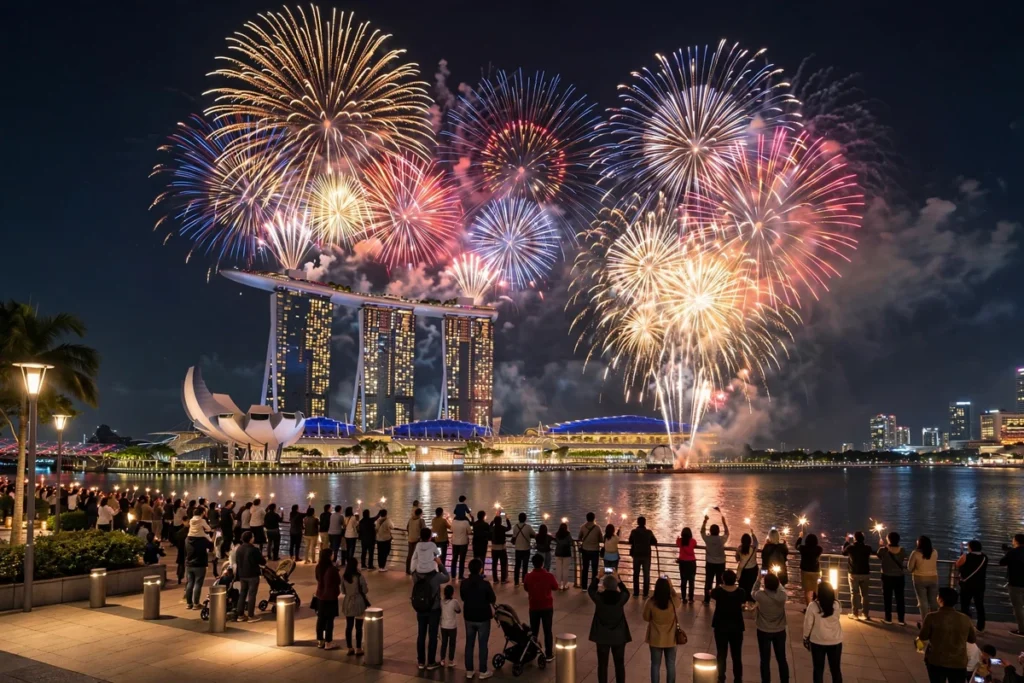
Fireworks explode over Marina Bay Sands as Singapore counts down to the New Year.
Watch: New Year in Singapore
Watch Singapore’s Marina Bay countdown — New Year fireworks over the bay.
At a Glance: New Year in Singapore
Singapore’s essential New Year facts — the bay, the family table and the season’s rituals.
| Fact | Detail |
|---|---|
| Marina Bay countdown | The bay hosts Singapore’s flagship fireworks and light display at midnight |
| Family customs | Many families gather for reunion-style dinners and exchange New Year wishes |
| Lo hei | The Lunar New Year salad toss for prosperity is a beloved ritual of the season |
| Chingay | The Chingay Parade — a street parade of floats and performers — follows in the Lunar New Year season |
Frequently Asked Questions
What is the Marina Bay Singapore Countdown?
The Marina Bay Singapore Countdown is Singapore’s official New Year’s Eve celebration, presented by the Urban Redevelopment Authority and supported by the Singapore Tourism Board. It features a midnight fireworks musical over Marina Bay (recently the 30-minute, four-chapter ELYSIUM), light projections on landmarks like the Fullerton Hotel, concerts, art installations, and a month of lead-up festivities — most of it free.
Where is the best place to watch the Marina Bay fireworks?
Merlion Park and the Esplanade waterfront offer the classic views (and the biggest crowds). The Jubilee Bridge gives panoramic sightlines, while Marina Barrage is breezier and more family-friendly. For comfort, book a bay-view hotel rooftop package well in advance. Arrive by early evening — crowd-control closures begin well before midnight.
Is New Year’s Day a public holiday in Singapore?
Yes. January 1 is a public holiday in Singapore. Most Singaporeans spend it quietly: family visiting, worship, brunch, and rest. Malls, restaurants, and attractions operate normally, making it a good sightseeing day.
How do Singapore’s different communities celebrate the New Year?
January 1 is shared national common ground — everyone joins the countdown in their own way. Each community also keeps its own traditional new year: Chinese New Year for the Chinese community, Awal Muharram (and the Hari Raya festivals) for Malay Muslims, and Deepavali/Pongal for Indian Singaporeans. The result is a year with multiple New Years, each with its own customs.
Is the Marina Bay Countdown free?
Yes — the waterfront viewing areas, light projections, and most concerts are free. Premium ticketed options (hotel packages, the STAR ISLAND-style experience at The Float in past years) exist for those who want reserved seating and amenities. The free experience, done right with an early arrival and a picnic mat, is excellent.
What should I wear to the Marina Bay Countdown?
Light, breathable clothing — Singapore in December is hot and humid (75–88°F) with possible tropical showers. Comfortable walking shoes, a compact umbrella or poncho, and a light layer for air-conditioned MRT rides home. Bring water, snacks, and a portable charger; leave valuables minimal in the dense crowds.
What’s the difference between the Marina Bay Countdown and Chinese New Year in Singapore?
The Marina Bay Countdown (December 31) is Singapore’s shared civic New Year — fireworks, concerts, and light shows for everyone. Chinese New Year (late January/February) is the traditional family festival: reunion dinners, red packets, temple visits, and the River Hongbao celebration. Locals celebrate both, but the emotional weight — and the ritual depth — belongs to Chinese New Year.
Singapore’s New Year is the city-state in microcosm: flawlessly staged at the bay, warmly human at the family table, and quietly plural in its calendars. Do the midnight fireworks with the hundreds of thousands — it’s genuinely one of the world’s great countdowns — but save some wonder for January 1 morning: the temple incense, the multilingual greetings, the brunch queues. That’s the other Singapore New Year, and it’s the one the locals keep for themselves. For a structured way to carry the fresh-start feeling into January, see our New Year reset guide, and for the words to send to everyone you visited, our 100 New Year wishes and captions for 2027.