At midnight on New Year’s Eve, in millions of Russian homes, the same small drama plays out. The television shows the Kremlin clock. A piece of paper, a pen, and a box of matches sit ready beside a glass of champagne. As the first chime sounds, someone scribbles a wish, sets the paper alight, drops the burning scrap into the glass, and drinks — ashes and all — before the twelfth chime fades. Do it in time, and the wish will come true in the new year. Miss the window, and you will have to wait another twelve months.
This is Russia’s most famous New Year ritual: burning your wish in champagne at midnight. It is part magic trick, part race against the clock, and entirely serious to the people who practice it — which is a great many Russians indeed. In a country where New Year (Novy God) is the biggest holiday of the year, bigger than Christmas, the midnight wish is the emotional peak of the night. This guide explains exactly how the ritual works, where it comes from, what surrounds it — Ded Moroz, the Kremlin chimes, the Olivier salad — and how to perform it yourself, safely, wherever you are.
The Ritual, Step by Step
Precision matters here, because the ritual is a timed event. Here is the classic version, as practiced across Russia:
Before midnight — the preparation. Tear off a small piece of paper — napkin-sized, no bigger — and have a pen and a lighter or matches within arm’s reach. Pour the champagne (Russians will tell you it should be properly chilled) but do not drink yet. Most importantly, decide your wish in advance. Veterans of the ritual insist on this: you will have roughly one minute, and a minute is no time to discover what you truly want. Keep the wish short, specific, and phrased positively — “I get the new job” rather than a paragraph of conditions.
The first chime — write. As the Kremlin clock begins to strike twelve (more on those chimes below), write your wish on the paper. Quickly. Legibility is optional; sincerity is mandatory.
Burn. Set the paper alight — over an ashtray or an empty plate, never over the carpet — and let it burn down. This is the step that gives the ritual its thrill: fire, at the dinner table, at midnight, on purpose.
Ashes into champagne. Tip the ashes into your champagne glass. Yes, really. Stir if you must.
Drink — before the twelfth chime ends. Drain the glass, ashes and all, before the final chime dies away. The whole sequence, from first pen stroke to last swallow, must fit inside the striking of the clock: about a minute.
The belief: if you finish in time, the wish is sealed and will come true in the new year. The ashes are the mechanism — by drinking them, you take the wish inside yourself, transforming a thought into something physical. It is sympathetic magic of the oldest kind, dressed up in party clothes.
Why the hurry? The magic of the liminal minute
Folklorists would point out that the ritual’s power comes from its liminality: it happens in the threshold moment between years, when — in folk belief across many cultures — the normal rules are suspended and wishes carry extra weight. The rush against the chimes is not incidental; it is the point. The difficulty is the magic. A wish you can make calmly, at leisure, is just a thought. A wish you must write, burn, and drink in sixty seconds while a clock hammers out the old year is a deed — and deeds, the ritual suggests, are what the universe answers.
There is also a practical wisdom buried in the haste. The ritual forces you to do what psychologists recommend for goal-setting: formulate one clear, concrete intention rather than a vague cloud of hopes. “I will run the marathon” fits on a scrap of paper; “I want next year to be better somehow” does not. Whether or not the ashes help, the clarity does.
Why New Year Is Russia’s Biggest Holiday
To an outsider, the intensity of the Russian New Year can be puzzling — until you learn its history. In the Soviet Union, Christmas was suppressed as a religious holiday, and its trappings were transferred wholesale to New Year. The decorated tree, the gift-bringer, the festive meal, the midnight magic: all of it migrated from December 25 to December 31. When the Soviet Union fell, Christmas returned — but New Year kept everything it had absorbed. The result is a secular midwinter festival of extraordinary scale: Russia’s true national holiday, celebrated with a fervor that dwarfs Christmas.
The cast of the Russian New Year will be familiar in outline and delightful in detail:
- Ded Moroz (Grandfather Frost). Russia’s gift-bringer: a tall, majestic figure in a long blue, red, or white fur-trimmed coat, carrying a staff, with a flowing white beard. Unlike Santa Claus, Ded Moroz does not sneak down chimneys — he arrives in person (or by troika in folklore) and distributes gifts openly. He is less jolly elf, more winter wizard.
- Snegurochka (the Snow Maiden). Ded Moroz’s granddaughter and companion: a young woman in a blue-and-white kokoshnik headdress who helps distribute gifts. Her presence makes the Russian New Year a family duo rather than a solo act.
- The Novogodnyaya yolka (New Year tree). The decorated fir or spruce, crowned with a star, hung with ornaments and tinsel. Under Soviet rule the tree was explicitly rebranded from Christmas to New Year; today the yolka is simply the tree of the season, full stop.
- The Kremlin chimes. The clock on the Spasskaya Tower of the Moscow Kremlin, whose twelve strokes at midnight are broadcast across the country’s eleven time zones. More on these below — they are the metronome of the wish ritual.
The feast: Olivier, herring, and Soviet champagne
The Russian New Year table is a cuisine unto itself, and it is inseparable from the midnight ritual — the champagne you drink your wish in comes from this table. The undisputed king is Olivier salad (salat Olivye): diced potatoes, carrots, peas, eggs, pickles, and bologna or chicken under a blanket of mayonnaise. Invented by a 19th-century Moscow chef, it became the Soviet festive salad par excellence, and no New Year table is complete without a vast bowl of it. Alongside come herring under a fur coat (seledka pod shuboy) — layered herring, beets, potatoes, and mayo — cold cuts, pickled mushrooms, pirozhki, and mandarins, whose scent Russians associate with New Year as strongly as pine.
And the champagne: for most of the Soviet era and beyond, the glass raised at midnight was Sovetskoye Shampanskoye — “Soviet Champagne” — the affordable sparkling wine that democratized the midnight toast. The name persists as a brand, and the tradition persists as a habit: whatever the bottle, it is shampanskoye in the glass when the chimes begin. The wish ritual grew up around this specific drink, which is why the ashes go into champagne and not, say, vodka — though Russia being Russia, someone has surely tried.
A holiday shaped by history
The Soviet roots of the Russian New Year explain its peculiar texture: it is at once deeply traditional and entirely modern, folk-magical and state-broadcast. The wish-burning ritual itself is hard to date precisely — it seems to have crystallized in the late Soviet period, passed from family to family rather than decreed from above — which makes it a genuine folk custom of the television age: a ritual designed for the living room, timed to a broadcast, performed with household objects. That is also why it travels so well. You do not need Russia to do it; you need paper, fire, champagne, and a clock.
The Twelve Chimes: Russia’s Midnight Metronome
Every version of the wish ritual is timed to the same clock: the Kremlin chimes (Kuranty), broadcast from the Spasskaya Tower as midnight arrives. The ritual’s one-minute window is the duration of the twelve strokes — and the strokes are the reason the whole country performs the ritual in synchrony, from Kaliningrad to Kamchatka (each time zone at its own midnight, one after another, a wave of burning wishes rolling east across eleven zones).
A delightful technicality: the chimes you hear on television are preceded by a short musical prelude, and pedants have long debated exactly when “midnight” — and therefore the ritual window — officially begins. Traditionalists start writing at the first audible stroke of the twelve; the truly hardcore begin during the prelude. For your own performance, the rule is simple: pick your clock, start at its first midnight stroke, and finish before the last one fades. A phone timer set for sixty seconds is a fine substitute for the Spasskaya Tower.
The chimes are followed, in the classic broadcast sequence, by the Russian national anthem — the moment when the whole table stands, glasses raised, and the new year is officially, musically, underway. Then come the phone calls and messages to relatives in other time zones, the exchange of gifts (many families open presents right after midnight), and the long night of toasting that stretches toward dawn.
Variations on the Ritual Across Russia
Like any living folk custom, the wish ritual has sprouted variants. Here are the ones you are most likely to encounter:
- The classic burn-and-drink. Described above: write, burn, ashes in champagne, drink before the twelfth chime. The standard against which all variants are measured.
- The pre-written wish. Pragmatists write the wish before midnight and keep the folded paper in a pocket or under the plate — then burn and drink during the chimes. Purists scoff; pragmatists finish on time.
- The collective wish. Families or companies of friends agree on a shared wish — health for a grandparent, success for a project — and perform the ritual together, a small chorus of burning paper at the table.
- The silent wish. Some Russians skip the paper entirely and simply make a silent wish during the chimes, holding the thought through all twelve strokes. The champagne is still drunk at the end — the toast is non-negotiable.
- The Old New Year encore. Russia also marks the Old New Year (Stary Novy God) on January 13–14 — the same Julian-calendar date behind Serbia’s Orthodox New Year — though in Russia it is a quieter, family-centered occasion rather than a second public festival. Some families repeat the wish ritual on Old New Year’s Eve as a second chance for wishes that missed the December deadline.
There are also the ritual’s superstitions of preparation: many Russians insist on entering the new year free of debts, with the house cleaned, old quarrels mended, and — a charmingly specific one — wearing something new. The logic is consistent with the wish itself: the year you get is shaped by the year you perform at midnight.
How to Perform the Ritual at Home (Safely)
You do not need to be in Russia to burn a wish in champagne — the ritual is gloriously portable. If you are celebrating New Year’s Eve at home, here is how to do it right:
1. Prepare your station. Small slips of paper (tissue or thin napkin burns fastest — avoid glossy or coated paper), a pen for each participant, a lighter or long matches, a fireproof plate or ashtray per person, and chilled champagne or sparkling wine in proper flutes. Keep a small bowl of water nearby for safety.
2. Write wishes in advance. Give everyone five quiet minutes before midnight to decide and write. The classic advice: one wish, short, specific, positive, present-tense. Fold the slips and keep them at each place setting.
3. Choose your countdown. A clock with audible chimes is ideal; a phone timer set to 60 seconds works. Nominate a timekeeper to call “start” at midnight.
4. Burn safely. Hold the paper over the fireproof plate, away from faces, sleeves, hair, and decorations. Let it burn down, then tip the ashes into the champagne. Never burn paper over carpet or near the tree.
5. Drink in time. Everyone drinks before the timer ends. Then toast — “S Novym Godom!” (Happy New Year!) — and compare notes on whether anyone actually finished.
6. Mind the guests. The ritual involves open flame and drinking ash — obviously not for small children, and worth skipping for anyone uncomfortable with either. The silent-wish variant (wish during the chimes, drink the champagne unadorned) includes everyone.
A note on the ashes: they are harmless in the quantities involved — a pinch of carbon in a glass of champagne — but the ritual is theater, not nutrition. If the idea bothers you, burn the wish and drink the champagne separately; folk magic is flexible, and the intention is the active ingredient.
New Year on Russian Television: The Broadcast Ritual
The wish ritual does not happen in a vacuum — it happens in front of the television, and Russian New Year’s Eve TV is a ritual in its own right. Understanding the broadcast explains why the whole country performs the wish at the same moment.
The evening’s viewing traditionally centers on The Irony of Fate (Iironiya sudby), Eldar Ryazanov’s beloved 1975 romantic comedy about a man who drunkenly ends up in the wrong city on New Year’s Eve. The film airs every December 31 — Russians quote it the way Americans quote It’s a Wonderful Life — and its scenes of Moscow apartments, bathhouses, and midnight confusion are the visual wallpaper of the holiday. For decades, no Russian New Year was complete without it.
As midnight approaches, the channels switch to live coverage from Red Square and the Kremlin. Then comes the President’s New Year address, broadcast at midnight in each time zone — a short speech summarizing the year and wishing citizens well. Immediately after the address, the Kremlin chimes strike twelve: the starting gun for the wish ritual. The anthem follows, and then the night’s entertainment — the Goluboy Ogonyok (“Little Blue Light”) variety show and its modern successors, a glittering procession of pop stars, comedians, and nostalgia acts that runs into the small hours.
This broadcast architecture is why the wish ritual feels so collective: millions of people are watching the same clock, hearing the same chimes, and burning their wishes in the same sixty seconds. It is a national moment of synchronized folk magic, mediated by television — and it is one reason the ritual has survived and spread: every year, the broadcast teaches it to a new generation.
In Pictures: New Year in Russia
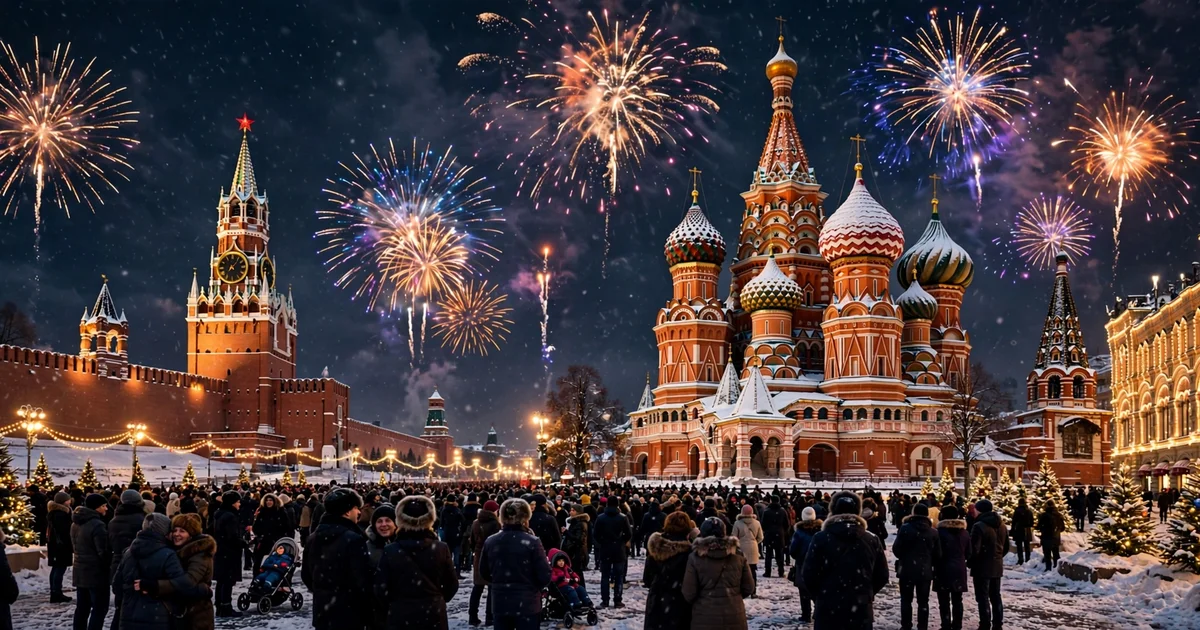
Russia’s Novy God is the year’s biggest holiday — the New Year tree, Ded Moroz, the President’s address and wishes burned in champagne.

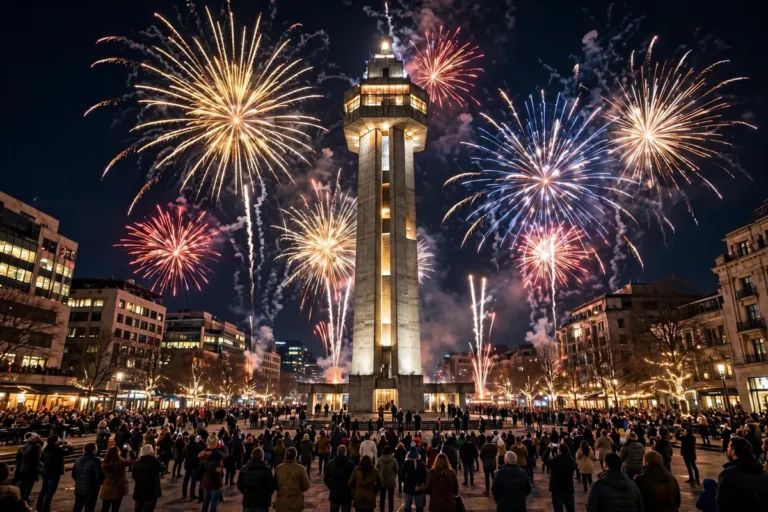
A towering New Year tree in Moscow’s Red Square with St. Basil’s Cathedral and midnight fireworks.
Watch: New Year in Russia
Russia lights up the night for the New Year — ABC News on the celebrations.
At a Glance: New Year in Russia
Russia’s essential Novy God facts — the tree, the address and the wish.
| Fact | Detail |
|---|---|
| Novy God | New Year’s Eve — Russia’s biggest holiday, bigger than Christmas |
| New Year tree | The yolka (fir tree) is decorated for New Year, not Christmas |
| Ded Moroz | Father Frost and his granddaughter Snegurochka deliver the gifts |
| President’s address | The televised address airs minutes before midnight, followed by the Kremlin chimes |
| Burning wishes | Tradition says: write a wish, burn it, stir the ashes into champagne and drink before 12:01 |
Frequently Asked Questions
What is the Russian New Year champagne wish tradition?
At midnight on New Year’s Eve, Russians write a wish on a small piece of paper, burn it, drop the ashes into a glass of champagne, and drink it before the Kremlin clock finishes striking twelve. Completing the ritual in time is believed to make the wish come true in the new year.
Why do Russians burn wishes in champagne?
The ritual is a form of folk magic: by burning the written wish and drinking the ashes, you take the wish inside yourself, transforming a thought into something physical. The race against the twelve chimes adds a liminal, threshold-moment power — wishes made in the minute between years are believed to carry extra weight.
Is it safe to drink champagne with paper ashes?
In the tiny quantities involved — the ash of a small slip of plain paper — it is harmless theater rather than a health risk. Use uncoated paper (avoid glossy or printed stock), burn it fully over a fireproof plate, and skip the ash-drinking if it bothers you: burning the wish and toasting separately keeps the spirit of the ritual.
What are the Kremlin chimes?
The clock chimes of the Spasskaya Tower on the Moscow Kremlin, broadcast across Russia at midnight on New Year’s Eve. Their twelve strokes set the ritual’s time limit — about one minute from first chime to last — and are followed by the national anthem, the official musical start of the new year.
Why is New Year bigger than Christmas in Russia?
Under Soviet rule, Christmas was suppressed and its trappings — the tree, the gift-bringer (Ded Moroz), the festive meal — were transferred to New Year. The holiday kept everything after the Soviet era, making Novy God Russia’s biggest celebration, with Ded Moroz, Snegurochka, the yolka tree, Olivier salad, and Soviet champagne as its icons.
Do Russians celebrate the Old New Year too?
Yes — Stary Novy God falls on January 13–14 (New Year’s Day by the Julian calendar), the same date as Serbia’s Orthodox New Year. In Russia it is a quieter, family-centered occasion, and some families use it as a second chance to perform the wish ritual.
What should I write on the wish paper?
Keep it short, specific, and positive: one clear wish in the present tense, such as “I get the new job” or “Mum’s health holds strong.” Decide before midnight — the sixty-second window is no time to discover what you want. Veterans of the ritual say vague wishes (“be happy”) produce vague results, while concrete ones give the new year something to work with.
There is something deeply human about the champagne-wish ritual. Strip away the fire and the ashes and what remains is a room full of people, at the most symbolic minute of the year, forced to answer the hardest question there is: what do you actually want? The burning paper is theater; the sixty seconds of total honesty are the real magic. Whether you perform it in Moscow or at your own kitchen table — and whether your wish comes true by magic or by the clarity the ritual forces on you — it is a remarkable way to cross the threshold. If the new year has you formulating wishes anyway, our New Year wishes and messages for 2027 can help you find the words before the chimes begin. S Novym Godom!