England does New Year with a particular kind of magic: the Thames exploding in light beneath the London Eye, Big Ben’s great bell tolling twelve as millions hold their breath, and — in the north — neighbors knocking on doors at midnight with coal and whisky in hand. English New Year traditions are a blend of the spectacular and the intimate, the ancient and the brand-new, shaped by region as much as by nation. This guide tours England’s New Year customs from London’s world-famous fireworks to Northumberland’s burning tar barrels, explains the traditions southerners and northerners actually keep, and shows you how to experience an English New Year wherever you are.
London: Fireworks, Big Ben, and the Thames at Midnight
The defining image of New Year in England is the London fireworks display: an almost twelve-minute pyrotechnic spectacular launched from barges on the River Thames and from the London Eye itself, choreographed to music and watched by hundreds of thousands of people along the riverbanks and by millions more on television around the world. It is one of the most recognizable New Year events on the planet, and it anchors the entire English celebration.
The moment itself belongs to Big Ben — the great bell of the Elizabeth Tower at the Houses of Parliament — whose twelve deep chimes mark the arrival of the new year. The tradition of gathering to hear the chimes is old; the fireworks are relatively new, but the combination has become canonical: the hush as the bell begins, the roar as the sky ignites, and then, across living rooms and pubs and riverside crowds, the singing of “Auld Lang Syne.”
A word of practical advice: the riverside viewing areas for the London fireworks are ticketed and typically sell out weeks in advance, with structured crowd management that reflects the event’s enormous scale. Many Londoners prefer to celebrate in pubs, restaurants, and private house parties, watching the display on television — the atmosphere is festive but, in the English manner, relatively contained, with celebrations usually winding down in the early hours of New Year’s Day. If you plan to attend in person in a future year, check official city channels for ticketing and viewing-area details, which change annually.
“Auld Lang Syne”: The Song England Borrowed from Scotland
No English New Year is complete without “Auld Lang Syne,” Robert Burns’s 1788 Scots poem set to a traditional folk tune — and its English history is a story in itself. Research by the University of Edinburgh has shown that the song’s use at New Year emerged principally through exiled Scots gathering outside St Paul’s Cathedral in London: homesick Scots in the capital sang it to bid farewell to the old year, and the custom spread from those gatherings across England and then the world. By 1929 the song was established enough internationally to appear on the electronic ticker at New York’s Times Square New Year celebration.
The English singing of it follows the Scottish formation: at midnight, singers cross their arms, join hands with their neighbors, and sing the verses — “Should auld acquaintance be forgot?” — raising joined hands on the final chorus. The title means roughly “old long since” or “days gone by,” and the song is a toast to old friendships. In England it is sung not only at New Year but at farewells of all kinds, yet midnight on December 31st remains its true home. Few English singers know all the verses; everyone knows the chorus, and the chorus is what matters.
The North of England: First-Footing Country
Travel north, and the English New Year grows more Scottish in character — because first-footing, the great threshold tradition, belongs to the north of England as much as to Scotland. The custom is identical in structure: the first person to cross the threshold after midnight sets the household’s luck for the year, and should arrive bearing coal (warmth), bread or shortbread (food), salt (flavor), a coin (prosperity), and whisky (good cheer).
Victorian accounts give a vivid picture of the northern English practice. Historians of Blists Hill Victorian Town in Shropshire describe New Year’s Eve as a busy night for young men roaming door to door offering to be the first foot — for a small fee — bringing their gifts of coal, food, whisky, or greenery to ensure a prosperous and healthy year. It was believed unlucky if the year’s first foot belonged to a woman, so the trade in male first-foots was brisk. The old preference for a dark-haired visitor — the folk memory of Viking raiders — applied here too, though modern northerners observe it with the same cheerful irreverence as the Scots.
First-footing survives in the north today in softened form: neighbors popping round after midnight with a bottle and good wishes, families designating a member to step outside and re-enter ceremonially. For the full meaning, rules, and gift symbolism, see our dedicated guide to first-footing — and for the festival it belongs to, our complete guide to Hogmanay.
Allendale’s Tar Bar’l: England’s Ancient Fire Festival
The most extraordinary New Year tradition in England — and one of the oldest anywhere in Britain — belongs to the Northumberland village of Allendale. On New Year’s Eve, the village holds the Tar Barrel Parade, known locally as the Tar Bar’l: around 45 local men, the “guisers,” dress in colorful or fanciful costumes and process through the streets carrying barrels of burning tar, sawdust, and paraffin on their heads, accompanied by a band, while crowds line the route.
Just before midnight, the guisers reach the town square and hurl their blazing barrels into a great bonfire. The crowd cheers, sings, and welcomes the new year around the fire. Like Scotland’s fire festivals, the Tar Bar’l is a winter-solstice inheritance — fire carried through the darkness to purify and protect the community — and it predates the modern fireworks era by centuries. It is also resolutely local: the guisers are Allendale men, the crowd is largely the village and its visitors, and the whole event has the intimate, slightly wild character of a tradition kept alive by the people who inherited it rather than by tourism boards.
London on New Year’s Day: The Parade
England’s New Year does not end at midnight. On January 1st, central London hosts the London New Year’s Day Parade, a spectacular procession that has run every year since 1987. Marching bands, cheerleaders, dancers, giant balloons, and performers from around the world wind through the West End past thousands of spectators, in what is billed as one of the great street celebrations of the season. It is the cheerful, family-friendly daylight counterpart to the midnight fireworks — and a fine reason to be in London on the first morning of the year, whatever the weather.
New Year’s Day in England is a public holiday, and the day’s other traditions are quieter: the January sales begin, drawing bargain-hunters to high streets across the country; hardy souls take part in New Year’s Day swims at beaches around the coast, plunging into frigid water for charity or sheer bravado (warm clothes and a hot drink afterward are essential); and many families simply recover — leftover celebration food, long walks, and the particular English pleasure of a quiet house after a loud night.
The Victorian New Year: Cleaning, Bells, and Twelfth Night
Much of what England does at New Year was codified in the Victorian era, and the period’s customs reveal the skeleton beneath the modern celebration. The Victorians took the pre-New Year clean seriously: the house was cleaned from top to bottom before midnight, rubbish removed, and ashes cleared from the hearth — a fresh beginning made physical. Cupboards and pockets were deliberately kept full at the year’s start, and a fire was kept blazing through the night: fullness and warmth as sympathetic magic for the twelve months ahead.
Church bells rang out at midnight to chase away evil — the sacred counterpart to the secular fireworks — and the festive season extended well beyond New Year’s Day. Celebrations continued until Twelfth Night, January 6th, the Feast of the Epiphany, when all Christmas decorations had to come down to ensure the household’s good luck. In some grander homes, greenery was kept until Candlemas on February 1st, then replaced with bowls of snowdrops in a ritual of “white purification.” The through-line is unmistakable: the English New Year, for all its modern fireworks, is built on very old ideas about cleanliness, fullness, light, and noise as weapons against the dark.
Regional Notes: How the Rest of England Celebrates
The South East and the Home Counties: Beyond London, the south-eastern New Year is largely a private affair — house parties, pub lock-ins, restaurant dinners, and the television broadcast of the Thames fireworks. The first-footing tradition is weaker here than in the north, and midnight is more likely to be marked with champagne and Auld Lang Syne than with coal on the doorstep.
The West Country: Coastal towns in Devon and Cornwall host their own New Year’s Day swims and harbor-side celebrations, and the region’s strong folk-music culture means pub sessions and ceilidh-style dancing feature heavily in local New Year parties.
The Midlands: Birmingham and Nottingham hold public fireworks and events, but the region’s New Year character is community-scale: clubs, pubs, and neighborhood parties, with first-footing surviving in pockets, particularly in former mining communities where the coal gift carried extra resonance.
Yorkshire and the North East: This is first-footing’s English heartland, and the customs here run closest to the Scottish original. Newcastle’s Quayside hosts a major fireworks display, and the region’s pubs do a roaring trade on New Year’s Eve. In old mining and fishing towns, the symbolism of the first-foot’s gifts — coal for warmth above all — was never abstract.
East Anglia: A quieter New Year, traditionally — village pub parties, farmhouse gatherings, and in coastal towns like Cromer and Southwold, the bracing New Year’s Day dip in the North Sea.
Food and Drink of the English New Year
Unlike some countries, England has no single canonical New Year’s Eve dish — the food is celebratory rather than symbolic. Champagne or prosecco is the midnight drink of choice in the south, whisky in the north. Party food runs to canapés, cheese boards, and late-night takeaway; restaurant New Year’s Eve menus are elaborate fixed-price affairs booked weeks ahead. The steak pie that Scots eat on New Year’s Day crosses the border in the north, and everywhere in England the first week of January belongs to leftovers, turkey curry, and the slow return to normal eating. One charming minor tradition: the first mince pie of the season is long gone by New Year, but the last of the Christmas cake often makes its final appearance at New Year parties, seen off with appropriate ceremony.
How to Do an English New Year (Wherever You Are)
The London-style celebration: Gather friends for the evening, dress up, and make midnight the centerpiece. Stream the Thames fireworks live, keep the sound up for Big Ben’s chimes, and sing Auld Lang Syne with arms crossed and hands joined — the formation matters. Serve champagne or prosecco, and follow the English pattern: a proper party that winds down in the small hours rather than running to dawn.
The northern-style celebration: Adopt first-footing. Agree with neighbors who will first-foot whom, assemble the gift kits (coal, bread or shortbread, salt, coin, whisky), and designate your midnight crosser to step outside at 11:55. Keep the fire — or the heating — blazing, keep the cupboards full, and welcome your first-foot with a dram. Our New Year’s Eve at home celebration plan offers a practical framework for hosting the evening itself.
New Year’s Day, English style: Sleep in, then get outside — the English New Year’s Day walk is a genuine institution, a bracing constitutional to clear the head. If you are near cold water and feeling brave, organize a charity dip in the Loony Dook spirit. In the evening, gather for a proper dinner and set your intentions for the year with the help of our New Year reset guide — the Victorians cleaned the house; you can clean the slate.
In Pictures: New Year in England
From the London Eye fireworks to the New Year’s Day Parade, England greets the New Year with spectacle and ceremony.
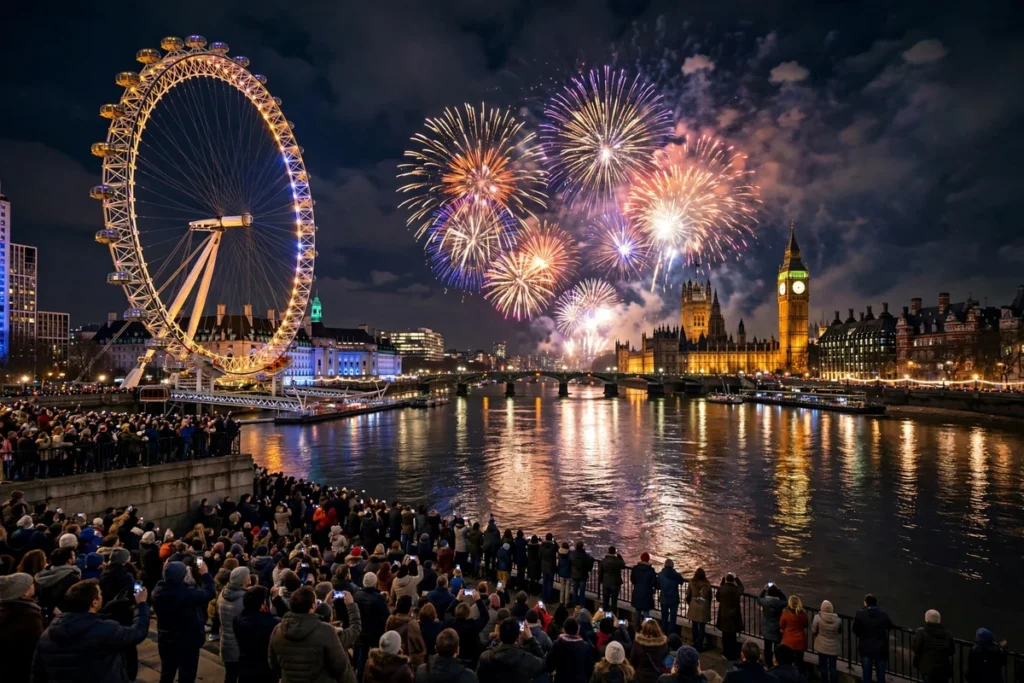
Fireworks explode over the London Eye and the Thames as Big Ben chimes in the New Year.
Watch: New Year in England
Watch the full fourteen-minute fireworks show over the Thames from London’s New Year celebration.
At a Glance: New Year in England
England’s essential New Year facts — the river, the bells and the parade.
| Fact | Detail |
|---|---|
| London Eye fireworks | The midnight display over the Thames is watched by crowds along the river and millions on TV |
| Big Ben | The Great Bell’s chimes mark the stroke of midnight |
| London New Year’s Day Parade | Held every January 1 since 1987, with marching bands and performers through central London |
| First-footing | Also practised in northern England — the first visitor after midnight brings symbolic gifts |
| Pub traditions | Many towns hold fancy-dress pub crawls and street parties on New Year’s Eve |
Frequently Asked Questions
What are traditional New Year customs in England?
England’s New Year traditions include London’s Thames fireworks display at midnight, the chimes of Big Ben, singing “Auld Lang Syne” with linked arms, first-footing (especially in the north, with gifts of coal, bread, salt, coin, and whisky), the Allendale Tar Barrel fire parade in Northumberland, the London New Year’s Day Parade (since 1987), New Year’s Day swims, and the start of the January sales.
Where is the best place to watch New Year fireworks in London?
The official display is centered on the River Thames around the London Eye, with ticketed viewing areas along the riverbanks that typically sell out weeks in advance. Many Londoners watch from pubs, restaurants, house parties, or elevated spots across the city. Check official city channels for the current year’s ticketing and viewing arrangements.
What is the Allendale Tar Bar’l?
The Tar Bar’l (Tar Barrel Parade) is an ancient New Year fire festival in Allendale, Northumberland. Around 45 costumed local men (“guizers”) carry burning barrels of tar, sawdust, and paraffin on their heads through the village, finally hurling them into a great bonfire in the town square just before midnight — a winter-solstice fire ritual centuries old.
Do English people do first-footing?
Yes — first-footing is well established in the north of England, where the custom mirrors the Scottish original: the first person over the threshold after midnight brings the year’s luck, bearing coal, bread, salt, a coin, and whisky. It is less common in the south, where midnight is more likely to be marked with champagne and song.
Why do English people sing a Scottish song at New Year?
“Auld Lang Syne” spread at New Year through Scots exiles gathering outside St Paul’s Cathedral in London, whose custom of singing Burns’s song at midnight was adopted by English celebrants and then the world. It is sung with crossed arms and joined hands, a formation that itself comes from the Scottish tradition.
What happens in London on New Year’s Day?
The London New Year’s Day Parade — running since 1987 — winds through the West End with marching bands, performers, and giant balloons. Elsewhere, the day brings the start of the January sales, New Year’s Day swims at beaches around the coast, and quiet recovery for most households.
England’s New Year is a study in contrasts: the most televised fireworks on earth and a village fire parade older than the fireworks’ gunpowder; a Scottish song sung with English gusto; ancient threshold magic practiced in postcodes with video doorbells. It works because every layer is sincerely kept — the spectacle, the song, the knock on the door at midnight. However you mark it, do one English thing this year: at midnight, cross your arms, join hands with whoever is nearest, and sing. The year will start better for it.
English New Year Superstitions: The Old Rules of Midnight
Beneath the fireworks and champagne, England keeps a substratum of old New Year superstitions — the kind of household rules that grandmothers enforced and grandchildren half-observe with a smile. They are worth knowing because they reveal what the English New Year is really for: not just celebration, but the careful management of fortune.
Nothing should leave the house on New Year’s Day. In the old tradition, nothing — not rubbish, not laundry, not a borrowed item — should be taken out of the house on January 1st, lest the year’s luck leave with it. Conversely, something should ideally be brought in: the first-foot’s gifts are the formal version, but even a bag of shopping carried home on New Year’s Day counts in folk logic.
The first voice on the phone. A lesser-known superstition holds that the first person you speak to in the new year — even by telephone — influences your fortune, which is why New Year’s Day morning was once a flurry of carefully chosen first calls to favored relatives. The modern group-chat “Happy New Year!” broadcast is arguably the same instinct, democratized.
Debts and quarrels settled. Like the Scots’ redding and the Irish settling of accounts, English tradition held that you should enter the new year owing nothing and feuding with no one. The practical Victorians framed it as respectability; the folklore framed it as magic. Either way, the advice holds up.
Mind the washing. The old prohibition on washing clothes on New Year’s Day — shared with Ireland — appears in English folklore too: wash away the year’s luck and you will spend twelve months regretting the laundry. Whether observed or not, it is a useful excuse for a day of rest.
Weather lore. English folk tradition reads New Year’s Day weather as an omen: a bright, clear January 1st promises a prosperous year, while wind direction on the morning supposedly predicts the year’s character. Farmers’ almanacs once printed such forecasts solemnly; modern celebrants check the sky with a wink and a hope.
New Year’s Resolutions: The English Fresh Start
England may not have invented the New Year’s resolution, but it industrialized the breaking of it. The resolution tradition — resolving to live better in the year ahead — is ancient (the Babylonians made promises to their gods at the new year), but the modern English version is a January ritual of gym memberships, dry January pledges, and earnest lists abandoned by February. Dry January, the month-long abstention from alcohol that began as a public-health campaign, has become one of England’s defining New Year customs — a collective, socially supported fresh start that fits the national character: self-improvement with a sense of humor about itself.
The English approach to resolutions pairs well with the older customs: the Victorian clean house, the full cupboards, the settled debts — all are resolutions made physical. If you want your resolutions to survive past January, treat them the way the old customs treat luck: as something you enact, not just intend. Write them down, speak them aloud at midnight, and give them a ritual — our New Year reset guide walks through a structured process for turning midnight intentions into a year-long practice.