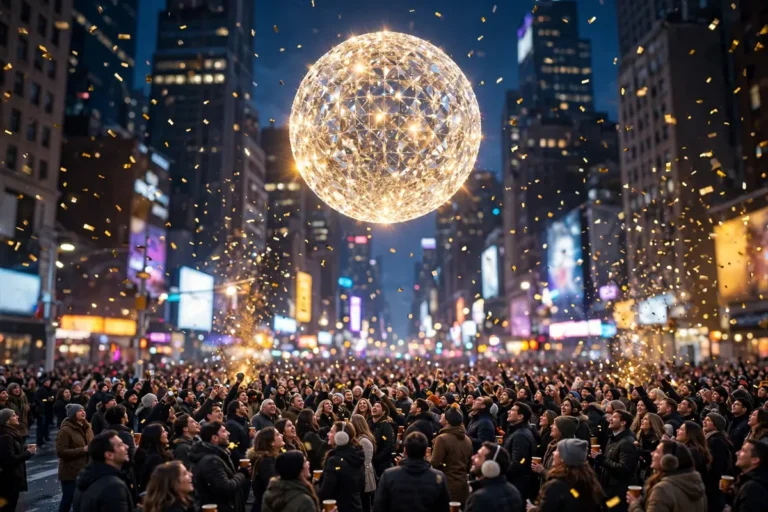
In Denmark, the way to tell someone you love them on New Year’s Eve is to throw a plate at their door. Not metaphorically — literally. Danes spend the year saving up chipped plates and old glasses, and on December 31 they hurl them at the front doors of friends and family, because a bigger pile of shards on your doorstep means more friends and more luck. Then, at midnight, the entire country climbs onto its chairs and jumps off in unison, leaping bodily into the new year. This is the complete guide to Denmark’s gloriously physical New Year traditions: how to smash plates properly (etiquette matters), how to jump off a chair without injury, what the king says at 6 p.m., and why the night ends with a tower of marzipan.
How to Smash Plates Like a Dane
The plate-smashing tradition (at smadre tallerkener, if you want the Danish) is Denmark’s most famous New Year’s custom, and it is exactly as joyful as it sounds. Here is how it works, and — more importantly — how to do it right.
Step 1: Save your plates all year
Danes do not buy plates to smash. They save them — the chipped mug, the plate with the hairline crack, the glass with the wobbly base. All year, the doomed crockery accumulates in a cupboard, waiting for December 31. If you are adopting the tradition abroad, start a “smash box” now: anything chipped, mismatched, or retired from daily service goes in. Porcelain, earthenware, and glass all shatter satisfyingly; avoid anything with sharp metal trim or sentimental value you will regret at 1 a.m.
Step 2: Choose your targets with love
This is the crucial etiquette point: you throw plates at the doors of people you like. Friends, family, beloved neighbors — the pile of shards on a doorstep is a public declaration of affection and a wish for luck. Throwing plates at a stranger’s door, or worse, an enemy’s, misses the point entirely and will just frighten someone. Traditionally the throwing happens in the evening or at night on December 31, often as groups move between parties. Aim for the door or the doorstep — never windows, never cars, never anything that can be damaged beyond a sweepable mess.
Step 3: Throw with feeling, clean up with grace
Put your back into it — a half-hearted toss is an insult to the tradition. The satisfying crash is the whole point: noise to scare off the old year’s bad spirits, shards as a tally of friendship. Folk wisdom says the bigger the pile outside your door on New Year’s morning, the luckier (and more beloved) you are. As for cleanup: the polite thrower helps sweep, or at least the gracious recipient sweeps with pride the next morning. Many Danes report genuine delight at finding their doorstep glittering with fragments — it is the rare mess that means you are loved.
A note for the cautious: this is a private custom between consenting households, not a public free-for-all. In apartment buildings, coordinate with neighbors; on quiet streets, keep it to people who know what is coming. And if you are hosting a Danish-style night at home, our practical New Year’s Eve at-home plan covers the logistics — though you will need to add “source sacrificial crockery” to the checklist yourself.
How to Jump Off a Chair at Midnight
The second great Danish physical tradition is the midnight chair jump. As the clock approaches twelve, everyone at the party climbs onto a chair — or a sofa, for the committed — and at the exact stroke of midnight, the whole room jumps off together, leaping into the new year. It is a literal enactment of jumping forward, and it is done with enormous solemnity for about three seconds and then enormous laughter.
The technique
Choose a sturdy chair — dining chairs, not desk chairs with wheels. Clear a landing zone: no coffee tables, no Sekt buckets, no small dogs. Stand on the seat (not the backrest, tempting as it is), hold your champagne if you are coordinated, count down with the television or the church bells, and jump at twelve. Land, cheer, hug, drink. Children adore this tradition and should get the sturdiest, lowest seating — a sofa is ideal for the under-tens.
Safety, seriously
A few thousand Danes jumping off furniture after an evening of champagne is exactly as risky as it sounds, so: no jumping from tables, no jumping while holding lit sparklers, and the host should do a quick landing-zone check at 11:55. The tradition is about joy, not the emergency room. Done right, it is the single most memorable three seconds of the night — a whole room suspended mid-air between one year and the next.
Denmark is not the only country that leaps: in Portugal, revelers leap off chairs too — with a piece of fruit in hand, no less. Compare the two in our guide to New Year traditions in Portugal.
6 P.M.: The King’s New Year’s Address
Before the plates and the jumping, Denmark pauses for something solemn. At 6 p.m. on December 31, the monarch delivers the New Year’s address (nytårstalen) — a short, reflective speech broadcast live on television and radio, watched by a huge share of the population. For 52 years it was Queen Margrethe II, whose addresses were national events: personal, literary, occasionally gently scolding, and always ending with her signature “Gud bevare Danmark” — God save Denmark.
The tradition entered a new era in January 2024, when Margrethe II abdicated in favor of her son, King Frederik X. The New Year’s address continues under the new king, and the 6 p.m. broadcast remains the emotional starting gun of the Danish New Year’s Eve: parties quiet down, the television goes on, and the country listens together before the evening’s festivities resume. If you are spending the night with Danes, treat the speech with the respect it commands — talking through it is a genuine faux pas. (For 2027, the address will air as usual on December 31; check Danish broadcasters for streaming options abroad.)
The New Year’s Table: Kransekage and Company
Danish New Year’s Eve dining is hearty and traditional. The meal often centers on boiled or roasted pork with kale — rich, warming winter food — followed by the undisputed star of the Danish New Year: kransekage, the “wreath cake.” Kransekage is a tower of concentric marzipan rings, stacked into a cone and decorated with icing, small flags, and ornaments, often with a bottle of champagne or port standing in the hollow center. At midnight, the tower is the ceremonial dessert: rings are broken off and eaten with champagne, and the person who gets the top ring gets bragging rights.
Champagne (or, increasingly, quality sparkling wine) is the midnight drink, and the toast is “Godt nytår!” — Happy New Year. Cod is another traditional New Year’s dish in some households, and the evening’s drinking is punctuated by the Danish custom of the skål with eye contact — look your drinking partner in the eye when you clink, or folk wisdom says seven years of bad… well, let us just say the Danes take eye contact seriously.
A Timeline of a Danish New Year’s Eve
Afternoon: Final preparations; the kransekage is assembled or collected from the bakery; the smash box of saved plates is loaded into bags. 6 p.m.: Everything stops for the King’s New Year’s address. Parties fall silent; the country watches together. 7–10 p.m.: Dinner — pork, kale, candles, conversation. The evening is unhurried; Danes dine long. 10–11:30 p.m.: The plate runs begin. Groups head out to decorate friends’ doorsteps with crockery; dessert (kransekage) is served; champagne is chilling. 11:55 p.m.: Everyone finds a chair. Landing zones are cleared. The countdown begins. Midnight: Jump. Then “Godt nytår!”, hugs, kransekage rings broken off, champagne all around. 12:30 a.m. onward: Fireworks (private fireworks are part of the night, though regulations tighten in many municipalities — check local rules), more plates for the late parties, and the slow wind-down. January 1: Sweep your doorstep with pride. Count your shards. That is your friendship, made visible.
Copenhagen and Beyond: Where the Night Happens
Unlike some capitals, Copenhagen does not stage one giant official countdown concert — Danish New Year’s Eve is overwhelmingly a private-party affair, hosted in homes. That said, the city has its public moments: the Town Hall Square (Rådhuspladsen) clock is the traditional countdown focal point, and fireworks light up the harbor at midnight. Tivoli Gardens, the famous amusement park, has in many years hosted special New Year’s programming — check dates for 2027, as winter opening schedules vary. For most Danes, though, the night belongs to the dining room, the doorstep, and the chair. If you are invited to a Danish home for the 31st, bring champagne and your saved plates; you will be family by midnight.
Hygge at Midnight: The Quiet Heart of the Danish Night
For all its plate-shattering chaos, the Danish New Year’s Eve is built on hygge — the untranslatable Danish art of coziness, warmth, and togetherness. The evening is deliberately slow. Dinner stretches for hours by candlelight. The television volume drops for the king’s speech. Even the wildest traditions — the plates, the jumping — are performed together, in a circle of people who have chosen each other for the year’s most symbolic night. Understanding hygge is understanding why Danes, who could party in the streets like their southern neighbors, mostly choose the dining room instead.
The hygge of the night is in the details: the candles (Danes burn more candles per capita than just about anyone), the long table that nobody leaves between courses, the champagne served in whatever glasses survived the plate box, the kransekage assembled with slightly lopsided rings because the children helped. It is in the pause at 6 p.m., when a whole nation goes quiet together. Visitors sometimes expect Scandinavian reserve; what they find on December 31 is Scandinavian warmth at full volume — loud, physical, and deeply affectionate. If your own New Year’s Eve leans toward the intimate rather than the epic, Denmark is your spirit country, and our at-home celebration plan is essentially the Danish method with an international accent.
There is a lesson in the Danish pacing worth stealing wherever you live: the night is long on purpose. The plates are thrown at ten, not at midnight, so there is time to come back inside, warm up, and eat cake. The jump happens at twelve, but the fireworks and the second wave of parties stretch past one. Nothing is rushed, because the point is not the countdown — it is the company you count down with.
Fireworks, Sparklers, and the Danish Debate
Like their German neighbors, Danes love private fireworks — and like their German neighbors, they are arguing about them. For decades, the turn of the year meant a neighborhood arms race of rockets and bordbomber (table fireworks), with the sky over every Danish town lit up at midnight. In recent years, concerns about injuries, frightened animals, and environmental damage have pushed many municipalities toward restrictions, designated firing zones, or outright local bans, and the national conversation resurfaces every December.
The practical upshot for 2027: assume the rules where you are may have changed, and check your municipality’s guidance before buying anything bigger than sparklers. What is not in dispute is the gentler end of the spectrum — sparklers (stjernekastere, “star throwers”) for children and the cautious, table fireworks for the dinner table, and the public displays over the harbors for everyone. Many Danish families have quietly shifted their midnight spectacle from the garden to the waterfront, watching the city’s professional show instead of staging their own. It is a very Danish compromise: keep the light, lose the risk, and nobody has to sweep up rocket sticks on January 1.
At midnight, after the jump, Danes step outside with their champagne, watch the sky, and shout their “Godt nytår!” into the cold air. However the light gets into the sky — rockets, municipal display, or just the neighbors’ show watched from the doorstep — the moment is the same. The old year is gone, the new one is here, and you arrived in it mid-air, off a chair, surrounded by people holding broken cake rings and full glasses.
January 1: Tømmermænd and the Repair Beer
Denmark has a word for the morning after — tømmermænd, literally “empty men,” the hollowed-out feeling of a proper New Year’s Eve — and a traditional cure: the reparationsbajer, the “repair beer,” a cold lager taken as medicine. January 1 is a day of glorious, well earned, deeply deserved inactivity: leftover kransekage rings for breakfast (there are always rings left; the tower is generous), the doorstep swept with pride, and the shard count assessed like a score. Tradition holds that a big pile means a loved household, and Danes will cheerfully compare doorsteps with neighbors. The rest of the day is for the couch, the leftovers, and — for the ambitious — a bracing walk in the cold air, which the Danes insist cures everything. It is the gentlest possible landing after the year’s loudest night.
Myth vs. Fact: Danish New Year Edition
Myth: Danes throw plates at anyone’s door. Fact: Only at the doors of friends and loved ones. The shards are affection, not vandalism — targeting strangers misses the entire point.
Myth: The more plates, the better, no matter what. Fact: Spiritually yes, practically no — aim at doors and doorsteps, never windows or cars, and coordinate in apartment buildings.
Myth: The Queen still gives the New Year’s speech. Fact: Queen Margrethe II abdicated in January 2024 after 52 years on the throne. King Frederik X now delivers the 6 p.m. address — the tradition continues, the monarch changed.
Myth: The chair jump is just for kids. Fact: Everyone jumps — grandparents included. It is the most democratic three seconds of the Danish year.
Myth: Kransekage is just a cake. Fact: It is architecture. The ring tower, the flags, the champagne in the center, the ceremonial breaking of rings at midnight — it is as much ritual object as dessert.
In Pictures: New Year in Denmark
Denmark’s New Year is delightfully destructive — smashing plates on friends’ doors and leaping off chairs at midnight.

Friends leaping off chairs at midnight as smashed plates pile up at the front door — Danish New Year traditions.
Watch: New Year in Denmark
Five crazy Danish traditions — including the New Year plate-smashing and chair-jumping customs.
At a Glance: New Year in Denmark
Denmark’s essential New Year facts — the plates, the leap and the queen’s speech.
| Fact | Detail |
|---|---|
| Smashing plates | Tradition says Danes throw old plates at friends’ doors — a pile of shards means you’re well loved |
| Jumping off chairs | Leaping from a chair at the stroke of twelve jumps you into the New Year |
| The monarch’s speech | The New Year address airs at 6pm on December 31 — a national moment |
| Kransekage | The towering ring cake is served at midnight with champagne |
| Midnight fireworks | Danes set off some of Europe’s most enthusiastic private fireworks |
Frequently Asked Questions
Why do Danes smash plates on New Year’s Eve?
Throwing old plates and glasses at the doors of friends and family is a Danish New Year’s tradition symbolizing affection and good luck. The pile of shards on a doorstep on New Year’s morning shows how many friends the household has — the bigger the pile, the luckier the year ahead. Danes save chipped crockery all year specifically for the occasion.
Why do Danes jump off chairs at midnight?
Standing on a chair and jumping off at the stroke of midnight is a literal “leap” into the new year — a physical enactment of jumping forward into the future. The whole party jumps together, making it a shared, joyful, slightly chaotic midnight moment. Use a sturdy chair, clear the landing zone, and keep it safe.
What is kransekage?
Kransekage (“wreath cake”) is the traditional Danish New Year’s cake: a tower of concentric marzipan rings stacked into a cone, decorated with icing and small flags, often with a bottle of champagne in the center. At midnight, guests break off rings to eat with their champagne.
What time is the Danish monarch’s New Year’s speech?
The New Year’s address (nytårstalen) airs at 6 p.m. on December 31, broadcast live on Danish television and radio. Since Queen Margrethe II’s abdication in January 2024, it is delivered by King Frederik X. Parties traditionally pause to watch it together in silence.
Is it okay for visitors to join in the plate smashing?
Absolutely — if you are throwing at the doors of people who know and like you. The etiquette: only target friends and family, aim at doors and doorsteps (never windows or cars), and help sweep up. Your Danish hosts will be delighted; few things flatter a Dane like a foreigner who arrives with a bag of plates.
Do Danes really save plates all year for this?
Yes — that is the authentic version of the tradition. The smash box fills up over twelve months with chipped mugs, cracked plates, and retired glassware, so nothing usable is wasted on the ritual. Buying new plates to smash defeats the purpose (and offends the Danish sense of practicality). Start your own box now and you will be ready by December.
What does “Godt nytår” mean, and when do you say it?
Godt nytår means “Good New Year” — the Danish equivalent of Happy New Year. Like the German “Guten Rutsch” rule, it is said after midnight, not before. In the final minutes of the old year, Danes wish each other a good evening; the new year’s greeting waits for the jump.
What should I bring to a Danish New Year’s Eve party?
Champagne (or good sparkling wine) and a bag of saved plates will make you a legend. A kransekage from a bakery works if you are not sure the hosts have one. And if you want the right words for the card or the midnight text, our New Year wishes, messages, and captions for 2027 has you covered — Godt nytår!
Denmark’s New Year is a full-contact celebration: affection you can hear shattering on a doorstep, a future you jump into feet-first, and a cake you dismantle ring by ring. Our Scandinavian neighbors keep their own beautiful midnight rituals — see New Year traditions in Sweden for poetry and bells at Skansen. However you spend the night, remember the Danish lesson: love loudly, leap together, and sweep up in the morning.
If the Danish night leaves you thinking about the year ahead rather than just the one behind, our New Year reset guide is the natural January follow-up — slower, quieter, and best enjoyed with the leftover kransekage. Godt nytår!