Canada rings in the new year the way it does most things: outdoors, in the cold, and with remarkable good cheer. On January 1, while much of the world is nursing a hangover under a blanket, thousands of Canadians strip down to swimsuits and sprint into near-freezing water. And on December 31, one of the country’s most spectacular natural wonders becomes the backdrop for one of its biggest parties. The New Year traditions in Canada: polar bear dips and Niagara Falls celebrations capture the national character perfectly — hardy, joyful, and just a little bit wild.
This guide covers both sides of the Canadian New Year. First, the polar bear dip phenomenon: its century-old history, where to take the plunge from Vancouver to Halifax, and how to survive your first one without turning into an icicle. Second, the Niagara Falls New Year’s Eve celebration: the free outdoor concert, the fireworks bursting over the illuminated falls, and the Winter Festival of Lights that turns the whole area into a glowing wonderland. Along the way, we will touch on the quieter customs — Quebec’s Réveillon feasts, Scottish Hogmanay echoes, and the simple pleasure of a January skate — that round out how Canadians welcome January 1.
The Polar Bear Dip: Canada’s Chilliest New Year Ritual
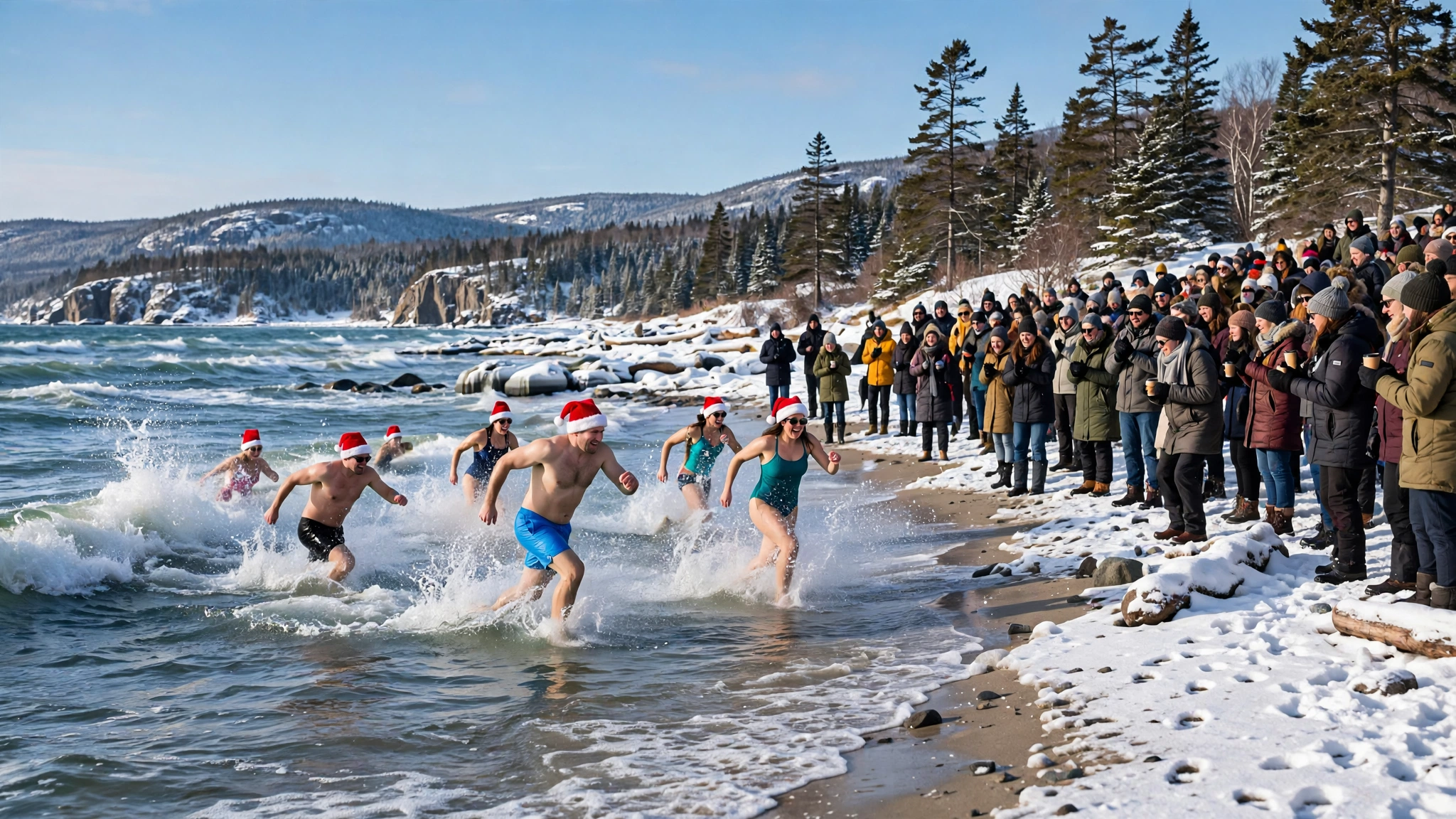
The concept is gloriously simple. On New Year’s Day, you put on a swimsuit (costumes strongly encouraged), run into the nearest ocean, lake, or river, submerge yourself briefly while screaming, and then sprint back out to a towel, a toque, and hot chocolate. Tens of thousands of Canadians do some version of this every January 1, in organized events from British Columbia to Nova Scotia.
Why? Ask ten dippers and you will get ten answers: it is a bracing way to start the year, a test of nerve, a charity fundraiser, a hangover cure of legendary potency, or simply the most fun you can have while technically hypothermic. What unites them is the feeling afterward — a full-body rush of exhilaration, the famous cold-water endorphin surge, and the unshakeable conviction that if you can do this on January 1, you can do anything the year throws at you. Many swimmers describe it as a reset button: the shock of the water wipes the slate clean in a way no resolution ever could. If that reset mindset appeals to you, our New Year reset guide offers a warmer, drier framework for starting fresh.
The dips are also deeply social. Spectators outnumber swimmers at every major event, lining the beaches with thermoses, cameras, and cowbells. Costumes range from the classic (Santa suits, tutus) to the elaborate (full Viking regalia, inflatable dinosaurs). Local charities often benefit — food bank drives are a staple of the Vancouver swim, for example. And there is an unwritten code of camaraderie: nobody cares how long you stay in (seconds count), everyone cheers for first-timers, and the shared suffering forges instant friendships on the beach.
Timeline: The Vancouver Polar Bear Swim, 1920 to Today
The granddaddy of them all is the Vancouver Polar Bear Swim at English Bay — one of the oldest and largest polar bear swims in the world. Its history reads like a love letter to Canadian eccentricity:
- 1920 — It begins with ten swimmers. Greek-Canadian Peter Pantages, an avid year-round swimmer who reportedly swam in English Bay three times a day, convinces about ten friends to join him for a New Year’s Day plunge. The Polar Bear Club is born.
- The early decades — a local curiosity. Through the 1920s–1960s, the swim grows steadily as a West End neighborhood tradition. Pantages remains its heart and soul, famously arranging for ocean liners to stop so he could take his daily dip even while traveling.
- 1971–1972 — honoring the founder. Pantages passes away in 1971; the following year the club adds a 100-yard race in his memory, the Peter Pantages Memorial, which continues to this day.
- 2014 — the record year. A remarkable 2,550 registered swimmers take the plunge, setting the event’s participation record. Crowds on the beach number in the many thousands.
- 2020 — the centennial. The swim celebrates its 100th anniversary, a century after Pantages and his friends first ran into the surf.
- 2026 — the 106th annual swim. The tradition continues on January 1, 2026, with the familiar formula: festival atmosphere from late morning, official swim at 2:30 PM, commemorative buttons for finishers, and a food bank drive on site.
For the upcoming edition, expect the classic schedule to hold: festivities at English Bay Beach from around 11:30 AM to 4 PM, the program beginning around 2 PM, and the official plunge at 2:30 PM sharp, started by flag and siren. Registration is free and encouraged (it gets you a commemorative certificate), costumes are the norm, and the Greater Vancouver Food Bank typically collects donations on site — so bring non-perishables. Exact timings can shift year to year, so check the City of Vancouver’s official page as January approaches.
Polar Plunges Across the Country: A Regional Tour
Vancouver may have the oldest swim, but the polar bear dip is a genuinely national tradition. Here is where Canadians take the plunge from coast to coast to coast:
British Columbia: English Bay and beyond
The Vancouver swim is the flagship, but Metro Vancouver hosts several alternatives. North Vancouver’s Deep Cove Penguin Plunge swaps the polar bear branding for penguins, with prizes for the silliest costumes and proceeds supporting marine search and rescue. Port Moody’s Penguin Plunge at Rocky Point Park is a smaller community affair, typically with swimmers hitting the water early in the afternoon. The through-line: stunning mountain-and-ocean scenery, water temperatures that rarely crack 7°C (45°F), and post-swim hot chocolate that tastes like victory.
Ontario: Toronto and the Great Lakes
Toronto’s polar bear dips have hopped between venues over the years, with Sunnyside and Woodbine beaches among the historic sites. Lake Ontario in January is brutally cold — often just above freezing — which arguably makes Ontario dippers the hardiest of the hardy. Smaller towns around the Great Lakes host their own versions, many tied to charity fundraising. Check local listings in December, as venues and organizers can change year to year.
Quebec: le plongeon polaire
Quebec’s dips lean into the province’s love of winter festivals. Events around Montreal and Quebec City often fold the plunge into broader New Year’s Day programming — think ice slides, tire sur glace, and poutine waiting on shore. The St. Lawrence River provides the icy venue, and the post-dip rewarming sometimes involves a sauna or a sugar shack-inspired treat.
The Maritimes: Halifax and Atlantic dips
Halifax’s New Year’s Day swims draw hardy Atlantic Canadians into water that is cold even by polar bear standards. Maritime dips tend to be intimate community gatherings rather than mega-events — a few dozen swimmers, a bonfire on the beach, and the particular camaraderie of people who have all agreed, collectively, to be slightly unhinged. It is worth noting that cold-water plunging has cousins across the northern hemisphere; the Dutch, for instance, have their own bracing winter swim culture alongside New Year traditions in the Netherlands like oliebollen and carbid shooting.
The Prairies and the North: the extreme edition
Edmonton, Calgary, and Winnipeg dips involve cutting through ice or using heated pools adjacent to frozen lakes — because when the air temperature is -25°C, the water is the warm part. In Whitehorse, Yukon, the polar bear dip is less an event and more a lifestyle statement. These are the dips where “don’t stay in longer than a minute” becomes genuinely important safety advice rather than a suggestion.
Niagara Falls on New Year’s Eve: Fireworks Over the Falls
If the polar bear dip is Canada’s January 1 signature, Niagara Falls owns December 31. The Canadian side of the falls — in Ontario, facing the famous Horseshoe Falls — hosts one of the country’s biggest free New Year’s Eve celebrations, and the setting is unbeatable.
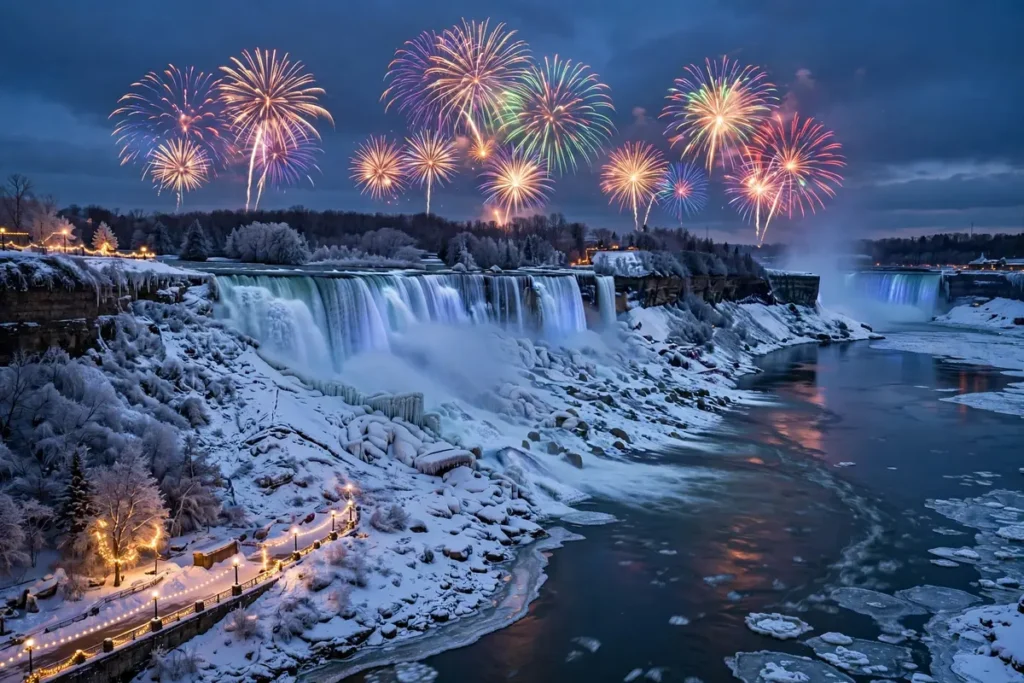
The centerpiece is the evening concert and countdown in Queen Victoria Park, right at the brink of the falls. The event is free and open-air: live musical acts through the evening, a massive crowd counted in the tens of thousands, and then the countdown itself — with fireworks launched over the gorge at midnight, exploding above the illuminated, thundering falls. Few New Year’s Eve backdrops on earth can compete with 600,000 gallons of water per second, lit in shifting colors, under a sky full of fireworks.
The party sits inside the larger Winter Festival of Lights, which typically runs from mid-November through early January and drapes the Niagara Parkway in millions of lights — illuminated displays along the river, in the parks, and across the falls themselves. Visiting for New Year’s Eve means you get the countdown plus one of North America’s great winter light displays in a single trip. Hotels with falls views book out far in advance for December 31, and the fallsview rooms command serious premiums — reserve early if a midnight panorama is on your bucket list.
Practical notes for Niagara Falls NYE: dress for standing outdoors for hours in genuine winter (layers, insulated boots, hand warmers); arrive early in the evening to claim a good viewing spot near the falls; and remember that the Canadian side is where the main event happens — you will need a passport to cross from the US side, and border lines on New Year’s Eve can be long. Public transit and shuttles within Niagara Falls, Ontario, beat driving and parking on the night itself.
More Canadian New Year Customs, Coast to Coast
Beyond the headline events, Canada’s New Year is stitched together from the country’s French, British, and Indigenous threads:
- Quebec’s Réveillon: In French Canada, New Year’s Eve centers on le Réveillon — a long, lavish late-night feast that can stretch past midnight. Traditional tables feature tourtière (meat pie), ragoût de pattes (pork stew), and plenty of wine. It is the warm, indoor counterpoint to the polar bear dip’s outdoor madness, and many families do both: feast at night, plunge at noon.
- Scottish Hogmanay echoes: With deep Scottish roots in Nova Scotia, parts of Ontario, and the Prairies, Canada absorbed Hogmanay customs — first-footing (the first visitor of the new year bringing luck), singing “Auld Lang Syne” at midnight with full-throated sincerity, and in some communities, the skirl of bagpipes to close out December 31.
- The Rideau Canal skate: Ottawa’s UNESCO-listed skating rink — the world’s largest naturally frozen skating rink in most years — typically opens in January, and a New Year’s Day skate under a crisp blue sky is a beloved low-key tradition for families who prefer blades to swimsuits.
- First Day hikes: Parks across the country host guided First Day hikes on January 1, from the seawall in Vancouver to the trails of Fundy National Park. It is the polar bear dip for people who like their New Year’s Day vertical rather than submerged.
- Fireworks bans and alternatives: Note that many Canadian municipalities restrict or ban private fireworks, so the big public displays — Niagara Falls chief among them — are the main show. Check local bylaws before buying your own.
How to Survive Your First Polar Bear Dip: A Practical Guide
Thinking of joining the madness? Here is the veteran’s playbook:
- Check the event details in December. Times, venues, and registration links are typically confirmed in the weeks before January 1. The Vancouver swim’s official 2:30 PM plunge time has been stable for years, but verify.
- Bring a buddy and a plan. Never dip alone. Designate someone to hold towels and dry clothes, and agree on a rewarming spot (a nearby café, your car with the heat blasting).
- Dress in layers you can shed fast. Wear your swimsuit under warm clothes. Keep everything — including shoes — on until the last possible minute. A robe or parka to throw on immediately afterward is worth its weight in gold.
- Wear water shoes. January beaches are rocky, and numb feet plus sharp stones is a bad combination. Cheap neoprene booties or old sandals work.
- Do not drink beforehand. Alcohol accelerates heat loss and impairs judgment — every major swim’s safety briefing says this explicitly. Save the celebratory drink for after you are warm and dry.
- Stay in briefly. Seconds, not minutes. Run in, dunk fully (the full-body shock is the point), and get out. Organizers typically advise against staying in longer than a few minutes; your body loses heat roughly 25 times faster in water than in air.
- Know your limits. If you have a heart condition, circulation issues, or any medical concern, the shoreline is the right place for you — cheering counts as participation. When in doubt, watch.
- Rewarm gradually. Towel off, dress in dry layers starting from the core, and drink something warm. Shivering afterward is normal; it is your body doing its job.
Prefer to keep your New Year’s Day on dry land? A relaxed outing has its own charm — our guide to planning a low-key New Year’s Day outing works as a template for any city, Canadian or otherwise.
Dip Culture: Costumes, Charities, and Unwritten Rules
What elevates the polar bear dip from a stunt to a tradition is the culture that has grown around it. The costume is practically mandatory at this point. Every January 1, English Bay fills with Santas, superheroes, bridal parties, inflatable T. rexes, and at least one person dressed as a thermometer. Prizes for best costume are common at organized swims, and the creativity on display rivals Halloween — except everyone is shivering. If you are a first-timer, a simple themed outfit (matching t-shirts with your group, a silly hat) is more than enough to fit in; the only real faux pas is showing up overdressed in a wetsuit, which veterans regard with gentle suspicion. The suffering is the point — neoprene is cheating.
Charity is the other pillar. Many dips double as fundraisers, and the Vancouver swim’s long-standing food bank drive is the best-known example: swimmers are encouraged to bring non-perishable donations or cash for the Greater Vancouver Food Bank, turning thousands of cold bodies into thousands of warm meals. Smaller community dips across the country raise money for everything from minor hockey to animal shelters. If you are organizing your own neighborhood plunge, attaching it to a cause is the fastest way to make it a tradition rather than a one-off dare.
Then there are the unwritten rules, passed down on frozen beaches like folklore. Do not splash the spectators — they are doing you the favor of witnessing. Cheer for everyone, especially the hesitant first-timer standing ankle-deep and reconsidering their life choices; today’s spectator is next year’s swimmer. Get your commemorative button or certificate after the swim, not before — you have to earn it. And the most sacred rule of all: the group photo happens before anyone is allowed to leave for hot chocolate. Someone always tries to sneak off early. It never works.
For all its silliness, the dip serves a real psychological function that explains its staying power. Psychologists who study ritual note that shared ordeals bond groups faster than shared pleasures, and that voluntary discomfort at a symbolic threshold — the first day of the year — creates a powerful sense of agency. You chose the cold; the cold did not choose you. Walking out of the water to applause, wrapped in a towel and grinning uncontrollably, you feel absurdly capable. It is hard to imagine a better emotional starting position for January.
In Pictures: New Year in Canada
Canada greets the New Year with a splash — polar bear dips from Vancouver to Toronto, plus Niagara Falls’ midnight fireworks.
Costumed swimmers charging into the icy water at Vancouver’s Polar Bear Swim on New Year’s Day.
Watch: New Year in Canada
Vancouver’s Polar Bear Swim at English Bay — the 105th annual New Year’s Day plunge.
At a Glance: New Year in Canada
Canada’s essential New Year facts — the plunge, the falls and the costumes.
| Fact | Detail |
|---|---|
| Polar Bear Swim | Vancouver’s English Bay swim has run since 1920 — one of the world’s oldest |
| How it works | Thousands plunge into the icy water on January 1, many in costume |
| Toronto | The Toronto Polar Bear Dip draws thousands to Lake Ontario |
| Niagara Falls | The falls host a major New Year’s Eve concert and midnight fireworks |
| Charity | Many plunges raise money for local charities |
Frequently Asked Questions
What is a polar bear dip?
A polar bear dip (or polar bear plunge) is a New Year’s Day tradition in which participants run into cold ocean, lake, or river water — usually in swimsuits and often in costumes — for a brief, bracing swim. Canada’s most famous is the Vancouver Polar Bear Swim at English Bay, held every January 1 since 1920, but similar events take place in cities across the country.
How old is the Vancouver Polar Bear Swim?
The Vancouver Polar Bear Swim dates to January 1, 1920, when Greek-Canadian swimmer Peter Pantages convinced about ten friends to plunge into English Bay with him. It is one of the oldest polar bear swims in the world and the oldest in Canada, drawing thousands of swimmers — a record 2,550 registered participants in 2014 — plus many thousands of spectators each year.
Is the Niagara Falls New Year’s Eve celebration free?
Yes. The outdoor concert and midnight countdown with fireworks over the falls, held in Queen Victoria Park on the Ontario (Canadian) side, is free to attend. It draws tens of thousands of people, so arrive early for a good viewing spot, dress warmly, and consider booking a fallsview hotel well in advance — they sell out for December 31.
Is it safe to do a polar bear dip?
For healthy adults following the guidelines, yes — but treat it with respect. Do not drink alcohol beforehand, stay in the water only briefly, never swim alone, and skip the plunge if you have heart or circulation issues. Organizers advise keeping warm clothes on until swim time and rewarming promptly afterward. Children should stay with an adult and dogs are best left at home.
What else do Canadians do on New Year’s Eve?
Traditions vary by region: Quebec families gather for le Reveillon, a lavish late-night feast featuring tourtiere; communities with Scottish roots keep Hogmanay customs like first-footing and “Auld Lang Syne” at midnight; many cities host public fireworks (check local bylaws on private fireworks); and January 1 brings First Day hikes, skates on rinks like Ottawa’s Rideau Canal, and of course the polar bear dips.
When is the best time to visit Niagara Falls for the holidays?
The Winter Festival of Lights typically runs from mid-November through early January, so any visit in that window delivers the illuminated falls and parkway displays. For the full experience — lights plus the free New Year’s Eve concert, countdown, and midnight fireworks — plan to be there on December 31, and book accommodations as early as possible.