There is no New Year’s Eve on earth quite like Brazil’s. While the Northern Hemisphere shivers through winter countdowns, Brazil celebrates the turn of the year at the height of summer — on the sand, in the surf, dressed head to toe in white, with two million people on Copacabana Beach jumping over ocean waves at midnight and tossing flowers to a sea goddess. The celebration is called Réveillon, and it is part religious ritual, part beach party, part national communion with the sea.
The New Year traditions in Brazil — white clothes and seven waves for Iemanjá — form the most visually stunning New Year’s celebration in the Americas. The white clothing symbolizes peace and spiritual cleansing, rooted in Afro-Brazilian religions. The seven waves are jumped one by one as the clock strikes twelve, each leap carrying a wish for the goddess of the sea. Around these two pillars cluster a constellation of smaller rituals: colored underwear for targeted intentions, lentils for prosperity, champagne toasts, and flower offerings floated out on the tide.
This guide is written as a practical how-to: how to dress, where to go, exactly how to perform each ritual, and how the celebration changes from Rio de Janeiro to Salvador to the far south. Whether you are planning to spend New Year’s Eve on a Brazilian beach or you simply want to borrow the magic for your own celebration at home, here is everything you need to do Réveillon the Brazilian way.
Step 1: Dress in White — and Choose Your Intention Color
The single most important rule of the Brazilian New Year is also the simplest: wear white. On December 31, from the favelas to the five-star hotels, Brazil turns into a sea of white clothing. The custom is so universal that showing up to a New Year’s party in dark colors marks you instantly as a tourist — albeit a forgiven one.
White (branco) carries layered meaning. On the surface, it symbolizes peace (paz), purity, and renewal — a clean slate for a clean year. But the roots run deeper, into the Afro-Brazilian religions of Candomblé and Umbanda, where white is the sacred color of Oxalá, the orixá associated with peace and creation, and the ritual garments of practitioners. Brazil’s New Year absorbed these traditions over generations until the white clothing became something the entire country shares regardless of faith: a collective, visible prayer for a peaceful year.
Practical notes for getting it right: the white should be real white, not cream or off-white, and the outfit is typically light and summery — linen shirts, white dresses, white shorts — because you will likely end the night in the ocean. Many Brazilians buy their Réveillon outfit new, treating it as part of the renewal. Footwear is often simple sandals or bare feet on the sand.
Then comes the personalization: the colored underwear. Beneath the uniform white, Brazilians wear underwear (or accessories — a ribbon, a bracelet, a flower in the hair) in the color of their specific wish for the year. The code is well established:
- White — peace and harmony (doubling down on the theme)
- Yellow or gold — wealth and prosperity
- Red — passion and love
- Pink — romance and affection
- Green — health and hope
- Blue — tranquility and good energy
- Orange — creativity and vitality
Accessories count too. If the idea of color-coded underwear feels too intimate, a yellow bracelet for prosperity or a red ribbon for love does the same symbolic work. The point is intention: you are dressing your hopes, not just your body.
Step 2: Get to the Beach Before the Fireworks
Réveillon is an outdoor celebration, and the beach is its cathedral. The most famous venue on the planet is Copacabana Beach in Rio de Janeiro, where the city’s official party draws crowds measured in the millions — in 2019, officials estimated more than 2.9 million people packed the sand and the seaside avenue. When midnight arrives, barges anchored offshore unleash a fireworks barrage that has run as long as fourteen minutes, using tons of pyrotechnics to paint the sky above Sugarloaf Mountain.
But you do not need Copacabana to do this properly. Every coastal city in Brazil — Salvador, Recife, Fortaleza, Florianópolis, Santos — throws its own beach Réveillon, and even inland cities celebrate with fireworks over rivers and lagoons. The essentials are the same everywhere: arrive early (the good spots fill by mid-evening), bring a blanket or a canga (the Brazilian beach sarong), pack food and drink for the long wait, and wear your white.
Logistics matter. On New Year’s Eve, traffic near the major beaches becomes nearly impassable, and Rio typically closes the Copacabana seafront avenue to cars entirely, turning it into a pedestrian promenade. Seasoned revelers arrive by metro or on foot, stake out their patch of sand by 8 or 9 p.m., and settle in for the countdown. Street vendors work the crowd selling champagne, beer, grilled cheese skewers (queijo coalho), and — crucially — white flowers for the sea goddess. Sanitation crews famously collect hundreds of tons of trash from Copacabana on New Year’s Day, a testament to the scale of the party.
If you are not near a beach, rivers, lakes, and even swimming pools work as stand-ins for the wave ritual. What matters is the water and the intention, not the postcode. Brazilians living abroad have been known to perform the seven waves in bathtubs, kiddie pools, and the surf of decidedly non-tropical coastlines — Iemanjá, devotees say, understands.
Step 3: Jump the Seven Waves for Iemanjá
This is the heart of it — the ritual that defines the Brazilian New Year. As midnight strikes, the crowd at the water’s edge turns to face the ocean and jumps over seven consecutive waves, one after another. With each jump comes a wish: seven waves, seven wishes, one for each leap into the new year.
The ritual honors Iemanjá, the Queen of the Sea — the beloved orixá of Afro-Brazilian religion, syncretized with Our Lady (Nossa Senhora) in Catholic tradition, whose feast day is February 2 but who receives her grandest public homage on New Year’s Eve. Jumping the waves is both an offering and a cleansing: the sea washes away the old year’s residue, and each wave you clear is a small victory carried into the new one.
Here is how to do it properly, according to tradition:
- Face the sea. Walk into the surf until the water is around your knees or thighs — deep enough for real waves, shallow enough to stay safe.
- Time your jumps. As each wave approaches, jump over it — a small hop is fine; this is symbolism, not athletics. Count as you go: one through seven.
- Make a wish per wave. Each jump carries one wish or one expression of gratitude. Seven waves, seven intentions. Some people whisper them; some hold them silently.
- Do not turn your back on the sea. This is the most cited rule of the ritual. After your seventh jump, walk backward out of the water, keeping your face toward the ocean. Turning your back on Iemanjá is considered disrespectful — you only turn around once your feet are out of the water and on dry sand.
A few practical cautions from experience: the ocean at midnight on New Year’s Eve is crowded, dark, and full of people who have been drinking since sunset. Stay in the shallows, keep your footing, watch for the undertow, and keep children close. Lifeguards work one of their busiest nights of the year on Réveillon — respect their whistle. And note the charming folk belief about love: tradition holds that after the waves, the first person you greet should be someone of the opposite sex if you are hoping for romance in the new year.
The wave-jumping is so central that even Brazilians who celebrate at home, far from any coast, find a way to honor it — a backyard pool, a bucket of water over the head, or simply seven symbolic hops in the living room. The goddess, as the saying goes, meets you where you are.
Step 4: Make an Offering to the Queen of the Sea
Jumping the waves is the personal ritual; the offering is the gift. Throughout New Year’s Eve, devotees and casual celebrants alike bring presents for Iemanjá to the shoreline — and the beach at midnight becomes a floating garden of devotion.
The classic offering is flowers, especially white ones: gladioli, roses, and lilies are tossed into the surf or laid at the water’s edge. White is Iemanjá’s color, and a wave of white petals rolling out with the tide is one of the signature images of the Brazilian New Year. Street vendors do a brisk trade in single stems and small bouquets all evening, so even the unprepared can participate.
More elaborate devotees prepare miniature boats — small wooden or woven vessels loaded with gifts: mirrors, combs, perfumes, soaps, jewelry, and blue-and-white ribbons. The little boats are launched into the surf with prayers, and their fate is read as an omen. If the sea carries your boat (or your flowers) away, Iemanjá has accepted the gift and the year looks bright. If the waves push it back to shore, tradition says the goddess is not pleased with the giver — a sign to reflect, make amends, and try again with a cleaner heart.
Alongside the offerings, you will see the filhas de santo — practitioners of Candomblé in their flowing white lace gowns — arranging candles in star-shaped patterns on the sand, surrounding food, drink, and flowers while songs and ritual invocations rise over the crowd. It is worth pausing to appreciate that this is not decoration or performance for tourists: it is a living religion, practiced openly and joyfully, and the respectful visitor watches, admires, and keeps a reverent distance from active rituals.
A note on responsibility that modern Brazil takes increasingly seriously: offerings should be biodegradable. Flowers and natural materials honor the goddess without harming her domain. The sea gives the ritual its power; keeping it clean is part of the devotion.
Step 5: Eat Your Lentils, Count Your Seeds, and Toast at Midnight
The Brazilian New Year is not only about the sea — the table has its own rituals, and they are all aimed at prosperity. The most widespread is eating lentils. Like in Italy and much of Latin America, lentils are eaten because their small, round, coin-like shape makes them edible symbols of money. The Brazilian twist is characteristically theatrical: in some regions, the custom calls for climbing onto something high — a chair, a step, a sturdy table — and eating seven spoonfuls of lentils from your elevated perch, rising literally as your fortunes rise.
Then there are the pomegranate seeds. A beloved Brazilian custom holds that you should eat a pomegranate at the turn of the year and keep seven of its seeds in your wallet all year long. The seeds are said to attract money — seven seeds, seven months of plenty, or simply a wallet that never quite empties. Come the following December, the old seeds are discarded and the ritual begins again.
At midnight itself, the champagne flows. Brazil’s toast is often made with sparkling wine or champagne, and many families add the continental custom of eating twelve grapes — one per chime — inherited, like Mexico’s, from Spain. The grapes, the lentils, the pomegranate seeds: the Brazilian New Year’s table is essentially a portfolio of edible investments, each one a small delicious bet on prosperity.
Supper itself, eaten before the beach exodus, is a summer feast: farofa, rice, grilled meats, salads, and tropical fruits. Because it is high summer, the meal is lighter than a Northern Hemisphere holiday dinner — this is a feast designed to be danced off, swum off, and jumped-over-waves off before the night is done.
Regional Tour: How Réveillon Changes Across Brazil
Brazil is a continent-sized country, and while the white clothes and the seven waves are national, each region adds its own accent. Here is how the celebration shifts as you travel:
Rio de Janeiro: The World Stage
Copacabana is the global icon — millions of people, the longest fireworks show in South America, live music stages, and an atmosphere that has to be experienced to be believed. It is magnificent and it is intense: pickpockets work the crowd, the sand becomes a crush by 11 p.m., and leaving afterward requires patience. Go for the spectacle of a lifetime; keep your valuables minimal and your white outfit simple.
Salvador, Bahia: The Spiritual Heart
If Rio is the spectacle, Salvador is the soul. As the historic center of Afro-Brazilian culture, Bahia’s Réveillon leans deepest into the Candomblé roots of the celebration. The offerings to Iemanjá here are at their most elaborate, the white lace gowns at their most beautiful, and the drumming at its most transcendent. Salvador’s celebration feels less like a party and more like a pilgrimage — which, for many, it is.
Florianópolis: The Island Party
Floripa, as locals call it, hosts one of Brazil’s most glamorous beach New Years, centered on Jurerê Internacional and the island’s constellation of beach clubs. The crowd skews young, beautiful, and international; the electronic music runs until dawn; and the wave-jumping happens between DJ sets. It is the choice for revelers who want the rituals and the rave.
João Pessoa, Paraíba: First Light
João Pessoa is the easternmost point of the Americas — the place where the sun rises first on the continent. For the spiritually inclined, there is something poetic about performing your seven waves where the new year’s first light touches the hemisphere. The celebrations here are smaller and more local than Rio’s, which many visitors prefer.
São Paulo and the Interior: The Urban Réveillon
Far from the coast, Brazil’s biggest city celebrates on Avenida Paulista — closed to traffic, packed with hundreds of thousands of people, with a fireworks show and massive concert stages. Without the sea, the wave ritual is adapted: fountains, pools, and symbolic jumps. The white dress code holds everywhere, though — from the Amazon to the pampas, Brazil wears white on December 31.
The Afro-Brazilian Roots of Brazil’s New Year
To understand why Brazil’s New Year looks the way it does, you have to understand the religions that shaped it. Candomblé and Umbanda — the Afro-Brazilian faiths born from the fusion of West African spiritual traditions with Catholicism under slavery — gave Réveillon its goddess, its color, and its relationship with the sea.
Iemanjá herself is a figure of extraordinary cultural power: the mother of waters, protector of fishermen and sailors, embodiment of maternal love and mystery. Her devotees dress in her colors — white and pale blue — and her presence at the turn of the year transforms a calendar event into something sacramental. When two million people in white jump seven waves at midnight, they are participating, knowingly or not, in one of the largest Afro-diasporic religious observances on the planet.
This is also why the celebration has a quality of genuine devotion beneath the party atmosphere. The candles in the sand, the flower boats, the songs — these are not staged for visitors. Visitors are simply welcome to witness them. The respectful traveler learns the basic etiquette: do not step through an active offering, do not photograph practitioners without permission, and if you jump the waves, do it with sincerity. Iemanjá, like the sea itself, can tell the difference.
The syncretism extends to the calendar. Iemanjá’s official feast day is February 2, when massive processions honor her in Salvador and Rio. But the New Year’s Eve homage has grown so large that for most Brazilians, December 31 is her night — the night the whole country, in white, turns to face her waters.
In Pictures: New Year in Brazil
On Copacabana beach, two million people in white jump seven waves at midnight to honour Iemanjá.
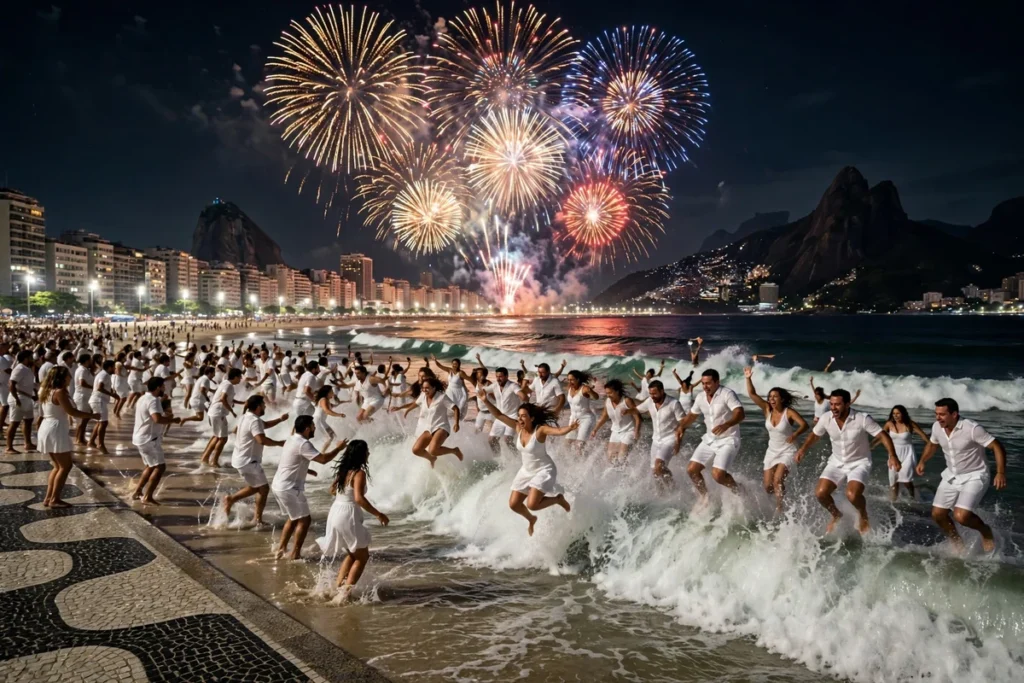
A sea of white on Copacabana beach — revellers jumping the waves as fireworks explode over Rio.
Watch: New Year in Brazil
Brazil’s New Year 2026 LIVE — spectacular fireworks over Copacabana Beach, Rio de Janeiro.
At a Glance: New Year in Brazil
Brazil’s essential New Year facts — the white, the waves and the goddess.
| Fact | Detail |
|---|---|
| White clothes | Wearing white honours Iemanjá, queen of the sea, and invites peace |
| Seven waves | Jumping seven waves at midnight — one per wave, with a wish each — is the classic ritual |
| Copacabana | Rio’s beach hosts one of the world’s biggest New Year parties, with fireworks over the bay |
| Flowers for Iemanjá | White flowers are cast into the sea as offerings |
| Lentils and grapes | Lentils for wealth and twelve grapes are also on many Brazilian tables |
Frequently Asked Questions
Why do Brazilians wear white on New Year’s Eve?
Wearing white on New Year’s Eve symbolizes peace, purity, and renewal for the coming year. The custom has roots in the Afro-Brazilian religions Candomblé and Umbanda, where white is the sacred color of Oxalá (the orixá of peace) and the ritual color of practitioners. Today the whole country wears white regardless of faith, and colored underwear or accessories underneath express specific wishes — yellow for wealth, red for passion, green for health.
What is the seven waves tradition in Brazil?
At midnight on New Year’s Eve, Brazilians go to the water’s edge and jump over seven consecutive waves, making a wish with each jump. The ritual honors Iemanjá, the Queen of the Sea in Afro-Brazilian religion. Tradition holds that after the seventh wave you must walk backward out of the water without turning your back on the sea until your feet are on dry sand.
Who is Iemanjá?
Iemanjá is the beloved orixá (deity) of the sea in the Afro-Brazilian religions Candomblé and Umbanda — the Queen of the Sea, protector of waters, and a maternal figure syncretized with the Virgin Mary in Catholic tradition. Her official feast day is February 2, but she receives her largest public homage on New Year’s Eve, when millions offer her flowers and jump seven waves in her honor.
What offerings do Brazilians give to Iemanjá?
The most common offerings are white flowers — especially gladioli and roses — tossed into the waves. Devotees also launch small boats loaded with gifts like mirrors, combs, perfumes, and jewelry. If the sea carries the offering away, it is read as acceptance and a good omen for the year; if the waves return it to shore, tradition says the goddess is displeased.
Why do Brazilians eat lentils on New Year’s Eve?
Lentils are eaten because their small, round shape resembles coins, making them a symbol of wealth and prosperity. Some regional customs call for eating seven spoonfuls of lentils while standing on something high — a chair or step — symbolizing rising fortunes. Related money rituals include keeping seven pomegranate seeds in your wallet all year.
Is Copacabana safe for New Year’s Eve?
Copacabana’s Réveillon is one of the world’s great parties, drawing millions, with heavy police and security presence — thousands of officers typically work the event. That said, it is an enormous, dense crowd at night: keep valuables to an absolute minimum, stay aware of your surroundings, arrange your return transport in advance, and be cautious in the water after drinking. Many visitors prefer the slightly calmer celebrations in Salvador, Florianópolis, or João Pessoa.
The New Year traditions in Brazil — white clothes and seven waves for Iemanjá — offer something rare: a New Year’s celebration that is simultaneously a massive party and a genuine spiritual practice. You can jump the waves as a lark and still feel, when the seventh wave breaks over you and the fireworks bloom above two million people in white, that you have taken part in something larger than a countdown. Whether you find yourself on Copacabana at midnight or borrowing the rituals for a New Year’s Eve at home, the formula holds: dress in white, face the water, jump seven times, and make your wishes count. If you are looking for the right words for those seven wishes, our collection of New Year wishes and messages will help. And if the beach-party energy calls to you, Argentina’s summer beach celebrations offer another Southern Hemisphere take on ringing in the year under the sun.