Strip away the venue, the menu, and the decorations from any naming ceremony, and what remains — the part guests actually remember — is the ritual. The candle lit with shaking hands. The tree planted in soft earth. The moment twenty people pressed inked thumbs onto a canvas and laughed through tears. Rituals are humanity’s oldest technology for marking what matters, and a naming ceremony without at least one is just a party with a baby present.
This guide is a field manual for choosing and performing naming ceremony rituals: what makes a ritual land emotionally (and what makes one fall flat), 24 meaningful rituals organized by element — light, water, earth, word, community, and modern inventions — with honest notes on cost, effort, and keepsake value, a chooser table to match rituals to your style, guidance on performing them without awkwardness, and a tour of naming rituals from world traditions you can honor respectfully. Whether you want one perfect candle or a ceremony woven from five symbolic acts, you’ll find your ritual here.
What Makes a Ritual Actually Work?
Not every symbolic act earns the name “ritual.” The difference between a moment that moves a room and one that feels like a craft project comes down to five qualities worth checking before you commit.
It involves the body. The most powerful rituals are physical: lighting, pouring, planting, pressing, tying, tasting. Abstract symbolism rarely moves people; embodied action does. If your ritual can be done entirely from a chair while reading, it is probably a reading, not a ritual — and that is fine, but don’t expect it to carry the ceremony’s emotional peak.
It produces something that lasts. The candle, the planted tree, the thumbprint canvas, the sealed time capsule — rituals that leave a tangible object extend the ceremony’s meaning across years. When choosing between two rituals you love equally, pick the one that leaves something behind. Future birthdays, nursery walls, and grown children asking “what’s this?” all argue for the keepsake.
It includes more than the parents. A ritual performed by two exhausted parents while everyone watches is a performance. A ritual that draws in grandparents, godparents, siblings, or the whole room is a communal act — and communal acts bond people. Design for participation: many hands on the shovel, many voices in the blessing, many thumbs on the canvas.
It can be explained in one sentence. “We light this candle to symbolize the light this child brings into our lives.” If the explanation needs a paragraph, the ritual is too clever. Guests should grasp the meaning instantly and feel it deeply — in that order.
It fits the setting. A sand ceremony on a windy beach is a comedy sketch; a fire ritual indoors is a fire hazard. Match the ritual to the venue, the weather, the baby’s temperament, and the crowd’s mobility. The right ritual in the wrong setting fails — the adequate ritual in the right setting soars.
Rituals of Light
Light is the oldest naming symbol there is — the child as a new light in the world — and light rituals photograph beautifully while remaining simple to perform.
1. The unity candle
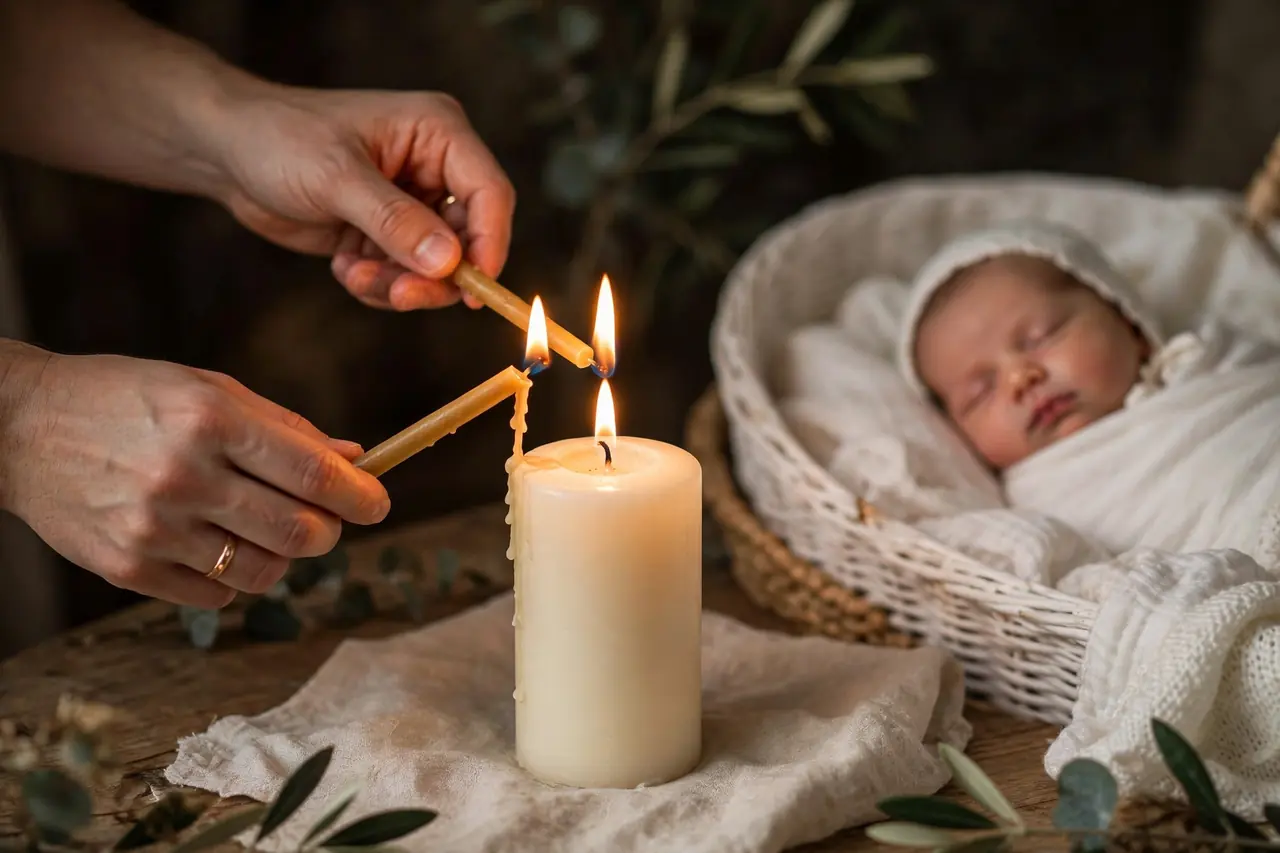
Two taper candles (representing the parents, or the two families) light one central pillar candle together. Speak a single sentence as the flames join: “From our two lives, one new light.” The pillar candle, personalized with the baby’s name and date, is relit on every birthday. Cost: under $30. Effort: minimal. Keepsake value: exceptional — this becomes a family heirloom.
2. The circle of candles
Each guest holds an unlit candle; the baby’s candle is lit first, then the flame is passed person to person around the room until everyone glows. Best done at dusk or indoors with dimmed lights. The visual — a whole room lit from one small flame — needs no explanation, though a single sentence (“one life, lighting many”) elevates it. Use dripless candles and have a fire-safe plan for children.
3. The lantern release (or lighting)
Guests write wishes on paper lanterns and light them together at dusk. Note: floating sky lanterns are banned in many areas for fire and wildlife reasons — check local regulations first, and consider the equally beautiful alternative of lighting stationary lanterns along the ceremony path instead. When in doubt, choose the stationary version; it is safer, legal everywhere, and photographs just as well.
4. The blessing flame passed hand to hand
A single lit candle is carried slowly around the gathered guests; each person holds it for a moment and speaks (aloud or silently) a blessing for the child before passing it on. The deliberate pace — this takes 10–15 minutes for a large group — creates a meditative hush that transforms the room’s energy. End by placing the candle beside the baby’s portrait, where it burns through the celebration.
Rituals of Water
Water signifies life, cleansing, and blessing across nearly every tradition — and water rituals have a tactile immediacy that guests find deeply moving.
5. The mingling of waters
Each family brings water from a meaningful source — a childhood home’s tap, a favorite river, the ocean, rainwater collected for the occasion — and pours it into a single beautiful vessel during the ceremony. The officiant explains: “Many streams, one river — many families, one child.” The mingled water can then be used to bless the baby (a drop on the forehead) or to water a newly planted tree, linking two rituals into one.
6. The blessing bowl
A wide, shallow bowl of water sits at the ceremony’s center. Guests approach one by one (or in a flowing line), dip their fingers, and touch a drop to the baby’s forehead — or simply hold their wet fingers over the baby in blessing — while speaking a silent or whispered wish. The physical gentleness of this ritual makes it ideal for elderly guests and young children, who can participate fully without words.
7. Rose petal water blessing
Float rose petals (or local flowers) on water in a large glass bowl as the ceremony’s centerpiece. During the naming moment, the parents lift the baby above the bowl and speak the name, then each gently sprinkles a few drops over the baby’s head. The visual is stunning — petals, water, light — and the bowl remains a gorgeous table centerpiece for the reception afterward.
8. The first bath blessing (private)
Not for the ceremony itself but for its quiet bookend: that evening, the parents give the baby a slow, warm bath “washing away” the excitement of the day while speaking blessings aloud. Some families add a drop of the ceremony’s mingled water to the bath. It is the most intimate ritual on this list — no audience, no photos needed — and parents describe it as the moment the day truly settled into memory.
Rituals of Earth
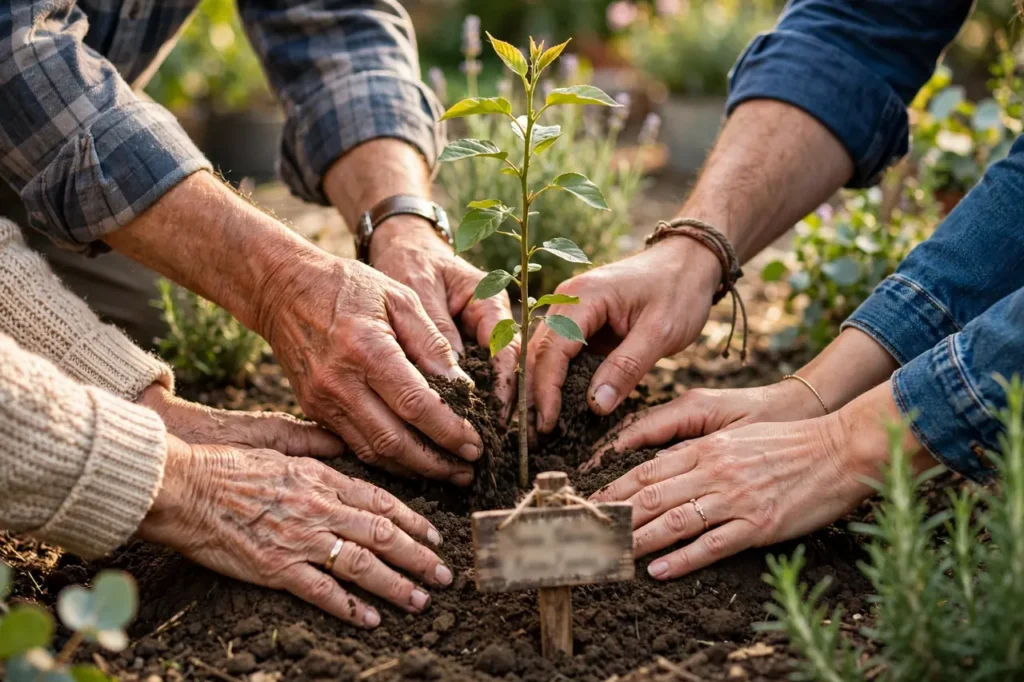
Earth rituals root the ceremony in place and growth — particularly powerful for outdoor celebrations, and beloved by families who want a living memorial.
9. Tree planting
The classic for good reason: during the ceremony, the family plants a young tree together, each generation adding soil or water, with a small plaque bearing the baby’s name and date. Choose a native species suited to the site so it thrives. If the venue isn’t yours, plant in a large container to take home and transplant later. The tree grows as the child grows — a metaphor so perfect it needs no explanation, though children delight in hearing it anyway.
10. The time capsule
Guests contribute small items — a newspaper front page, a letter, a photo, a playlist, predictions for the child’s future — into a sealed container buried or stored to be opened on a milestone birthday (the 18th is traditional; the 10th is more fun). Bury it with ceremony: let the children present dig the first scoop. Include a “do not open until” label and tell two responsible people where it is, because time capsules are famously lost.
11. Handprint and footprint clay
Press the baby’s handprint or footprint into air-dry clay during the ceremony, then invite grandparents and godparents to add their own prints around it. The result — tiny prints surrounded by the big ones — is almost unbearably poignant and becomes instant nursery art. Buy the kit in advance and do a practice press on the parents’ hands, because ceremony-day is not the moment to learn clay consistency.
12. Stone stacking (cairn building)
Provide smooth stones and paint pens; each guest writes a word or short blessing on a stone and adds it to a growing cairn during the ceremony. The finished stack — dozens of blessings in stone — can live in the garden permanently. This ritual is wonderfully inclusive: toddlers can carry stones, elderly guests can write from their seats, and nobody needs instructions beyond “write something you wish for this child.”
Rituals of Word and Keepsake
Some rituals live in language and objects — quieter than fire and water, but often the most treasured in retrospect.
13. The blessing book
A beautiful blank book is passed around during the celebration; each guest writes a blessing, hope, or piece of advice on their own page. Unlike a guest book signed in a receiving line, this one is written slowly, over food and conversation, and the entries show it — longer, funnier, more honest. Read one entry aloud each year on the child’s birthday until the book is done.
14. Letters to the future
Provide stationery and ask each guest to write a letter to the child, to be opened at age 18 (or 21). Seal them in individual envelopes into a keepsake box. The parents write the longest letters. Pro tip: include a self-addressed, stamped envelope for faraway guests who want to participate by mail — and set a deadline, because good intentions evaporate.
15. The name scroll
The baby’s full name is calligraphed (or beautifully hand-lettered by a talented friend) onto a scroll or fine art print, along with its meaning, origin, and the date. During the ceremony, the parents unroll it for all to see, then sign it alongside the godparents and grandparents as witnesses. Framed, it becomes the nursery’s centerpiece — the child’s identity, literally illuminated.
16. The quilt of wishes
Provide fabric squares and fabric markers; guests write or draw wishes on squares that are later sewn into a quilt (by a crafty relative or a commission service). The baby is wrapped in it for the ceremony’s final blessing. A quilt made of 30 people’s handwriting is an object of almost absurd sentimental power — start collecting squares early, because sewing takes time.

Rituals of Community
These rituals make the gathered community the ceremonial actor — ideal for families whose village showed up in force.
17. The naming circle
Guests form a circle around the family. The officiant speaks the baby’s full name, and the circle repeats it back in unison — then each person, going around, speaks one word they wish for the child (“joy,” “courage,” “wonder”). The accumulation of thirty sincere words, spoken aloud in sequence, is overwhelming. No props, no cost, no rehearsal — just voices, and it never fails.
18. The ribbon binding
Each guest holds a length of ribbon; the ribbons are tied together into one long strand that is gently looped around the gathered family (not tightly — symbolically) while the officiant speaks about the ties that bind. The knotted ribbon is kept as a keepsake. Use soft, wide ribbon in the ceremony’s colors, and pre-cut lengths to avoid a tangle that eats ten minutes.
19. The communal toast
More than a toast — a structured one. The host invites everyone to raise their glasses and, on the count of three, speak the baby’s name aloud together, followed by a shared sip. Simple? Yes. But thirty voices saying a newborn’s name in unison, followed by laughter and clinking glasses, creates a peak moment that professional event planners envy. Works with sparkling cider, obviously.
20. The promise web
Guests stand in a circle holding a ball of yarn; each person, after speaking a promise or blessing, tosses the ball (holding their strand) to someone across the circle. Within minutes a literal web of connection spans the group — a visible metaphor for the community holding this child. Photograph it from above if you can. Then carefully gather it as a keepsake, or cut strands for each guest to tie as bracelets.
Modern Invented Rituals
Tradition is just a ritual that worked — these are the new ones, invented by creative families in recent years, already proving their staying power.
21. The playlist of a life
Each guest contributes one song to “the soundtrack of [baby’s name]’s life” with a note explaining their choice. The compiled playlist becomes the ceremony’s background music and a gift the child inherits — imagine discovering at sixteen the songs thirty people chose for you before you could hear. Print the tracklist with the dedications as a keepsake booklet.
22. The first-book library
Instead of cards, each guest brings a beloved children’s book inscribed with a message to the baby. During the ceremony, the books are stacked into a tower and the baby is photographed “crowned” by literature. The child starts life with a real library, each book carrying a personal inscription — and guests love shopping for the perfect title far more than they love shopping for cards.
23. The fingerprint tree
A large art print of a bare tree is displayed; each guest presses an inked thumbprint onto the branches as a “leaf” and signs beside it. By ceremony’s end the tree blooms with dozens of colorful leaves — a collaborative artwork for the nursery wall. Use archival ink pads and have wipes ready; the only risk is enthusiastic toddlers, which is also the charm.
24. The video time capsule
Set up a quiet corner with a phone on a tripod and a prompt card (“Say [name] and tell them one thing about the world they were born into”). Guests record 30-second messages throughout the celebration. Edit into a single film — it takes an evening — and store copies in two places. Of all modern rituals, this one ages best: imagine the child watching it at eighteen, seeing their grandmother young and laughing.
Choosing Your Rituals: The Quick Guide
| Ritual | Vibe | Cost | Keepsake |
|---|---|---|---|
| Unity candle | Warm, classic | $ | The candle itself |
| Mingling of waters | Spiritual, elemental | $ | The vessel |
| Tree planting | Earthy, enduring | $$ | A living tree |
| Time capsule | Playful, forward-looking | $ | The capsule |
| Naming circle | Communal, powerful | Free | Memory + recording |
| Blessing book | Intimate, literary | $ | The book |
| Fingerprint tree | Joyful, visual | $ | Framed artwork |
| Video time capsule | Modern, emotional | Free | The film |
| Stone cairn | Grounded, inclusive | $ | Garden monument |
| Letters to the future | Tender, private | $ | The letter box |
Choose one primary ritual for the ceremony’s peak and optionally one secondary ritual for the celebration. More than two rituals in one event dilutes all of them — restraint is what makes each act feel significant rather than scheduled.
Watching traditional rituals performed — like the beautiful ceremony above — shows you the unhurried pacing that makes rituals work: notice how each act is given its own silence, how the officiant explains briefly and then steps back, and how the family’s attention stays on the act rather than the audience.
How to Perform Rituals Without Awkwardness
The gap between a moving ritual and an awkward one is almost entirely preparation. These practical rules prevent the fumbles:
Rehearse the mechanics once. Not the emotions — the logistics. Light the candle beforehand to check the wick. Pour the water to check the vessel doesn’t dribble. Press the clay to check the consistency. Every ritual has one physical failure mode; find it in rehearsal, not in performance.
Explain briefly, then begin. One sentence of meaning, then action. “We plant this tree so that as [name] grows, something living grows with them.” Long explanations before rituals kill momentum; the meaning deepens during the act, not before it.
Narrate gently while it happens. Silence during a ritual is powerful — but ten seconds of silence feels eternal to a nervous parent. The officiant can quietly narrate (“…and now grandmother adds the first soil”) to hold the room’s attention through slower moments. Think nature documentary, not sports commentary.
Have a wrangler. Designate one practical person to manage props: handing the officiant the candle, whisking away the water bowl, holding the baby while parents’ hands are busy. Rituals involve objects, objects need hands, and the parents’ hands are holding a baby. The wrangler is invisible when everything works and invaluable always.
Let imperfection stand. The candle gutters. The tree leans. The toddler eats a petal. These are not failures — they are the texture of a real ceremony, and they become the stories told at every future retelling. The only true ritual failure is rushing; everything else is character.
Naming Rituals from World Traditions
If your family carries one of these traditions, honor it fully and centrally — and if you’re borrowing from a tradition not your own, do so with study and respect, ideally guided by someone who lives it.
The whispered name (Hindu naamkaran). The father whispers the baby’s name into the right ear — traditionally written first in uncooked rice — while Vedic mantras are chanted. The intimacy of the whisper, the name’s first sounding meant only for the child, is profoundly moving even for observers unfamiliar with the tradition.
The adhan (Muslim tradition). The call to prayer is whispered into the newborn’s right ear, so the first words the child hears are the declaration of faith, with the iqamah in the left. Families celebrating a naming day often reenact or honor this moment within the larger gathering, pairing it with the announcement of the name’s meaning.
Water pouring (West African traditions). In many West African naming ceremonies, water is poured or sprinkled while the name is announced — sometimes with the officiant tasting the water first to symbolize that the name, like water, is essential and pure. The communal call-and-response that often accompanies it makes it one of the most participatory rituals in this guide.
The red thread (Chinese and East Asian influence). Adapted from the legend of the red thread of fate, family members tie red cords around the baby’s wrist (loosely, briefly) while speaking blessings of connection — the invisible ties that bind this child to their people. Guests can receive matching cords as favors, a tangible reminder of the day’s promise.
Anointing with oil (Christian baptism). The signing of the baby with sacred chrism oil — “sealed with the gift of the Holy Spirit” — is among the oldest continuously practiced naming rituals in the world. Its power lies partly in its antiquity: the same gesture, the same words, performed for nearly two thousand years. When including it, a brief explanation for unfamiliar guests multiplies its impact.
Frequently Asked Questions
How many rituals should a naming ceremony include?
One primary ritual, optionally one secondary. A single well-performed ritual becomes the ceremony’s signature moment; three or four in sequence make the event feel like a variety show and exhaust the audience’s emotional attention. If you love many rituals, assign the extras to the reception as stations guests can visit at leisure.
Can we invent our own ritual?
Absolutely — and you should, if nothing on this list feels like yours. The recipe: a physical action, a one-sentence meaning, participation beyond the parents, and something that lasts. Test it by explaining it to a friend in thirty seconds; if their eyes light up, you have a ritual. If they look confused, simplify.
What if our families have conflicting ritual traditions?
Include one ritual from each side, performed with equal honor and explained with equal care. The ceremony becomes a genuine weaving rather than a competition. Brief both families beforehand on what to expect and why it matters to the other side — understanding defuses nearly all tension, and most families are moved to see their traditions treated with respect.
Are rituals appropriate for a secular ceremony?
Completely. Rituals predate religion and belong to no single tradition — lighting candles, planting trees, and speaking promises are human acts, not sectarian ones. Frame them in universal language (light, growth, community, hope) and they carry full weight without any theological scaffolding. Some of the most moving naming rituals ever performed happened in backyards with no clergy present.
How do we keep toddlers engaged during rituals?
Give them a job: carrying a stone, holding a ribbon, pressing a thumbprint. Children engage through doing, not watching — a toddler with a task is a participant, while a toddler without one is a countdown timer. Keep rituals short, let imperfect participation stand, and never shush a child’s wonder; it is usually the most honest response in the room.
What do rituals cost on average?
Most rituals on this list cost between $0 and $50 — candles, clay kits, stones, paper, ribbon. The tree-planting and commissioned pieces (calligraphed scrolls, sewn quilts) run higher, roughly $50–$200. The emotional return on these small investments is absurdly high; rituals are the best value in the entire event budget.
Can rituals be adapted for a virtual ceremony?
Yes, with a “ritual kit” mailed ahead: a candle, a stone, a card for the blessing book. During the livestream, everyone performs the act simultaneously — lighting candles together across twelve time zones is genuinely moving. Keep the mechanics dead simple (anything requiring precise timing across video lag will frustrate), and have the host narrate clearly.
What if a ritual goes wrong during the ceremony?
It will, in some small way, and it will be fine — usually better than fine. The candle won’t light on the first try; the tree will list sideways; someone will pour water on the wrong spot. Smile, fix it, move on. Guests don’t remember flawless rituals; they remember human ones. The only true failure is visible panic, so rehearse the mechanics and then release the outcome.
Choose the Act That Chooses You Back
Read through these 24 rituals once more and notice which one your mind keeps returning to — the one you can already picture, the one that made your throat tighten slightly. That is your ritual. Trust the tug; it is usually the right one, because the rituals that move us are the ones already entangled with our own story.
Then give it the only things it needs: a little rehearsal, a one-sentence explanation, and the courage to perform it slowly, in front of everyone you love, with your whole attention on the small human at the center of it all. Do that, and the ritual will do the rest — it will take ten ordinary minutes and make them unforgettable. For more ways to mark the milestones, explore our Baby & Children celebrations, these baby’s first Halloween ideas, and practical tips for traveling with your baby as the adventures begin.