Every well-dressed man you know owns roughly the same set of clothes. Not the same brands, not the same budget — the same categories. That is the open secret of menswear: a small set of men’s wardrobe essentials covers nearly every situation, from job interviews to weekend errands, as long as the pieces fit well and work together. This guide covers exactly what those essentials are, how to choose each one, and how to combine them into outfits without thinking too hard about it.
No trend-chasing, no 47-piece checklists. Just the core pieces that earn their place, the fit rules that make cheap clothes look expensive, and a simple system for getting dressed well every day.
The Philosophy: Fewer, Better, Coherent
Menswear rewards restraint. Unlike womenswear, where silhouettes change dramatically season to season, the fundamental shapes of men’s clothing — the button-down shirt, the chino, the blazer, the boot — have been stable for decades. That stability is your advantage: buy the right version once, and it serves you for years.
Three principles govern everything below:
- Fit is 80 percent of style. A $30 shirt that fits your shoulders, chest, and sleeve length looks better than a $200 shirt that does not. Tailoring is the highest-ROI money in menswear.
- Neutral colors multiply combinations. Navy, gray, white, black, brown, and olive mix freely. One burgundy or forest-green piece adds personality without breaking the system.
- Cost per wear beats sticker price. A $180 pair of boots worn 300 times costs $0.60 per wear. A $60 pair that falls apart in a year costs more. Buy the best version you can afford of the things you wear most.
The Essential Tops
1. Plain Crew-Neck T-Shirts (3–4)
The foundation of casual dressing. Choose white, black, navy, and gray or olive. Look for mid-weight cotton (around 180–220 GSM) that holds its shape — tissue-thin tees look cheap and wear out fast. The fit: shoulders at your shoulder bones, sleeves ending mid-bicep, body skimming the torso without clinging or billowing. A good tee works alone, under an overshirt, or under a blazer for smart-casual settings.
2. Oxford Cloth Button-Down Shirts (2–3)
The most versatile shirt a man can own. White and light blue are mandatory; a third in a subtle pattern (university stripe, micro-check) adds range. Oxford cloth’s texture dresses down naturally, so the same shirt works tucked into chinos for the office and untucked over jeans on weekends. Button-down collars stay in place without a tie — a small detail that keeps casual looks tidy.
3. Polo Shirts (2)
The step between a tee and a button-down. Navy and white (or gray) cover it. Modern polos with a structured collar and a trim — not tight — fit look sharp; the baggy golf-course polo of the 2000s does not. Wear with chinos and loafers for a put-together weekend look.
4. Casual Button-Up Shirts (2)
Flannel for cold months, linen for warm ones. These are your untucked-over-tee shirts, your rolled-sleeve summer shirts, your layered-under-a-sweater shirts. One solid and one pattern (plaid, subtle print) give you range without clutter.
The Essential Bottoms
5. Dark-Wash Jeans (1–2)
Dark indigo or black jeans with no distressing are the hardest-working bottoms in menswear — acceptable nearly everywhere short of formal events. Straight or slim-straight cuts suit most bodies; avoid anything so tight it restricts movement or so loose it pools at the shoe. Raw or selvedge denim lasts years and fades beautifully if you are willing to break it in; quality stretch denim is the pragmatic choice for most men.
6. Chinos (2)
Khaki/tan and navy (or olive). Chinos bridge the gap between jeans and dress trousers — appropriate for business-casual offices, dinners, and dates. Flat-front, mid-rise, with a slight taper reads modern without chasing trends. They should sit at the waist without a belt holding them up and break just once at the shoe.
7. Tailored Trousers (1)
One pair of gray or navy wool-blend trousers covers interviews, weddings, funerals, and any event with “dress code” in the invitation. Get these tailored even if nothing else in your closet is — the difference between off-the-rack and hemmed-and-tapered trousers is the difference between looking okay and looking sharp.
8. Shorts (1–2, seasonal)
For warm climates: tailored chino shorts in khaki and navy, hitting just above the knee. Athletic shorts live in the gym bag, not the wardrobe count.
The Essential Layers
9. Navy Blazer (1)
The single highest-leverage item in this entire guide. A well-fitting navy blazer — single-breasted, two buttons, patch or flap pockets — elevates jeans and a tee to date-night, sharpens chinos for the office, and pairs with gray trousers for events. Look for half-canvassed construction if your budget allows; it drapes better and lasts longer than fused jackets. This is the piece most worth tailoring.
10. Crew-Neck Sweater (2)
Merino wool in navy and gray (or charcoal). Merino regulates temperature, resists odor, and looks refined — it layers over button-downs, under blazers, or stands alone. Avoid chunky acrylic knits that pill after three washes; a mid-gauge merino sweater at a fair price outperforms them for years.
11. Versatile Jacket (1–2)
Pick based on climate and lifestyle: a Harrington or bomber for mild weather, a field jacket for rugged casual, a leather jacket if it suits your style. One good jacket you reach for daily beats three you forget. For cold climates, add a proper winter coat — wool overcoat for dressier needs, insulated parka for real winter.
12. Lightweight Overshirt or Overshirt-Jacket (1)
The modern layering workhorse: worn open over a tee like a jacket, or buttoned as a shirt. Olive, charcoal, or navy in cotton twill or flannel. It adds structure to casual outfits with zero effort.
The Essential Shoes
13. White Minimalist Sneakers (1)
Clean white leather sneakers go with jeans, chinos, and even casual tailoring. Keep them clean — a magic eraser and ten minutes weekly. Our guide to the best sneakers breaks down the options by use case and budget.
14. Brown Leather Shoes (1)
Choose based on lifestyle: loafers for business casual, derby shoes or brogues for dressier needs, Chelsea boots for the style-conscious. Brown is more versatile than black for most wardrobes — it pairs with navy, gray, khaki, and denim. One quality pair, resoled when needed, outlasts five cheap pairs.
15. Boots (1, climate-dependent)
Desert boots, chukkas, or Chelsea boots in suede or leather handle fall through spring and add instant polish to jeans-and-sweater outfits. Waterproof them if your climate demands it.
16. Athletic Shoes (1)
Actual athletic shoes for actual athletics — running, gym, sports. Keeping these separate from your fashion sneakers extends the life of both.
The Essential Accessories
17. A Good Watch (1)
You do not need a luxury timepiece. A clean, simple watch — 38–42mm case, leather or metal strap — finishes every outfit. It is the one accessory visible in nearly every context, including short sleeves.
18. Belts (2)
One brown leather, one black leather, widths matched to your trousers’ loops. The old rule holds: match belt to shoes, roughly.
19. Socks and Underwear (the unglamorous foundation)
Enough quality pairs to never think about them: mid-calf dress socks in navy, gray, and black; no-show socks for sneakers; underwear in fabrics that survive washing. Replace annually — worn-out basics undermine everything above them.
20. Cold-Weather Accessories (seasonal)
A wool scarf, simple beanie, and leather gloves in dark neutrals. Inexpensive, transformative in winter photos and in person.
Fit Rules: The Details That Matter
Essentials only work if they fit. Memorize these checkpoints and use them in every fitting room:
| Garment | Fit Checkpoint | Tailor-Fixable? |
|---|---|---|
| Dress shirts | Shoulder seam at shoulder bone; one finger between neck and collar; cuffs end at wrist bone | Sleeves, body taper — yes; shoulders — no |
| Jeans / trousers | Sit at waist without belt; single break at shoe; no pulling at pockets | Hem, taper, waist — yes |
| Blazer | Shoulders lie flat; lapels lie flat on chest; sleeves show ¼–½ inch of shirt cuff | Sleeves, waist suppression — yes; shoulders — effectively no |
| T-shirts | Shoulder seam at bone; sleeve hits mid-bicep; hem ends mid-fly | Not worth it — buy the right size |
| Shoes | Thumb’s width at toe; heel snug with no slip; widest foot part at shoe’s widest point | No — fit must be right off the shelf |
The tailor rule of thumb: shoulders on jackets and the seat of trousers must fit off the rack, because altering them is expensive or impossible. Almost everything else — hems, tapers, sleeve length, waist suppression — is cheap and routine. A $25 alteration budget per garment transforms mid-range clothes into a custom-looking wardrobe.
Outfit Formulas: 10 No-Think Combinations
With the essentials above, these formulas cover two weeks without repeating:
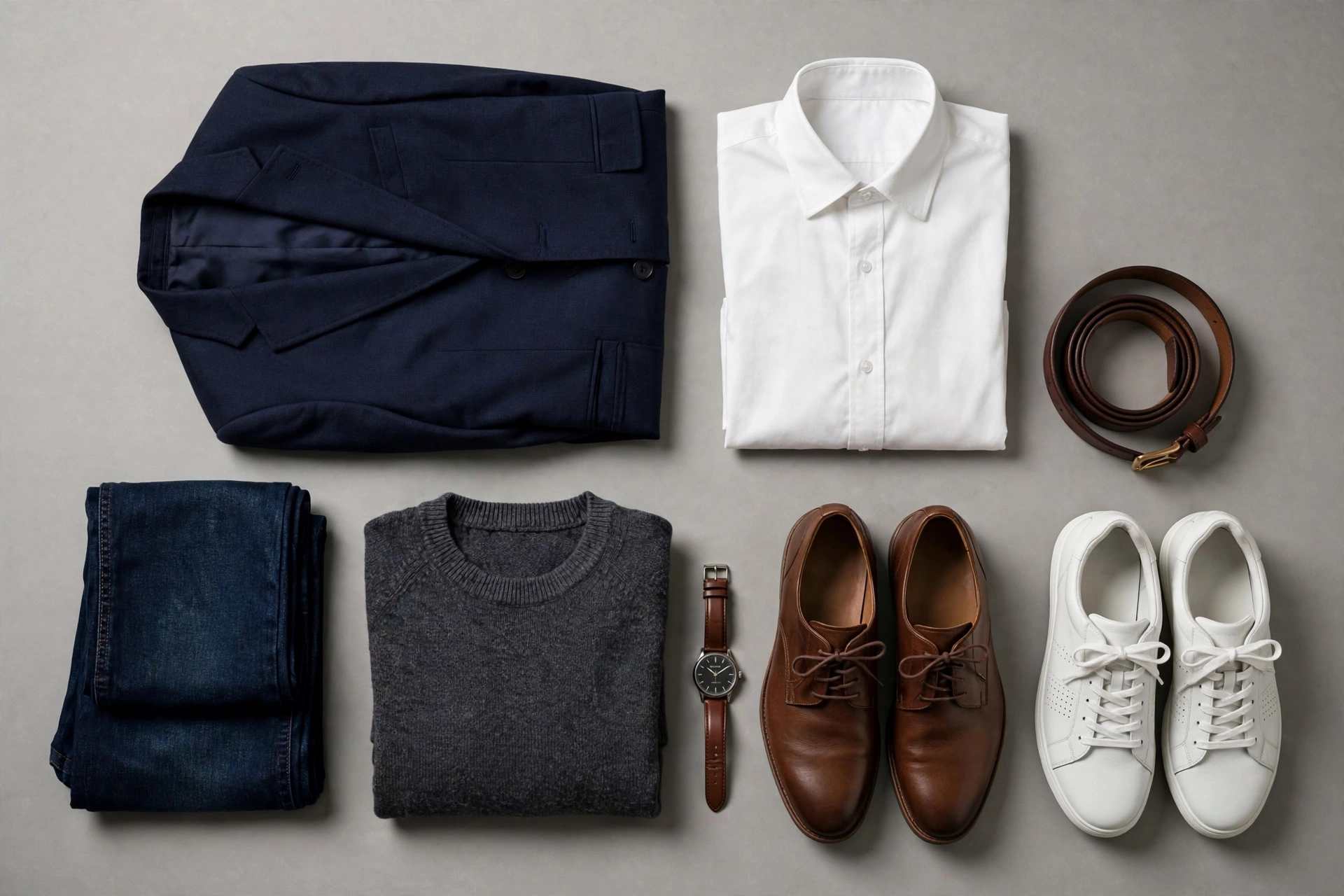
- Smart casual default: Navy blazer + white oxford + dark jeans + brown loafers
- Office business-casual: Light blue oxford + navy chinos + brown derbies + watch
- Weekend errands: Gray crew tee + dark jeans + white sneakers
- Date night: Black crew sweater + dark jeans + Chelsea boots
- Summer day: Linen shirt (sleeves rolled) + khaki chino shorts + clean sneakers
- Fall uniform: Flannel shirt + olive overshirt + dark jeans + boots
- Winter layered: Merino sweater over oxford + wool trousers or dark jeans + overcoat + boots
- Travel day: Navy polo + stretch chinos + white sneakers + light jacket
- Interview / formal: Navy blazer + white shirt + gray trousers + brown dress shoes + simple tie
- Evening out: Black tee + black jeans + leather jacket + Chelsea boots (monochrome, minimal effort, maximum effect)
Notice the pattern: each formula is 3–4 essentials plus shoes. When every piece coordinates, getting dressed is combinatorial, not creative — which is exactly the point.
Building It on a Budget: The Priority Order
You do not need all twenty items tomorrow. Buy in order of impact-per-dollar:
- Shoes first. People notice shoes more than any other item, and good shoes transform cheap outfits while cheap shoes ruin good ones. White sneakers + brown leather shoes cover 90 percent of life.
- Bottoms second. Dark jeans and one pair of chinos that fit perfectly.
- Tops third. Plain tees and two oxfords.
- The blazer fourth. The force multiplier — save for a good one and tailor it.
- Layers and the rest. Fill in seasonally, one quality piece at a time.
Thrift stores are goldmines for blazers, wool sweaters, and leather shoes — the expensive-when-new categories where secondhand quality beats new fast fashion. For new basics at fair prices, see our roundup of the best online clothing stores and, for brand-level guidance, the best clothing brands for men.
Seasonal Adjustments
The essentials list is year-round, but a few seasonal swaps keep it working in extreme weather:
- Summer: Trade the merino sweater for a lightweight knit or an extra linen shirt, swap boots for clean canvas sneakers or loafers without socks, and add tailored shorts. Linen shirts are the warm-weather cheat code — breathable, wrinkle-tolerant in a good way, and sharper than any tee.
- Winter: Add a proper overcoat or insulated parka, swap the overshirt for a heavier flannel or quilted layer, and make sure one pair of boots can handle slush. Thermal base layers under trousers extend every outfit’s range without changing how you look.
- Rain: A water-resistant jacket and shoes that survive puddles protect the rest of the wardrobe. Suede is beautiful and fragile — save it for dry days.
The rule stays the same across seasons: each seasonal piece should work with at least three year-round pieces, or it does not earn its place.
Care and Maintenance: Protect the Investment
A wardrobe of essentials only pays off if the pieces last. The basics:
- Wash less, wash cold. Jeans rarely need washing — spot-clean and air out. Wash everything else cold and inside-out to preserve color and fabric.
- Hang knits folded, not hung. Hanging stretches sweater shoulders; fold them. Hang shirts and jackets on wide wooden hangers.
- Rotate shoes. Never wear the same leather shoes two days running — they need 24 hours to dry and recover. Shoe trees are a $20 investment that doubles shoe life.
- Repair, don’t replace. Re-heel shoes, mend seams, replace buttons and zippers. A cobbler and a tailor cost less than replacements and keep broken-in pieces in service.
- Store seasonally. Clean wool and store with cedar to prevent moth damage. Off-season clothes in breathable containers, not plastic bags.
Mistakes That Undermine Good Essentials
- Wearing athletic clothes as casual clothes. Gym shoes, performance tees, and basketball shorts outside the gym read as “didn’t try.” The essentials above take the same effort and look infinitely better.
- Logos and graphics overload. One graphic tee is personality; a wardrobe of them is a billboard collection. Essentials should be mostly solid.
- Ignoring the mirror below the waist. Men obsess over shirt fit and neglect trouser break and shoe condition — yet that is where the eye lands.
- Buying for a fantasy life. The tuxedo-adjacent suit for galas you never attend, the hiking boots for hikes you never take. Buy for the calendar you have.
- Skipping the tailor. Off-the-rack is a starting point, not a finished product. Budget alterations into every significant purchase.
Frequently Asked Questions
How many clothes does a man actually need?
Around 25–35 pieces covers nearly every man: the 20 essentials in this guide plus seasonal items and a few personal-preference pieces. Most men already wear only 20–30 items regularly — this guide just makes those items the right ones.
What colors should a man’s wardrobe focus on?
Navy, gray, white, black, brown, and olive form the core — every combination works. Add one or two accent colors you like (burgundy, forest green, dusty blue) in tops and accessories for personality.
How much should I spend building a wardrobe?
A solid essentials wardrobe can be built for $800–$1,500 over several months if you shop sales and thrift the expensive categories (blazer, shoes, coats). Prioritize shoes, bottoms, and the blazer — spend less on tees and casual shirts, which are easily replaced.
Do I need a suit?
A navy blazer plus gray trousers handles most situations that once required a suit. If your career or social life includes formal events, add one well-tailored navy or charcoal suit — but for many men, the blazer-trouser combination is the more useful investment.
How do I know if clothes fit properly?
Use the fit table above as a fitting-room checklist. The two non-negotiables: jacket shoulders must fit off the rack, and trousers must sit at your waist without a belt doing the work. Everything else can be tailored.
Where should I buy men’s basics?
Start with retailers known for consistent sizing and decent fabrics at fair prices — our best online clothing stores roundup covers the strongest options, and the best clothing brands for men guide goes deeper by style and budget.
Men’s style is not complicated — it is disciplined. Get the essentials right, get them tailored, keep them maintained, and you will be the best-dressed man in most rooms you enter, without ever thinking about clothes for more than five minutes a morning.
Men’s Wardrobe Essentials: Frequently Asked Questions
How many pieces do I actually need for a complete men’s wardrobe?
A functional men’s wardrobe can be built on roughly 25 to 35 pieces, including shoes and outerwear. The formula that works for most men is seven to ten tops, four to five pairs of trousers, two to three layers like sweaters or overshirts, one blazer, one versatile jacket, and four to five pairs of shoes. This capsule is enough to dress well for work, weekends, and evenings out without decision fatigue. The key is not the number but the coordination: every piece should work with nearly every other piece, which is why neutral colors dominate the essentials list. Start with the core neutrals — navy, gray, white, brown, olive — and add color only after the foundation is solid.
Should I buy expensive basics or save money on the essentials?
Spend more on the pieces that take the most abuse and sit closest to your skin: shoes, outerwear, and trousers. A well-made pair of leather shoes can be resoled and last a decade, while cheap shoes fall apart in a year and look worse every month. Save on t-shirts, socks, and underwear, where quality differences are marginal and replacement is frequent. The middle ground — shirts, sweaters, jeans — deserves mid-range spending: good fabric and construction that survive dozens of washes. As a rule of thumb, cost-per-wear is the metric that matters. A $300 blazer worn 100 times costs $3 per wear; a $60 blazer that loses its shape after 10 wears costs $6 per wear and looks worse doing it.
How important is tailoring for off-the-rack clothing?
Tailoring is the single highest-impact upgrade most men can make. Even a $30 hem and taper on trousers or taking in the waist of a shirt transforms how off-the-rack clothes look on your body. The areas worth altering are sleeve length, trouser length and taper, and shirt waist suppression. What tailoring cannot fix is shoulders — if a jacket’s shoulders don’t sit right, put it back. Find a local tailor, bring one garment at a time, and learn what each alteration costs in your area. Most men are surprised that 80 percent of the “he always looks sharp” effect comes from fit, not price tags.