Korean Curry Recipes: 15 Comforting Bowls
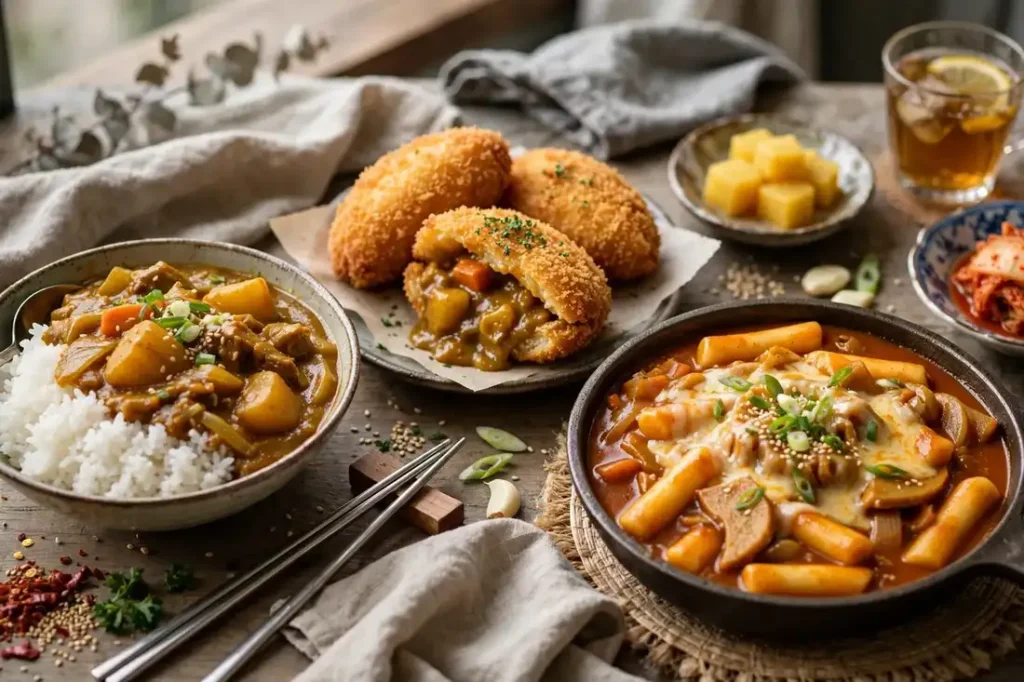
Korean curry (ka-re) is its own delicious thing — milder and sweeter than Indian or Japanese curry, thick with potatoes, carrots, and onions, served over rice with kimchi on the side. It is Japanese curry’s Korean cousin, adapted over decades into pure comfort food.
These fifteen recipes span the Korean curry world: the classic pork-and-potato ka-re rice, curry udon, curry tteokbokki fusion, and creative riffs — plus how to build the roux from scratch. Each recipe includes the authentic technique notes — the gochujang balance, the sesame oil finish, the banchan that belong alongside — so your Korean cooking tastes like the real thing, not an approximation.
The Korean curry roux block (Ottogi is the classic brand) is the weeknight shortcut; the from-scratch roux is the weekend project. Both are here.
15 Korean Curry Recipes
From the classic ka-re rice to fusion experiments.
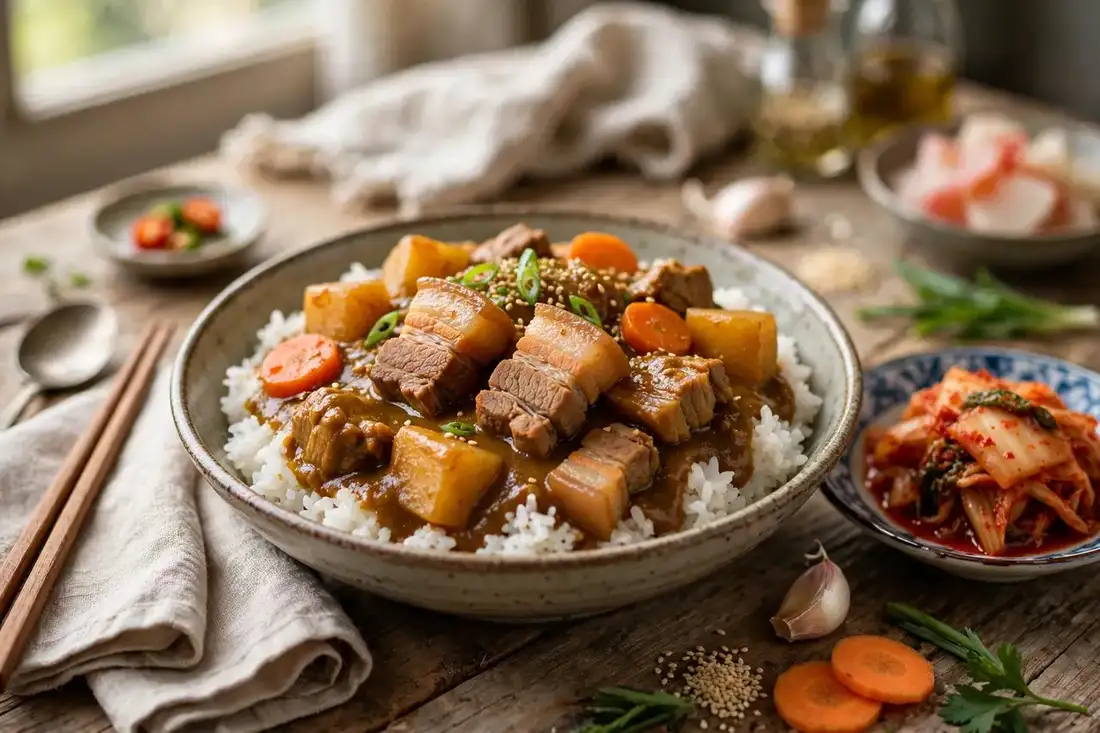
Classic Pork Ka-re Rice
The definitive Korean curry: tender pork, potatoes, carrots, and onions in sweet-savory curry over rice — with kimchi alongside.
Time: 45 minutes | Servings: 4 servings | Good to know: The classic
Ingredients:
- 1 lb pork shoulder, cubed
- 2 potatoes, chunked
- 2 carrots, chunked
- 1 onion, chunked
- 1 box Korean curry roux
- 4 cups water
- Rice and kimchi to serve
How to make it:
- Brown pork.
- Add vegetables and water; simmer 20 minutes.
- Stir in roux blocks; simmer 10 minutes until thick.
- Serve over rice with kimchi.
Pro tip: Break the roux into small pieces — it melts faster and smoother.
Chicken Curry Rice
Lighter than pork but just as comforting — chicken thighs in the same sweet-savory curry.
Time: 40 minutes | Servings: 4 servings | Good to know: Weeknight
Ingredients:
- 1 1/2 lbs chicken thighs
- Potatoes, carrots, onion
- Korean curry roux
- Rice and danmuji
How to make it:
- Brown chicken.
- Simmer vegetables 15 minutes.
- Add roux; thicken 10 minutes.
- Serve over rice with pickled radish.
Pro tip: Thighs stay juicy; breasts dry out in the simmer.
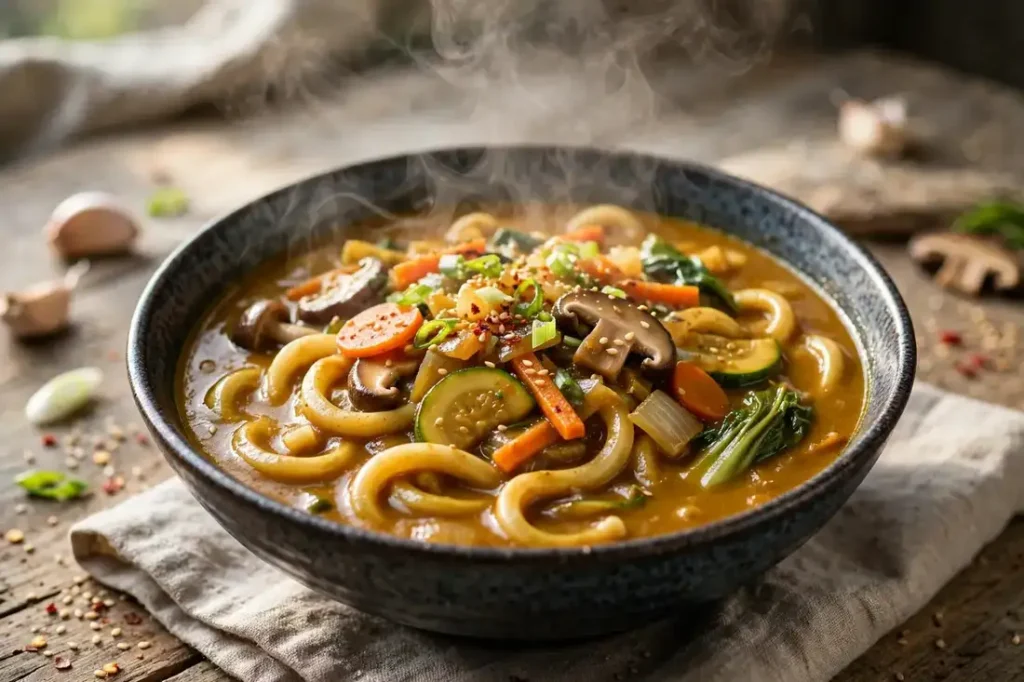
Curry Udon
Thick udon noodles in rich curry broth — the slurpable Japanese-Korean crossover.
Time: 30 minutes | Servings: 4 servings | Good to know: Slurpable
Ingredients:
- 4 portions udon noodles
- Pork or chicken, sliced
- Onion, carrots
- Curry roux + dashi broth
- Scallions
How to make it:
- Simmer protein and vegetables in dashi.
- Melt in roux.
- Add cooked udon; simmer 5 minutes.
- Top with scallions.
Pro tip: The broth should coat the noodles — thicker than soup, thinner than sauce.
Curry Tteokbokki
The fusion snack: chewy rice cakes in curry sauce instead of gochujang — mild, comforting, addictive.
Time: 25 minutes | Servings: 4 servings | Good to know: Fusion
Ingredients:
- 1 lb tteok (rice cakes), soaked
- Curry roux + water
- Fish cakes
- Scallions
- Sesame oil
How to make it:
- Simmer tteok in water 5 minutes.
- Stir in roux; add fish cakes.
- Simmer until thick and glossy.
- Finish with sesame oil.
Pro tip: Soak refrigerated tteok 20 minutes — they cook evenly instead of cracking.
From-Scratch Curry Roux
The weekend project: butter-flour roux with curry powder, garam masala, and honey — better than the box.
Time: 30 minutes | Servings: Makes 1 batch | Good to know: Pantry
Ingredients:
- 6 Tbsp butter
- 6 Tbsp flour
- 3 Tbsp curry powder
- 1 Tbsp garam masala
- 1 Tbsp honey
- 2 tsp soy sauce
How to make it:
- Cook butter and flour 10 minutes to peanut color.
- Stir in spices 2 minutes.
- Add honey and soy.
- Cool; use like box roux or freeze.
Pro tip: The color of the roux determines the depth — go darker than you think.
Beef Curry Rice
Hearty beef curry with the long simmer the cut deserves — chuck becomes spoon-tender.
Time: 1 hour 30 min | Servings: 6 servings | Good to know: Weekend
Ingredients:
- 3 lbs beef chuck
- Potatoes, carrots, onion
- Curry roux
- Beef broth
How to make it:
- Brown beef in batches.
- Simmer 1 hour until tender.
- Add vegetables 20 minutes.
- Melt in roux; thicken.
Pro tip: Low and slow — the beef should yield to a spoon.
Curry Bread (Ka-re Pan)
Japanese-Korean bakery favorite: curry-filled bread, breaded and fried (or baked) — the portable curry.
Time: 2 hours | Servings: 12 buns | Good to know: Bakery
Ingredients:
- Bread dough
- Thick curry filling (cooled)
- Panko
- Egg wash
How to make it:
- Make thick curry; cool completely.
- Wrap in dough balls.
- Egg wash; panko coat.
- Fry 3–4 minutes or bake 20 minutes.
Pro tip: The filling must be thick and cold — runny filling bursts the buns.
Vegetable Curry Rice
The meatless ka-re: mushrooms, sweet potato, and chickpeas in the same comforting curry.
Time: 40 minutes | Servings: 4 servings | Good to know: Vegetarian
Ingredients:
- Mushrooms, sweet potato, chickpeas
- Onion, carrots
- Curry roux
- Rice and kimchi
How to make it:
- Sauté mushrooms deeply.
- Simmer vegetables 15 minutes.
- Melt in roux.
- Serve over rice.
Pro tip: Brown the mushrooms hard — they are the meaty depth here.
Curry Ramyeon
Instant noodles upgraded: ramyeon in curry broth with egg and cheese — the late-night legend.
Time: 15 minutes | Servings: 2 servings | Good to know: Late-night
Ingredients:
- 2 packs ramyeon
- Curry powder or roux
- 2 eggs
- Cheese slices
- Scallions
How to make it:
- Boil noodles 3 minutes.
- Stir in curry.
- Crack in eggs; top with cheese.
- Melt and slurp.
Pro tip: The cheese slice is not optional — it is the dish.
Seafood Curry Rice
Shrimp and mussels in a lighter curry — the coastal ka-re.
Time: 35 minutes | Servings: 4 servings | Good to know: Coastal
Ingredients:
- Mixed seafood
- Potatoes, carrots
- Curry roux (mild)
- Fish stock
- Rice
How to make it:
- Simmer vegetables in stock 15 minutes.
- Melt in roux.
- Add seafood last 5 minutes.
Pro tip: Seafood goes in last — it overcooks in the simmer.
Curry Kimbap
Kimbap rolls with curry-seasoned rice — the picnic upgrade.
Time: 45 minutes | Servings: 4 rolls | Good to know: Picnic
Ingredients:
- Sushi rice + curry powder
- Nori
- Fillings: egg, spinach, carrot, danmuji
- Sesame oil
How to make it:
- Season rice with curry powder and sesame oil.
- Roll with fillings.
- Slice; pack for picnic.
Pro tip: Cool the rice before rolling — hot rice steams the nori soggy.
Leftover Curry Croquettes
Crispy fried croquettes from leftover curry rice — the next-day magic.
Time: 40 minutes | Servings: 12 croquettes | Good to know: Leftovers
Ingredients:
- 3 cups leftover curry rice
- Flour, egg, panko
- Oil for frying
How to make it:
- Chill the rice (it firms).
- Form balls; bread.
- Fry 3–4 minutes until golden.
Pro tip: Cold rice is structural — warm rice falls apart in the fryer.
Curry Donkatsu
Crispy pork cutlet with curry sauce poured over — the Korean-Japanese comfort plate.
Time: 40 minutes | Servings: 4 servings | Good to know: Crispy
Ingredients:
- Pork loin cutlets
- Panko breading
- Curry sauce
- Rice, cabbage salad
How to make it:
- Bread and fry cutlets.
- Make curry sauce.
- Slice cutlets; pour curry over.
- Serve with rice and cabbage.
Pro tip: Rest the cutlets 3 minutes before slicing — the crust sets and stays crisp.
Curry Gnocchi
The fusion experiment: pillowy gnocchi in Korean curry sauce — carb-on-carb comfort.
Time: 30 minutes | Servings: 4 servings | Good to know: Fusion
Ingredients:
- Potato gnocchi
- Curry sauce
- Parmesan
- Scallions
How to make it:
- Make curry sauce.
- Boil gnocchi until they float.
- Toss; top with parmesan and scallions.
Pro tip: Pan-fry the boiled gnocchi 2 minutes for crispy edges — worth it.
Dry Curry Rice
The drier, spicier style: curry-seasoned fried rice with pork and vegetables.
Time: 25 minutes | Servings: 4 servings | Good to know: Dry style
Ingredients:
- Day-old rice
- Ground pork
- Curry powder
- Vegetables
- Fried egg to top
How to make it:
- Brown pork with curry powder.
- Add vegetables.
- Add rice; fry until toasted.
- Top with fried egg.
Pro tip: Day-old rice fries; fresh rice steams — plan ahead.
Korean Curry Tips
The roux block is a legitimate ingredient, not a compromise — Korean home cooks use it proudly. Ottogi Mild is the classic; Hot for the brave. The from-scratch roux is a fun project, but the box delivers 90% of the joy for 10% of the work. No shame in the shortcut.
Kimchi alongside is not optional — the sour crunch cuts the curry’s richness and completes the meal. Danmuji (pickled radish) is the other traditional partner. The curry is only half the dish; the pickles are the other half.
- Stock the Korean pantry: gochujang, gochugaru, soy sauce, sesame oil, rice vinegar, and danmuji are the foundation.
- Sesame oil is a finishing oil, not a cooking oil — add it off heat for aroma.
- Rice is the center: invest in a rice cooker and good short-grain rice; everything else orbits it.
- Taste constantly and balance: Korean food lives in the sweet-salty-spicy triangle.
- Banchan (side dishes) make the meal — even two simple ones transform dinner.
- The table is interactive: ssam wraps, stews served bubbling, lettuce for wrapping everything.
Korean Curry Guide
Roux levels and their best uses.
| Curry Style | Heat | Best For | Serve With |
|---|---|---|---|
| Ottogi Mild | Gentle | Kids, beginners | Rice + kimchi |
| Ottogi Medium Hot | Medium | The standard | Rice + danmuji |
| Ottogi Hot | Spicy | Heat lovers | Rice + kimchi |
| From-scratch roux | Adjustable | Weekend project | Rice + pickles |
| Curry udon | Medium | Noodle lovers | Scallions |
| Curry tteokbokki | Mild-medium | Snack | Sesame oil |
| Seafood curry | Mild | Pescatarian | Rice + lemon |
| Vegetable curry | Mild | Meatless Monday | Rice + kimchi |
| Curry ramyeon | Medium | Late night | Egg + cheese |
| Curry bread | Mild | Bakery | As snack |
| Curry kimbap | Mild | Picnic | As is |
| Croquettes | Medium | Leftovers | Tonkatsu sauce |
| Curry Donkatsu | Medium | Cutlet + curry | Rest before slicing |
| Curry Gnocchi | Medium | Fusion | Pan-fry gnocchi |
| Dry Curry Rice | Spicy | Fried rice | Day-old rice |
Key Ingredients: The Korean Curry Pantry
Korean curry is weeknight comfort built on a few Japanese-influenced staples.
Korean curry roux (Ottogi vs. S&B)
The roux block is the heart of Korean curry — and the brand choice shapes the result. Ottogi (Korean) is sweeter and milder, with a distinctly Korean flavor profile; S&B (Japanese) is more savory and complex, with deeper spice notes. Within Ottogi: Mild (the children’s and beginner’s choice — gentle, sweet), Medium Hot (the standard — balanced warmth), Hot (genuinely spicy). The blocks are pre-portioned (break along the scored lines); one box (8 servings) needs about 5½ cups of liquid. Store opened boxes airtight — the blocks absorb moisture and odors. And the from-scratch roux here replicates the block’s function (fat + flour + spices) with better flavor — the weekend upgrade.
Potatoes (the curry sponge)
Potatoes are not filler in Korean curry — they are essential: their starch thickens the sauce naturally, and their mild flesh absorbs the curry flavor like a sponge. The variety matters: waxy potatoes (Yukon Gold — the ideal) hold their shape through the simmer; starchy russets disintegrate (which thickens more but loses the chunks). Cut large (1½-inch chunks — small pieces dissolve); add them with the other vegetables (they need the full simmer to cook through and absorb). The potato that has simmered 20 minutes in curry — creamy inside, curry-stained outside — is the bite people remember. Do not skimp; the curry needs its potatoes.
Kimchi (the mandatory side)
Kimchi alongside Korean curry is not optional — it is structural. The curry is rich, sweet, and mild; the kimchi is sour, funky, and crunchy — the contrast cuts the richness and resets the palate between bites. This is the Korean meal-composition principle: the rich main needs the sharp side. Aged (sour) kimchi works best here (its acidity is more pronounced); fresh kimchi is fine but milder. And the danmuji (yellow pickled radish) — the sweet-crunchy traditional curry accompaniment — adds another textural dimension. The curry is half the dish; the pickles are the other half. Serve both, always.
Honey and apple (the sweetness)
Korean curry’s distinctive sweetness — milder and sweeter than Indian curries — comes from added sweeteners: honey, sugar, or grated apple in the roux and the pot. The from-scratch roux here uses honey (its floral notes complement the curry spices); grated apple (the Japanese kare secret) adds sweetness plus pectin (natural thickening) plus fruity depth. The amount is small (1–2 tablespoons per pot) but the effect is transformative — it rounds the spices’ edges and creates the comforting, almost nostalgic sweetness that defines Korean curry. Taste and adjust: the sweetness should whisper, not shout.
Dashi (the broth upgrade)
Water works for Korean curry; dashi works better. The Japanese-influenced Korean curry tradition often uses dashi (or light chicken stock) as the simmering liquid — the umami depth makes the curry taste more complex without adding identifiable flavor. Instant dashi powder (a teaspoon per 2 cups of water) is the weeknight solution; homemade is the weekend luxury. For the curry udon here, dashi is essential — the noodle broth needs its savory clarity. This is the invisible upgrade: no one identifies ‘dashi’ in the finished curry, but everyone notices the curry tastes better. The umami foundation, quietly doing its work.
Technique Masterclass: Korean Curry Perfection
The roux-melt technique: the most common Korean curry failure is lumpy roux — chalky white bits floating in the sauce. The causes: adding the blocks to boiling liquid (the exterior melts and seals, trapping dry interior), or adding them whole (they melt unevenly). The method: reduce to a gentle simmer (not a rolling boil), break the blocks into small pieces, add them gradually while stirring, and wait for each addition to melt before adding more. The sauce thickens as the roux’s starch hydrates — give it 5–10 minutes of gentle simmering after the last addition. If lumps persist despite care, a whisk (not a spoon) breaks them up — the wires shear what the spoon pushes around.
Vegetable sequencing for even cooking: potatoes, carrots, and onions need different times — but Korean curry cooks them together. The solution is sizing: cut the slowest (potatoes) largest? No — cut them to cook evenly: potatoes and carrots in 1½-inch chunks (they need 20 minutes), onions in large chunks (they need 15 — added 5 minutes later, or cut larger to slow them). The test: a potato chunk should yield to a fork with slight resistance at 20 minutes — if it is still hard, the curry needs more time (the roux can wait; add it after the vegetables are tender). The roux goes in LAST, after the vegetables are done — early roux + undercooked vegetables = the timing error that ruins the pot.
The thickness calibration: Korean curry should coat a spoon thickly — thicker than soup, thinner than paste — and the calibration happens in the last 10 minutes. Too thin: simmer uncovered (the evaporation concentrates), or mash a few potato chunks into the sauce (the starch thickens naturally). Too thick: add broth or water in 1/4-cup increments (the roux continues thickening as it sits — err slightly thin, because the curry firms up off heat). The next-day thickness (leftover curry is always thicker — the starch retrogrades) is fixed with a splash of water when reheating. Write down your liquid ratio once dialed in — the pot, the roux brand, and the vegetables all affect it, so your kitchen’s ratio is personal.
The from-scratch roux (the weekend project): the homemade roux — butter + flour cooked to peanut-butter color + curry powder + garam masala + honey — surpasses the box in depth and complexity. The critical stage is the flour cooking: 8–12 minutes over medium heat, stirring constantly, until it smells nutty and turns the color of peanut butter (darker = deeper flavor, but black = burned and bitter — there is no recovery from burned roux). The spices go in for the last 2 minutes (their volatile oils bloom in the fat; added earlier, they scorch). Cool completely before storing (it keeps 3 months refrigerated, 6 frozen — portioned in ice cube trays for single-pot use). The effort is real; the payoff is the curry people ask about.
Serving architecture (the complete plate): the Korean curry plate is composed — not just ‘curry on rice.’ The architecture: hot short-grain rice (mounded, not spread — the curry pools around it), curry ladled alongside (not drowning the rice — the diner mixes to taste), kimchi and danmuji in small dishes (the sharp contrasts), and optionally a fried egg on top (the runny yolk enriches the curry — the modern addition). The rice-to-curry ratio: roughly 1:1 by volume (too much curry overwhelms; too little leaves plain rice). Eat with a spoon (the Korean way — the curry, rice, and kimchi combined in each spoonful). The composed plate is the complete comfort — every element has its role.
The Smart Shopping List
Korean curry needs the curry powder, the sweet vegetables, and the rice — the comforting, the weeknight.
The Curry (the blocks & powder)
Korean curry powder (the Ottogi or the S&B — the mild, the savory-sweet; the 3.5 oz box), Japanese curry roux blocks (the Vermont or the Java — the convenient; the 8 oz box, the 4 servings), and the homemade blend (the turmeric, the coriander, the cumin, the fenugreek — the 2 tablespoons; the toasted, the ground). The Korean curry (the mild — the family; the sweet vegetables — the comfort) is the weeknight’s — the 30-minute, the one-pot.
The Sweet Vegetables
Potatoes (the 2 — the waxy; the 1-inch cubes; the hearty), carrots (the 2 — the sweet; the 1-inch; the color), onions (the 2 — the sliced; the sweet; the caramelized), and the peas (the 1 cup — the frozen; the green; the last 5 minutes). The sweet vegetables (the potatoes, the carrots, the onions — the 2:1:1; the cubed; the tender) are the curry’s body — the mild curry needs the sweet.
The Proteins
Chicken thighs (the 1 lb — the bite-sized; the forgiving), pork (the shoulder — the cubed; the tender), beef (the chuck — the braised; the 30-minute), and the vegetarian (the chickpeas — the 2 cans; the hearty). The protein (the 1 lb — the bite-sized; the browned first — the Maillard; the 5-minute) is the curry’s substance — the sear is the depth.
The Rice (the bap)
Short-grain rice (the 3 cups cooked — the sticky; the bap), the cooker (the 20-minute — the fresh; the warm), and the cauliflower rice (the keto — the sautéed; the 5-minute). The rice (the short-grain — the sticky; the curry’s partner — the 1:1) is the meal — the curry over rice, the Korean comfort.
The Seasoning
Soy sauce (the tablespoon — the umami; the depth), honey or sugar (the teaspoon — the sweetness; the measured), black pepper (the 1/2 teaspoon — the warmth), and the bay (the leaf — the removed; the aromatic). The seasoning (the curry powder — the primary; the soy + the honey — the supporting; the 2-minute) is the balance — the mild, the savory-sweet.
The Serving
The bowls (the deep — the rice, the curry; the 2-cup), the kimchi (the aged — the side; the tangy contrast), the pickled radish (the danmuji — the sweet-sour; the palate cleanser), and the scallions (the sliced — the fresh; the garnish). The serving (the rice — the molded; the curry — the ladled; the 2-minute) is the comfort — the weeknight, the warm.
Make-Ahead, Storage & the Curry
The Korean curry prep (Sunday, 20 minutes): the vegetables cubed (the potatoes, the carrots, the onions — the 1-inch; the 4-day refrigerated), the protein portioned (the chicken — the bite-sized; the 2-day), the curry roux portioned (the blocks — the 4; the pantry), and the rice planned (the cooker — the fresh; the 20-minute). The 20 minutes (the cubing — the 15; the portioning — the 5) makes the weeknight curry the 30-minute (the 5-minute sear — the 5-minute vegetables — the 15-minute simmer — the 5-minute rice). The prepped is the frictionless — the weeknight curry becomes the routine.
Storage specifics: Korean curry 4–5 days (the refrigerated — the flavors improve through day 3; the potatoes absorb; the 5-day max; the reheated — the gentle), the rice 4 days (the refrigerated — the 90-second microwave; the water sprinkle), the components (the cubed vegetables — the 4-day; the protein — the 2-day), and the freezer (the curry — the 3-month; the portion-sized; the potatoes — the slightly soft on thaw; the acceptable). The cool-within-2-hours (the shallow — the danger zone); the label (contents, date — the authority). The curry (the better on day 2 — the meld; the planned) is the meal-prep’s — the Sunday pot, the week’s comfort.
Reheating the curry: the stovetop (the gentle — the 10-minute; the stirred; the water splash — the thickened; the 1/4 cup), the microwave at 70% (the single — the stirred halfway; the 3-minute), and the fresh rice (the cooker — the 20-minute; the 90-second reheated; the warm). The reheated curry (the day-3 — the improved; the fresh rice — the warm; the kimchi — the fresh side) is the comfort renewed — the 10-minute, the satisfying. The curry’s improvement (the potatoes — the absorbing; the flavors — the melding) is the meal-prep’s reward — the time deepens, the reheat revives.
The curry variations (the formula): the protein (the chicken, the pork, the beef, the chickpeas — the swapped; the formula holds), the heat (the mild — the family; the medium — the gochugaru teaspoon; the customizable), the vegetables (the sweet potato — the swapped; the zucchini — the summer; the seasonal), and the toppings (the cheese — the melted; the 2-minute; the corn-cheese-adjacent; the egg — the fried). The Korean curry (the mild — the sweet vegetables; the 30-minute — the one-pot; the comfort — the weeknight) is the family’s — the children’s favorite, the adult’s comfort, the weeknight’s answer.
The weeknight system (the Korean curry as the routine): the Sunday prep (the 20-minute — the cubed, the portioned), the weeknight cook (the 30-minute — the sear, the simmer; the 5 weeknights — the 2 curry nights), the leftovers (the lunches — the thermos; the 4–5 day), and the freezer (the monthly — the doubled batch; the 3-month bank). The Korean curry (the 30-minute — the one-pot; the mild — the comforting; the prepped — the effortless) is the weeknight’s comfort — the pot that the family gathers around, the mild that the children love, the leftovers that the week thanks.
Watch: Korean Curry at Home
Watch the classic ka-re rice build, the from-scratch roux, and the curry udon method:
Korean Curry FAQs
What is the difference between Korean, Japanese, and Indian curry?
Korean ka-re descends from Japanese curry (introduced in the early 1900s) — both are mild, sweet, thick roux-based curries with potatoes and carrots. Indian curries are a different family entirely: spice-layered, regional, usually thinner and more complex. Korean curry is comfort food; Indian curry is cuisine.
Which Korean curry roux should I buy?
Ottogi is the standard — Mild for kids and beginners, Medium Hot for the classic taste, Hot for spice lovers. S&B (Japanese) also works and is easier to find. Store the box in the pantry; it keeps for a year. One box makes about 8 servings.
Can I make Korean curry spicier?
Yes — add gochugaru (Korean chile flakes) or fresh chiles to the simmer, or start with the Hot roux. A spoonful of gochujang stirred in at the end adds both heat and depth. The base curry is mild by design; the heat is yours to add.
What are the essential Korean pantry ingredients?
Gochujang (fermented chile paste), gochugaru (chile flakes), soy sauce, sesame oil, toasted sesame seeds, rice vinegar, and kimchi. With these seven, you can cook 80% of Korean home cooking. Add doenjang (soybean paste) and danmuji (pickled radish) as you go deeper.
Is Korean food spicy?
It can be, but heat is adjustable — gochugaru and gochujang provide the fire, and you control the amount. Many beloved dishes (bulgogi, japchae, gimbap, seolleongtang) are not spicy at all. Start mild; the cuisine rewards exploration at every heat level.
Keep Exploring DayZora Food Guides
If you enjoyed these recipes, you will love these hand-picked guides from our team:
- our guide to the best food trucks in the USA
- the best ramen in the USA
- our late-night food guide for the USA
Fifteen bowls of Korean comfort — from the weeknight ka-re rice to the from-scratch roux project. The classic pork curry is the foundation; everything else is delicious exploration.
Thick curry, hot rice, sour kimchi. Comfort, Korean-style.