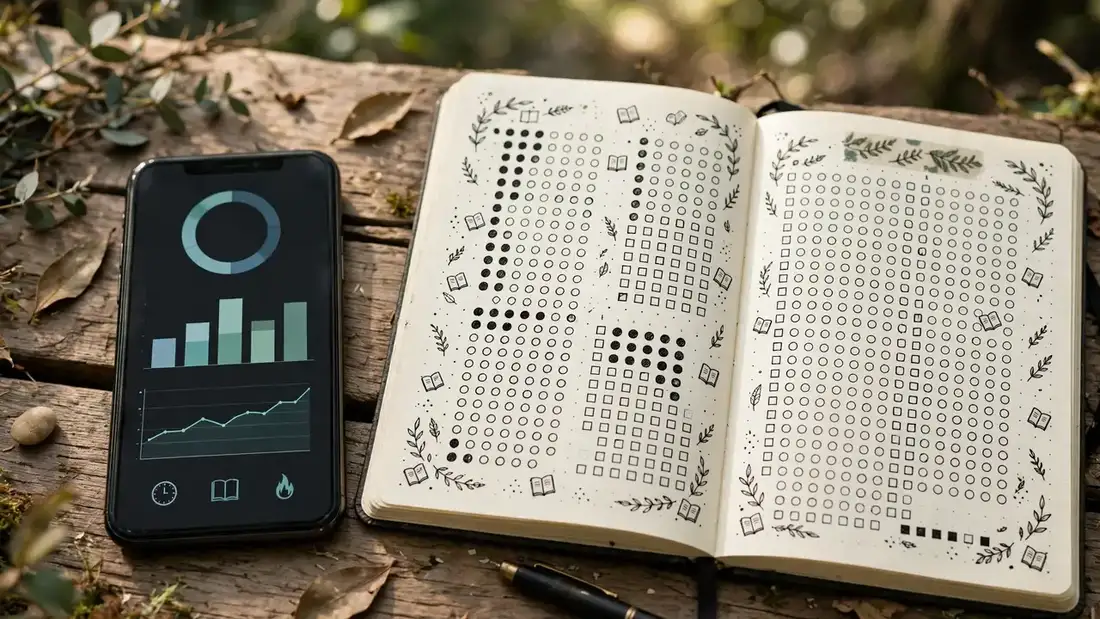
How to Track Your Reading Habit: Apps, Journals & Systems
Tracking turns reading from a vague intention into a visible habit. The data, pages, streaks, ratings, reveals patterns: when you read most, what you abandon, which genres you actually finish. The best tracking system is the one you will maintain past February.
This guide compares the major approaches: the big apps (Goodreads, StoryGraph), the habit timers (Bookly), and the analog journals. Each has a personality; match it to yours.
App Trackers: Goodreads vs. The StoryGraph
Goodreads remains the default: the largest community, the most reviews, the annual Reading Challenge that motivates millions. Its shelves and ratings are simple, and the social features let you see what friends are reading. The downsides are real: a dated interface, Amazon ownership that bothers some, and recommendations that feel blunt. The StoryGraph is the indie challenger: mood-based recommendations (‘adventurous, emotional, lighthearted’), detailed stats (pace, page counts, moods over time), half-star ratings, and content warnings. Its community is smaller but passionate, and its stats dashboard delights data lovers. Many serious readers now use both: Goodreads for the social graph and challenge, StoryGraph for the stats and discovery. Whichever you choose, the key habit is logging immediately after finishing; a tracker with a backlog is a tracker you will abandon. Set a modest yearly goal, 12 or 24 books, and let the streak do the motivating.
Habit Timers and Streaks: The Bookly Approach
If apps feel like admin, try tracking time instead of titles. Bookly’s timer-based approach gamifies reading sessions: start the timer, read, and watch minutes, pages, and streaks accumulate. The psychology is sound; streaks are among the most powerful habit motivators, and seeing ’47 minutes today’ is more motivating than an empty shelf. Pair the timer with a daily minimum so small it is embarrassing to skip, ten minutes, and let the streak compound. The data reveals your real patterns: most readers discover they read in consistent windows (the commute, the pre-sleep half hour) and can then protect those windows fiercely. A simpler version works with any timer and a paper calendar: mark an X for every reading day, and protect the chain. The goal is not impressive stats; it is the quiet satisfaction of a habit that runs itself.
Analog Journals: The Slow Tracking Revival
Paper reading journals are booming, and the reasons are instructive. A physical journal, with pages for each book’s rating, favorite quotes, and one-paragraph reviews, forces the reflection that apps skip. Writing by hand about what you read deepens memory and clarifies taste; many journalers report that the practice alone doubled their reading satisfaction. The classic setup is simple: a notebook, a page per book, date finished, star rating, three favorite lines, and one sentence on who should read it. Add a yearly spread for the challenge count and a TBR list you curate ruthlessly. The journal’s weakness is searchability, which is why hybrid systems thrive: quick logging in an app, deeper reflection on paper. Whichever system you choose, review it monthly; the patterns in your own reading history are the best recommendation engine you will ever own.

Recommended Reading to Go With This Guide
1. Goodreads by Amazon
The largest book-tracking community: shelves, ratings, reviews, and the annual Reading Challenge. The social features and massive review database remain unmatched despite a dated interface. Where reading goals live.
Why it fits: The default home for reading challenges and shelves.
Best for: Social readers and challengers · Amazon · 2006
2. The StoryGraph by Nadia Odunayo
The indie Goodreads alternative with mood-based recommendations and detailed reading stats. Its content warnings and half-star ratings won devoted fans. The thinking reader’s tracker.
Why it fits: The stats-rich tracker for data-loving readers.
Best for: Data-loving readers · Nadia Odunayo · 2019
3. Bookly by Bookly
The reading timer app that gamifies sessions: track minutes, pages, and streaks with beautiful stats. The focus timer helps build the daily habit. Best for readers who respond to streaks.
Why it fits: The habit-builder: timers, streaks, and session stats.
Best for: Streak-motivated readers · Bookly · 2016
4. Literal by Literal Club
The Gen-Z book tracker with a social feed, book clubs, and sleek design. Its community features feel modern where Goodreads feels dated. The rising alternative for young readers.
Why it fits: Book clubs and social reading for the next generation.
Best for: Young social readers · Literal Club · 2021
5. Libby by OverDrive
The library app that made borrowing ebooks and audiobooks genuinely delightful. Syncs across devices, sends to Kindle, manages holds across multiple library cards, and works offline. Free with a library card, which makes it the best value in reading. The gold standard every other app is judged against.
Why it fits: A natural fit here: every reader with a library card
Best for: Every reader with a library card · OverDrive · 2017
6. Kindle App by Amazon
Amazon’s reading app syncs with Kindle devices and offers the largest ebook store, Whispersync audio pairing, and X-Ray character tracking. The reading experience is polished, and Prime Reading offers free rotating titles. The default choice for Amazon-ecosystem readers.
Why it fits: A natural fit here: amazon-ecosystem readers
Best for: Amazon-ecosystem readers · Amazon · 2009
7. Audible by Amazon
The audiobook giant’s credit system and Plus catalog remain the deepest audiobook library. Whispersync pairs with Kindle, and the originals are genuinely good. Best for listeners who finish a book or more monthly.
Why it fits: A natural fit here: heavy audiobook listeners
Best for: Heavy audiobook listeners · Amazon · 1997
8. Hoopla by Midwest Tape
The library app with no waitlists: borrow ebooks, audiobooks, comics, and movies instantly. Monthly borrow limits vary by library. The perfect complement to Libby for impatient readers.
Why it fits: A natural fit here: impatient library readers
Best for: Impatient library readers · Midwest Tape · 2013
Quick-Start Checklist
- Start today: take the smallest first step from this guide within 24 hours.
- Set up your system: choose one app or journal and log your starting point.
- Schedule it: put a recurring 20-minute block on your calendar.
- Find a buddy: tell one person your goal for built-in accountability.
- Review monthly: check progress, adjust the system, and celebrate wins.
Tips for Getting the Most Out of This List
Start with the ‘Best for’ lines. They are the fastest way to match a book to your current mood and experience level.
Mix one stretch pick with one comfort pick. Alternating challenging and easy reads keeps momentum high and prevents burnout.
Use your library first. Most of these titles are free through Libby with a library card; buy only the ones you know you will re-read or lend.
Track what you finish. A simple list of completed books, with one-line reactions, sharpens your taste faster than any recommendation engine.
Share your favorites. Pressing a beloved book into a friend’s hands doubles its value and starts the conversations reading tracking books are made for.
Common Mistakes to Avoid
Mistake one: the all-at-once overhaul. Beginners try to change everything simultaneously, new app, new journal, new schedule, then collapse under the admin. Change one variable at a time and let each become automatic before adding the next.
Mistake two: optimizing instead of doing. Researching the perfect system feels productive but produces nothing. Spend eighty percent of your book-related time on the actual activity and twenty percent on the system, not the reverse.
Mistake three: comparing your chapter one to someone’s chapter twenty. The enthusiasts posting impressive stats have years of habit behind them. Compare yourself only to your own last month.
Mistake four: letting a bad week become a quitting story. Missed days are data, not verdicts. Shrink the habit to its smallest version, do that, and rebuild from there. The only failed system is the one you abandon.
Watch: Low pressure way to track your books | Reading Journey #booktube #readmore #readinghabit
For a visual companion to this guide, this video covers the topic with real examples and recommendations. Watching a fellow reader talk through their picks is often the fastest way to find your next favorite.
Reading Trackers Compared
The best tracker is the one you will actually open. Compare the main approaches before committing.
| Method | Cost | Strengths | Weaknesses |
|---|---|---|---|
| Goodreads | Free | Huge database, annual challenge, friend activity | Clunky app, limited stats, Amazon-owned |
| StoryGraph | Free / paid Plus | Rich stats, mood tracking, no Amazon | Smaller community, some features paywalled |
| Paper journal | Cost of notebook | Creative, screen-free, fully customizable | No auto-import, easy to abandon |
| Spreadsheet | Free | Total control, great for data lovers | Manual entry, no social features |
| Bookly / reading timer apps | Freemium | Session timing, streaks, focus stats | Can gamify reading into a chore |
| Simple notes app | Free | Zero friction, always with you | No stats or reminders |
Frequently Asked Questions
How long does it take to How To Track Reading Habit?
Most people can get started in a single weekend and see real results within a month. The key is starting small: pick the easiest first step from this guide and do it this week. Consistency beats intensity; a modest routine you maintain outperforms an ambitious one you abandon. Give any new system at least three weeks before judging it.
What is the biggest mistake beginners make with How To Track Reading Habit?
Trying to do everything at once. Beginners overload themselves with tools, rules, and ambitions, then quit when it becomes unsustainable. Start with one change, master it, then add the next. The second biggest mistake is waiting for perfect conditions; start messy and refine as you go.
Do I need to spend money to How To Track Reading Habit?
No. Everything in this guide can be done for free or nearly free. Paid tools and upgrades exist, but they are conveniences, not requirements. Start with the free approach, and only spend when you have identified a specific friction that money actually solves.
How do I stay motivated with How To Track Reading Habit?
Motivation follows action, not the other way around. Build the smallest possible daily version of the habit, track your streak visibly, and connect with others doing the same thing. Review your progress monthly; seeing how far you have come is the most reliable fuel for continuing.
Can I How To Track Reading Habit if I am really busy?
Yes, and busy people often do it best because they are forced to be efficient. Shrink the habit to fit your schedule: ten focused minutes beat an aspirational hour you never find. Protect one small window daily and treat it as non-negotiable.
What should I do when I fall off track with How To Track Reading Habit?
Restart immediately without guilt. One missed day is nothing; the danger is the story that you have ‘failed’ and might as well quit. Shrink the habit temporarily to make restarting easy, and examine what derailed you so you can design around it next time.
How do I choose between similar books on this list?
Read the ‘Best for’ line and the ‘Why it fits’ note under each entry; they are designed to differentiate. When two books sound equally appealing, pick the shorter one first: finishing builds momentum. You can also sample the first chapter of each through free previews; voice and pacing differences become obvious within pages. There is no wrong choice among well-curated options.
Should I read these books in any particular order?
No strict order is required unless entries note a series sequence. A good approach is to alternate: one book that stretches you, one that comforts you. For series, always read in publication order to avoid spoilers. For standalone titles, follow your curiosity; the list is a menu, not a syllabus.
What if I start a book and don’t like it?
Quit it. The fifty-page rule gives every book a fair trial, then grants full permission to move on. Forcing yourself through a book you dislike teaches your brain that reading is punishment, which kills the habit. Set it aside, pick the next title that excites you, and revisit the abandoned book in a year; tastes change.
Are audiobook versions just as good?
For narrative books, absolutely: listening and reading produce comparable comprehension and enjoyment. Some titles even improve in audio with great narration. Dense or reference-heavy books favor print for flipping back, but for most of this list, the audiobook counts fully as reading it. Use whichever format fits your life.
How can I remember what I read?
Write one paragraph per finished book: what it was about, what you thought, who should read it. This tiny habit dramatically improves retention and builds a personal recommendation history. Highlighting key passages and discussing books with others also cements memory. The goal is not perfect recall but a shelf of ideas you can return to.
What’s the best way to build a consistent reading habit?
Attach reading to an existing routine: ten pages with morning coffee, twenty minutes before sleep, audiobooks during commutes. Keep the next book always ready so there is no gap between finishes. Track your streak visibly, join a challenge for accountability, and protect the habit’s joy above all: the readers who read most are the ones having the most fun.
Can I gift books from this list?
Yes, books make excellent gifts when matched to the recipient’s taste rather than your own. Use the ‘Best for’ lines to match, choose a beautiful edition for gift-giving, and include a note about why you picked it. A personally recommended book with a handwritten inscription beats a generic bestseller every time.
Where should I buy books to support authors most?
Buying new from independent bookstores supports both authors and local literary culture. Pre-orders especially help authors hit bestseller lists. That said, libraries, used bookstores, and borrowing all support reading culture too; the best purchase is the one that gets the book read.
How do reading tastes change over time, and should I revisit this list?
Reading taste is a moving target: the thriller phase gives way to the memoir phase, which gives way to the history phase, often without notice. Revisit this list yearly, because the entries you skipped will hit differently at different life stages. A book that bored you at twenty-five can become a favorite at forty, and the reverse happens too. Keep a simple log of what you loved and when; patterns emerge that predict your next obsession better than any algorithm. The list is stable, but you are not, which is exactly why curated lists reward rereading. What you need from books changes as your life changes, and a good list has something for every version of you.
What is the difference between a good book and a great one?
Good books entertain or inform; great books change the reader slightly. The difference usually comes down to specificity: great books have a voice you could recognize blindfolded, observations you have never seen put into words, and the courage to be about something real. Craft matters, but so does ambition. As you work through this list, notice which books you keep thinking about weeks later versus which ones evaporate; that residue is the most honest quality metric available. Over time, calibrating your own good-versus-great detector is more valuable than any single recommendation, because it turns every future book choice into a better bet.
Should I take notes while reading?
Light note-taking dramatically improves what you keep from a book, but heavy note-taking can kill the joy that makes you read at all. The sweet spot: a star rating, three favorite lines, and one sentence on who should read it, captured right after finishing. For nonfiction, note the two or three ideas you want to apply; for fiction, note the moments that moved you. Digital highlights are convenient but rarely reviewed, so the handwritten summary wins for retention. The goal is not a perfect archive but a conversation with your future self, who will thank you for the breadcrumbs.
How do I get my partner, kids, or friends into reading?
Never assign; infect. Leave the right book where they will trip over it, talk about what you are reading with genuine enthusiasm, and match the recommendation to their existing interests rather than your taste. For kids, read aloud long past the age they can read alone; the shared ritual matters more than the title. For reluctant adults, start with audiobooks during commutes or the shortest, most propulsive book on this list. Remove every ounce of friction: library cards, charged e-readers, books on the nightstand. Enthusiasm is contagious, but only when it is genuine and pressure-free.
Is it better to read widely or deeply?
Both, in seasons. Wide reading, many genres, many authors, builds taste and serendipity; it is how you discover what you love. Deep reading, everything by one author, or a full year in one genre, builds expertise and the particular pleasure of mastery. Beginners should read widely until patterns emerge, then go deep on whatever pulls hardest. Alternate by quarter: three months of exploration, three months of immersion. The readers with the richest inner libraries tend to have done both for years, and the oscillation keeps either mode from going stale.
What role should rereading play in my reading life?
A bigger one than the culture suggests. Rereading a beloved book is not a failure to progress; it is how depth works. Books reveal new layers at different life stages: the novel you loved at twenty is a different novel at forty because you are a different reader. A good rule is one reread for every four new books, which keeps the habit fresh while honoring the titles that shaped you. Rereading also calibrates taste: noticing why a favorite still works teaches you what to look for in new books. Never feel guilty about a comfort reread; it is maintenance for the reading soul.
How do I handle the overwhelm of too many recommendations?
Recommendation overwhelm is real, and the fix is a system, not willpower. Keep a single ‘to read’ list, capped at twenty titles; when it is full, a new addition must displace something. Rank by excitement, not obligation, and let the bottom half expire guilt-free every few months. Follow only two or three recommendation sources whose taste overlaps yours; more sources means more noise. And remember the liberating math: you will never read everything, so the goal is not completeness but a steady stream of books you love. A short list you actually read beats a long list you admire.
Do book awards and bestseller lists matter?
They matter as discovery tools, not verdicts. Awards surface ambitious, well-crafted books you might otherwise miss, and bestseller lists reveal what the culture is actually reading, which has its own value for conversation. But both have blind spots: awards skew literary, bestsellers skew commercial, and neither measures whether you will love a book. Use them as one input among many, alongside trusted recommenders and your own taste history. The best use of a prize list is as a menu of candidates to sample, not a syllabus to complete. Your own finished-and-loved shelf is the only award that counts.
How do I find time to read with a busy schedule?
Stop looking for free time and start using found time: the commute, the lunch line, the waiting room, the twenty minutes before sleep. Audiobooks convert chores and exercise into reading hours without touching your calendar. The ‘ten pages’ rule works because starting is the hardest part; momentum usually carries you past the minimum. Audit one week honestly and you will find five to seven hours of reclaimable screen time. The readers who read most are not less busy; they are more deliberate about the cracks in their days.
What makes a book worth buying versus borrowing?
Buy the books you will reread, lend, or display: favorites, references, and beautiful editions. Borrow everything else from the library, which is free and guilt-free. A good rule is the ‘second read’ test: if you finished a borrowed book and immediately want to own it, buy it. Otherwise, let it return to the shelf. This keeps your home library curated instead of cluttered, and every book on your shelf earns its place.
How can I discuss books better in conversation?
Move past ‘did you like it’ to specific observations: a character’s choice, a surprising structure, a line you underlined. Asking ‘what did you think of the ending’ opens more doors than ‘was it good.’ Share your genuine reaction, including confusion or dislike; honest disagreement makes the best book talk. And listen as much as you share: other readers notice things you missed, which is half the pleasure of reading socially.
Why do some books become classics while others fade?
Classics survive because they keep generating new meanings for new readers: the prose rewards rereading, the themes stay relevant, and each generation finds its own reflection in them. Many bestsellers fade because they were perfectly tuned to one moment. The test of time is really a test of depth: books with specificity, ambiguity, and emotional truth outlast books built on novelty. When choosing what to read, a mix of enduring classics and fresh voices gives you both roots and wings.
The Bottom Line
The right book at the right moment can change a habit, a mind, or a year. Start with Goodreads, The StoryGraph, Bookly: each one earned its place here and each one delivers. Then follow your curiosity through the rest of the list, quit freely, share generously, and keep reading. The best reading tracking book is ultimately the one you finish, and the second-best is the one it leads you to next.
Keep Exploring on DayZora
For more ideas, see our guide to reading resolutions: how to read 52 books in a year. For more ideas, see our guide to beginner workout plan for the new year. For more ideas, see our guide to coffee shop drinks explained.