Here is a secret the party industry does not want you to know: the most memorable Halloween parties are almost never the most expensive ones. Guests do not remember how much you spent on decorations — they remember laughing until their cheeks hurt, the clever costume someone made from thrift-store finds, and the feeling that the whole night was fun. Learning how to throw a Halloween party on a budget is not about cutting corners; it is about spending smart on the things guests actually notice and skipping everything they do not.
This guide proves it with numbers: a complete party plan for 15 guests for under $100, room-by-room decoration strategies using dollar-store and homemade items, crowd-feeding menus at under $3 per person, costume ideas that cost next to nothing, free entertainment that fills the whole evening, and a printable shopping list. Whether your budget is $50 or $150, you will find a plan that works.
The $100 Party Blueprint
Before diving into details, here is the full budget at a glance. Every number below is based on real-world prices at discount and dollar stores:
| Category | What You Get | Budget |
|---|---|---|
| Decorations | Dollar-store + DIY for whole house | $20 |
| Food | Chili bar + snacks for 15 | $35 |
| Drinks | Punch + cider (spiked & unspiked) | $15 |
| Activities | Printed games, DIY photo booth | $10 |
| Prizes | Dollar-store trophies & candy | $10 |
| Buffer | Forgotten items, ice, extras | $10 |
| Total | 15 guests, full evening | $100 |
That is under $7 per guest for a complete party. The sections below show exactly how to hit these numbers — and where to trim further if your budget is tighter.
Decorations: The $20 Haunted House
Decorations are where most party budgets explode — and where savings are easiest. Guests experience your party in dim, atmospheric lighting, which means cheap decorations look ten times better than they do in the store’s fluorescent glare. Atmosphere beats expense every time.
The Dollar-Store Hit List
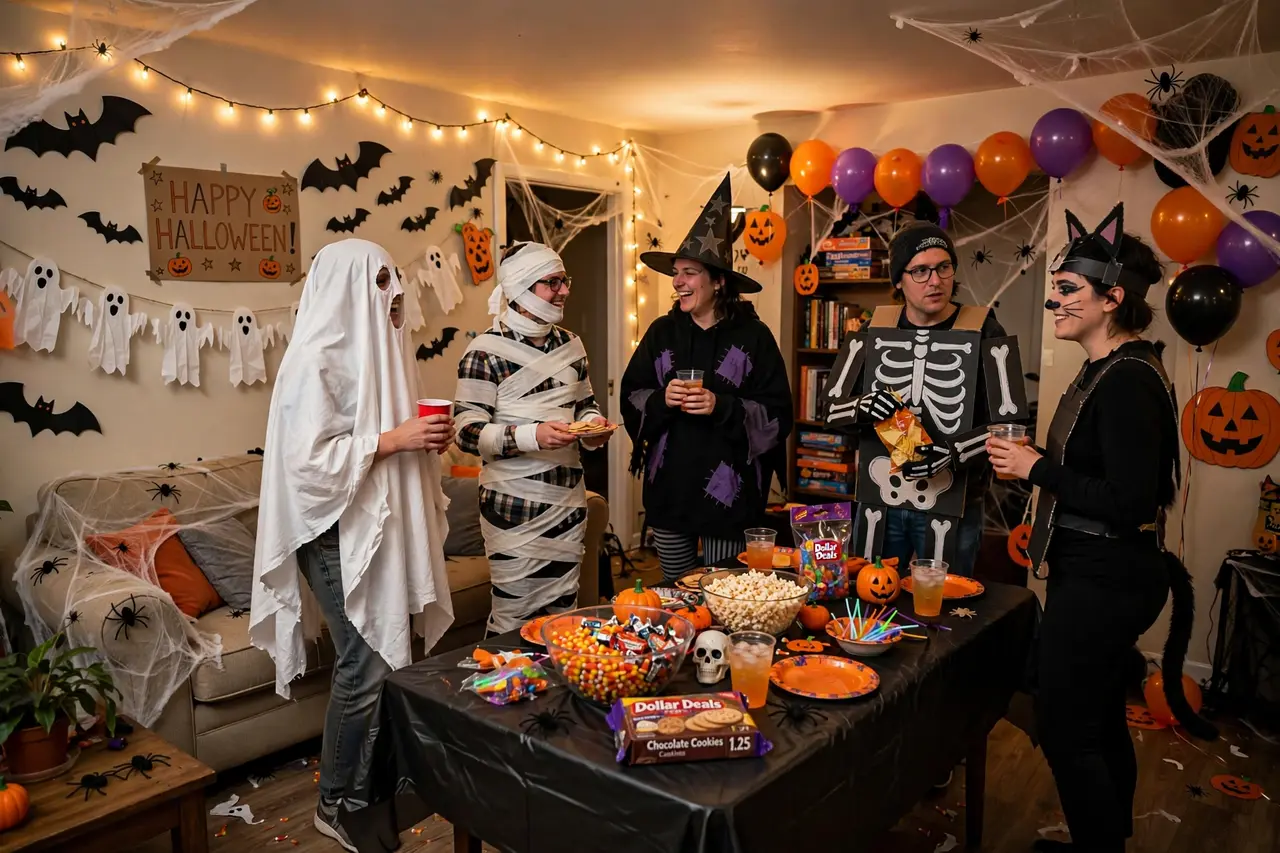
With $20 at a dollar store, buy: black plastic tablecloths (walls and tables — instant haunted house), a bag of plastic spiders and rats, two packs of window clings, orange and purple string lights, fake spider webs (the stretchy kind), LED tea lights, black and orange balloons, and a “caution” tape roll. That single haul, deployed strategically, transforms a living room.
DIY Decorations That Look Expensive
Floating candles: hang white paper-towel rolls (with LED tea lights inside) from the ceiling with fishing line. In dim light, they look like the floating candles from a certain famous wizard school. Cost: nearly zero.
Milk-jug ghosts: draw ghost faces on empty milk jugs with permanent marker, drop in a string of fairy lights or LED lights. Line your walkway with them. Cost: zero if you save jugs for two weeks.
Newspaper spooky silhouettes: cut bat, cat, and witch shapes from black construction paper (or painted newspaper) and tape them to windows — backlit from inside, they look professional.
Cheesecloth ghosts: drape white cheesecloth over balloons on stands, add felt eyes. Hang from doorways. Ethereal and elegant for pennies.
Apothecary jars: fill empty jars and bottles with colored water, plastic bugs, and handwritten “potion” labels (“Eye of Newt,” “Bat Wings”). Cluster on a table with a black cloth — instant mad-scientist lab.
Room-by-Room Priority
Do not try to decorate the whole house. Focus spending and effort where guests actually spend time: the entryway (first impressions), the main party room, the food table (your centerpiece moment), and the bathroom (one funny decoration — guests always remember the bathroom). Bedrooms and offices get a closed door and zero dollars. For table-styling techniques that make a buffet look abundant on little money, our table decoration ideas translate beautifully to Halloween spreads.

Food: Feeding 15 People for $35
Food is the second-biggest budget line, but Halloween food has a secret advantage: the theme does the heavy lifting. “Mummy hot dogs” are just pigs in a blanket with a clever name. Presentation — not expensive ingredients — makes budget food feel festive.
The $35 Menu
- Chili bar ($15): two slow-cookers of chili (one meat, one bean) with rice, shredded cheese, sour cream, and chopped onions. Chili is the ultimate budget party food: cheap per serving, feeds a crowd, stays hot for hours, and everyone likes it.
- Mummy pigs in a blanket ($6): two packs of cocktail sausages + crescent roll dough, wrapped in strips with mustard-dot eyes. Gone in minutes, every time.
- Popcorn bar ($4): big batch of popcorn with shakers of salt, cinnamon sugar, and parmesan. Serve in paper lunch bags stamped with a pumpkin face.
- Veggie “graveyard” ($5): raw veggies arranged as a graveyard scene with hummus “dirt” and cauliflower “ghosts.” Healthy, photogenic, cheap.
- Dirt cups ($5): chocolate pudding cups layered with crushed cookies and gummy worms. Make-ahead, kid-approved, adult-secretly-thrilled.
Drinks for $15
Witch’s brew punch ($8): two liters of lemon-lime soda + a half-gallon of lime sherbet + gummy eyeballs. Served in a cauldron (or any black bowl) with dry ice nearby for fog effect (handle dry ice with tongs — never put it directly in drinks).
Hot apple cider ($7): a gallon of cider warmed in a slow cooker with cinnamon sticks and orange slices. The smell alone decorates your house. Offer a “spiked” side bottle of rum or bourbon for adults to add themselves — far cheaper than premade cocktails.
Skip: individual sodas (expensive per serving), fancy mixers, and anything requiring a bartender. A punch bowl and a cider pot cover every guest.
Costumes: Looking Great for Under $15
The costume paradox: the most complimented costumes at budget parties are usually the cheapest, because creativity impresses more than cash. Encourage it with a “best thrifted costume” contest category.
The $10 costume formula: thrift store base ($5–7) + one clever accessory ($3–5) + makeup you own. Examples: black clothes + cat ears headband = cat; white sheet + sunglasses = “blind ghost”; all-black + cardboard “censored” bar = censored celebrity; cardboard box + paint = Lego brick, dice, or TV.
Group costumes multiply value: coordinate with friends — a “box of crayons” group needs only solid-color clothes plus a homemade crayon hat each. Group costumes photograph amazingly and cost almost nothing per person.
Makeup over masks: a $5 face-paint palette creates skeletons, zombies, witches, and clowns for the whole party — one palette serves 10+ faces. YouTube makeup tutorials are free; practice once before party day.
As host, set the tone: wear a great budget costume yourself. Nothing kills a budget party’s vibe faster than a host who clearly spent $200 on a rental while telling guests to “keep it cheap.”
Free Entertainment: Filling 4 Hours for $10
Entertainment is where budget parties often shine brightest, because the best Halloween games are free. Plan a loose arc: active game → creative activity → group game → wind-down.
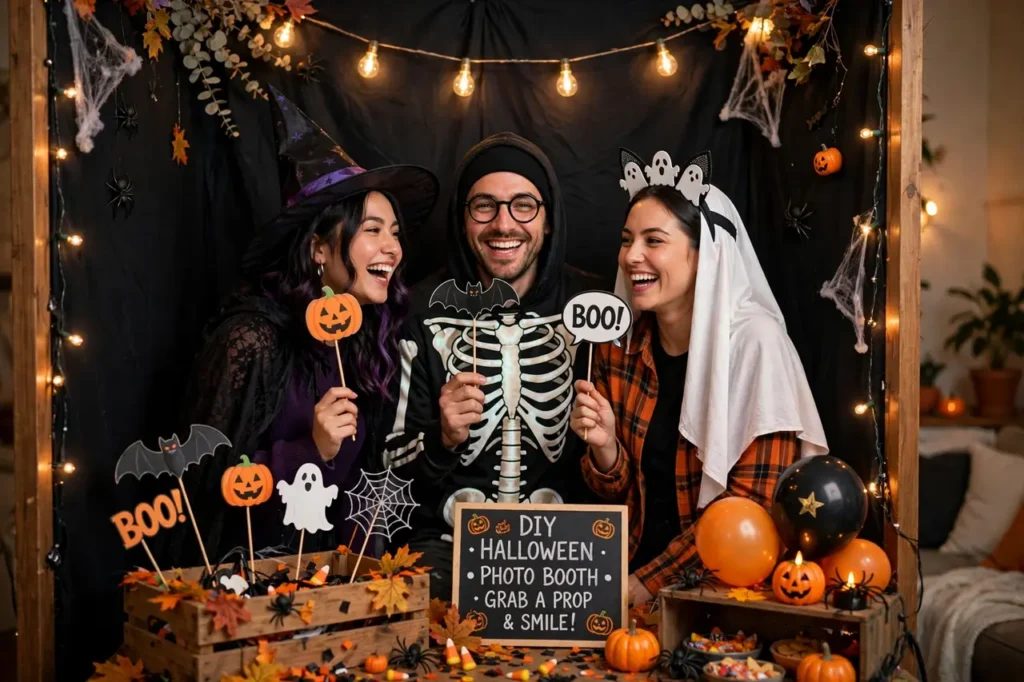
Hour 1 — Costume parade & voting (free): as guests arrive, photograph each costume against your DIY photo booth (a black tablecloth backdrop + props from the dollar store: hats, mustaches on sticks, empty frames). Post photos to a shared album and open voting for categories: scariest, funniest, most creative, best homemade, best group.
Hour 2 — Pumpkin carving or decorating ($10 for mini pumpkins): mini pumpkins at $1 each give every guest a take-home activity. Provide markers, stickers, and a few shared carving tools — or go no-carve with paint. This fills a full hour and doubles as a favor.
Hour 3 — Party games (free): Halloween bingo (print free cards), murder-mystery-in-an-envelope (free printables online), or a trivia round using our budget celebration playbook‘s game-night principles — team games with dollar-store prizes keep energy high for pennies.
Hour 4 — Wind-down (free): announce costume contest winners with fanfare, do a group photo, and transition to background music and conversation. End with a “leftover lottery” — guests draw numbers for leftover food and decorations to take home. Nobody leaves empty-handed, and you have less to clean up.
The $10 Activity Kit
Mini pumpkins ($8 for 8–10), a pack of bingo cards printed at home ($1 in ink), and dollar-store prizes ($1–2). That is the entire entertainment budget — everything else is free.
Sample Shopping List
| Item | Where | Qty | Est. Cost |
|---|---|---|---|
| Black plastic tablecloths | Dollar store | 6 | $6 |
| Stretchy spider webs | Dollar store | 3 | $3 |
| Plastic spiders/rats | Dollar store | 2 bags | $2 |
| LED tea lights | Dollar store | 2 packs | $2 |
| Orange/purple string lights | Dollar store | 2 | $2 |
| Window clings | Dollar store | 2 packs | $2 |
| Balloons (black/orange) | Dollar store | 2 packs | $2 |
| Caution tape | Dollar store | 1 | $1 |
| Ground beef + beans + tomatoes | Grocery | Chili for 15 | $15 |
| Rice, cheese, sour cream, onions | Grocery | Toppings | $8 |
| Cocktail sausages + crescent dough | Grocery | 2 packs each | $6 |
| Popcorn kernels + bags | Grocery | 1 bag + 20 bags | $4 |
| Veggies + hummus | Grocery | 1 tray’s worth | $5 |
| Pudding cups + cookies + gummy worms | Grocery | 15 servings | $5 |
| Lemon-lime soda + lime sherbet | Grocery | Punch | $8 |
| Apple cider + cinnamon sticks | Grocery | 1 gallon | $7 |
| Mini pumpkins | Grocery/patch | 10 | $10 |
| Prizes (candy + trinkets) | Dollar store | Assorted | $10 |
| Total | $100 |
Money-Saving Power Moves
Go potluck for food: assign categories (one guest brings a side, another a dessert) and your food budget drops to $15. Guests love contributing — it makes the party feel communal.
BYOP (bring your own pumpkin): guests bring their own carving pumpkin; you provide tools and templates. Saves $30–60 instantly.
Shop after Halloween — for next year: November 1st sales discount decorations 50–90%. Buy next year’s supplies now and store them; your future self will weep with gratitude.
Reuse relentlessly: black tablecloths, string lights, and plastic props last for years. Store them labeled (“Halloween — living room”) and your annual decor cost drops to near zero after year one.
Digital invitations: free e-vites or a group chat beat $15 paper invitations. Include the potluck assignments, BYOP note, and costume theme in the invite so guests arrive prepared.
One signature thing: instead of decorating everywhere thinly, create one spectacular focal point — a dramatic food table, a photo booth wall, a porch display. Guests photograph and remember the one amazing thing; they do not notice the undecorated hallway. Our budget celebration ideas use the same principle for weddings and anniversaries.
Party-Day Timeline
| Time | Task |
|---|---|
| 2:00 PM | Start chili in slow cookers; chill drinks |
| 3:00 PM | Hang decorations (entryway, main room, food table) |
| 4:00 PM | Set up food station, photo booth, game areas |
| 4:30 PM | Make punch; set out snacks; light candles/lights |
| 5:00 PM | Quick tidy; change into costume; start playlist |
| 5:30 PM | Guests arrive — costume photos at the booth |
| 6:30 PM | Food served; casual mingling |
| 7:30 PM | Pumpkin decorating activity |
| 8:30 PM | Games (bingo/trivia) + contest voting |
| 9:30 PM | Award ceremony; group photo; leftover lottery |
| 10:00 PM | Wind-down; playlist to background; goodbyes |
Pumpkin carving is the ultimate budget party activity — one pumpkin per guest, endless entertainment. This tutorial shows how simple it can be:
Budget Party Themes That Cost Nothing Extra
A theme makes a budget party feel intentional rather than improvised — and the best themes cost nothing beyond what you already planned to buy. The trick is choosing themes where the guests supply the decor with their costumes.
Decades Night: guests dress from their favorite decade; your playlist does the decorating. Print decade signs on home paper (“The ’80s Corner”) and let costumes carry the theme. Cost to you: $0 beyond the base plan.
Black-and-White Ball: everyone dresses in black and white only; you decorate in black and white only. The visual unity looks stunningly elegant in photos and requires zero specialty purchases — black tablecloths and white candles are dollar-store staples.
Mad Scientist Lab: you already own jars and bottles; add tap water with food coloring, printed “specimen” labels, and a borrowed lab coat for yourself. Guests come as scientists, monsters, or experiments.
Pajama Horror Movie Night: guests wear pajamas (or pajama-adjacent costumes like “tired zombie”), you screen a Halloween movie, and the whole party is blankets, popcorn, and low lighting. The most comfortable party you will ever host.
Thrift-Store Challenge: every costume must come entirely from thrift stores, with receipts as proof. Award prizes for the cheapest costume and the most creative transformation. This theme actively celebrates budget creativity — perfect for your crowd.
The Dollar-Store Decorating Masterclass
Walking into a dollar store without a plan leads to a cart of random skeletons. Walk in with this room-by-room strategy and $20 becomes a haunted house.
Entryway ($5): this is your first impression — spend disproportionately here. A black tablecloth draped over the door frame (cut a slit for entry), a “caution” tape X across it, two milk-jug ghosts flanking the steps, and a bowl of candy with a sign (“Take 2 — the ghosts are watching”). Guests decide the party is amazing within ten seconds of this.
Main room ($8): stretch spider webs across one corner (never the whole room — restraint reads as style), hang paper bats at varying heights from the ceiling with tape, cluster black and orange balloons in corners, and drape a black tablecloth over a side table as a “potion station” with your apothecary jars. Dim overhead lights; rely on string lights and LED candles. Darkness is doing half your decorating for free.
Food table ($4): your centerpiece moment. Black tablecloth, an orange runner (a strip of orange plastic tablecloth works), labels for every dish written on folded cardstock (“Witch’s Brew,” “Mummy Dogs,” “Graveyard Veggies”), and one dramatic element — a cauldron punch bowl with dry-ice fog, or a carved pumpkin centerpiece. Guests photograph the food table more than any other spot; make it count.
Bathroom ($2): one plastic rat in the soap dish, a “bloody” handprint (washable paint) on the mirror, and a Halloween hand towel. Guests always talk about the bathroom. Two dollars, unforgettable.
Photo booth ($1): a black tablecloth taped to the wall, dollar-store props on sticks (mustaches, hats, speech bubbles saying “BOO!”), and good lighting (a floor lamp aimed at the backdrop). This is your party’s social-media engine — every shared photo is free advertising for next year’s invite list.
Feeding Special Diets Without Breaking the Budget
Budget food that excludes guests is not a bargain. These cheap swaps cover the most common needs:
- Vegetarian/vegan: the bean chili pot already covers this. Label it clearly. Popcorn, veggie graveyard, and fruit are naturally vegan.
- Gluten-free: chili over rice is gluten-free; label the crescent-dough items as containing gluten. Corn tortilla chips with salsa ($3) add a safe, cheap option.
- Nut allergies: keep all food nut-free and say so on the invitation — it costs nothing and prevents emergencies. Check the cookie and candy labels.
- Kids: set aside plain versions before adding spice — a small pot of mild chili, plain popcorn, unadorned hot dogs. Kids eat the same menu, minus the heat.
Ask about allergies and dietary needs in the invitation (one line: “any food allergies I should know about?”). Cooking inclusively from the start is far cheaper than making separate dishes last-minute.
After the Party: Reuse, Store, Save
A budget party pays dividends for years if you handle the aftermath right. Before bed, sort decorations into three piles: keep (lights, tablecloths, props in good shape), toss (torn webs, used balloons), and donate (unopened extras). Pack the keepers in a labeled bin — “Halloween Party” — with a copy of your shopping list and a note about what worked. Next year’s party starts 80% planned.
Send a thank-you message within two days with the shared photo album link and the costume contest winners. Mention next year’s date if you know it (“same time next October?”). The cheapest marketing for a repeat party is a happy guest list — and nothing builds a guest list like a legendary $100 Halloween night.
Three Real $100 Parties (and What Made Them Work)
The apartment chili night: twelve guests in a one-bedroom apartment. The host spent $95 total: chili bar, punch, dollar-store webs, and a borrowed projector for a movie. The standout? A “worst costume” contest where guests competed to look the most ridiculous — the photos are still shared every October. Lesson: constraints breed creativity.
The backyard bonfire bash: twenty guests, $110 (slightly over, but potluck sides brought it effectively under). A fire pit, s’mores ($12), hot dogs roasted on sticks, and a storytelling circle after dark. Decorations were just string lights and carved pumpkins guests brought themselves. Lesson: fire + darkness + stories = atmosphere money cannot buy.
The classroom-parent party: fifteen kids and ten parents, $85. Pizza ($30), a scavenger hunt with printed clues (free), mini-pumpkin decorating ($12), and a costume parade with dollar-store ribbons for every child. It ended at 8 PM sharp, before meltdowns. Lesson: for kids, structure beats spending — every minute was planned, and nothing cost more than a dollar per child.
Quick-Start Checklist: Two Weeks to Party Day
- 14 days out: send digital invitations with potluck assignments, BYOP note, and costume theme.
- 10 days out: dollar-store run (decorations, prizes, tablecloths); start saving milk jugs and jars.
- 7 days out: grocery run for non-perishables; print game cards, bingo sheets, and food labels.
- 3 days out: DIY decorations (paper bats, apothecary labels, photo booth backdrop).
- 1 day out: buy perishables; prep anything make-ahead (dirt cups, veggie tray); charge cameras.
- Party day: follow the timeline table above; start chili by 2 PM; enjoy your own party.
The Host’s Mindset: Why Budget Parties Win
Here is the psychological truth behind every great budget party: guests mirror the host. A host who is relaxed, laughing, and clearly having fun gives everyone permission to do the same — regardless of what the decorations cost. A host who is stressed about money, apologizing for paper plates, or anxiously hovering over the food creates tension no amount of spending can fix. So the real budget-party skill is not bargain hunting; it is letting go. Accept the paper plates. Laugh when the punch spills. Dance badly. Your guests will remember the night you were fully present far longer than they would remember expensive centerpieces. The $100 is just logistics — your energy is the party.
When to Spend vs. When to Save
Not every dollar is equal. Spend on the things guests physically interact with: food quality (fresh ingredients beat fancy presentation), lighting (good string lights get reused for years), and one memorable activity. Save on everything disposable: plates, napkins, cups, and single-use decorations. The golden rule — if guests will touch it, taste it, or take it home, spend a little more; if it gets thrown away at midnight, spend as little as possible. And never spend money solving a problem that creativity solves free: a hand-drawn sign beats a store-bought banner, a borrowed speaker beats a rented sound system, and a genuinely fun game beats an expensive one every single time.
Frequently Asked Questions
Can I really throw a good Halloween party for $100?
Yes — the blueprint above feeds and entertains 15 guests for exactly $100, and the shopping list shows every line item. The keys are: a slow-cooker chili bar (cheapest crowd food), dollar-store decorations deployed in dim lighting, one focal-point display instead of whole-house decor, and free games. Guests consistently rate budget parties higher than expensive ones when the host is relaxed and the activities are fun.
What is the cheapest way to feed a crowd at a Halloween party?
A chili bar or baked-potato bar, both under $2.50 per serving for 15 people. Slow-cooker recipes scale beautifully, stay hot for hours without attention, and accommodate vegetarians with a second pot. Supplement with popcorn and one themed snack (mummy hot dogs or dirt cups) rather than a wide spread — three good items beat ten mediocre ones.
How do I decorate for Halloween with almost no money?
Dim the lights — atmosphere is free and makes everything look better. Then: black plastic tablecloths on walls ($1 each), homemade paper bats on windows, milk-jug ghosts on the walkway, and one dramatic focal point (a styled food table or photo booth). Borrow fog machines or projectors from friends rather than buying. And shop November 1st sales for next year at 70–90% off.
Should I do potluck to save money?
Potluck is the single biggest budget saver — it can cut your food costs by two-thirds. Assign categories to avoid duplicates (“you bring a side, you bring dessert”), and you handle one main dish plus drinks. Most guests are happy to contribute; it makes the party feel communal rather than cheap. Just communicate clearly in the invitation.
How many guests can I host on $100?
Fifteen comfortably, twenty if you go potluck. Beyond twenty, switch to a drop-in open-house format with lighter snacks (popcorn, punch, one main dish) rather than a full meal. The per-guest cost actually drops with bigger crowds for decorations and activities — food is the only cost that scales linearly.
What is the biggest budget mistake Halloween party hosts make?
Buying themed disposable everything — plates, napkins, cups, tablecloths in “Halloween patterns” cost 3–5x plain orange and black versions that look just as festive. Second biggest: overbuying candy and snacks. Plan food per the shopping list, not per anxiety. And third: decorating rooms guests never enter. Focus on four zones: entryway, main room, food table, bathroom.
Can I throw a budget Halloween party for kids specifically?
Kids’ parties are actually cheaper: pizza ($5 per large pie feeds 4–5 kids), a scavenger hunt (free), pumpkin decorating ($1 mini pumpkins), and a costume parade cost under $60 for 12 kids. Skip the elaborate goody bags — one mini pumpkin and a printed coloring page is a favor kids genuinely like. Schedule 2–3 hours max; kids’ parties should end before sugar crashes begin.
How do I make cheap decorations not look cheap?
Three rules: dim the lights (everything looks better in atmospheric lighting), cluster items instead of spreading them thin (a dense spooky corner beats sparse decorations everywhere), and commit to a tight color palette (black + orange + purple reads as “designed”; rainbow reads as “random”). One dramatic focal point — a styled food table or photo wall — makes the whole party feel intentional.
What if I have never hosted a party before?
A Halloween budget party is the ideal first party: the theme gives you a built-in plan, guests entertain themselves with costumes and games, and expectations are fun-focused rather than fancy. Follow the timeline table, keep the guest list to 10–12 for your first time, and remember that guests want you relaxed — a calm host with paper plates beats a stressed host with china every time.
How far in advance should I plan a budget party?
Three weeks is ideal: week one for invitations and the shopping list, week two for dollar-store and grocery runs (watch for sales), week three for DIY decorations and food prep. Budget parties actually benefit from early planning — it gives you time to borrow items, catch sales, and DIY instead of panic-buying at full price.