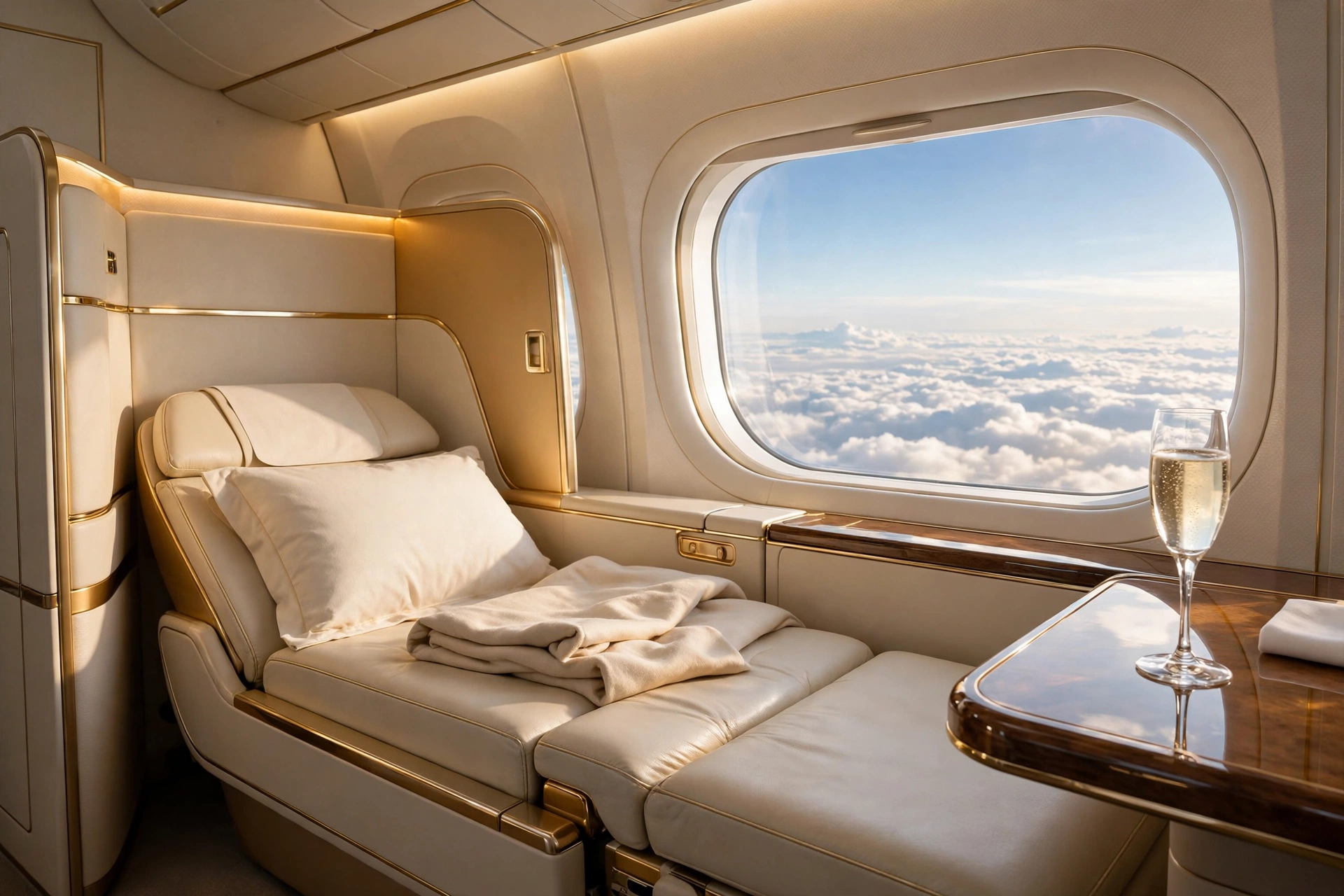
Flying first class has always felt like a luxury reserved for CEOs and celebrities — lie-flat seats, champagne on demand, and a flight attendant who actually remembers your name. But how to fly first class for cheap is not the mystery it used to be. With the right mix of points strategy, timing, and booking tactics, ordinary travelers routinely sit up front for a fraction of the published fare — sometimes for less than the cost of a regular economy ticket bought at the wrong time.
The truth is that airlines sell far fewer first class seats at full price than most people assume. Cabins go out with empty premium seats on thousands of flights every week, and carriers would rather sell those seats cheap — through upgrades, award space, and last-minute offers — than fly them empty. This guide breaks down every legitimate strategy that actually works in 2026: from credit card points and upgrade bidding to the exact days and booking windows when premium cabins drop in price. No gimmicks, no clickbait — just the tactics savvy travelers use over and over.
What “Flying First Class for Cheap” Really Means
Before diving into tactics, it helps to calibrate expectations. A published first class fare on a domestic US route typically runs $800 to $2,500 one way, while international first class — on the few airlines that still offer a true first class cabin — can run $8,000 to $20,000+ round trip. “Cheap” in this context usually means one of three things:
- A steep discount off the published fare: Paying $400 to $900 for a domestic first class seat that lists at $1,800, through sales, upgrades, or off-peak booking.
- Points and miles redemption: Using 25,000 to 120,000 miles (depending on route) plus modest taxes to book a premium seat that would cost thousands in cash.
- A low-cost upgrade: Buying an economy ticket and upgrading for $75 to $500 at check-in or via an upgrade bid.
Internationally, the terminology matters. Most US airlines now sell their best long-haul product as business class, which is what premium economy upgrades into. True first class still exists on carriers like Emirates, Singapore Airlines, Lufthansa, Air France, and a handful of others — and the strategies below apply to both, with notes where the rules differ.
Typical First Class Prices: What You Are Trying to Beat
Knowing the baseline helps you recognize a genuine deal. Typical one-way published fares (always verify current pricing before booking, as fares change constantly):
| Route Type | Typical First Class Fare (One Way) | What “Cheap” Looks Like |
|---|---|---|
| Short domestic (e.g., New York to Chicago) | Typically $600–$1,200 | $200–$400 via upgrade or sale |
| Transcontinental (e.g., New York to Los Angeles) | Typically $1,000–$2,500 | $350–$800 via upgrade or points |
| US to Europe (business class) | Typically $3,000–$7,000 round trip | $1,200–$2,500 via points or deals |
| US to Asia (business/first) | Typically $5,000–$15,000 round trip | $2,000–$4,000 via award bookings |
| Ultra-long-haul first class (Emirates, Singapore) | Typically $10,000–$25,000 round trip | Under $3,000 via miles is the gold standard |
15 Proven Strategies to Fly First Class for Cheap
1. Build a Points and Miles War Chest
This is the single most powerful strategy on the list. Credit card sign-up bonuses routinely deliver 60,000 to 100,000 points — often enough for a one-way business or first class award ticket internationally. A domestic first class award ticket typically costs 25,000 to 50,000 miles each way on American, Delta, or United, while a business class award to Europe can run 60,000 to 80,000 miles through partner programs.
The key is earning transferable points — Chase Ultimate Rewards, Amex Membership Rewards, Capital One miles, or Citi ThankYou points — rather than locking yourself into a single airline. Transferable points can be moved to a dozen airline partners, letting you shop for the best award pricing on any given route. A $95 to $550 annual-fee travel card with a strong sign-up bonus is, mathematically, the cheapest first class ticket most people will ever “buy.” Just be sure you can pay the balance in full; interest charges instantly erase the value.
For a deeper walkthrough of how award bookings actually work, see our guide on how to use airline miles — it covers transfer partners, sweet spots, and the mistakes that waste thousands of miles.
2. Book Economy, Then Upgrade With Miles
Many travelers fixate on booking award tickets outright, but upgrading a paid economy ticket with miles is often the cheaper path — especially on domestic routes. Airlines like American and United let you upgrade from economy to first class for roughly 15,000 miles plus a small co-pay each way on many fares. On international routes, upgrading from a discounted economy fare to business class with miles can cost half the miles of a full award ticket.
The catch: not all economy fares are upgrade-eligible. Deep-discount basic economy tickets usually cannot be upgraded at all. The sweet spot is a mid-tier economy fare — often only $30 to $80 more than basic — that qualifies for mileage upgrades. Always check the fare rules before you buy.
3. Bid for an Upgrade
Dozens of airlines now run formal upgrade-bidding programs (often powered by a company called Plusgrade). After booking economy, you receive an email inviting you to name your price for a premium seat. Bids that win typically land at 20 to 40 percent of the fare difference between economy and first class.
Bidding works best when the premium cabin is wide open — midweek flights, off-peak seasons, and routes with heavy premium capacity. Bid the minimum on flights that look empty (check the seat map during booking; lots of open premium seats is a green flag), and bid closer to the suggested “strong bid” range on popular routes.
4. Ask About Paid Upgrades at Check-In
When you check in online 24 hours before departure, airlines frequently offer deeply discounted cash upgrades — sometimes as low as $75 to $250 on domestic flights. These offers exist because the airline’s revenue system has decided the seat probably will not sell at full price, so anything above zero is profit.
Transcontinental routes are the classic hunting ground: a $199 upgrade offer on a New York to Los Angeles flight turns a $350 economy ticket into a lie-flat experience for $549 total, versus a $1,800 published first class fare. The upgrade offers are dynamic and unpredictable, which is why frequent travelers check in the moment the window opens.
5. Fly When the Premium Cabin Is Empty
First class pricing is driven by business travelers, which means the cheapest premium seats cluster around the times business travelers avoid: Tuesday, Wednesday, and Saturday flights, red-eyes, very early morning departures, and holiday periods like Thanksgiving week (ironically, the days around the holiday are cheap in premium cabins because corporate travel stops).
Our analysis of the cheapest day to fly shows the same pattern holds even more strongly up front: midweek premium fares can run 30 to 50 percent below Monday morning and Thursday evening peaks on business-heavy routes like New York–Chicago or San Francisco–New York.
6. Buy Miles When Airlines Run Promotions
Airlines sell their own miles directly, and several times a year they run promotions offering 50 to 100 percent bonus miles. During a 100 percent bonus sale, you can effectively buy miles for around 1.8 to 2.2 cents each. If a first class award ticket costs 50,000 miles on a route where the cash fare is $1,500, buying the miles for roughly $1,000 and redeeming immediately saves you $500 — with no credit card required.
The golden rule: only buy miles when you have a specific redemption in mind and have confirmed award availability first. Speculative mile-buying is how people end up with orphan balances. But as a targeted tactic for a trip you are definitely taking, it is one of the most reliable discounts in travel.
7. Hunt Mistake Fares and Flash Sales
Airlines occasionally publish fares with missing fuel surcharges or currency-conversion errors — the famous “mistake fares” that have put first class seats on sale for economy prices. These typically last hours, not days. Premium-cabin mistake fares are rarer than economy ones, but they happen several times a year, and deal-alert services exist specifically to ping you the moment one appears.
More common are legitimate flash sales: airlines periodically discount premium cabins 30 to 50 percent to stimulate demand on specific routes. Setting up flight price alerts for your target routes — in both economy and business/first — is the practical way to catch these. We explain exactly what mistake fares are and whether airlines have to honor them in our mistake fares explained guide.
8. Use Positioning Flights to Cheaper Gateways
Premium fares vary wildly by departure city. A business class fare from New York to London might be $2,200 while the same class of service from a smaller city costs $4,500 — because competition at major gateways forces prices down. Savvy travelers book a cheap domestic positioning flight to the gateway, then the discounted premium fare onward.
The math only works if the positioning flight is cheap and the schedule has enough buffer for separate tickets (never book tight connections across separate tickets). But on international premium travel, gateway arbitrage routinely saves $1,000 or more per person.
9. Earn Elite Status — Then Let Upgrades Come to You
Airline elite status remains the most consistent source of free first class upgrades on domestic US routes. Mid-tier and top-tier elites on American, Delta, and United are upgraded on a large share of domestic flights, prioritized by status level and fare class.
Earning status takes real flying — typically 30 to 100 flight segments or the equivalent in spending per year — so this strategy suits frequent travelers rather than occasional ones. But if you already fly regularly for work, concentrating all your flying on one airline alliance instead of spreading it around is the difference between sitting up front for free and never getting upgraded at all.
10. Use Systemwide Upgrade Certificates
Top-tier elites earn systemwide upgrade certificates (American calls them SWUs, United calls them PlusPoints at the highest tier, Delta offers Global Upgrade Certificates to Diamond members). These instruments upgrade a paid economy ticket all the way to business or first class — including on international flights — and they are the single best value in frequent flyer programs.
You cannot buy these certificates, but they are transferable within program rules in limited ways, and some travelers earn them faster than they can use them. If you know a top-tier elite, traveling together on the same reservation can occasionally extend upgrade benefits to you.
11. Book Through Partner Airlines for Better Award Prices
The same seat can cost dramatically different amounts of miles depending on which airline’s program you book through. A United business class seat to Europe might cost 80,000 United miles — or 60,000 miles through a partner program like Avianca LifeMiles or Air Canada Aeroplan for the exact same flight. This is the “award sweet spot” concept, and it is where advanced points users save 25 to 40 percent on every premium redemption.
The trade-off is complexity: partner bookings often cannot be made online and require calling, and change/cancellation policies are stricter. But for a $5,000+ premium ticket, an hour on the phone to save 20,000 miles is an excellent hourly rate.
12. Consider Premium Economy as a Stepping Stone
On international routes, premium economy fares are often only 30 to 60 percent more than economy — and premium economy tickets are far easier and cheaper to upgrade to business class with miles than standard economy tickets are. Some travelers also find that premium economy itself, on airlines with strong products like Japan Airlines or Virgin Atlantic, delivers 70 percent of the business class comfort for a fraction of the price.
This is also a psychological trick worth naming: the jump from economy to premium economy is the biggest comfort-per-dollar upgrade in commercial aviation. If business class pricing will not budge, premium economy is a legitimate luxury consolation.
13. Travel in Shoulder Season
Premium cabin pricing follows leisure demand curves on international routes. Flying business class to Europe in late October or early March — instead of June — can cut the fare nearly in half, because the same lie-flat seat is chasing far fewer buyers. The experience onboard is identical; only the price and the weather at your destination change.
This pairs powerfully with the points strategies above: award availability in premium cabins is also dramatically better in shoulder season, since fewer travelers are competing for the same award seats.
14. Stay Flexible on Dates and Airports
A one-day shift can change a premium fare by hundreds of dollars. Use the flexible-date search on Google Flights or the airline’s own site to scan a month of premium fares at once — the visual fare calendar makes the cheap days obvious. Similarly, check alternate airports: flying into or out of a secondary airport in a metro area (or a nearby city entirely) sometimes unlocks far cheaper premium pricing.
Flexibility is also the key to award travel. Having a three- or four-day window instead of fixed dates roughly triples your chances of finding premium award space on popular routes.
15. Volunteer When Flights Are Oversold
When a flight is oversold, gate agents need volunteers to take a later flight — and the compensation is negotiable. Travelers with flexible schedules have parlayed a voluntary bump into travel vouchers worth $500 to $1,000+, which can then be applied toward a first class ticket on a future trip. Occasionally, volunteers are rebooked directly into first class on the next flight as a thank-you.
This is opportunistic rather than plannable, but frequent flyers who position themselves near the gate and listen for the announcement turn it into a reliable discount stream over time.
First Class vs. Business Class: Know What You Are Buying
On domestic US flights, “first class” means a wider seat with extra legroom, priority boarding, and a meal on longer flights — nice, but not life-changing. On international flights, the hierarchy is different:
| Feature | Domestic First Class | International Business Class | International First Class |
|---|---|---|---|
| Seat | Wider recliner, ~37–40″ pitch | Lie-flat bed, direct aisle access | Private suite, sometimes with doors |
| Lounge access | Usually not included | Included | Flagship/first lounges included |
| Dining | Hot meal on longer flights | Multi-course, dine-on-demand | Restaurant-style, caviar, vintage champagne |
| Typical discount strategy | Upgrades, sales | Points, mistake fares | Points, partner awards |
| Worth paying cash for? | Rarely at full price | Sometimes on long-haul | Almost never — use miles |
The practical takeaway: internationally, business class is the sweet spot for value. True first class is an aspirational redemption best experienced with miles, not cash.
Is Flying First Class Worth the Money?
Honest answer: it depends entirely on the flight length and what you paid. On a 90-minute domestic hop, even a $200 upgrade is mostly about comfort and priority — pleasant, not transformative. On a 10-hour overnight flight, a lie-flat seat is the difference between arriving functional and arriving destroyed, and it can genuinely be worth a few hundred dollars.
The value equation most experienced travelers use:
- Under 3 hours: Only worth it if the upgrade is under $150 or free via status. The seat is nicer, but you will survive economy.
- 3 to 6 hours: Worth $200 to $400 for the upgrade, especially on transcontinental routes with lie-flat seats.
- Overnight long-haul (6+ hours): Worth serious effort — points, upgrades, or discounted fares — because sleep quality determines your first two days of the trip.
- Daytime long-haul: Nice but less critical; premium economy often suffices.
One more consideration: first class includes checked bags (usually two free), priority security and boarding, and lounge access on international itineraries. If you were going to buy lounge access and check bags anyway, subtract those costs from the upgrade price to get the true premium.
5 Mistakes That Keep People in Economy
- Booking basic economy: The cheapest fare class is almost never upgradeable. That $40 saving can cost you a $200 upgrade opportunity.
- Spreading miles across five programs: 20,000 miles in four different programs buys nothing. Concentrate earning until you have a usable balance in one place.
- Searching only one airline’s website: Award availability and paid fares differ across sites. Check the airline, its partners, and Google Flights before committing.
- Ignoring the 24-hour check-in window: The best discounted upgrade offers appear at check-in and disappear fast. Set an alarm.
- Letting points expire: Most programs have expiration policies (or used to waive them during the pandemic era). A small earning activity every 18 to 24 months keeps balances alive — check your program’s current rules.
Frequently Asked Questions
What is the cheapest way to fly first class?
For most travelers, the cheapest reliable path is booking an economy ticket and upgrading: with miles, through a bid, or with a discounted cash offer at check-in. Domestic first class upgrades routinely cost $75 to $300, versus $800 to $2,500 for a published first class fare. Internationally, redeeming credit card points for a partner award ticket is usually cheapest — a business class seat to Europe can cost the equivalent of under $1,500 in points value.
Can you get upgraded to first class for free?
Yes, but it is increasingly reserved for elite status holders. Operational upgrades — free bumps to first class when economy is oversold — still happen, and they go to the highest-status, highest-fare passengers first. Dressing well and asking politely at the gate used to work in the 1990s; today, upgrades are allocated by algorithm, not charm.
How far in advance should you book first class?
For paid fares, the sweet spot is typically 3 to 6 weeks out domestically and 2 to 4 months out internationally — though premium fares are less predictable than economy. For award tickets, book as early as possible: premium award space is released 11 to 12 months out and the best seats go first. Last-minute award space also appears 1 to 2 weeks before departure when airlines release unsold premium seats.
Is it cheaper to upgrade at the airport?
Sometimes significantly. Airlines would rather sell a first class seat for $150 at the gate than fly it empty, so day-of-departure upgrade prices are often the lowest you will see. The risk is availability — on popular business routes the cabin may already be full. Check-in (24 hours out) is the safer version of the same tactic.
Do flight attendants decide who gets upgraded?
No. Upgrades are processed by the airline’s system based on status, fare class, and time of request. Gate agents execute the list the system produces. Being polite helps with discretionary gestures (a better economy seat, a drink voucher), but it will not move you up the upgrade list.
What is the difference between first class and business class on international flights?
International business class is a lie-flat seat with lounge access and premium dining — the product most US airlines sell as their top cabin. International first class, offered by a shrinking list of carriers (Emirates, Singapore Airlines, Lufthansa, Air France, ANA, and a few others), adds private suites, more space, superior food and champagne, and ground services like chauffeur transfers. First class typically costs 30 to 100 percent more than business for a meaningfully better but not transformative experience.
The Bottom Line
Learning how to fly first class for cheap comes down to one insight: almost nobody sitting up front paid the published fare. They used points, upgraded a cheaper ticket, bid strategically, or simply flew at the right time. Pick two or three strategies from this guide that fit how you already travel — a points-earning credit card plus check-in upgrade awareness is enough for most people — and the front of the plane stops being a fantasy and becomes a habit. The champagne tastes the same whether you paid $2,000 or $200 for the seat.