Few themes fit New Year’s Eve as naturally as the Roaring Twenties. The jazz age was itself a celebration of a new era — a decade that opened with the end of a war and a pandemic, and answered with champagne, jazz, and defiant joy. A Great Gatsby New Year’s Eve party channels exactly that spirit: art deco glamour, live-wire music, batched cocktails, and a room full of people dressed like the future is something to toast rather than fear.
This guide builds your Gatsby party as five immersive pillars — the look, the costumes, the feast, the drinks, and the sound — followed by a four-week countdown checklist, a party-night schedule, and a realistic budget snapshot. It is a different kind of hosting guide from our masquerade ball hosting guide: where the masquerade runs on mystery and ritual, Gatsby runs on exuberance and abundance. Pick the energy that suits your crowd — or read both and steal the best ideas from each. And if the full production feels like too much, our practical at-home New Year’s Eve plan scales the celebration down without losing the magic.
Why Gatsby Works for New Year’s Eve
The fit is almost suspiciously perfect. The 1920s aesthetic — gold, black, geometric glamour — is already the default visual language of New Year’s Eve decor, so a Gatsby party never feels forced. The era’s music (jazz, swing, Charleston) is inherently celebratory and danceable across generations, unlike more niche theme music. The costume vocabulary is widely understood — everyone knows what a flapper or a 1920s gangster looks like — which means guests can participate at any budget, from a thrifted dress and a headband to full tailored splendor. And the theme has a built-in midnight moment: the entire decade was a toast to new beginnings, so raising a glass at midnight feels like the theme fulfilling its destiny rather than an interruption of it.
One caution: do it with affection, not caricature. The best Gatsby parties evoke the era’s glamour — the geometry, the gold, the jazz — without tipping into costume-shop cliché. Think art deco, not Halloween. The pillars below are designed with that line in mind.
Pillar 1: The Look — Building the Deco World
Art deco is a gift to party decorators: it is bold, geometric, and achievable with paper, paint, and light. The palette is non-negotiable — black, gold, and cream, with optional deep accents (emerald or burgundy). Everything below serves that palette.
The geometry trick
Deco is geometry made glamorous: sunbursts, chevrons, fans, stepped arches. You can create this vocabulary cheaply and at scale. Cut large sunburst shapes from gold poster board and mount them on black walls or black fabric panels — a dozen sunbursts transform a living room. Print or draw repeating fan patterns on a long roll of black paper for a runner-style wall treatment behind the bar or buffet. Use gold washi tape to add geometric borders to plain black tablecloths. The eye reads repetition as design: the same motif, repeated confidently, looks expensive.
Light like the jazz age
The 1920s were the first electric decade — lean into warm, abundant, slightly theatrical light. Strings of warm-white fairy lights (never cool white; cool white reads as hospital, not speakeasy). Table lamps with warm bulbs replacing overhead lighting. Candles everywhere — real or LED — in gold or black holders. If your budget allows one splurge, make it an uplight or two in amber aimed at the ceiling: it makes any room feel taller and more dramatic. A mirrored or metallic surface (a tray, a vase, a sequin tablecloth) multiplies every light source.
The statement pieces
Every Gatsby party needs two or three focal points that photograph beautifully and anchor the theme:
- The champagne tower: a coupe tower (stacked champagne coupes, poured from the top) is the single most Gatsby image in existence. You need 20–30 inexpensive coupes and two to three bottles of sparkling wine to fill one. Practice the pour once before the party. Place it where guests arrive — it is decor, entertainment, and the first drink in one.
- The feather centerpieces: tall ostrich-feather plumes in gold or black vases, one per table. They are the fastest visual shorthand for the era, they photograph dramatically, and quality faux plumes cost a few dollars per bunch.
- The deco backdrop: a black-and-gold geometric backdrop for photos — sunburst panels, a gold fringe curtain, or a painted arch. Our DIY New Year’s Eve decorations guide includes step-by-step builds for exactly these pieces, with materials lists and costs.
Table dressing
Black tablecloths, gold chargers (cardboard ones look fine under candlelight), cream napkins folded simply, a single feather or a sprig of greenery at each place. Scatter gold confetti shapes — stars, circles, deco fans — across the tables. Place cards in small gold frames or tented black cardstock with gold pen double as decor. Keep centerpieces tall and narrow so guests can see each other across the table; a centerpiece that blocks conversation is a failure no matter how pretty.
Pillar 2: The Costumes — Dressing Your Guests for 1925
A theme party lives or dies on guest participation, and Gatsby has a structural advantage: the costumes are intuitive, flattering, and available at every price point. Your job is to make participation easy and set the bar clearly on the invitation.
What to put on the invitation
Be specific and encouraging: “Roaring Twenties attire — think Gatsby, not Halloween. Flapper dresses, fringe, headbands, and pearls; suits with suspenders, bow ties, fedoras, and pocket squares. Thrift stores and closets are your friends — come as your most glamorous 1925 self.” Include a link to a short inspiration board or a few reference photos. Crucially, add: “Costumes encouraged but not required — cocktail formal at minimum.” The escape clause matters: it converts anxious non-participants into attendees instead of declines.
The guest costume cheat sheet (share this with invitees)
- Flapper (her): a straight, knee-length dress (fringe or beaded ideally; any dark dress works), a headband worn across the forehead, long pearl or bead necklaces, T-strap or Mary Jane heels, a feather boa for drama. Hair: finger waves if ambitious, a low sleek bun if not. Red lipstick does half the work.
- Dandy/gentleman (him): a suit (pinstripe ideal, any dark suit fine), suspenders, a bow tie or club-collar shirt, a fedora or newsboy cap, a pocket square, two-tone or polished dress shoes. A fake cigarette holder or a pocket watch adds character without cost.
- Budget version (anyone): all black + one era signifier. A black dress with a $5 headband and pearls reads instantly as flapper; black trousers, white shirt, suspenders, and a bow tie reads instantly as 1920s gentleman. The single-signifier trick is the difference between “I don’t have a costume” and “I’m in theme.”
The host’s secret weapon: the accessory basket
Buy a basket of inexpensive era accessories — headbands, feather boas, bow ties, fedoras, long pearl necklaces, cigarette holders — and place it by the door with a sign: “Forgot your 1920s? Borrow ours.” It rescues the guests who came in plain cocktail attire, gives shy participants a low-commitment entry point, and produces some of the night’s best photos when the initially reluctant guest ends up in a boa by 11 PM. Budget around $40–$60 for a well-stocked basket; it is the highest-ROI decor line in the entire party.
Pillar 3: The Feast — Eating Like Jay Gatsby
Gatsby’s parties were famous for abundance — “champagne and stars” on the lawn. Your menu should feel generous and a little decadent, but it must survive a standing, mingling, dancing crowd. The rules: one-handed foods, no knife work, nothing that wilts in two hours, and a late-night course for the final stretch.
The 1920s-inspired menu
You do not need historically perfect dishes — you need the feeling of a jazz-age spread. Structure it in waves:
- The raw bar moment (8:30 PM): shrimp cocktail in individual glasses, oysters if the budget allows (even one tray feels extravagant), smoked salmon on rye toasts. Served cold, elegant, unmistakably celebratory.
- The hot passed course (9:30 PM): mini crab cakes, bacon-wrapped dates, chicken satay skewers, arancini. Two or three options, passed on trays or set as a grazing station. This is the substantive food — guests who skipped dinner refuel here.
- The Gatsby cheese and charcuterie landscape (all evening): a generous board — or better, a whole table — of cheeses, cured meats, grapes, figs, nuts, honey, and good crackers. It is self-serve, it looks abundant in photos, and it feeds grazers all night. Label the cheeses; it costs nothing and feels upscale.
- The midnight sweet (12:15 AM): a dessert that photographs gold — chocolate truffles dusted with edible gold shimmer, mini éclairs, champagne cupcakes. Passed on a mirrored tray if you have one.
- The 1 AM landing (12:45 AM): sliders, or a popcorn bar with fancy seasonings, or pigs in blankets. Late-night food is part hospitality, part harm reduction — it keeps the final hour joyful and the rides home safe.
Quantity math
For a cocktail-style party: 8–10 appetizer pieces per guest for the evening’s core (more if dinner is skipped), plus the grazing table and late-night course. It is better to have one abundant station than three sparse ones — perceived abundance is the Gatsby feeling, and a picked-over tray at 10 PM kills it. When in doubt, add bread, cheese, and fruit: cheap, filling, and photogenic.
Pillar 4: The Drinks — Batched Like a Speakeasy
The 1920s were the golden age of the cocktail — partly because Prohibition made masking rough spirits a culinary art. Your bar should honor that heritage with two or three batched classics, a champagne program, and a proper zero-proof option. Batching is non-negotiable at party scale: no host can shake individual cocktails for thirty guests and enjoy their own party.
The Gatsby cocktail lineup
- The French 75 (signature): gin, lemon juice, simple syrup, topped with champagne. Bright, celebratory, era-perfect, and dangerously drinkable. Batch the gin-lemon-syrup base in pitchers; guests top with champagne from an ice-bucketed bottle station. Garnish: lemon twist. Name it on a framed menu card: “The Gatsby 75.”
- The Bee’s Knees (batch two): gin, lemon, honey syrup — a Prohibition classic whose honey smoothed rough bathtub gin. Batch fully; serve over ice with a lemon wheel. Slightly sweeter, crowd-pleasing, and the name gets a laugh on the menu card.
- The champagne program: prosecco or cava for the tower and general pouring; one or two bottles of real champagne reserved for the midnight toast. Chill everything at least four hours ahead. Coupe glasses for the tower moment, flutes (or coupes) for midnight — have 20% more glassware than guests.
- The zero-proof star: a Sparkling Gold Rush — sparkling apple cider, honey syrup, lemon, served in a coupe with a lemon twist. It looks identical to the alcoholic cocktails in photos, which is the point: non-drinking guests should feel equally celebrated, not visibly abstaining. Also keep sparkling water with citrus and good ice available all night.
Bar math and logistics
Plan on three drinks per guest for the evening plus the midnight toast pour. That translates roughly to: one 750ml bottle of spirits per 8–10 guests (for batched cocktails), one bottle of bubbly per 2–3 guests across the evening, plus the dedicated midnight champagne. Buy 25% more ice than your worst-case estimate — one pound per guest is the baseline, and the champagne buckets drink ice fast. Set the bar up as a self-serve station after an initial hosted hour: batched pitchers labeled with menu cards, an ice bucket, garnishes in small bowls, and a discreet sign with the rideshare plan. A self-serve bar after 10 PM frees you to actually host.
Pillar 5: The Sound — Five Hours of Jazz-Age Energy
Music makes the era real in a way decor cannot — it is the difference between a gold-and-black party and a twenties party. Build the night as a musical arc:
- 8:00–9:30 PM — The Arrival: authentic 1920s jazz and early swing at conversation volume. Think Louis Armstrong’s Hot Five, Duke Ellington’s early orchestra, Django Reinhardt, Bessie Smith. It is historically right, sonically gorgeous, and it tells guests immediately that this is not a generic party with gold balloons.
- 9:30–11:00 PM — The Lift: electro-swing and modern jazz-age-inspired dance music bridge the eras — the vintage sound with a modern beat gets all generations moving. Mix in big-band swing, rockabilly, and danceable Motown. The floor should start filling.
- 11:00 PM–midnight — The Swell: anthemic, emotional, communal. Songs about time passing and new beginnings, building in intensity. The last ten minutes should feel cinematic.
- Midnight: your chosen midnight song — make it a genuine showstopper, not an afterthought — then the toast.
- 12:15–1:30 AM — The Release: the biggest dance hits across eras. The theme has done its work; now it is just a great party. End with a communal singalong — the last song is the one everyone will remember.
Technical notes: test the full playlist once through before the party (flow matters more than individual songs). Keep volume conversational until 10 PM — nothing kills a theme party faster than shouting over music during the arrival hour. If hiring a DJ, brief them on the arc explicitly; if using a playlist, assign a trusted friend as “music captain” with your phone, so you are not DJing your own party.
The 4-Week Countdown Checklist
4 weeks out
- Send invitations with the costume guide and the “cocktail formal minimum” escape clause.
- Set the budget and start the tracker.
- Book or buy the big items: feather plumes, backdrop materials, coupe glasses for the tower, the accessory basket contents.
- Plan the menu and bar; place any catering or rental orders (NYE vendors book early).
- Start the playlist — building five hours of music takes longer than you think.
3 weeks out
- Build the decor: sunburst panels, geometric wall treatments, the photo backdrop. Our photo booth ideas guide has full prop and backdrop plans that slot right into a Gatsby aesthetic.
- Buy all alcohol now — better selection and prices before the holiday crush.
- Test-batch both signature cocktails; adjust sweetness and strength. (Taste-testing is quality control. Take the job seriously.)
- Chase RSVPs with a fun nudge: a costume-teaser photo or a poll for the midnight song.
- Plan the midnight moment: countdown method, toast words, confetti logistics.
2 weeks out
- Final headcount; adjust food and drink quantities.
- Confirm vendors and recruit 2–3 party-night helpers with assigned roles.
- Do the evening lighting test: overheads off, fairy lights and candles on, walk the space.
- Charge speakers, mics, cameras, LED candles. Buy ice-delivery slot or freezer space plan.
- Assemble the host emergency kit (stain remover, safety pins, chargers, mints, pain relievers) for the guest bathroom.
1 week out
- Deep clean party zones; stage furniture in party configuration.
- Set up everything non-perishable: backdrop, lighting positions, bar layout, tables.
- Prep freezable food; batch cocktail bases (add fresh citrus and bubbles on the day).
- Plan your own outfit — the host sets the costume bar.
- Rest. A radiant host is part of the decor.
Party day
- Morning: fresh groceries, flowers, ice confirmation.
- Afternoon: hang decor, set tables, build the champagne tower dry run (stack the coupes; pour at 8 PM, not before — flat champagne in a tower is a tragedy).
- Two hours before: helpers arrive, run-sheet walkthrough, stations assigned.
- One hour before: candles lit, arrival jazz on, accessory basket by the door, host dressed and holding water, not a drill.
Party-Night Schedule
- 8:00 PM: Doors. Champagne tower pour — the arrival spectacle. Guests directed to the accessory basket and the photo backdrop.
- 8:30 PM: Raw bar / first food wave. Jazz at conversation volume.
- 9:30 PM: Hot food passed. Music lifts. Optional: a Charleston dance-off or a “best dressed” vote (ballot box by the bar; winner announced at 11:30). For more structured fun, see our 25 New Year’s Eve party games for adults.
- 11:30 PM: Best-dressed winner announced. Champagne pre-poured for midnight; flutes distributed.
- 11:55 PM: Gather the room. Music fades. The host’s thirty seconds of prepared words.
- 12:00 AM: Countdown, toast, midnight song, confetti. Let it breathe.
- 12:15 AM: Dessert passed on the mirrored tray. Dance floor opens for the release set.
- 12:45 AM: Late-night food out. Rideshare reminders — say it from the mic once, warmly and clearly.
- 1:30 AM: Last song — the communal singalong. Lights up gently. Coats, hugs, carriages.
Budget Snapshot (20 Guests)
- Intimate speakeasy ($350–$650): DIY decor (sunbursts, fairy lights, candles), accessory basket, homemade passed appetizers + grazing table, batched cocktails + prosecco, playlist. The era does the heavy lifting; candlelight does the rest.
- Full Gatsby ($800–$1,400): rented glassware and linens, real floral + feather centerpieces, catered hot appetizers, a hired bartender for the first three hours, upgraded champagne for midnight, professional photo backdrop.
- West Egg gala ($2,000+): venue or full-home transformation, live jazz trio for the arrival hours, full catering, professional lighting, photographer, custom invitations, confetti cannons at midnight.
Allocate roughly: 30% food, 25% drink, 20% decor and lighting, 15% costumes/accessories/favors, 10% contingency. And remember the Gatsby rule of perceived abundance: one overflowing table beats three sparse ones, at any budget.
In Pictures: A Great Gatsby New Year’s Eve
The Jazz Age was itself a celebration of a new era — champagne, jazz, and defiant joy. A Gatsby party channels it perfectly for New Year’s Eve.
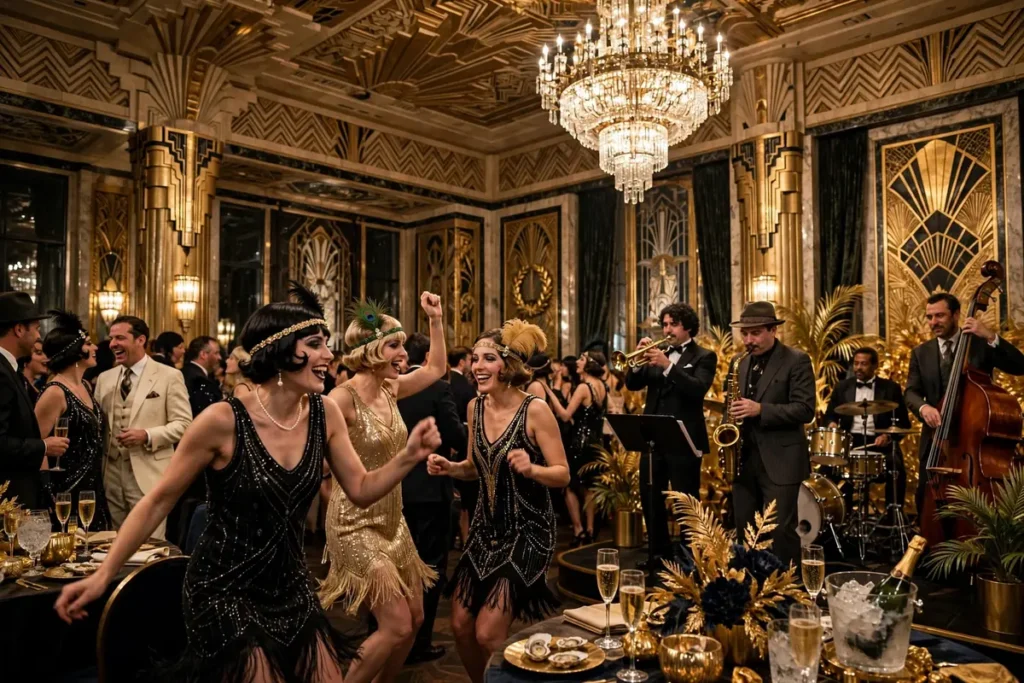
Roaring Twenties glamour: gold and black, feathers and fringe, champagne at midnight.
Watch: A Great Gatsby New Year’s Eve
A full Great Gatsby party setup with an event planner — gold and black décor, balloon installs, and photo moments.
At a Glance: A Great Gatsby New Year’s Eve
The Gatsby rules: palette, décor, drinks, attire, music, and the photo corner.
| Element | The Gatsby rule | Detail |
|---|---|---|
| Palette | Black, gold, white (silver accents) | Non-negotiable per the post |
| Décor | Art deco patterns, feathers, pearls, sequins | Maximalist: more is more |
| Drinks | Champagne tower, French 75, Gin Rickey, Sidecar | 1920s classics (widely cited cocktail history) |
| Attire | Flapper dresses, tuxedos, headbands, fedoras | The dress code sets the scene |
| Music | Jazz bands or 1920s playlists | The era’s heartbeat |
| Photo | A Gatsby photobooth corner with props | The most-shared element |
Frequently Asked Questions
Will guests actually dress up?
With this theme, yes — at higher rates than most costume parties, because the costumes are flattering and the barrier is low. The keys: give a specific, encouraging costume guide on the invitation, include the “cocktail formal minimum” escape clause so no one declines from anxiety, and stock the accessory basket for the hesitant. Expect roughly two-thirds in real effort, one-third in the escape clause plus borrowed accessories — and the borrowed-accessory third often ends up the most photographed.
What is the difference between a Gatsby party and a generic 1920s party?
Tone. A generic 1920s party can tip into gangster-costume cliché; a Gatsby party aims for the novel’s specific glamour — art deco geometry, champagne towers, jazz, old-money elegance with new-money exuberance. Keep the palette disciplined (black, gold, cream), the music genuinely jazzy for the first hours, and the decor geometric rather than kitschy, and you will land on the right side of the line.
How do I build a champagne tower without disaster?
Use a stable, level table. Build with clean, dry coupes: a base layer (say 4×4), then 3×3, 2×2, 1 on top — each upper glass resting in the gaps of the layer below. Pour slowly from the top glass, letting champagne cascade down. Practice once with water. Pour it at 8 PM as guests arrive — the tower is an arrival spectacle, and champagne poured too early goes flat. Have two to three bottles ready for the pour.
What if some guests do not drink alcohol?
Give them the full experience, not an afterthought. The Sparkling Gold Rush in a coupe looks identical to the cocktails; keep it batched and labeled as a menu item, not hidden. Also stock good sparkling water, and make sure the midnight toast includes a non-alcoholic pour already in hand — no one should be glassless at midnight.
Can I do this theme in a small space?
Absolutely — 12 to 18 guests in an apartment is the sweet spot. Concentrate the decor: one dramatic backdrop wall, the champagne tower as the centerpiece, candles everywhere. Small spaces intensify the speakeasy feeling. Skip the dance floor ambitions; a Gatsby party in close quarters becomes a champagne salon, which is arguably more authentic to the era’s apartment parties anyway.
What should the host wear?
The best costume in the room — it is part of the job. For her: the full flapper, beaded dress, headpiece, long gloves. For him: the sharpest suit you own with suspenders, bow tie, and pocket square, or a white dinner jacket for peak Gatsby. The host’s outfit sets the ceiling; guests rise to meet it.
A Little Party Never Killed Nobody — But Boredom Might
The Roaring Twenties were, at heart, a collective decision to celebrate anyway — to answer uncertainty with music, beauty, and champagne. That is why the theme never really ages, and why it fits New Year’s Eve better than any other night of the year. Your Gatsby party does not need to be the most expensive night of anyone’s year. It needs the five pillars standing together: the deco geometry glowing in candlelight, guests transformed by a headband and a bow tie, the tower pouring at eight, the French 75s circulating, and Armstrong giving way to the countdown.
Build it in four weeks, run it off the schedule, and when midnight comes — when the confetti falls and the room is gold and everyone is singing — you will understand what Fitzgerald was really writing about. Not the wealth. The possibility. Here is to the new year, old sport. Make it roar.