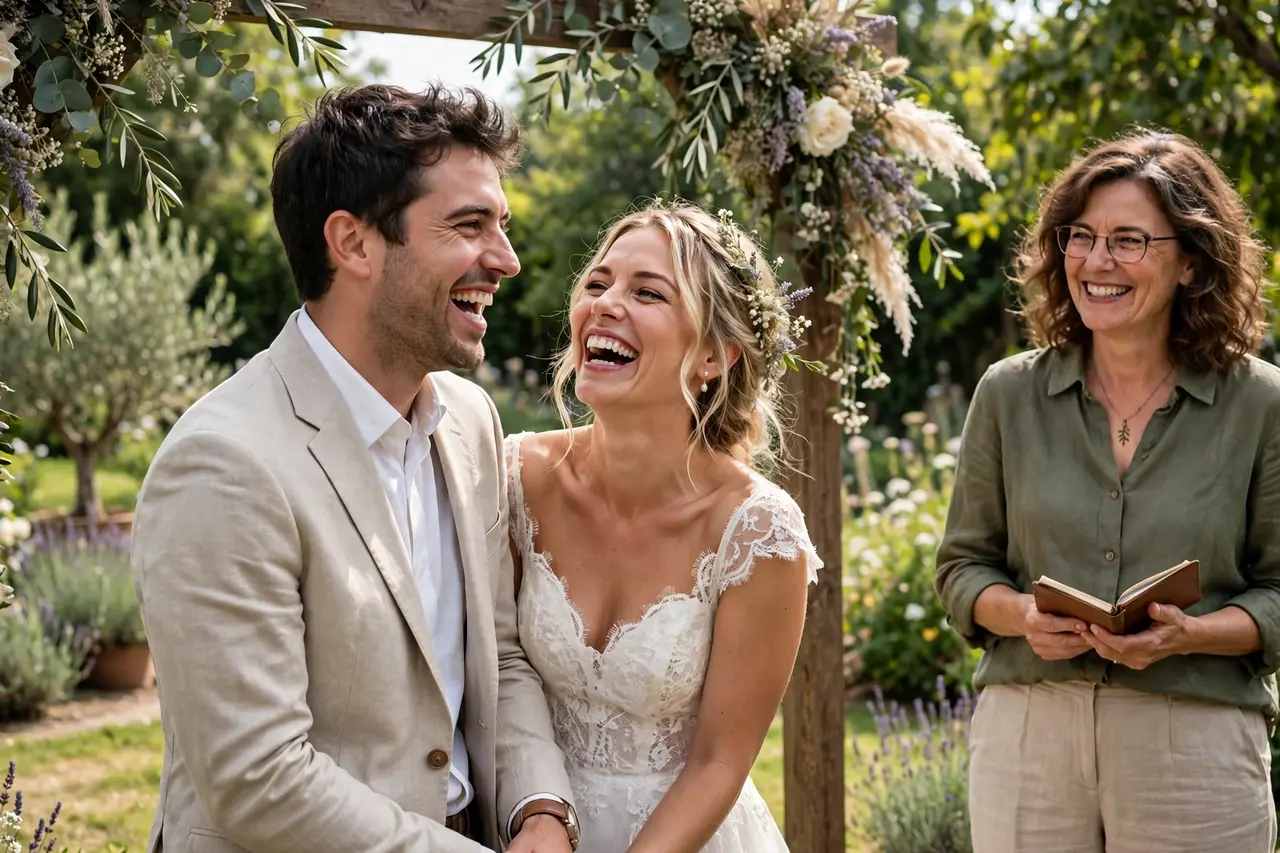
Here is a truth the wedding industry does not advertise: some of the most beloved vow renewals in history were funny. Not funny as in “we didn’t take it seriously” — funny as in “we take each other so seriously that we can laugh about the thermostat wars, the snoring, and the Great IKEA Incident of 2019.” Humor, deployed with love, is one of the most honest registers a couple can choose. It says: I know you completely — the glorious and the ridiculous — and I am still here, laughing.
But funny vows are high-wire work. The line between hilarious and hurtful, between charming and cringe, is thin, and you are walking it in front of an audience with no net. This guide gives you original funny vow renewal examples that actually work, the rules that separate great funny vows from disastrous ones, one-liners you can sprinkle into any vow set, and delivery techniques borrowed from stand-up comedy that will help your humor land. Every example is written fresh — steal them outright or use them as templates for your own material.
The Golden Rules of Funny Renewal Vows
Before the examples, internalize these rules. They are the difference between a room roaring with laughter and a room shifting uncomfortably in its seats.
Rule one: punch up at the marriage, never down at your partner. Jokes about shared absurdities — the terrible apartment, the disastrous vacation, the fact that you are both incapable of assembling furniture — unite the room. Jokes that make your partner the butt of the joke divide it. “We survived my cooking” is funny. “We survived her cooking” is a gamble. When in doubt, make yourself the punchline. Self-deprecation is the safest and most charming form of wedding humor.
Rule two: every joke needs a sincerity chaser. The ideal structure is laugh, then land. A funny line releases tension; the sincere line that follows gives the laughter meaning. Think of humor as the delivery vehicle for sentiment: the joke gets the room’s attention and lowers its defenses, and then the true thing slides in while everyone is still smiling. Vows that are all jokes feel like a roast. Vows that alternate joke-truth-joke-truth feel like love.
Rule three: know your audience’s limits. Your college friends will laugh at anything. Your grandmother will not. Your partner’s parents are evaluating whether their child married well. Write for the most conservative person in the room, then add exactly one joke for the inner circle — the one that makes your best friends howl while everyone else smiles politely. Bathroom humor, ex-partner jokes, and anything involving the wedding night are off the table. Always.
Rule four: test the material. Comedians do not debut an hour of untested material on opening night, and neither should you. Read your funny vows to one brutally honest friend — the one who will tell you a joke does not work. If they wince, cut it. If they laugh and then go quiet at the sincere parts, you have nailed the ratio. Never debut humor cold at the ceremony.
Rule five: agree on the tone together. The single biggest funny-vow disaster is tonal mismatch: one partner delivers a heartfelt tearjerker while the other does five minutes of stand-up. It makes the funny one look unserious and the serious one look humorless. Coordinate in advance. If one of you is doing funny, the other should be warm-with-humor, not solemn. You are a team; perform like one.
Full Funny Vow Examples
Complete, ceremony-ready funny vows. Each follows the laugh-then-land structure.
“[Name], when I married you, I promised to love you in sickness and in health. Since then you have given me your colds, your stomach bugs, and your firm belief that WebMD is a diagnostic tool. I have held your hair back, driven you to urgent care at 2 a.m., and learned that ‘I’m fine’ means anything but. And I’d do it all again — because the person who trusts me with their worst moments is the person I want for all of them. I vow to keep showing up: with soup, with terrible jokes, and with love that doesn’t flinch at the gross parts.”
“I take you again to be my spouse — my emergency contact, my tech support, and the only person legally allowed to eat off my plate. I promise to love you through good times and bad, through home renovations and in-law visits, through every software update that changes where the buttons are. I promise to keep laughing at your jokes, including the ones I’ve heard two hundred times, because your laugh is still my favorite sound. And I promise that no matter how many years pass, I will still pretend not to notice when you steal the blankets.”
“Years ago I stood here and made a bunch of promises I didn’t fully understand. Let me update them with the wisdom of experience. I vow to continue loving you even though you leave one sip of milk in the carton. I vow to keep pretending your driving doesn’t terrify me. I vow to watch the shows, eat the leftovers, and kill the spiders — though we both know you could do it yourself and just enjoy watching me suffer. But seriously: you’re my favorite person, my best decision, and the only one I’d want stuck in an airport with. Here’s to forever — or at least to the next time we need to renew these, because I’m clearly getting better at them.”
“[Name], we’ve been married long enough that I can predict your order at any restaurant, finish your sentences, and know exactly which sigh means what. Some might call that routine. I call it fluency — I am fluent in you. I speak your hangry, your tired, your ‘I need ten minutes alone,’ and your happy dance. My vow is to stay fluent: to keep learning the new dialects as we change, to keep translating for the kids, and to keep choosing the conversation — even the 1 a.m. ones about nothing — for the rest of our lives.”
One-Liners to Sprinkle Into Any Vows
Not every couple wants fully funny vows, but almost every vow set benefits from one or two well-placed laughs. Drop these into otherwise sincere vows to release tension and prove authenticity.
On forever: “They say marriage is forever. At this point I’ve invested too much in couples costumes to quit now.” On partnership: “You’re the Wi-Fi to my buffering — I literally cannot function without you.” On growth: “We’ve grown so much together. Mostly around the middle, but emotionally too.” On commitment: “I’d choose you again in every lifetime, though next time I’m picking the one where we both sleep through the night.”
On daily life: “I vow to love you on laundry day most of all, because that’s when the romance is really tested.” On teamwork: “We’re a great team. You make the plans, I provide the moral support and snacks.” On the future: “I can’t wait to grow old with you, mostly so we can finally be the couple that complains about loud music together.” On devotion: “You’re stuck with me. The good news is I’m hilarious. The bad news is you’ve heard all my material.”
The key to deploying one-liners: place them early in the vows, never at the end. Open with the laugh to relax the room (and yourself), build through sincerity in the middle, and close on genuine emotion. Ending on a joke makes the whole vow feel like a bit; ending on truth makes the jokes feel like love.
The 70/30 Formula: Balancing Humor and Heart
The most reliable structure for funny renewal vows is the 70/30 formula: roughly seventy percent sincere, thirty percent funny. In a three-minute vow, that means about two minutes of genuine sentiment and one minute of humor, interwoven — not two separate blocks. The humor should feel like your personality shining through the sincerity, not like a comedy set with feelings stapled on.
Here is how the formula looks in practice. Open with a funny line to break the ice and signal the tone. Move into sincere territory: a real memory, real gratitude. Drop another laugh — an observational joke about married life. Build to the emotional peak: the true thing, said plainly. Close with one final line that is either pure sincerity or a joke that lands on sincerity (“You’re stuck with me — and honestly, you’ve never looked happier about it”).
Read your draft and highlight the funny lines. If more than a third is highlighted, trim jokes until the sincerity dominates. Then read it aloud and notice where you naturally get emotional — those are the load-bearing walls of the vow. The jokes are decoration; the emotion is structure. Never sacrifice structure for decoration.
Funny vs. Cheesy vs. Cringe: Know the Line
Not all humor is equal. This table will help you audit your material before the ceremony — if any of your jokes land in the right-hand column, rewrite or cut them.
| Funny (Keep) | Cheesy (Use Sparingly) | Cringe (Cut Immediately) |
|---|---|---|
| Specific observational humor about shared life | Generic “ball and chain” marriage jokes | Jokes at your partner’s expense about appearance or ability |
| Self-deprecating lines | Puns that need explaining | Ex-partner or dating-history references |
| Gentle teasing you both laugh about privately | Overused internet vow memes | Bathroom, bedroom, or bodily-function humor |
| Callbacks to real stories guests know | Rhyming vows that sacrifice meaning for rhyme | Inside jokes with zero context for the audience |
| Warm exaggeration (“you’ve heard all my material”) | Props or costumes during the vows | Anything that needs “you had to be there” |
The test is simple: would you be comfortable if your partner’s grandmother repeated the joke at the reception? If yes, keep it. If you hesitate, cut it. Grandmother-proofing is the most reliable humor filter ever devised for ceremonial occasions.
Comedic Timing for Non-Comedians
Great material dies with bad timing and mediocre material survives with great timing. These delivery techniques are borrowed from stand-up and adapted for ceremonies.
Pause before the punchline. The laugh lives in the beat of silence before the funny word. “I vow to love you even though you… leave one sip of milk in the carton.” That micro-pause lets the audience anticipate and then release. Rushing through jokes to “get to the serious part” kills them; the joke deserves its moment.
Pause after the laugh. When the room laughs, wait. Let it crest and begin to fade before you continue. Talking over laughter signals nervousness and steps on your own material. New speakers almost always rush this — consciously count “one-Mississippi” in your head before resuming.
Deliver funny lines straight. The biggest amateur mistake is grinning or giggling through the joke, which tells the audience when to laugh and ruins the surprise. Say the funniest lines with a sincere face and let the words do the work. The contrast between your earnest delivery and the absurd content is what generates the laugh.
Make eye contact on the sincere lines, not the jokes. Look at the audience (or your partner, smiling) during humor; lock eyes with your partner during the true lines. This physical pattern teaches the room when to laugh and when to feel, and it ensures the emotional peaks land directly on the person they are for.
Have a recovery plan. Even tested jokes sometimes die — the room is tired, the microphone is weird, the moment is off. If a joke bombs, do not apologize, do not explain it, and absolutely do not repeat it louder. Just move to the next line with confidence. One dead joke in a sea of sincerity is invisible; apologizing for it makes it the moment everyone remembers.
Reading the Room on the Day
No amount of preparation fully predicts the room’s energy. Stay adaptable with these game-day adjustments. If the audience is warm and laughing easily, you can lean into the humor slightly — add the extra one-liner you were on the fence about. If the room is emotional and tearful from earlier in the ceremony, pull back on comedy and let the sincerity lead; forcing laughs into a tender moment feels jarring.
Watch your partner above all. If they are laughing, you are golden. If they look uncomfortable — even slightly — pivot to sincerity immediately and stay there. Your vows are for them first; the audience’s laughter is a bonus, not the objective. The best funny vows in history were the ones where the couple was clearly having fun together, audience or not.
And remember the deeper truth underneath the comedy: you are choosing funny vows because joy is central to your marriage. Say that, once, plainly, amid the laughter. “You make me laugh every day, and I think that’s the real secret” — one sincere sentence like that transforms a comedy set into a love story. For couples who want to extend the laughter into the celebration, our funny anniversary card messages and anniversary photo captions keep the tone going, and our budget celebration ideas prove the best parties run on joy, not money.
Funny Vows for Every Kind of Couple
Generic funny vows are good; funny vows calibrated to your specific situation are great. Here are complete examples for the situations couples ask about most.
For second marriages: “[Name], we’ve both done this before, which means we’re either very brave or very bad at learning lessons. I prefer brave. I vow to love you with the wisdom of experience — which is to say, I now know that ‘we need to talk’ is never about something good, that the dishwasher has a correct loading method (yours), and that a successful marriage is mostly about saying ‘you were right’ quickly. Here’s to getting it right this time — together, finally, forever.” The key with second-marriage humor is lightness without baggage: acknowledge the past with a wink, never with specifics.
For couples renewing later in life: “[Name], we’ve reached the age where ‘a night out’ means falling asleep on the couch by nine, and honestly? It’s perfect. I vow to keep sharing the remote — or at least to keep pretending I don’t mind your shows. I vow to be your emergency contact, your pill organizer consultant, and your partner in complaining about the youth. We’ve traded wild nights for quiet mornings, and I’d make that trade every time. You’re my favorite person to grow old with — mostly because you’re doing it first and can warn me what’s coming.” Age humor works when it is affectionate and self-inclusive — “we,” never “you.”
For adventure couples: “[Name], we’ve climbed mountains, gotten lost in four countries, and survived a tent collapsing in a thunderstorm — twice. Our marriage has a higher adventure-per-year ratio than most action movies. I vow to keep saying yes to your crazy plans, to keep packing the first-aid kit you mock until you need it, and to keep finding our way back — to camp, to the car, to each other. You’re my favorite adventure, my safest risk, and the only person I’d trust to navigate, literally and otherwise.”
For homebody couples: “[Name], while other couples were out conquering the world, we perfected the art of the perfect night in — and I wouldn’t trade our couch for any of their stories. I vow to keep fighting you for the good blanket, to keep pretending your true-crime documentaries don’t keep me up at night, and to keep ordering enough takeout that the delivery drivers know us by name. Adventure is overrated. Give me you, takeout, and the show we’re definitely going to finish this time.”
The pattern across all of these: take the couple’s actual identity, exaggerate it lovingly, then land on sincere devotion. Identity-based humor flatters because it says “I know exactly who we are, and I love it.” For more ways to celebrate your particular story, our anniversary date ideas for couples span every couple type from adventurers to homebodies.
The Reception Toast: Extending the Humor
Your funny vows end at the ceremony, but the comedy can continue at the reception — where the setting is looser and the expectations are different. A two-minute funny toast after the vows lets you use the material that was too edgy for the ceremony: the slightly spicier anecdotes, the impressions, the callbacks to the vows themselves (“as I said earlier, the Wi-Fi metaphor really holds up”). The rule of the toast: it should feel like an encore, not a second set. One or two strong bits, a sincere closing line, and hand the microphone to the next person while the room is still laughing.
Watch: A Joyful 20-Year Vow Renewal
For proof that celebration and sincerity go hand in hand, watch this wonderful 20-year anniversary vow renewal — a family affair full of love, laughter, and genuine emotion. Notice how the joy in the room amplifies the meaning of the moment rather than undercutting it. That is exactly the energy funny vows aim for: a ceremony where everyone is smiling and nobody doubts the depth.
Frequently Asked Questions
Are funny vows appropriate for a vow renewal?
Yes — if humor is authentic to your relationship. Funny vows work best for couples whose everyday love language includes laughter. The key is balance: aim for roughly 70% sincere and 30% funny, coordinate tone with your partner so you match, and make sure every joke is affectionate. A renewal is a celebration; joy belongs there.
What topics are off-limits in funny vows?
Avoid jokes about your partner’s appearance, intelligence, or abilities; ex-partners; infidelity (even jokingly); bathroom or bedroom humor; and anything involving family conflict. Grandmother-proof every line: if you would be embarrassed for the most conservative guest to repeat it, cut it. Punch up at the marriage, never down at your partner.
How do we avoid a tone mismatch between our vows?
Discuss tone explicitly in advance — this is the most important coordination step for funny vows. If one partner goes funny, the other should be warm-with-humor rather than solemn. You do not need to share content, but agree on the ratio: both mostly sincere with humor woven in, or both fully comedic. Never surprise your partner with an unexpected tone.
What if a joke bombs during the ceremony?
Move on immediately with total confidence — no apology, no explanation, no repeating it. One dead joke surrounded by sincerity is invisible to everyone except you. The audience wants you to succeed and will forget a flat line within seconds if you do not draw attention to it. Keep going; the next sincere line will reset the room.
Can funny vows still be moving?
The best funny vows are more moving than solemn ones, because the laughter opens the audience emotionally. The laugh-then-land structure — joke followed by sincere truth — is devastatingly effective: the humor lowers defenses and the sincerity walks through. Many guests report crying harder at funny vows than serious ones, precisely because they did not see the emotion coming.
Should we write funny vows together?
Collaborating on the comedy is smart even if you keep the sincere parts secret. Workshopping jokes together ensures the humor lands for both of you, prevents accidental sore spots, and is genuinely fun — many couples say writing funny vows together was one of their favorite parts of renewal planning. Test the material on one honest friend before the day.
How long should funny vows be?
Two to three minutes is ideal. Comedy has a shorter half-life than sincerity — a five-minute funny vow risks feeling like a routine, while a tight two-minute set leaves the audience wanting more. If you have abundant material, save the extra jokes for the reception toast, where a longer comedic turn is expected and welcome.
What if our families have very different senses of humor?
Write for the most conservative audience member and add exactly one inside joke for your circle. Universal observational humor about married life — snoring, thermostats, blanket theft — crosses all family cultures. Avoid anything requiring generational or subcultural context. When in doubt, sincere-with-a-smile beats edgy every time at a family ceremony.
Laugh Together, Love Longer
Couples who laugh together last — the research actually backs this up, but you do not need a study to know it is true. You have lived it. Your marriage survived because somewhere in the hard years, you both kept finding things funny. Funny vows are just that survival strategy, formalized and celebrated.
So write the jokes. Test them on your brutally honest friend. Pair every laugh with a truth. Then stand up, deliver the funny lines straight, land the sincere ones looking into your partner’s eyes, and enjoy the sound of everyone you love laughing with you. That sound — joy, shared, out loud — is what the whole renewal is for. And years from now, when you remember this day, it won’t be the perfect phrasing you recall. It’ll be the laughter.