First time flying can feel like learning a foreign country’s customs in a single afternoon: the airport has its own language, its own lines, and its own unwritten rules. The good news is that millions of first-time flyers navigate it successfully every month, and nearly every anxiety you have has a simple, boring solution. This guide walks you through the entire journey in order — booking, packing, the airport, security, boarding, and landing — so you can walk into the terminal knowing exactly what happens next.
Before You Book: ID and Documents
For US domestic flights, every traveler 18 and older needs acceptable identification at the security checkpoint. Since May 2025, that means a REAL ID-compliant driver’s license or state ID (look for the star marking) or another accepted document such as a passport. A standard non-compliant license will not get you through. For international flights, you need a valid passport, and many countries require six months of remaining validity — check your destination’s entry rules before booking, not after.
Booking tips for first-timers:
- Choose nonstop flights when possible. Connections add the two things beginners find hardest: navigating an unfamiliar airport on a deadline and rebooking when the first flight is late.
- Pick daytime flights. Delays cascade through the day, so the first flight out is statistically the most on-time, and daylight makes everything less disorienting.
- Select your seat at booking if it is free; window seats give first-timers the best views and a wall to lean on, aisle seats give easy bathroom access.
- Read the baggage rules for your fare before packing. Budget fares may charge for carry-ons and basic economy on some airlines excludes them — surprises at the gate are expensive.
- Download the airline’s app and create an account. Mobile boarding passes, gate change alerts, and rebooking tools all live there.
Packing for Your First Flight
- Liquids rule (3-1-1): in your carry-on, liquids and gels must be in containers of 3.4 ounces (100ml) or less, all fitting in one quart-size clear bag. Full-size shampoo goes in checked luggage or gets confiscated.
- Keep essentials in your personal item: ID, phone and charger, medications, a change of clothes, snacks, and anything you cannot afford to lose. Checked bags are occasionally delayed; your personal item is your insurance.
- Dress for the plane: cabins are cold and dry. Layers, warm socks, and comfortable shoes you can slip off beat style every time. Avoid complicated belts and jewelry that slow you at security.
- Pack entertainment: download shows, music, and podcasts before leaving; airplane Wi-Fi is slow, pricey, or absent.
- Empty water bottle: bring it empty through security, fill it at a fountain after. Hydration matters more at altitude than you expect.
At the Airport: The Full Walkthrough
Arrive with time to spare
The standard guidance is 2 hours before domestic flights, 3 hours before international. First-timers should take the upper end. Rushing is the root cause of nearly every first-flight horror story.
Check in
Check in online 24 hours before departure via the app (you will get your boarding pass there), or use the airline’s kiosks or counter at the airport. If you are checking a bag, you will tag it at the kiosk or counter and hand it over — keep the claim sticker.
Security screening
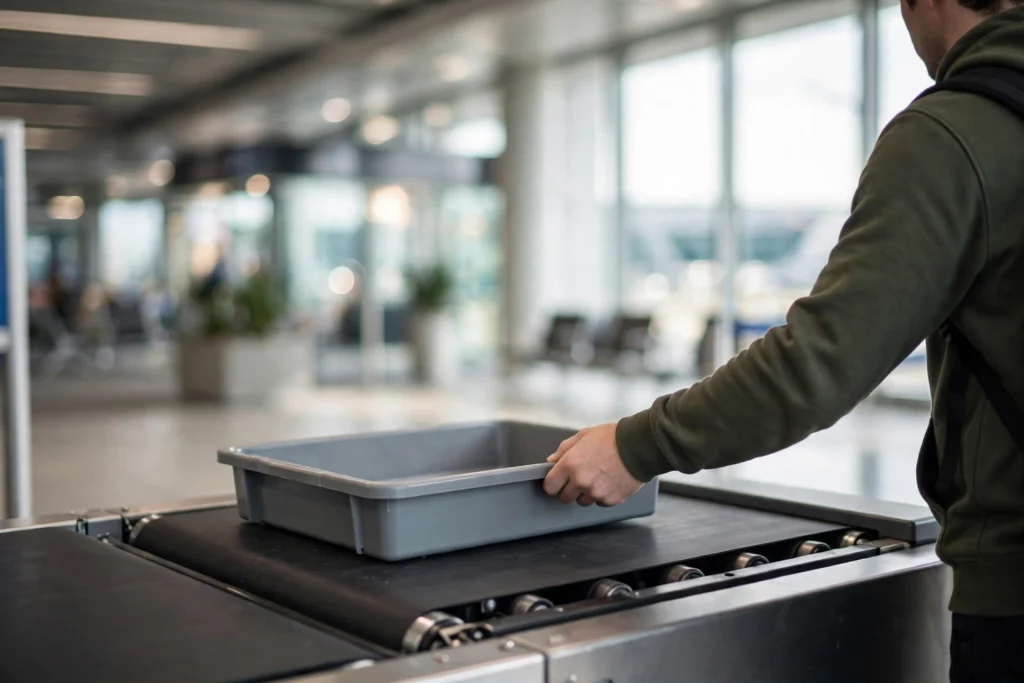
Follow signs for your airline’s checkpoint. Have your ID and boarding pass ready. The standard drill: laptop and 3-1-1 bag out of your carry-on into a tray, shoes and belt off (unless you have PreCheck), jacket off, pockets empty, then walk through the scanner. Watch travelers ahead of you and copy them — everyone was new once. If you are selected for additional screening, it is routine and not personal.
Finding your gate
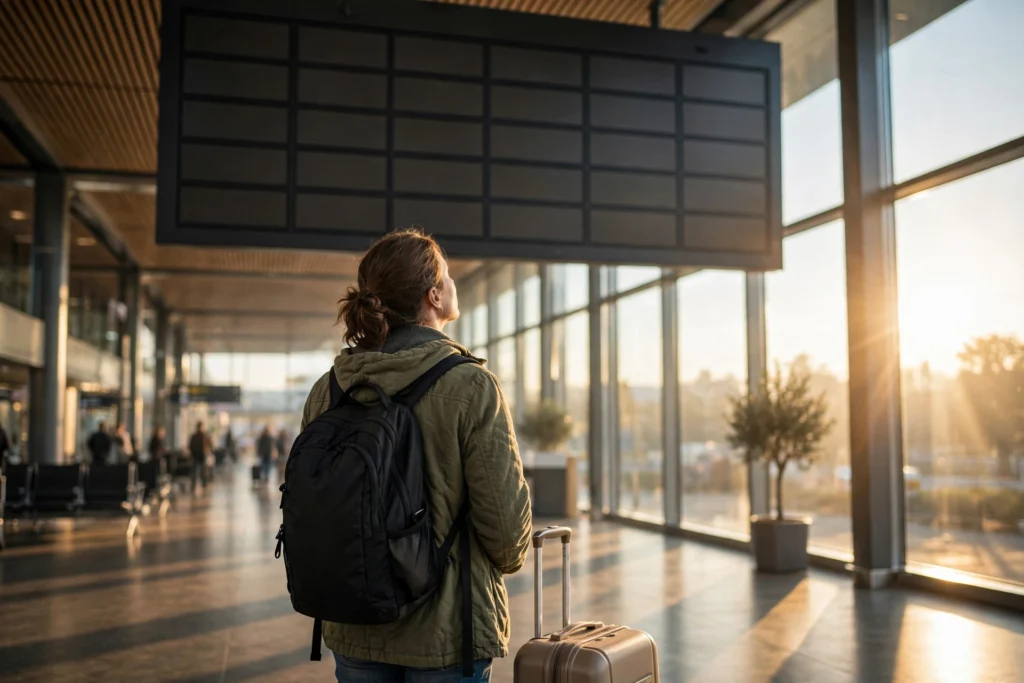
Your gate is on your boarding pass and the departure boards, but gates change. Check the app or boards again after security and head straight there first; then you can explore food and shops with the comfort of knowing where to return. Note the boarding time (typically 30–45 minutes before departure), not just the departure time.
Boarding
Airlines board in groups, called in order — your group is printed on the boarding pass. Line up when your group is called, have the pass ready (phone brightness up), and stow your carry-on in the overhead bin wheels-first or under the seat in front of you. Take your seat, buckle up, and stow tray tables and seatbacks upright when instructed.
In flight
The seatbelt sign, the safety briefing, the beverage service — it is all routine. Chew gum or yawn during ascent and descent to equalize ear pressure. Walk the aisle on flights over a few hours. Flight attendants are there for safety first and are happy to answer questions; asking is always better than guessing.
Landing and after
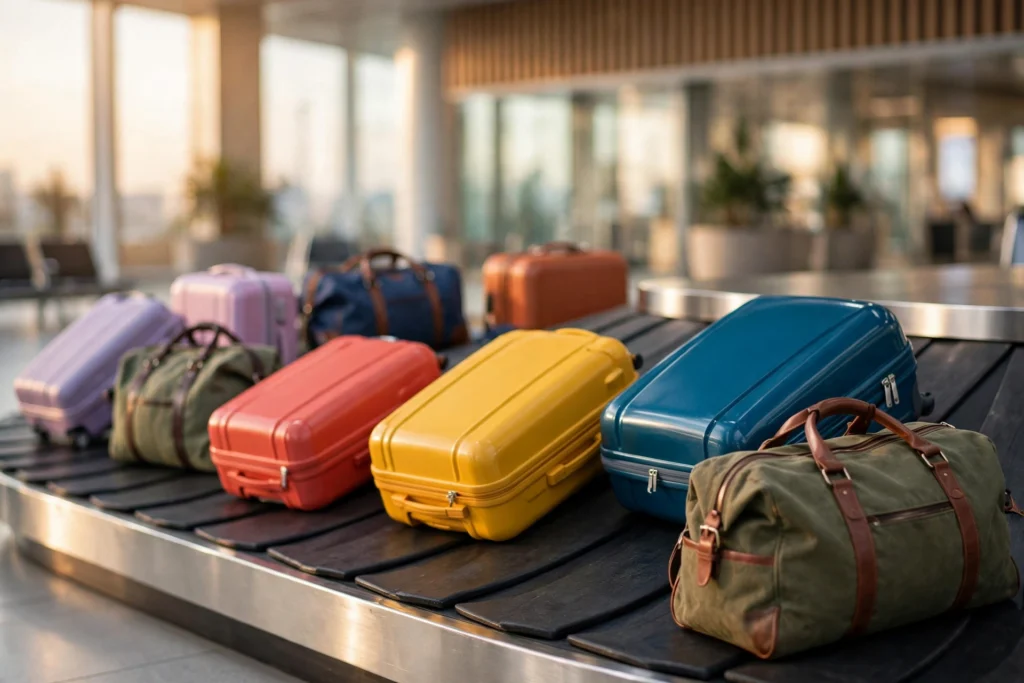
Stay seated until the seatbelt sign turns off. Follow signs to baggage claim if you checked a bag (the carousel number appears on arrival boards), or straight to the exit if you did not. International arrivals go through passport control and customs first — have your passport and customs form ready.
Understanding Delays and Cancellations
Delays happen to everyone. If yours does: check the app before joining the service-desk line (you can often rebook yourself in seconds), know that significant delays entitle you to rebooking or a refund of the unused ticket, and keep receipts for any expenses. The short version of your rights is worth knowing before you need it, and traveling with a portable charger turns a delay from a crisis into an inconvenience.
Two delay concepts first-timers should know. A delay means your flight still operates, just late — you keep your ticket and get rebooked automatically if you misconnect. A cancellation means the flight does not operate at all — the airline must rebook you or refund you, your choice. In both cases, do not wait passively at the gate: the travelers who act first (app rebooking, polite agent request, alternative routings researched on the spot) get the remaining seats. And if the delay stretches for hours, ask about meal vouchers for airline-caused disruptions — you will not always be offered them unprompted, but asking is free.
10 Mistakes First-Time Flyers Make
- Arriving too late. The number one beginner error. Pad your timing generously.
- Wrong ID. Non-REAL ID licenses do not work for domestic flights anymore. Check for the star.
- Full-size liquids in the carry-on. They will be thrown away at security. Every time.
- Not checking the gate. Gates change; the boarding pass printed at home is a starting point, not gospel.
- Confusing boarding time with departure time. Boarding closes 10–15 minutes before departure. “On time” means at the gate early.
- Overpacking the carry-on. If it does not fit in the sizer, it gets gate-checked — sometimes for a fee.
- Booking tight connections. Under an hour between flights leaves no margin for the delays beginners cannot absorb.
- Forgetting to eat and hydrate. Airport food is expensive and altitude dehydrates; pack snacks and refill water post-security.
- Not downloading entertainment. Assume no usable Wi-Fi and prepare accordingly.
- Panicking at security. It is a practiced routine. Watch, copy, breathe. The agents process thousands of first-timers a week.
Connecting Flights: A First-Timer’s Survival Guide
If you could not get a nonstop, connections add a second airport to navigate on a deadline. Here is how to survive them:
- Minimum connection times: for domestic connections, 60 minutes is the realistic floor for beginners; 90+ is comfortable. For international connections, allow 2–3 hours (you may clear immigration and recheck bags mid-journey).
- Know your gates before you land. The connecting gate is usually on your boarding pass and in the app, but it can change mid-flight — check the app as soon as you land and follow the signs, not your memory of the terminal map.
- Stay airside when you can. On most domestic connections you never leave the secure area; just walk (or ride the tram) to the next gate. You only re-clear security if changing terminals that are not connected post-security.
- If your first flight is delayed: tell a flight attendant before landing — they can sometimes arrange for you to deplane first or confirm your connection is held. Then check the app for automatic rebooking; airlines rebook misconnected passengers without you asking, though the new itinerary may not be ideal, so review it.
- Checked bags transfer automatically on single-ticket itineraries; you only collect and recheck when entering the US from abroad or when tickets were booked separately.
Your First International Flight: Extra Steps
- Passport validity: many countries require six months of remaining validity beyond your travel dates. Check the State Department’s country pages, not travel forums.
- Visas and entry authorizations: some destinations need advance visas; others need electronic authorizations (like the EU’s ETIAS system) completed before boarding. The airline will deny boarding without required documents.
- Customs forms: many countries still use paper or app-based arrival cards; flight attendants distribute them before landing. Keep a pen handy.
- Money: carry a small amount of local currency for arrival (or know the airport ATM situation), and notify your bank of travel dates so your cards work.
- Phone plan: international roaming is brutally expensive on many US plans. Arrange an eSIM, travel pass, or local SIM before departure.
- Time zones: set your watch to destination time when you board and try to sleep accordingly; it is the simplest jet lag defense there is.
After You Land: Getting Out of the Airport
The trip is not over at the gate. Before you fly, decide how you are getting from the destination airport to your lodging: pre-booked shuttle, rideshare pickup zones (every major airport signs these clearly), taxi queues, or public transit. Screenshot the directions while you still have Wi-Fi. If someone is picking you up, confirm exactly which terminal and door — “arrivals” at a big airport can mean six different curbs. Keep your phone charged through the flight so it is alive for this final leg, and keep your ID accessible until you are fully out; you may need it for rental cars or hotel check-in.
Seat Selection Strategy for First-Timers
Where you sit shapes your first flight more than you expect. Window seats give you the views, a wall to lean on for naps, and no neighbor climbing over you — the classic first-timer pick, and the right one for most people. Aisle seats give easy bathroom and stretch access without disturbing anyone, better for restless travelers and long flights. Middle seats are nobody’s first choice; if stuck with one, the unwritten rule grants you both armrests. A few more tips: seats near the front deplane faster (worth it on tight connections), exit rows offer legroom but come with responsibilities and often fees, and the very back rows feel turbulence most. If seat selection costs extra on your fare, a window or aisle seat is one of the few add-ons genuinely worth paying for on a first flight — $15–$40 for hours of comfort is good value.
Frequently Asked Questions
How early should I get to the airport for my first flight?
Two hours for domestic, three for international, and add 30 minutes to that as a first-timer. You can always kill time at the gate; you cannot rewind a missed bag cutoff.
What ID do I need to fly domestically?
A REAL ID-compliant driver’s license or state ID (with the star), a passport, or another TSA-accepted document. Standard licenses without REAL ID compliance are no longer accepted at checkpoints.
Can I bring food through airport security?
Yes, solid foods are fine. Drinks must be purchased after security or comply with the 3-1-1 liquids rule. Packing snacks is one of the smartest first-timer moves.
What happens if I miss my flight?
Go to the airline’s service desk or call immediately; airlines typically rebook missed-flight passengers on the next available flight, sometimes for a fee depending on the fare. This is why generous timing matters.
Do I tip flight attendants?
No, tipping is not customary for US flight crews. A genuine thank-you is appreciated.
Is flying safe for nervous first-timers?
Commercial aviation is the safest form of long-distance travel by an enormous margin. Turbulence feels dramatic but is a normal, well-understood part of flight — the aircraft is built for far worse than anything you will feel as a passenger.
What should I wear on my first flight?
Layers, warm socks, and slip-on shoes. Cabins run cold and dry, security is easier without lace-up boots and metal-heavy outfits, and you will be sitting for hours. Comfort beats style at 35,000 feet.
Can I use my phone on the plane?
Yes, in airplane mode. Cellular service must stay off, but Wi-Fi (purchased or free), downloaded entertainment, and Bluetooth headphones are all fine once the crew announces devices are permitted — usually shortly after takeoff.
How do unaccompanied minors or special assistance work?
Airlines offer unaccompanied-minor services (typically ages 5–14, with fees) where staff escort the child through connections, and free wheelchair or mobility assistance for anyone who requests it when booking. Request assistance at booking, not at the airport, to guarantee it is arranged.
What is the hardest part of flying for first-timers?
Ask a hundred first-time flyers and the answer is remarkably consistent: the airport, not the airplane. Navigation, timing, security, and gates cause nearly all the stress; the flight itself is usually anticlimactic in the best way. That is why this guide front-loads airport logistics — master the terminal and the sky takes care of itself.
Should I buy travel insurance for my first flight?
For a simple domestic trip, usually not necessary — but consider it for expensive nonrefundable bookings or international first flights, where trip interruption and medical coverage matter more. The decision framework is the same as for any trip: insure the losses you cannot comfortably absorb.
Can I bring my own food and drinks on the plane?
Solid food, yes — pack whatever you like. Drinks must be bought after security or brought in containers complying with the liquids rule. Most US domestic flights still serve complimentary nonalcoholic beverages, with food for purchase on longer routes; international flights typically include meals.
What is the single best tip for a first-time flyer?
Give yourself more time than you think you need. Nearly every first-flight disaster story — missed flights, sprinted terminals, security-line panic — traces back to cutting it close. An extra hour at the airport costs nothing; a missed flight costs hundreds and a day of stress.
How early should I arrive at the airport for my first flight?
The standard guidance is two hours before a domestic flight and three hours before an international one — and as a first-timer, take the full buffer rather than trimming it. Large airports, holiday travel weeks, and unfamiliar parking or transit all eat time in ways you cannot predict on a first trip. The extra hour costs you nothing; a missed flight costs hundreds of dollars and a day of stress. Once you have flown a few times and know your home airport’s rhythms, you can start shaving the margin.
What is the 3-1-1 liquids rule?
TSA’s 3-1-1 rule limits carry-on liquids to containers of 3.4 ounces (100 milliliters) or less, all fitting in one quart-sized clear zip-top bag, one bag per passenger. Anything larger goes in checked luggage or stays home — and yes, the half-used full-size shampoo bottle will be confiscated. Medically necessary liquids and baby formula have separate allowances but must be declared at the checkpoint. The rule applies at US checkpoints and similar versions exist worldwide, so the quart bag habit travels well.
What do I do during a layover?
For short layovers, stay in the terminal and head toward your next gate: check the departure boards as soon as you land, since gate changes are common, and use the remaining time for food, restrooms, and stretching your legs. Do not leave the airport unless you have several hours and know the local transit cold — re-clearing security is where layovers go wrong. On longer layovers, many airports now offer quiet rest areas, showers for a fee, and surprisingly good food halls; a little research turns dead time into a pleasant break.
Your first flight is the start of a skill that compounds: each trip makes the next one easier. When you are ready to plan the second one, our how to find cheap flights guide stretches your budget, cheapest time to travel helps you pick dates, and US travel news keeps you current on the rules of the sky.