There is a particular kind of magic in holding your love story in your hands. Not on a phone screen, not in a cloud folder you never open, but in a real book — pages you can turn, photos you can touch, handwriting you can recognize at a glance. A first meeting anniversary memory book takes the scattered artifacts of your relationship — the ticket stubs, the blurry photos, the screenshots of late-night conversations — and turns them into a narrative. It says: this happened, it mattered, and here is the proof.
Memory books make extraordinary anniversary gifts because they cannot be bought off a shelf. Every one is unique by definition, and the effort they require is exactly what makes them meaningful. But they can also feel overwhelming to start. What goes in? What stays out? How do you organize ten years of memories into something coherent? This guide answers all of it: the best formats from handmade scrapbooks to professional photo books, exactly what to include on every page, prompts that unlock memories you forgot you had, and step-by-step methods for finishing the book without it becoming a second job. Whether you are crafty or can barely operate scissors, there is a memory book approach here that fits you.
Why a Memory Book Beats Almost Any Other Gift
Ask couples what anniversary gift they treasure most, and an overwhelming number point to something handmade and personal rather than something expensive. The psychology is straightforward: gifts that require time and thought signal investment in a way that money cannot. A memory book is hours of your life converted into an object — every page is evidence that you paid attention, that you remembered, that you cared enough to preserve.
Memory books also do something no other gift does: they tell the story back to both of you. In the rush of daily life, couples forget their own history. The inside jokes fade, the early adventures blur, the exact feeling of those first months gets filed away. Opening a memory book together is like watching the director’s cut of your own romance — you remember things you had genuinely forgotten, and you see your partner remembering them too. That shared remembering is one of the most bonding experiences a couple can have.
There is a practical dimension as well. Photos live on phones now, which means they effectively do not exist. The average person has thousands of photos they will never look at again. A memory book forces curation: the forty photos that actually matter, printed, captioned, and given context. Years from now, when your phone is long gone and the cloud service has changed its terms, the book will still be on the shelf. It is the most future-proof gift you can make.
Choosing Your Format: Five Approaches That Work
Not all memory books are created equal, and the right format depends on your skills, your timeline, and how you want the finished book to feel. Here are the five approaches worth considering, from most hands-on to most hands-off.
The Classic Handmade Scrapbook
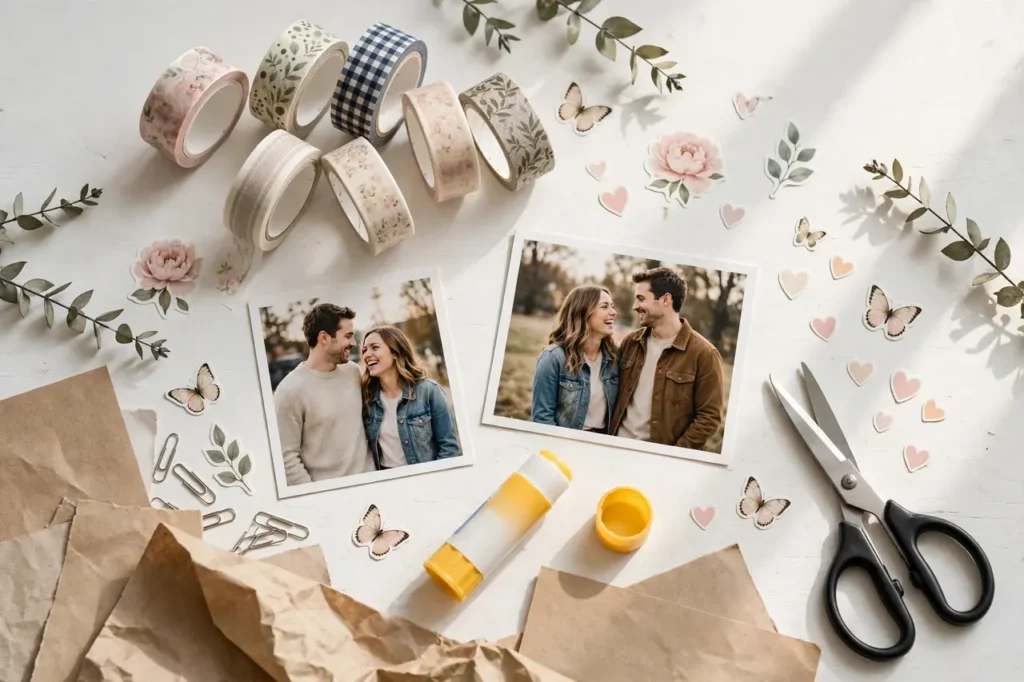
The scrapbook is the original memory book and still the most personal option. You buy an archival-quality album, print your photos, and build each page by hand with decorative paper, stickers, washi tape, and handwritten captions. The charm is in the imperfection — the slightly crooked photo, the doodle in the margin, the ticket stub taped in at an angle. It looks like love, because love is a little messy. The downside is time: a proper scrapbook takes fifteen to thirty hours. Start at least two months before the anniversary, work on it in weekly sessions, and accept that the last pages will be simpler than the first. That is fine. The book documents your effort as much as your memories.
The Professional Photo Book
Services that turn your digital photos into bound, printed books have made it possible to create something that looks professionally published in an evening. Upload your photos, choose a layout, add captions, and a gorgeous hardcover book arrives in a week or two. The result is sleek and durable — these books last decades — and the process is genuinely enjoyable once you get into the flow of selecting and sequencing photos. The trade-off is less tactile personality: no ticket stubs, no handwriting, no three-dimensional mementos. Compensate by writing longer, more personal captions than you think you should. The words carry the intimacy that the format cannot.
The Letter Collection Book
This is the sleeper hit of memory book formats. Instead of building around photos, you build around writing: a collection of letters, each on its own page or in its own envelope tipped into the book. Write one letter for every year you have been together, or one for every significant milestone. Ask close friends and family to contribute letters too — their outside perspective on your relationship is often the most moving part. Bind it simply: a beautiful journal, letters pasted or tucked in, a ribbon to close it. For partners who are moved more by words than images, this format is unbeatable, and it requires zero craft skills.
The Digital Interactive Book
For the tech-comfortable couple, a digital memory book — built as a private website, a designed PDF, or a multimedia presentation — can include things paper cannot: video clips, voice memos, animated timelines, links to “our song” on streaming services. It is also the easiest format to collaborate on secretly with friends and family, since contributors can upload from anywhere. The risk is the same as with all digital things: formats change, links die, and a file on a hard drive does not get opened the way a book on a coffee table does. If you go digital, print a physical copy too, even a simple one. Future you will be grateful.
The Hybrid: Printed Book Plus Keepsake Box
The hybrid approach gives you the best of everything. Create a professional photo book for the visual narrative, then pair it with a keepsake box containing the three-dimensional artifacts that do not fit on pages: the movie tickets, the dried flower, the hotel key card, the handwritten note. Present them together. The book tells the story; the box holds the evidence. This approach is also the most forgiving for beginners, because the box requires no design skills at all — just a beautiful container and meaningful objects.
What to Put on Every Page: The Essential Contents
The blank page is the enemy. Here is a contents framework that works for any format — think of it as the table of contents for your love story. You do not need every element, but hitting most of them guarantees a book that feels complete.
Open with the beginning: how you met, told in both of your voices if possible. Even a few sentences each, side by side, set up the entire book. Follow with a timeline of the early days — first date, first trip, the moment you knew — illustrated with whatever photos exist from that era. Early-relationship photos are often scarce and low quality; that is part of their charm. A blurry photo from a real moment beats a polished photo from a staged one every time.

The middle of the book is the adventure section: trips, moves, holidays, the big shared experiences. Organize these chronologically or thematically — “all our beach trips” can be more evocative than strict chronology. Include the ephemera: boarding passes, restaurant receipts with the date circled, the wristband from the festival. These small artifacts trigger richer memories than photos alone, because they are tied to sensory details — the smell of that restaurant, the sound of that concert.
Dedicate a section to the ordinary days. This is the part most memory books skip, and it is the part couples treasure most later. The Sunday morning pancake ritual. The way you always fight about the thermostat. The TV show you watched together for six seasons. Ordinary life is the actual substance of a relationship; the big events are just the highlights. A page titled “A Completely Normal Tuesday” with a photo of your messy living room will make you both laugh harder in twenty years than any vacation photo.
Close with the present and the future. A recent photo you both love. A letter to each other about right now — what you appreciate, what you are looking forward to. Leave a few blank pages at the end titled “To Be Continued.” It is a small gesture that turns the book from a finished monument into a living document, and it sets up the lovely tradition of adding to it on future anniversaries.
Memory Prompts That Unlock the Good Stuff
Staring at a blank page trying to “write something meaningful” is paralyzing. Prompts bypass the pressure by giving your brain a specific doorway. Use these to generate captions, letters, and page themes — answer them quickly, without overthinking, and you will be amazed what surfaces.
Start with sensory prompts: What did the place smell like the night you met? What song was playing? What were you wearing, and what did you think of what they were wearing? Sensory details are the fastest route to vivid memory, and they make the best captions because they put the reader inside the moment. “The bar smelled like cedar and spilled beer, and you were wearing that green sweater I pretended not to notice” is worth ten generic captions about having a great time.
Move to story prompts: What is the funniest thing that happened on your first date? What did your friends say when you told them? What is something you believed about your partner in the first month that turned out to be completely wrong? What is a small kindness from the early days that you still think about? These questions surface the anecdotes that make a memory book feel alive rather than curated.
Then the reflective prompts, which are best for letters: When did you first realize this was serious? What has your partner taught you? What is a hard time you got through together, and what did it show you about each other? What do you hope the next ten years look like? Answer honestly rather than romantically — the truest lines are always the most moving. “You taught me how to apologize properly, which I did not know was a skill” will mean more than any sonnet.
Finally, crowdsource. Ask each contributor — friends, siblings, parents — one specific question rather than a general “write something.” “What is your favorite memory of us as a couple?” or “What did you think when we first got together?” Specific questions get specific answers, and specific answers are what make the contributed pages shine. Give contributors a deadline two weeks before you need the pages done; people are loving but slow.
Gathering Materials: What You Actually Need
One reason memory book projects stall is supply overwhelm — a craft store aisle with ten thousand options is paralyzing. Here is the short, honest list. For a handmade scrapbook: one archival-quality album (12×12 is the standard and gives you room to work), a paper trimmer, acid-free adhesive (tape runners are cleaner than glue sticks), a set of archival pens in black and one accent color, and two or three packs of patterned paper in a palette you like. That is the core kit. Everything else — stickers, stamps, die-cuts, ribbons — is optional garnish. Buy the garnish only after you have started, when you know what your pages actually need.
For photos, print more than you think you need — around 100 for a full book — in a mix of sizes. Most pages work best with one large anchor photo and two or three smaller ones. Matte prints look more premium than glossy and do not show fingerprints. If your early photos only exist on ancient phones or social media, screenshot them at the highest resolution available and print small; a 3×3 print of a blurry 2014 selfie has more emotional power than a blank space where it should be.
For a letter-collection book: one beautiful blank journal or album with thick pages, good envelopes in a matching size, a quality pen, and optionally wax seals or stickers for closing envelopes. Presentation matters enormously here because the format is simple — a ten-dollar journal looks sad, but a forty-dollar one with a ribbon closure looks like a treasure. This is the place to spend.
For a professional photo book: nothing but your photo library and an evening. Choose a service with layflat pages if your budget allows — photos that span the full spread look dramatically better. Order one copy first to check quality before ordering duplicates as gifts for parents. And always, always proofread every caption before you approve the print. Typos in a printed book are forever.
The Assembly Process: From Chaos to Keepsake
Here is a realistic workflow that takes you from a pile of stuff to a finished book without burnout. It assumes a handmade or hybrid book; adjust the timeline for simpler formats.
Phase one is the dig — one weekend, no crafting allowed. Pull every photo, ticket, letter, and artifact you can find. Dump phone photos into a folder. Text friends and family for photos you do not have. Raid the junk drawer, the shoebox in the closet, the envelope of “stuff” everyone keeps for no reason. The goal is abundance: you will use maybe a third of what you gather, but choosing from plenty beats hunting for one more item mid-project.
Phase two is the sort — one evening. Spread everything out and group it chronologically or by theme. As you sort, jot caption ideas on sticky notes and stick them to the photos. Do not write final captions yet; just capture the raw memory while it is fresh. This is also when you identify gaps: the trip with no photos, the year with nothing from it. For gaps, write a short paragraph instead — sometimes the missing photo becomes the most honest page in the book.
Phase three is the build — two to four weekly sessions. Work in page spreads, not single pages; a spread is the natural unit of a book. Start with the pages you are most excited about, not page one. Momentum matters more than order. Keep sessions to two hours max; craft fatigue produces sloppy pages and resentment. Put on music from the era you are documenting — it sounds sentimental because it works.
Phase four is the finish — one evening, a week before the anniversary. Write the opening and closing letters last, when the whole story is in front of you and you know what it adds up to. Add page numbers or a simple table of contents if you are feeling ambitious. Photograph every page for backup. Then wrap it beautifully and hide it somewhere your partner will never look. The hiding is harder than the making; choose wisely.
Photo Selection: The Art of Choosing
The difference between a good memory book and a great one is curation. Forty perfect photos beat four hundred pretty good ones. As you select, apply three filters. First, the emotion filter: does this photo make you feel something? If your reaction is “nice photo” rather than a pang, cut it. Second, the story filter: does this photo represent a moment, or is it just two people smiling at a camera? Candid and contextual photos — cooking together, laughing at something off-camera, asleep on a road trip — carry more narrative weight than posed ones. Third, the variety filter: make sure the book shows the full range of your life together, not just vacations and holidays. The Tuesday photos earn their place.
Caption every photo, even briefly. A photo without a caption is a riddle; with one, it is a story. The best captions do three things in one or two lines: name the when and where, add one specific detail, and hint at the feeling. “Big Sur, 2019 — the fog never lifted and we ate gas station sandwiches on the cliff. Perfect day.” That is a whole memory in twenty words. For couples building photo-heavy books, our guide to marriage anniversary photo ideas for couples offers posing and curation tips that transfer directly to memory book layouts.
One advanced move: include one or two photos of just your partner, taken when they were not performing for the camera, with a caption about what you see in them. These pages consistently become the recipient’s favorite. Being truly seen — and having proof that someone was paying attention — is one of the most romantic things a memory book can deliver.
Presenting the Book: Make the Moment Count
You have spent weeks making this thing; do not hand it over like a birthday card. The presentation should honor the effort. The classic move is a quiet moment for two: after dinner on the anniversary, phones away, open it together from the first page. Read the captions aloud. Let yourselves get emotional. Do not rush — plan for this to take an hour, and let it.
If you made the book as part of a small gathering, consider a middle path: give it privately first, then bring it to the party for guests to browse. Guests love flipping through a memory book at a celebration — it gives them something meaningful to do and endless conversation starters. Just be prepared for it to disappear into a corner with a crowd around it; that is the highest compliment it can receive.
Pair the book with one small complementary gift to round out the moment: a bottle of wine from the year you met, a playlist of songs from your early days, or a simple piece of jewelry engraved with the date. And write a card — a real one, by hand — even though the book itself is the gift. The card is the bow on the package. For more gift-pairing ideas, see our personalized anniversary gifts for couples guide.
Format Comparison: Cost, Time, and Impact
Still deciding which approach fits your life? This comparison breaks down the real investment each format requires, so you can choose with eyes open.
| Format | Typical Cost | Time Required | Skill Level | Best For |
|---|---|---|---|---|
| Handmade scrapbook | $60–$150 in supplies | 15–30 hours | Basic crafting | Maximum personal touch; tactile keepsakes |
| Professional photo book | $40–$120 per book | 4–8 hours | None | Polished look on a tight timeline |
| Letter collection | $30–$70 | 8–15 hours | None | Word-oriented couples; group contributions |
| Digital interactive book | $0–$50 | 6–12 hours | Basic tech skills | Video and audio memories; distant collaborators |
| Hybrid book + keepsake box | $80–$180 | 8–15 hours | Minimal | Best of both worlds; forgiving for beginners |
Watch: A Real Vow Renewal Celebration
Before you start building, take a few minutes to soak in what these milestones feel like when they come to life. This vow renewal video follows a couple celebrating decades together, surrounded by the people who witnessed their story unfold. Watch for the personal details — the photos on display, the way guests react to shared memories, the emotion of retelling the beginning. It is a beautiful reminder of why preserving your story in a memory book matters: one day, these are the moments you will want to hold in your hands.
Frequently Asked Questions
How far in advance should I start a memory book?
For a handmade scrapbook, start eight to ten weeks before the anniversary, working in weekly two-hour sessions. A professional photo book needs two to three weeks including printing and shipping time. A letter collection needs six weeks, mostly to give contributors time to write. Whatever the format, finish one full week early — last-minute crafting produces mistakes and stress.
What if I am not crafty at all?
Choose the professional photo book or letter collection format — both require zero craft skills and produce beautiful results. The emotional impact of a memory book comes from curation and words, not from decorative technique. A simply assembled book full of well-chosen photos and honest captions will move your partner more than a technically perfect one with generic content.
How do I get photos from friends and family without spoiling the surprise?
Text or email a small group with a clear, specific ask: “I’m making a surprise memory book — please send your three favorite photos of us as a couple by Friday.” People love being included in surprises and will generally keep the secret. Create a shared album link so contributions land in one place without endless message threads.
Should the book cover our whole relationship or just the early days?
Cover the whole arc, but weight it toward the beginning and the present. The early days are what a first-meeting anniversary celebrates, and the present is what makes the book feel alive. The middle years can be represented with a highlights approach — one spread per major chapter — rather than exhaustive documentation. Leave blank pages at the end for the future.
What do I write if I am bad with words?
Write plainly and specifically — that beats flowery every time. Instead of “you are my everything,” try “you always save me the last bite, and after nine years that still gets me.” Use the prompts in this guide, answer them quickly without editing, and use your first drafts. Short and true always outperforms long and strained. Our anniversary photo caption ideas can also spark short, caption-length lines.
Can I make a memory book for someone else’s anniversary?
Absolutely — memory books make phenomenal gifts for parents’ or friends’ milestone anniversaries. Crowdsource photos and letters from their circle, organize it chronologically, and present it at the celebration. For a parents’ anniversary, include pages from each decade of their marriage and letters from their children; it reliably produces tears. Pair it with ideas from our DIY anniversary gift ideas for a complete handmade gift.
How do I preserve a handmade book so it lasts?
Use acid-free, lignin-free, archival-quality materials for everything — album, paper, adhesive, and pens. Non-archival materials yellow and damage photos within a few years. Store the finished book away from direct sunlight and humidity, and photograph every page as a digital backup. With archival materials and reasonable storage, a handmade book lasts generations.
What is the biggest mistake people make with memory books?
Trying to include everything. An overstuffed book with four hundred photos and no curation feels like a chore to look through; a curated book with forty perfect photos and real captions feels like a treasure. Be ruthless in selection, generous in words, and remember that blank space on a page is not emptiness — it is breathing room that lets the important things stand out.
Your Story, Bound and Kept
A memory book is a bet on the future disguised as a gift for the present. It says that what you have is worth preserving, worth revisiting, worth handing down. Long after the anniversary dinner is forgotten, the book will be there — on the shelf, in the keepsake box, pulled out on quiet evenings and big milestones alike.
Start this week, even if the anniversary is months away. Pull the photos. Send the texts asking for contributions. Buy the album. The hardest part of any memory book is beginning; once the first page exists, the rest follows like a story that wanted to be told. And when you finally hand it over and watch your partner turn the pages — laughing, tearing up, remembering — you will understand that you did not just make a gift. You made proof: of where you started, how far you have come, and how much of the story is still unwritten.