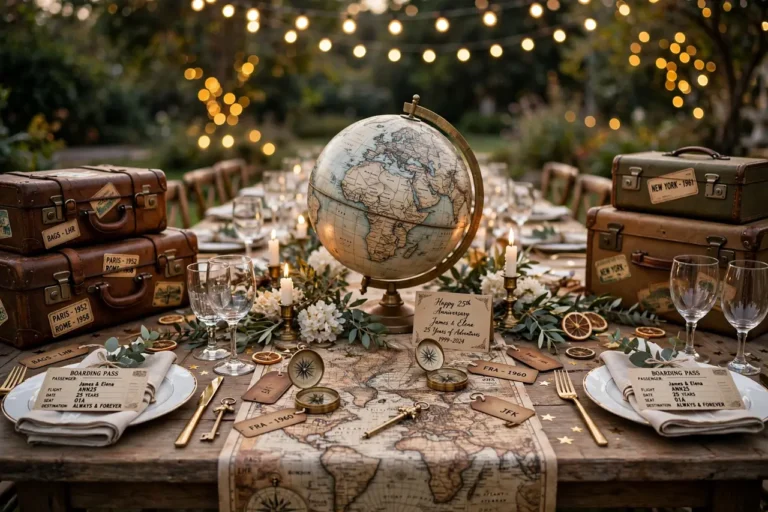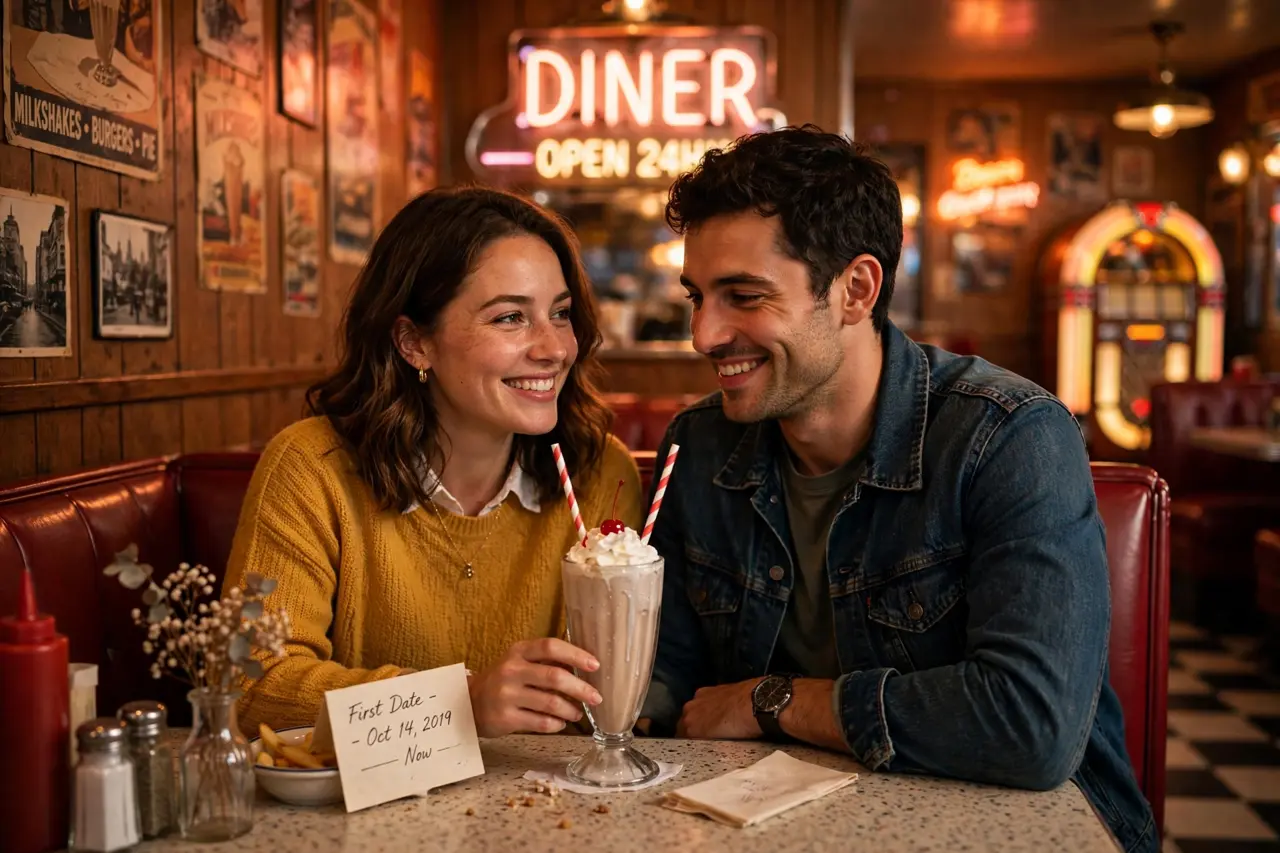
Of all the ways to celebrate a first meeting anniversary, one stands apart for pure emotional voltage: recreating your first date. There is something almost cinematic about walking back into the restaurant, the park, or the coffee shop where it all began — ordering the same things, wearing something close to the original outfits, and watching your own history replay with the knowledge of everything that came after. These first date anniversary recreation ideas will show you how to pull it off, from forensic reconstruction of the original evening to graceful handling of the parts you would rather forget.
Whether your first date was a fairy tale or a beautiful disaster, a faithful recreation turns it into legend. This guide covers the psychology of why recreations hit so hard, a step-by-step planning method, three levels of fidelity to choose from, and honest advice for the tricky bits — closed venues, forgotten details, and first dates that were, frankly, terrible. By the end, you will have a complete blueprint for an anniversary your partner will talk about for years.
Why Recreating Your First Date Works So Well
Nostalgia is not just a feeling; it is a psychological mechanism with measurable effects. Researchers studying nostalgia find that it increases feelings of social connectedness, self-continuity (the sense that your life is one coherent story), and even optimism about the future. A first-date recreation is essentially a nostalgia machine: it surrounds you with the sensory cues of your beginning — the same smells, sounds, tastes, and places — and lets your brain do the rest.
There is also the contrast effect, which is where the real magic lives. On your first date, you were nervous strangers performing your best selves. On the recreation, you are established partners who know each other’s coffee orders and worst habits. Experiencing the same setting from the other side of that transformation makes the growth of the relationship viscerally obvious. You do not just remember how far you have come; you feel it, in your body, in the booth where you once sat rigid with nerves and now sprawl with ease.
Couples who do recreations consistently report a specific moment — usually about twenty minutes in — when the performance drops and the laughter starts. Someone misremembers an order, someone admits what they were actually thinking that night, and the evening shifts from reenactment to something better: a director’s commentary on your own love story. Plan for that moment. Leave room for it. It is the point.
Step One: Reconstruct the Original Like a Detective
A great recreation starts with research. Two weeks before the anniversary, become an archivist of your own beginning. The goal is a “source document” — a one-page brief covering the key facts of the original date.
Mine your message history. Scroll back to the messages from that era. You are looking for: the planning exchange (“want to grab dinner Thursday?”), any mention of the venue, and — gold — anything you said afterward to friends about how it went. Screenshot the planning messages; you may want to read them aloud on the night.
Check the financial archaeology. Bank and card statements, if you still have access to them, will tell you exactly where you went and what you spent. A surprising number of couples have reconstructed entire first dates from a single card statement line.
Interview the witnesses. Text the friend who set you up, the roommate who helped you pick the outfit, the sibling who got the nervous pre-date phone call. Ask specifically: what did I say beforehand, what did I wear, what time did I get home, what was my verdict that night. Their answers will differ from your memory in delightful ways.
Reconstruct the sensory details. What was the weather? What were you listening to on the way there? What did the place smell like? Sensory details are what make a recreation feel like time travel rather than dinner. Write down everything you can recover, even the trivial stuff — especially the trivial stuff.
Note what you cannot recover. Some details are gone: the closed restaurant, the demolished venue, the outfit donated years ago. List these too, because each one becomes a creative decision (covered below) rather than a disappointment.
Compile it all into your brief: date, venue, time, weather, outfits, orders, conversation highlights, the verdict each of you gave afterward, and the gaps. This document becomes your planning bible — and, tucked into an envelope, a wonderful gift in itself years later.
Step Two: Choose Your Fidelity Level
Not every recreation should aim for documentary accuracy. Choose the approach that fits your original date, your budget, and your appetite for theater:
| Fidelity Level | What It Means | Best For | Effort |
|---|---|---|---|
| Forensic replica | Same venue, same table if possible, same orders, same outfits (or closest equivalents), same route there | Great first dates at venues that still exist; milestone anniversaries | High — requires research and sometimes travel |
| Inspired homage | Same type of venue and menu, key rituals honored, details adapted to the present | Closed venues, moved cities, online meetings, or first dates with unrepeatable logistics | Medium — the sweet spot for most couples |
| Reimagined upgrade | The spirit of the original, elevated: the dive bar becomes the cocktail bar, the picnic becomes the catered version | First dates that were charmingly rough; couples who want nostalgia plus luxury | Medium–High — costs more, plans easier |
The inspired homage is the most popular choice for good reason: it captures the emotional truth without the logistical suffering. If your first date was coffee at a shop that is now a parking lot, the homage is coffee at the best shop in your current neighborhood, with the same order and the same nervous energy lovingly mocked. Nobody at the table will feel the difference — because the difference was never the point.
A note on the forensic replica: it is spectacular when it works, but verify before you commit. Call the venue ahead. Restaurants change menus, remodel, and close; showing up to a beloved spot that is now a vape shop is a comedy you want to plan for, not stumble into. If the venue is gone, pivot proudly to homage — and make the pivot part of the story.
The Venue: Getting Back to Where It Started
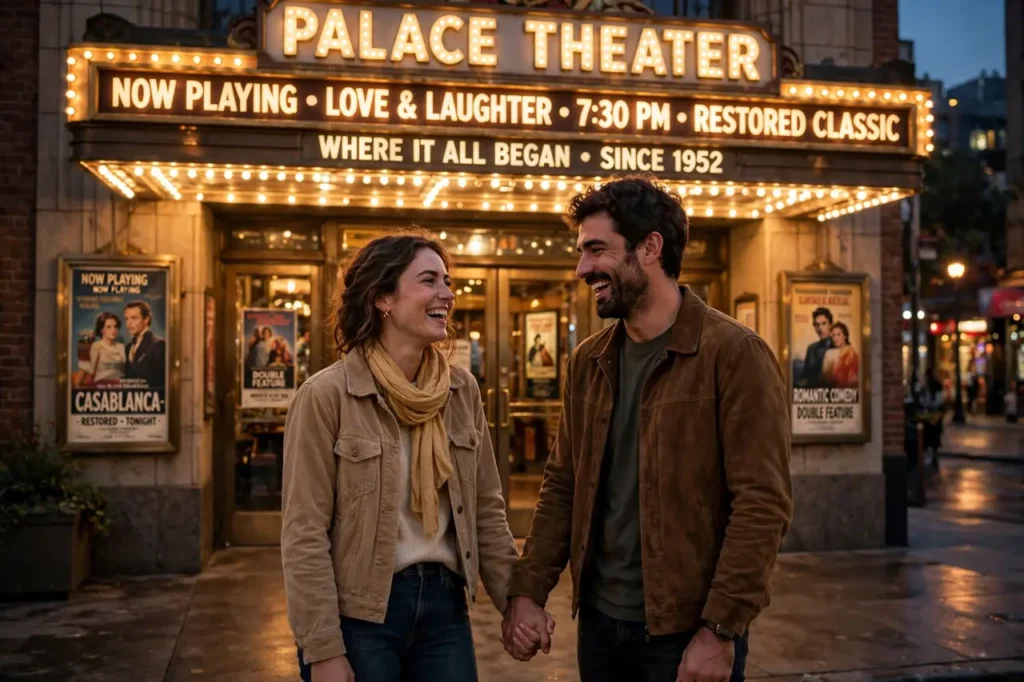
The venue is the soul of the recreation, so give it real thought. Start with reconnaissance: is the place still there, still the same, still good? A quick visit a week before (solo, or with a friend as cover) lets you check the menu, request the specific table, and brief the staff. Telling the host “we had our first date here six years ago and we’re recreating it” unlocks a level of service and goodwill that money cannot buy — staff love this story and will often conspire to make it perfect.
If the venue is gone or you have moved away, you have three good options. Option one: the pilgrimage. If it is within a few hours’ drive, make the trip part of the anniversary — the drive itself becomes a chapter. Our mini getaway ideas are built for exactly this kind of short romantic trip. Option two: the spiritual successor. Find the closest equivalent in your current city — same cuisine, same vibe, same price point — and declare it the new original. Option three: bring the venue home. Recreate the restaurant in your dining room: the same cuisine cooked or ordered in, a printed menu with the original items, the playlist from that era. Home recreations are often the most intimate because you control every detail.
For couples who met somewhere unconventional — a hiking trail, a bookstore, a laundromat, an airport — lean into it. The weirder the venue, the better the recreation, because the story is the whole point. Yes, go back to the laundromat. Bring champagne. The other customers will be delighted, and you will dine out on that story forever.
Food and Drink: Recreating the Menu
Food memory is the most powerful memory of all — smell and taste bypass the rational brain and go straight for the emotions. Getting the menu right pays outsized dividends.
Order the original dishes. If you remember what you both ordered, order exactly that, even if your tastes have changed. The gap between “what I ordered to impress you” and “what I would order now” is prime anniversary conversation material. If only one of you remembers, let that person order for both of you — surrendering the menu is a small, sweet reenactment of early-date deference.
Recreate the drinks. The cocktail, the wine, the beer, the terrible sugary thing you ordered because you were nervous — drinks are often better remembered than food, and easier to reproduce faithfully. If your first date involved coffee, find out the roast or blend if you can; coffee nerds will go to remarkable lengths to help with this quest.
Honor the mishaps. Did someone spill something? Order something inedible? Send something back? Recreate the mishap deliberately and laugh about it. One couple we know reenacts the moment he knocked over a full glass of red wine every single anniversary — she brings a white tablecloth from home, he brings the “accident.” It is their thing now, and it is wonderful.
End with the original dessert — or the one you wish you had ordered. If the date ended with dessert, repeat it. If it ended too early (nerves, curfews, bad planning), this is your chance to write the better ending: order the dessert, linger over coffee, take the long way home. The recreation is allowed to be an improvement. That is, in a sense, what anniversaries are for.
What to Wear: The Outfit Question
The outfit decision sets the tone, so make it deliberately. You have three philosophies to choose from, and couples should agree in advance — nothing kills the mood like one person in a lovingly recreated 2019 outfit and the other in gym shorts.
The faithful reproduction. Dig out the actual clothes if you still have them, or approximate them as closely as possible: same colors, same style, same level of trying-too-hard. Photograph the result next to the original photo. The comedy value is immense, and the tenderness sneaks up on you.
The elevated homage. Same palette or same vibe, but current and grown-up: the spirit of the original outfit with a decade of better tailoring. This says “we have grown” while honoring “where we started,” and it photographs beautifully.
The deliberate contrast. Wear what you would wear now, and let the contrast tell the story. This works especially well for long-term couples: the visual gap between then-outfits (in the old photos you bring) and now-outfits (on your bodies) becomes the evening’s running theme.
Practical notes: check old photos for the actual outfits rather than trusting memory (memory lies about clothes with complete confidence). If the original involved something uncomfortable — the too-tight shoes, the jacket borrowed from a roommate — reproduce the look, not the suffering. And whatever you choose, tell each other the dress code in advance. Surprise outfits are how anniversary photos get ruined.
Recreating the Conversation (and Improving on It)
The bravest part of a first-date recreation is revisiting the conversation — because first-date conversation is, by universal consensus, a minefield of awkwardness you have spent years forgetting. Here is how to do it well:
- Open with the actual opener. Whoever spoke first, say the actual first line again — as best you remember it. It will get a huge laugh, and it breaks the ice even between people who have shared a bed for a decade.
- Play “what I was actually thinking.” Take turns revealing the unspoken thoughts behind the original dialogue. “When I asked about your job, I was actually thinking about whether you would judge my apartment.” This game converts old awkwardness into current intimacy, which is the entire emotional payload of the evening.
- Ask the questions you were afraid to ask then. First dates are auditions; anniversaries are home. Ask now what you wanted to ask then: what were you most afraid of, what did you almost not tell me, when did you know. The answers, years later, are invariably better than they would have been.
- Read the receipts. If you found the old planning messages, read them aloud — the formality, the overthinking, the “haha” inflation. Early texting is a cringe-comedy goldmine, and laughing at your former selves together is profoundly bonding.
- End with the verdict update. Each of you gave the date a private verdict that night (to friends, to journals, to yourselves). Share the original verdict, then give the updated one: what would you rate it now, knowing everything? Spoiler: it always scores higher in retrospect.
When the Original Date Was Terrible
Let us address the elephant: some first dates were objectively bad. The restaurant was awful, someone was late, the conversation stalled, the whole thing nearly ended the story before it started. If that is your history, the recreation is not just possible — it is potentially the funniest, most romantic option on this entire list.
The key is framing: you are not recreating a bad date; you are staging a loving roast of it. Go full theater. Exaggerate the worst moments. The partner who was forty-five minutes late arrives forty-five minutes late on purpose, to a hero’s welcome. The terrible waiter becomes a role one of you plays. The dish that was inedible gets ordered and ceremonially pushed aside.
This works because of a beautiful psychological quirk: surviving something bad together is bonding, and commemorating the survival is even more bonding. The terrible first date that you laugh about every anniversary becomes a better story than the perfect first date ever could be. Perfection is forgettable; disaster, survived together, is mythology.
One rule: both partners must be genuinely okay laughing about it. If any part of the original is still tender — a real hurt, a genuine embarrassment — leave that part out or handle it gently. The roast is loving or it is nothing. Check in beforehand: “are we good to roast the lateness thing?” Consent makes comedy safe, even between people who love each other.
Documenting the Recreation: Photos Worth Taking
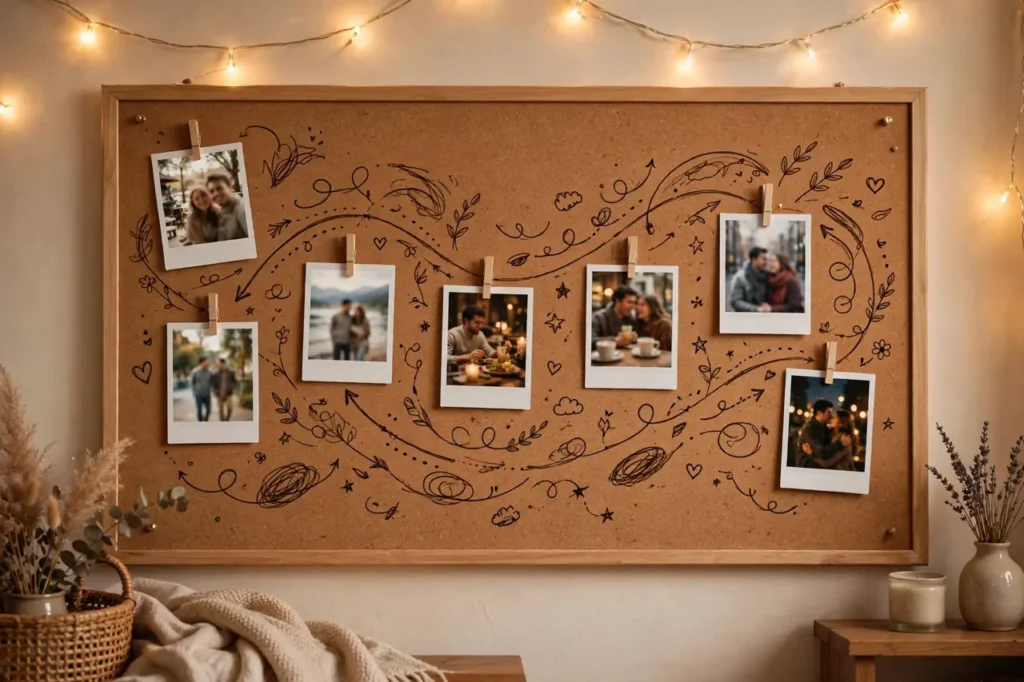
A recreation without documentation is a missed opportunity — future anniversaries will want this material. Plan your shots in advance so photography enhances the evening rather than interrupting it. Our couples’ photo ideas guide has posing and shot-list inspiration that adapts perfectly to recreation evenings.
The essential shots: the side-by-side (original photo held up in the recreated scene), the table setting before you sit down, the menu or order ticket, the “then and now” outfit comparison, one candid mid-laugh photo (ask the server — they love being part of this), and a final photo in the same pose as your earliest photo together. Six photos, each taking under a minute, and you have a complete visual record.
Then do something with them. The couples who get the most from recreations build a growing archive: a dedicated album, a wall frame that gains a photo each year, or a digital folder shared between you. Year one’s recreation photos become year five’s “remember when we recreated it the first time” material. Traditions compound; documentation is how.
The Morning After: Extending the Anniversary Glow
Do not let the recreation end at the restaurant door. The couples who get the most from these evenings build a soft landing for the morning after: the same breakfast you would have wanted after the original date, the photos uploaded into your shared album before noon, and a short voice memo recorded together — three sentences each about what the night felt like. That memo, saved alongside your reconstruction brief, becomes the seed of next year’s planning and a time capsule you will treasure. Anniversaries end; the archive compounds. Give future you something to open.
Watch: Turning Your Story Into a Keepsake
Recreation is about reliving the story — but some couples go one step further and turn the story into something they can hold. This video follows a partner who secretly spent weeks transforming their real relationship history into a custom song paired with a photo album of the moments behind the lyrics: a masterclass in taking “how we met” and making it tangible.
Even if you do not commission a custom song, borrow the video’s core insight: the most powerful anniversary artifacts combine narrative (your story, in order) with sensory detail (the photos, the lyrics, the objects). Whether your keepsake is a playlist with liner notes, a printed timeline, or a full recreation evening, that combination is what makes it unforgettable.
Frequently Asked Questions
What does it mean to recreate your first date?
It means deliberately revisiting the key elements of your first date — the venue, the food, the outfits, the route, the rituals — on an anniversary, to relive the beginning with the perspective of everything since. Recreations range from forensic replicas to loose homages; the emotional core is the same: experiencing your origin story again, together.
How do you plan a first date recreation?
Start two to three weeks out: reconstruct the original details from messages, statements, photos, and witnesses; choose your fidelity level (replica, homage, or reimagined upgrade); verify the venue still exists; book the table and brief the staff; plan outfits, orders, and a few conversation games; and leave unscheduled room for the evening to breathe. The full method is in the step-by-step sections above.
What if the restaurant or place we met is closed?
Pivot to an inspired homage: find the closest equivalent venue, or recreate it at home with the same cuisine, a printed menu, and the era’s playlist. Many couples find the home version more intimate. Alternatively, make the pilgrimage part of the anniversary with a short trip — our weekend getaway ideas for couples are perfect for building a recreation around a journey.
Should we tell the restaurant staff what we are doing?
Yes — when you book, not when you arrive. A quick “we had our first date here six years ago and we’re recreating it” transforms the staff into co-conspirators: better tables, well-timed surprises, and often a complimentary touch. Restaurants genuinely love these stories, and the staff’s delight becomes part of your evening.
What if we do not remember the details of our first date?
You remember more than you think — and the reconstruction process is half the fun. Mine old messages, card statements, and photos; interview friends who heard about it at the time. Whatever remains unknown becomes creative license: fill the gaps with your best guesses and make the guessing part of the evening’s entertainment.
Is recreating a first date cheesy?
It is cheesy in the way that all the best romantic gestures are cheesy — which is to say, only to people who are not in the relationship. Couples who do recreations consistently describe them as surprisingly moving rather than silly. The cheese is the delivery mechanism; the payload is genuine: a visceral reminder of how far you have come.
How much does a first date recreation cost?
It costs whatever the original date cost, adjusted for inflation and ambition — typically the price of a nice dinner out, $75 to $250 for two. Forensic replicas involving travel cost more; home homages can run under $50. The budget section of this guide’s companion planning applies: spend on the experience and the food, not on props.
What if our first date was terrible? Should we still recreate it?
Absolutely — with the loving-roast framing described above. Terrible first dates make the best recreations because the comedy writes itself and the underlying message (“we survived that and chose each other anyway”) is deeply romantic. Just confirm with your partner that every element you plan to roast is genuinely funny to both of you now.
Can we recreate a first date if we met online?
Yes — recreate the first in-person meeting, or honor the digital beginning: re-read your first messages, cook the meal from your first video call, visit the place you met in person for the first time. The “venue” of an online meeting is a moment in time rather than a place, so anchor the recreation in sensory details from that era: the songs, the foods, the news of that week.
How do we make it a tradition without it getting stale?
Vary the fidelity level each year: forensic replica on milestone years, loose homage in between, reimagined upgrades when you want luxury. Alternate who plans it. Add one new ritual element each year — a new photo for the archive, a new question for the journal. Traditions stay fresh through variation within a stable frame, not through repetition of identical details.
The takeaway:
Your first date was the pilot episode — uncertain, unpolished, full of promise nobody could yet see. The recreation is the anniversary special: same characters, same setting, but now you know how the story goes, and you get to enjoy it without the nerves. Plan it with care, leave room for laughter, document it well, and do not be surprised if the recreation becomes the tradition you both look forward to most. After all, every love story deserves at least one good remake — especially when you are both in it. Happy anniversary.