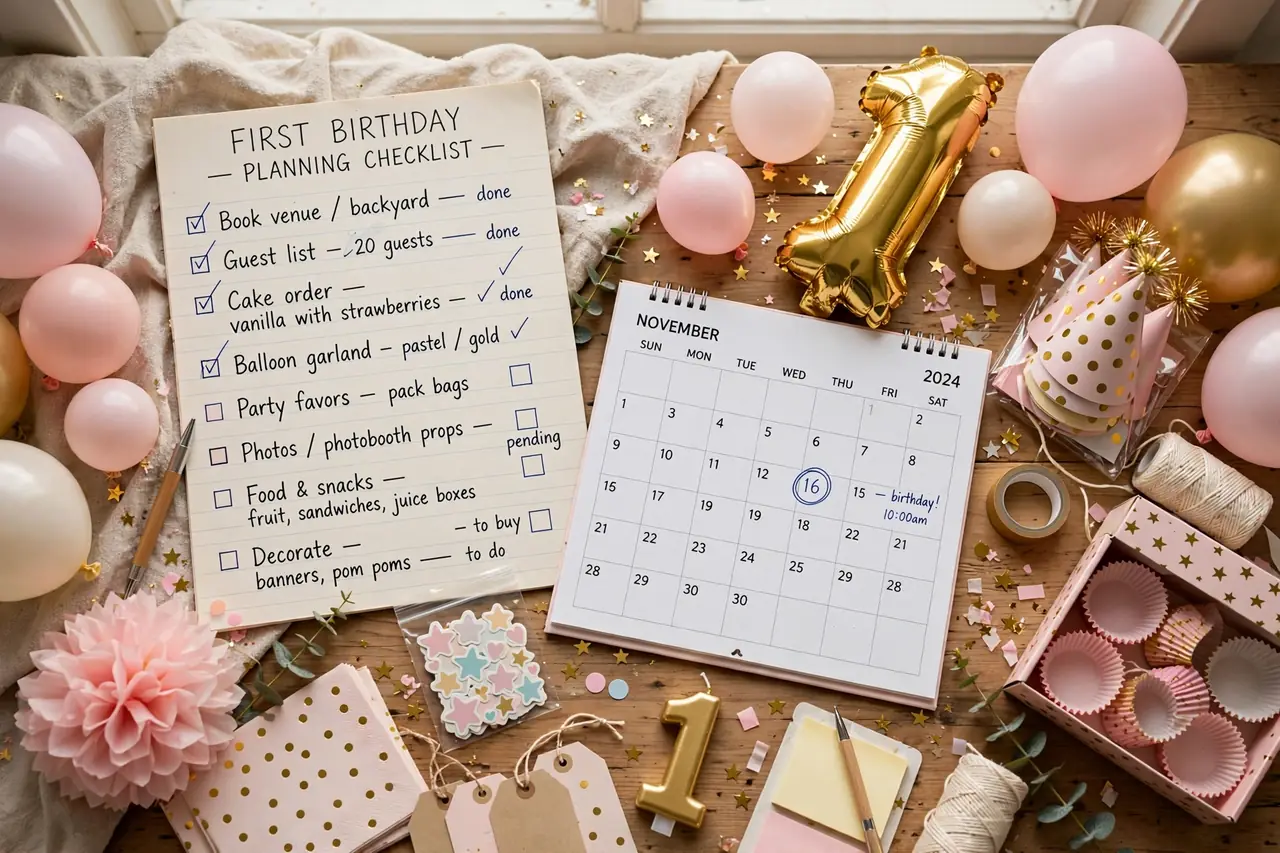
The difference between a relaxed first birthday party and a frantic one isn’t budget, guest count, or Pinterest skills — it’s timing. Parties that feel effortless were planned on a timeline: decisions made weeks ahead, tasks spread across days, and a day-of schedule built around the only schedule that truly matters — the baby’s. This first birthday party timeline gives you both: an eight-week planning countdown with exactly what to do when, and a detailed day-of schedule down to the half hour.
Inside you’ll find week-by-week checklists from two months out to party day, a nap-friendly party timing guide, a minute-by-minute day-of schedule you can print, contingency plans for rain, meltdowns, and late vendors, and answers to every timing question parents ask. Follow this timeline and you’ll spend the party actually enjoying your baby’s first birthday — which is, after all, the entire point.
Why a Timeline Matters More Than a Theme
First-time party planners consistently underestimate two things: how long tasks take with a baby underfoot, and how much last-minute scrambling steals joy from the day itself. Without a timeline, everything compresses into the final 48 hours — the cake order, the grocery run, the decorating, the cleaning — while you’re also caring for a one-year-old who senses your stress and responds by not napping. The result is the classic party-parent paradox: you throw a beautiful celebration you’re too exhausted to enjoy.
A timeline distributes the work across eight weeks so no single week is overwhelming. Early weeks handle big decisions (date, venue, guest list) that benefit from lead time. Middle weeks handle ordering (cake, decor, outfit) where shipping and bakery schedules demand advance notice. Final weeks handle the physical work (shopping, prepping, decorating) in manageable chunks. And the day-of schedule eliminates decision fatigue — when the timeline says “3:15: cake,” you do cake, instead of wondering whether it’s too early while guests hover.
The timeline also protects the baby’s routine, which is the hidden foundation of every successful first birthday. A party scheduled against the nap, a cake moment pushed past bedtime, a celebration that runs long — these are the real sources of party-day meltdowns, not bad planning elsewhere. Every timing recommendation below is built around typical one-year-old sleep patterns, because a rested baby is a happy birthday baby, and a happy birthday baby is the whole ballgame.
One more thing the timeline gives you: the ability to say no. When a relative suggests adding a pony ride the week before, when a friend proposes moving the party outdoors the day before, when your own brain generates “just one more” ideas at midnight — the timeline is your objective answer. “That’s not on the timeline” is a complete sentence. Protect the plan, and the plan protects the party.
Your 8-Week First Birthday Party Timeline
8 Weeks Out: The Big Decisions
This week is about the three decisions everything else depends on: date and time, guest list, and venue. Choose the date first — weekends are standard, but consider your baby’s rhythm. Morning people? A 10 a.m. party. Afternoon napper? The 2:30 slot. Avoid holiday weekends when guests travel. Once the date is set, draft the guest list with a hard cap (25–30 is the sweet spot for a home party). Then decide: home, a park pavilion, or a rented venue. Home is cheapest and most nap-friendly; parks are great for large groups but need weather backup; venues cost more but handle setup and cleanup.
Also this week: set your budget. Decide the total number first, then allocate roughly: 40% food and cake, 20% decorations, 15% venue (if any), 10% outfit and photography, 15% contingency. Write it down. Budgets that live in your head expand; budgets on paper hold.
6–7 Weeks Out: Theme, Invitations, and Key Bookings
Choose your theme now — it drives every purchase after this. Then send invitations (paper or digital) with an RSVP deadline three weeks before the party. Digital invitations are faster, cheaper, and make RSVP tracking automatic; paper invitations are keepsakes. Either is fine — just get them out. Late invitations are the number one cause of low turnout.
Book or arrange the big-ticket items: order the cake (custom bakeries need 4+ weeks), book a photographer if you’re hiring one, reserve a venue or park pavilion if needed, and order the birthday outfit if it’s custom or personalized. These are the items with the longest lead times — everything else can be bought closer to the date.
4–5 Weeks Out: Details and Decor
Order decorations now — balloon garland kits, banners, tableware, the smash cake topper. Shopping early means better selection and time for exchanges. Plan the menu in detail: what you’re serving, what you’re making vs. buying, and quantities. Start a shopping list divided into “buy now” (non-perishables, paper goods, favors) and “buy later” (fresh food, flowers).
This is also the week to plan activities and games — decide on your one or two structured activities, buy any supplies, and designate your photographer (even if it’s just a talented friend with a good phone). If you’re doing a video montage or photo display, start gathering photos now; collecting a year’s worth of pictures always takes longer than expected.
3 Weeks Out: RSVPs and Confirmations
Chase RSVPs. Message everyone who hasn’t responded — a friendly “hey, need final numbers this week!” text works. Finalize your headcount and adjust food quantities. Confirm all vendors: the bakery (flavor, size, pickup time), the venue, the photographer, any rentals. Confirmations now prevent disasters later.
Buy the non-perishables: paper goods, decorations you haven’t ordered, favor supplies, candles, any serving pieces you need. Assemble goodie bags this week — it’s a perfect nap-time task. If you’re DIYing decorations (painting signs, assembling centerpieces), do it now, not the week of the party.
2 Weeks Out: Food Prep and Final Orders
Finalize the menu with exact quantities based on your RSVP count. Place any catering or deli orders. Buy drinks, snacks, and pantry items — everything non-perishable. If you’re baking the cake or cupcakes yourself, do a trial run this week so there are no surprises.
Plan the day-of schedule in detail (use the template below). Confirm who’s helping with what — setup crew, food duty, photography, cleanup. Write it down and share it; vague “can you help?” requests produce vague help. Specific assignments (“Can you arrive at 1:00 to inflate balloons?”) produce actual help.
1 Week Out: The Home Stretch
Deep-clean the party areas — not the whole house, just where guests will be. Babyproof the party space: outlet covers, moved breakables, gated stairs. Buy perishables that keep a few days: cheese, deli items, sturdy fruits. Charge everything: camera batteries, the Bluetooth speaker, your phone. Confirm the cake pickup/delivery time one more time.
Do a walk-through: stand in your party space and imagine the flow. Where does the food go? Where’s the cake table? Where do gifts pile up? Where’s the quiet zone for overstimulated babies? Rearrange furniture now, not on party day. This fifteen-minute exercise prevents 90% of day-of logistical headaches.
2–3 Days Out: Fresh Food and Setup Prep
Grocery run for fresh items: fruits, vegetables, bread, dairy. Prep what you can: make dips, bake cupcakes (frost later), cut vegetables, assemble anything that holds. Pick up the balloons if you’re using helium — or plan to inflate the morning of. Set up anything that can sit for two days: tables, chairs, non-balloon decorations, the photo display. The more that’s done now, the calmer party morning will be.
Day Before: Decorate and Prep
Decorate fully — hang the balloon garland, set the tables, arrange centerpieces, hang the photo banner. Seeing the space come together is the best stress relief. Prep cold food: assemble platters (cover and refrigerate), make anything served cold. Pick up the cake if your bakery allows day-before pickup (most buttercream cakes are fine overnight in a cool spot). Lay out outfits — the baby’s portrait outfit, party outfit, and smash outfit, plus your own. Pack the diaper bag with party-day extras: backup outfits, extra wipes, the smash outfit, plastic bags for messy clothes.
Then stop. Eat dinner, go to bed at a reasonable hour, and resist the urge to add “just one more” decoration. The party is ready. Anything you think of at 11 p.m. the night before is, by definition, unnecessary.
Party Day: The Morning
8:00 — Wake up, normal routine. Feed the baby breakfast at the usual time; a hungry baby is a cranky party guest. 8:30 — Final food prep: frost cupcakes, slice fruit, set out room-temperature items. 9:30 — Inflate balloons, do any last decorating touches. 10:00 — Baby’s morning nap (protect this fiercely — no “quick errands” during nap time). 11:00–12:00 — While the baby naps: shower, get dressed, set up the food table, put drinks on ice, do a final walk-through. 12:00 — Wake the baby gently, dress in the portrait outfit, take morning portraits if you haven’t yet. 12:30 — Feed the baby lunch. A well-fed baby handles the party; a hungry one doesn’t.

The Day-Of Party Schedule (2:30–4:30 Party)
This is the golden-window afternoon party — the most popular first birthday slot. Adjust times proportionally for morning or evening parties.
| Time | What’s Happening | Your Job |
|---|---|---|
| 1:00–1:30 | Setup crew arrives | Direct setup; you handle food table and final touches |
| 1:30–2:00 | Baby’s pre-party nap (if needed) | Finish setup; get yourself ready |
| 2:00–2:15 | Get baby dressed; final check | Portrait outfit on; walk-through; breathe |
| 2:30 | Guests arrive | Greet at the door; direct to food and drinks |
| 2:30–3:00 | Mingling and free play | Be present; let the photographer work; enjoy |
| 3:00–3:15 | Group game or activity | Lead or delegate; keep it to 15 minutes |
| 3:15–3:20 | Quick change into smash outfit | Change the baby; set up the cake |
| 3:20–3:35 | Smash cake + happy birthday song | Parent speech here; photos; celebrate |
| 3:35–4:00 | Cake served; presents (optional) | Cut and serve; open a few gifts if desired |
| 4:00–4:30 | Wind-down; goodbyes | Hand out favors; thank guests; relax |
| 4:30+ | Cleanup | Delegate! Many hands make it fast |
Notice what’s not on the schedule: stress. Every block has buffer built in. If the smash cake runs long because the baby is having the time of their life, steal five minutes from the wind-down. If guests arrive late (they will), the mingling block absorbs it. The schedule is a guide, not a prison — but having it means you’re making small adjustments, not improvising the whole afternoon.
Alternate Schedule: The Morning Party (10:00–12:00)
If your baby is a morning person, here’s the compressed morning-party version. The rhythm is the same — arrive, mingle, activity, cake, wind-down — just shifted earlier and slightly tighter, since morning babies fade faster.
| Time | What’s Happening |
|---|---|
| 8:30 | Setup crew arrives; final food prep |
| 9:30 | Get baby dressed; portraits if not done earlier |
| 10:00 | Guests arrive; brunch food served |
| 10:00–10:45 | Mingling and free play |
| 10:45–11:00 | Group activity or game |
| 11:00–11:20 | Smash cake + happy birthday song + parent speech |
| 11:20–11:45 | Cake served; presents (optional) |
| 11:45–12:00 | Goodbyes and favors; baby goes down for nap on time |
The morning party’s superpower is the on-time nap afterward — the baby parties, then sleeps, and you spend the afternoon basking in the afterglow instead of managing an overtired toddler. The trade-off is an early setup: decorations must be done the night before, full stop. There’s no “quick morning decorating” when guests arrive at ten.
Nap-Friendly Party Timing: The Science
Most one-year-olds take two naps (morning and afternoon) or are transitioning to one midday nap. Your party time should respect this, not fight it. Here’s how the three common party slots interact with nap schedules.
Morning party (10:00–12:00): Works if the baby’s first nap is late morning or they’ve dropped to one nap. Schedule the party to end before the nap, not during it. The risk: babies who nap at 10 will be cranky by 11. Only choose this slot if you know your baby handles late mornings well.
Afternoon party (2:30–4:30): The gold standard. The baby naps 12:30–2:00 (or 1:00–2:30), wakes refreshed, parties for two hours, and is in bed at the normal time. This slot works for both two-nap and one-nap babies with minor adjustments. If your baby takes a late afternoon catnap, shift to 2:00–4:00.
Evening party (5:00–7:00): Risky for most one-year-olds — it collides with dinner, bath, and bedtime routines. Only choose this if your baby is genuinely a night owl and the guest list is small family. The advantage: working guests can attend. The disadvantage: an overtired birthday baby.
Whatever slot you choose, communicate the baby’s nap needs to your helpers. “The baby naps 12:30 to 2:00 — please don’t schedule anything during that window” is a reasonable boundary. And build the schedule so the emotional high points (smash cake, speech) happen in the first 90 minutes, when the baby is at their best — not at the end, when everyone’s running on fumes.
Contingency Plans: When Things Go Sideways
Rain (outdoor party): Have an indoor backup space identified from the start — your home, a relative’s garage, a rented tent. Make the call by 9 a.m. party day; waffling wastes the setup window. Many park pavilions have covered areas — confirm when booking.
The baby won’t nap: An overexcited baby may skip the pre-party nap. Don’t panic — move the party start 30 minutes later if possible, keep the first hour low-key, and watch for tired signs. A baby who misses one nap can still have a good party; just move the cake earlier.
The baby melts down: Have the quiet zone ready (a bedroom with dimmed lights and familiar toys). Take the baby there for 10–15 minutes. The party continues without you — that’s what helpers are for. Most meltdowns pass; don’t cancel the cake over a bad ten minutes.
The cake is late or damaged: Keep a grocery store backup cake or cupcakes in the fridge — $25 of insurance. If the custom cake is delayed, serve the backup and present the real one when it arrives. Guests won’t know the difference, and the photos still work.
Key helper cancels: Identify your critical tasks (setup, food, photography, cleanup) and have a backup person for each. A simple group text the week before — “you’re my backup if X can’t make it” — prevents day-of scrambling.
Too many guests / too few: Both happen. Too many: open more food, spread out activities, and remember that a full house is a happy problem. Too few: cherish the intimacy — small parties are often the most meaningful, and the baby won’t know the difference.

Printable Checklist Summary
Here’s the entire eight-week timeline as a quick-reference checklist. Print it and check items off as you go.
| When | Tasks |
|---|---|
| 8 weeks out | Set date and time; draft guest list; choose venue; set budget |
| 6–7 weeks out | Choose theme; send invitations; order cake; book photographer/venue; order custom outfit |
| 4–5 weeks out | Order decorations; plan menu; start shopping list; plan activities; start photo collection |
| 3 weeks out | Chase RSVPs; confirm vendors; buy non-perishables; assemble goodie bags; DIY decorations |
| 2 weeks out | Finalize menu; place catering orders; buy pantry items; trial-run baking; assign helper tasks |
| 1 week out | Deep-clean party areas; babyproof; buy longer-lasting perishables; charge devices; walk-through |
| 2–3 days out | Fresh grocery run; prep-ahead cooking; pick up balloons; early setup |
| Day before | Full decorating; cold food prep; cake pickup; lay out outfits; pack party bag; rest |
| Party day | Morning prep; protect the nap; final touches; party 2:30–4:30; delegate cleanup |
Vendor Communication: What to Say and When
Clear vendor communication prevents most party-day disasters. For the bakery, confirm three times: at ordering (flavor, size, design, pickup/delivery time, price), two weeks out (reconfirm date and time), and two days out (final confirmation). Get the confirmation in writing — email or text, not just a phone call. Ask for the baker’s direct number for day-of emergencies, and clarify what happens if you’re running late for pickup.
For venues and rentals, confirm the setup and breakdown windows in writing: when you can access the space, when you must be out, what’s included (tables? chairs? linens?), and the cancellation policy. Visit the space once before the party if possible — photos lie about size and lighting. For photographers (professional or friend), share the day-of schedule in advance, list your must-have shots, and confirm arrival time and duration. A friend-photographer needs the same briefing as a pro — “just take pictures” produces random results; a shot list produces an album.
For caterers or deli orders, confirm the headcount three days out (after your RSVP deadline), the pickup or delivery time, and how the food should be stored and served. Ask about lead time for changes — most caterers need 48 hours’ notice for headcount adjustments. And always have a vendor contact list printed and shared with your day-of helper, so you’re not the single point of failure for every question.
The Week After: Post-Party Timeline
The party ends, but the timeline doesn’t. Day after: return rentals, refrigerate leftovers properly, and back up all photos to at least two locations. Within three days: send thank-you messages — a photo of the baby with the gift plus a personal note. Digital thank-yous are fine; the photo is what matters. Within a week: print your favorite photos, update the baby book, and file the speech in the memory box.
Within two weeks: write down your memories of the day while they’re fresh — what the baby did, who said what, the funny moments. Future you will thank present you. This is also the time for an honest debrief: what worked, what didn’t, what you’d do differently. If you’re already thinking about year two (many parents are), these notes are gold.
And finally: rest. You just planned and executed a major event while parenting a one-year-old. The post-party crash is real. Give yourself the same grace you’d give a friend — order takeout, skip the deep clean for a day, and look at the photos. You did it. The timeline worked. The baby is one, the party was beautiful, and you were present for it. That’s the whole victory.
Watch: First Birthday Party Prep Timeline
See a real party prep timeline in action — this video walks through 24 hours of first birthday preparation, from supply runs to decorating to party day, showing how the planning timeline plays out in real life.
FAQs About First Birthday Party Timelines
How long should a first birthday party last?
Two hours is the sweet spot — 90 minutes minimum, three hours maximum. Longer parties exhaust the baby, the parents, and the toddler guests. A tight two-hour party with a clear schedule feels abundant; a sprawling four-hour party feels endless. When in doubt, shorter is better.
When should I send invitations?
Six to seven weeks before the party for most guest lists; eight weeks if guests are traveling. Set the RSVP deadline for 10 days before the party — this gives you time to chase stragglers and finalize food quantities without last-minute panic.
What if my baby’s nap schedule changes before the party?
It might — one-year-olds are in transition. Two weeks before the party, observe the emerging pattern and adjust your party time if needed. Shifting a 2:30 party to 3:00 is a minor change for guests but a major one for the baby. Communicate any time change immediately.
Should I schedule activities or let the party flow?
Schedule one structured activity and the cake; let everything else flow. Over-scheduled parties stress the host and bore the babies. The schedule above has exactly one game block — that’s intentional. Free play, food, and the cake provide plenty of structure.
How early should I start setting up on party day?
Start major setup 90 minutes before guests arrive, with most decorating done the day before. Party morning should be for food prep and final touches only — not for hanging the balloon garland from scratch. If you need more than 90 minutes, you didn’t do enough the day before.
What time should the smash cake happen?
Two-thirds through the party — for a 2:30–4:30 party, that’s 3:15–3:30. Early enough that the baby is still happy, late enough that most guests have arrived and settled. Never schedule the cake for the last 15 minutes; departing guests and a tired baby make for a rushed, stressful finale.
How do I handle cleanup without it taking all evening?
Delegate before the party, not during. Assign specific people: one on trash, one on food storage, one on decoration takedown. Use disposable or compostable tableware to eliminate dishwashing. Most cleanups take 30–45 minutes with four helpers. And it’s okay to leave non-urgent tidying for tomorrow — rest tonight.
Can I plan a first birthday party in less than 8 weeks?
Yes — compress the timeline proportionally. Four weeks is very doable: week 1 for big decisions and invitations, week 2 for orders, week 3 for prep, week 4 for the final push. Two weeks is tight but possible for a simple home party — skip custom orders, buy everything off the shelf, and keep the guest list small. The timeline scales; the principles don’t change.
A great timeline makes everything else easier. For the details it schedules, see our birthday party ideas, our table decoration ideas for the setup, and our at-home celebration guide. On a budget? Our budget celebration ideas prove planning beats spending.
Eight weeks, one day-of schedule, and a contingency for everything — you’re ready. The timeline does the worrying so you don’t have to. Print the day-of schedule, tape it inside a kitchen cabinet, and then forget about it and be present. Your baby only turns one once. The timeline makes sure you actually get to enjoy it.