Edinburgh Hogmanay is not a New Year’s Eve — it’s a three-day festival, and it is the reason Scotland’s capital is often called the home of New Year. While most cities compress their celebrations into a single night, Edinburgh stretches the turn of the year across December 30, 31, and January 1: a torchlight procession of thousands through the medieval Old Town, a massive open-air concert and street party beneath the castle, midnight fireworks fired from the castle ramparts, and a bracing New Year’s Day dip in the Firth of Forth for the brave. Nowhere else does the New Year with this much stamina.
“Hogmanay” is the Scots word for the last day of the year, and in Scotland the New Year has historically mattered more than Christmas — a legacy of the Reformation era, when Christmas celebrations were suppressed and Hogmanay became the great winter festival. That heritage survives in traditions found nowhere else: first-footing (being the first person to cross a friend’s threshold after midnight, bearing symbolic gifts), the singing of “Auld Lang Syne” — written by Robert Burns, an Ayrshire Scot — and a national talent for seeing the old year out properly.
This ultimate 3-day festival guide walks you through each day of Edinburgh’s Hogmanay: the Torchlight Procession, the Concert in the Gardens and Street Party, the midnight fireworks, the Loony Dook, plus tickets, accommodation, food and drink, and the practicalities of a Scottish winter.
What Makes Hogmanay Different
Most New Year celebrations are built around a single midnight. Hogmanay is built around three days of escalating festivity, each with its own character. December 30 is atmospheric and communal — fire, procession, and spectacle. December 31 is the big commercial celebration — concerts, DJs, street parties, and the midnight moment. January 1 is eccentric and restorative — cold-water dips, ceilidh dancing, and the slow business of starting the year.
The festival is also unusually participatory. The Torchlight Procession isn’t something you watch from behind a barrier — you buy a torch and walk in it. The ceilidhs aren’t performances — they’re mass dances where strangers link arms. First-footing isn’t a custom you observe — it’s something your Scottish friends will expect you to do. Hogmanay rewards those who join in, and this guide is written for joiners.
A note on planning: Edinburgh’s Hogmanay is a ticketed festival run by event organisers on behalf of the city, and the programme — headliners, procession routes, ticketing details — is announced fresh each year, typically in autumn. The structure below (three days, procession-concert-dook) has been stable for years, but always check the official Edinburgh’s Hogmanay channels for the current year’s line-up, ticket release dates, and any changes before you book travel.
Day 1 — December 30: The Torchlight Procession
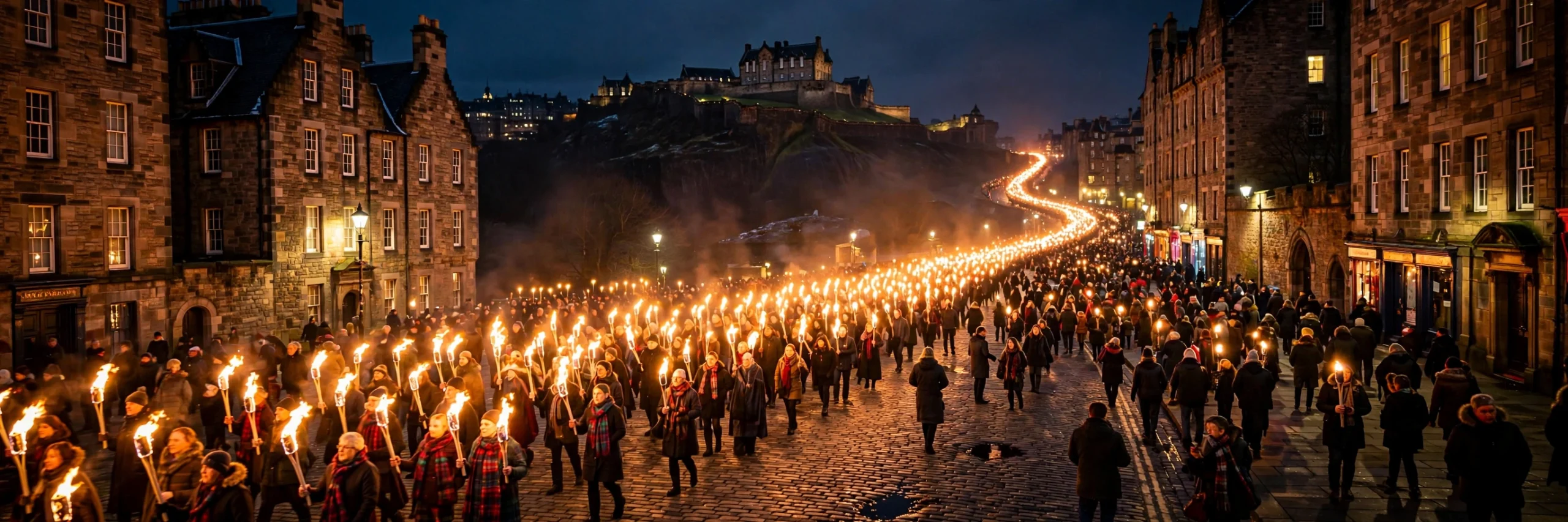
Hogmanay opens with fire. On the evening of December 30, tens of thousands of torch-bearers gather in the city centre and process through the streets in a river of flame — one of the most atmospheric sights in the European winter calendar. The procession traditionally winds through the Old Town and culminates in a finale with fireworks, and in many years the route has ended at Calton Hill or Holyrood Park with a son et lumière (sound-and-light) climax.
Taking part
This is the most accessible of the three days: anyone can join. Torches are sold in advance and (in some years) on the night, with proceeds traditionally supporting a designated charity — check the current year’s arrangements when you buy. The procession moves at a walking pace and covers a route of a couple of kilometres through the city; it’s suitable for families with older children, though the crowds are dense and the torches are real fire, so keep small children close and follow stewards’ instructions.
What it feels like
Imagine the Royal Mile and the surrounding closes lit only by thousands of hand-held flames, the smell of paraffin and winter air, pipe bands playing from the sidelines, and the castle floodlit above it all. The procession is part pagan ritual, part community celebration, and entirely unforgettable — photographers should note that the best shots come from the edges of the route (elevated positions on the Mound or North Bridge in past years) rather than from inside the crush of torches, where smoke and crowding make photography difficult.
Practicalities for the 30th
Arrive at the assembly point early — the gathering itself is part of the experience, with street performers and a building sense of occasion. Dress warmly (you’ll be standing and walking slowly in the December cold), wear sturdy shoes for cobbles, and leave valuables at your accommodation: the crowds are joyful but dense. Road closures affect the city centre from the afternoon; plan to walk in or use public transport.
Day 2 — December 31: Concert, Street Party and Midnight Fireworks
December 31 is the main event, and it comes in two flavours: the ticketed Concert in the Gardens and the vast Street Party that takes over Princes Street and the surrounding New Town.
The Concert in the Gardens
Set in West Princes Street Gardens in the shadow of Edinburgh Castle, the Concert in the Gardens is Hogmanay’s headline music event — big-name acts playing an open-air show with the floodlit castle as the backdrop. Past line-ups have mixed international headliners with Scottish acts, and the setting is genuinely spectacular: the gardens sit in the valley below the castle rock, so the stage, the crowd, and the fortress above form a natural amphitheatre.
Tickets are required and the concert sells out — the headliner announcement (usually in autumn) is the starting gun for Hogmanay planning. If the line-up matters to you, book the moment tickets go on sale; if you’re coming regardless, early booking still gets you the best prices. The concert typically runs through the evening with support acts building to the headliner, then the crowd counts down together before the midnight fireworks erupt from the castle directly overhead — the closest most people will ever stand to a major fireworks display.
The Street Party
If the concert is the headline act, the Street Party is the people’s celebration: Princes Street and the surrounding streets closed to traffic and given over to multiple stages, DJs, street performers, bars, and tens of thousands of revellers. The Street Party is also ticketed (wristband entry with bag searches and stewards), and it offers the great communal countdown — the moment when the whole of central Edinburgh, from the concert gardens to the far end of Princes Street, counts down together and the castle fireworks light up the sky.
The Street Party suits those who want variety and movement: drift between stages, find the music you like, eat from the food stalls, and position yourself for midnight wherever the mood takes you. The classic midnight viewpoint is anywhere on Princes Street with a clear view of the castle — the fireworks fire from the castle itself, so the closer and more central, the more overwhelming (in the best way) the display.
The midnight fireworks
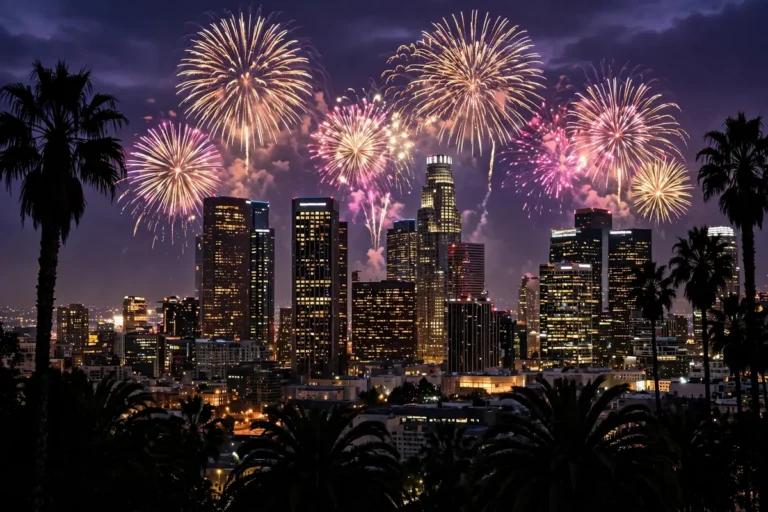
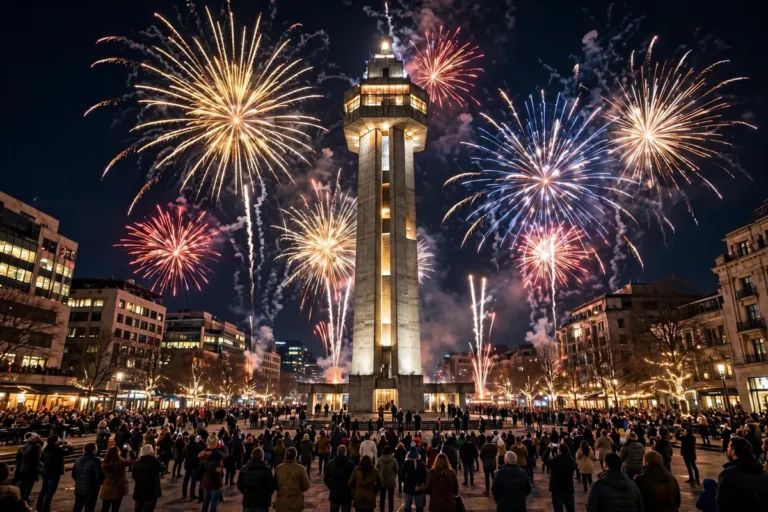
At the stroke of twelve, fireworks erupt from Edinburgh Castle — from the ramparts and the rock itself — in a display that uses the fortress as both launchpad and backdrop. Because the castle sits on its volcanic crag above the city, the fireworks are visible from vantage points all across Edinburgh, but inside the official zones you’re directly beneath the launch site: the sound rolls off the rock, the sky fills from horizon to horizon, and the crowd’s roar is part of the show. After the display, the tradition is “Auld Lang Syne,” sung en masse with arms crossed and hands joined — in the city of Burns’s birth nation’s capital, it carries a weight it has nowhere else.
First-footing after midnight
The old Scottish custom of first-footing holds that the first person to enter a home after midnight brings luck for the year — traditionally a tall, dark-haired man bearing coal, shortbread, salt, and whisky (symbols of warmth, food, flavour, and good cheer). Modern first-footing is more relaxed, but the principle survives: after the fireworks, Edinburgh’s pubs, clubs, and house parties carry the celebration deep into the morning, and being welcomed across a threshold with a dram remains the perfect Hogmanay nightcap.
Day 3 — January 1: The Loony Dook and New Year’s Day
The Loony Dook
On the morning of January 1, while sensible people are still asleep, hundreds of costumed revellers gather at South Queensferry — the town beneath the Forth Bridge, a short trip from Edinburgh — parade through the streets in fancy dress, and plunge into the freezing Firth of Forth. This is the Loony Dook (“dook” being Scots for a dip or plunge), Hogmanay’s gloriously eccentric finale and one of the great New Year’s Day traditions of the British Isles.
The Dook is a spectator event as much as a participant one: the fancy-dress parade is half the entertainment, with costumes ranging from the witty to the barely-there. Participants (“dookers”) typically register in advance, and the event raises money for charity — check the current year’s registration details if you want to take the plunge. Spectators line the beach and the high street; the atmosphere is joyful, freezing, and very Scottish.
Should you dook? The water in January is around 7°C — cold enough to take your breath away and, for most people, cold enough to make the whole thing last about ninety seconds. Dookers’ wisdom: wear fancy dress you can move in (and don’t mind ruining), bring a warm change of clothes and a towel in a waterproof bag, wear footwear you can walk on shingle in, and have something warm to drink waiting. Never dook alone, never dook drunk, and if you have heart or circulation conditions, spectate — the parade is just as fun from the sidelines.
New Year’s Day in Edinburgh
Back in the city, January 1 is a public holiday in Scotland (as is January 2), and Edinburgh wears its hangover gracefully. The classic recovery walk is up Arthur’s Seat — the ancient volcano in Holyrood Park — for panoramic views over the city, the Firth, and the hills beyond; the bracing wind does more for a Hogmanay headache than any remedy. The Royal Mile’s cafés do a roaring trade in full Scottish breakfasts, and the city’s museums and galleries (check holiday opening hours) offer quiet, warm refuge.
January 1 is also ceilidh day in spirit if not in schedule: many visitors use the day to set their intentions for the year ahead over a long lunch, then find an evening ceilidh or traditional music session to dance the stiffness out. Edinburgh’s pubs with live folk music — Sandy Bell’s, the Royal Oak — are atmospheric choices, though they’ll be busy.
Tickets, Prices and When to Book
Edinburgh’s Hogmanay is a ticketed festival, and the booking calendar drives the whole trip.
What needs tickets
- Torchlight Procession (Dec 30): torch purchase to walk in the procession (watching from the sidelines is free). Buy torches in advance — they sell out.
- Concert in the Gardens (Dec 31): ticketed, tiered pricing, sells out on headliner strength. The must-book event.
- Street Party (Dec 31): ticketed wristband entry, usually the most affordable of the three paid events.
- Loony Dook (Jan 1): participant registration (often charity-linked); spectating is free.
Exact prices and on-sale dates are announced each year — typically in late summer or autumn — through the official Edinburgh’s Hogmanay channels. The reliable pattern: concert tickets go first and fastest, street party tickets follow, and torch sales open closer to December. Book accommodation before you book event tickets, because Hogmanay-week rooms in Edinburgh are the real constraint (see below).
The booking sequence that works
- Summer: book accommodation the moment your dates are firm — central Edinburgh sells out for Hogmanay.
- Autumn: watch for the programme announcement; buy concert and street party tickets on release.
- Early December: buy torch-party places, register for the Dook if dooking, book restaurants for Dec 30/31 and Jan 1.
- Mid-December: check transport plans, road closures, and the final event timings.
Where to Stay: Accommodation Strategy
Edinburgh at Hogmanay is one of the toughest hotel markets in the UK — demand massively exceeds supply across the festival, and prices reflect it. The Old Town and New Town put you within walking distance of everything (the procession, the concert, the street party), which matters enormously on nights when central roads are closed and transport is disrupted. Staying central means you can walk home at 1am instead of queuing for transport.
If the centre is full or beyond budget, Leith (the historic port district, now the city’s foodie quarter) offers good value with easy bus and tram links; the West End and Stockbridge are attractive and well-connected; and towns along the rail lines — Linlithgow, Falkirk, even Glasgow (45 minutes by train) — work for the determined, though late-night returns on Dec 31 need careful planning around transport schedules. Self-catering apartments are popular for the three-day format: a flat with a kitchen lets you do first-footing properly and host your own Hogmanay supper.
Book direct where you can, check cancellation terms (winter weather can disrupt travel), and be wary of third-party listings that look too good to be true during a sell-out week. If you’re travelling with a group, one apartment for four often costs less than two hotel rooms — and gives you a living room for the crucial post-midnight dram.
Food and Drink: Eating Through Hogmanay
The Hogmanay table
Scottish New Year food is hearty winter fare. Steak pie is the traditional Hogmanay dinner in many households — rich, warming, and made for feeding a crowd. Shortbread appears everywhere (it’s also a traditional first-footing gift). Clootie dumpling, black bun (a dense fruit cake in pastry, traditionally eaten at Hogmanay and Twelfth Night), and tablet (a crumbly crystalline fudge) are the sweet heritage. For the full experience, book a restaurant serving a Hogmanay gala dinner on Dec 31 — Edinburgh’s restaurants run special menus, and they book out weeks ahead.
Whisky and the dram
No Hogmanay guide can ignore whisky. The midnight dram is ritual: a single malt raised to the new year, preferably shared. Edinburgh’s whisky bars — from the historic to the contemporary — are at their best over the festival; a guided tasting on Dec 30 is a fine way to calibrate your palate for the days ahead. Pace yourself: three days of festival plus whisky is a marathon, and the Loony Dook is markedly less appealing with a hangover.
Ceilidh culture
The ceilidh (pronounced “kay-lee”) is the social dance at the heart of Scottish celebration — group dances with called instructions, live fiddles, and an etiquette of grabbing the nearest stranger as your partner. Edinburgh hosts ceilidhs throughout the festival, from grand ticketed balls to pub back-room dances. You need no experience: the caller teaches each dance, and the whole point is joyful chaos rather than precision. If you do one participatory thing at Hogmanay beyond the torchlight, make it a ceilidh.
Practical Tips: Weather, Transport and Survival
Weather: Scotland in late December
Edinburgh at Hogmanay is cold — typically 2–6°C — with short days (sunset around 3:30pm), frequent rain or sleet, and the possibility of proper winter weather. Wind off the Firth cuts through inadequate clothing. The festival goes ahead in all but the most extreme conditions (high winds have affected the fireworks in past years — always check official channels on the day). Dress in full winter kit: thermal base layers, insulating mid-layers, a waterproof and windproof outer shell, warm hat, gloves, scarf, and waterproof footwear with grip for cobbles and hills. Fashion is irrelevant; warmth is everything. Hand warmers are worth their weight in gold during the hours of standing on Dec 31.
Getting around
Central Edinburgh is compact and walkable, and walking is the best transport on festival nights — road closures make driving pointless and taxis scarce. Lothian Buses and the tram run special Hogmanay timetables with late-night services; details are published in December. If you’re staying outside the centre, know your last bus/tram home on Dec 30 and your plan for the early hours of Jan 1 (night services exist but are crush-loaded after midnight). For the Loony Dook at South Queensferry, special transport is usually laid on — check the event information.
Crowds, safety and phones
The Street Party and concert zones are stewarded with bag searches and entry controls; surrounding streets hold large unstructured crowds. Standard big-event sense applies: agree a meeting point, keep phones charged (cold drains batteries — carry a power bank in an inside pocket), minimise valuables, and keep children close in dense areas. Emergency and first-aid points are stationed at all official events. Pace your drinking across three days — Hogmanay rewards the steady, not the speedy.
Money and booking
Edinburgh is a card-friendly city; official event vendors are cashless in most cases. Budget generously: Hogmanay week is peak pricing for accommodation, restaurants run gala menus at gala prices, and the three days of tickets, torches, transport, and drams add up. It’s worth it — but go in with open eyes.
How Hogmanay Compares: Choosing Your New Year
Every great New Year city has a personality. London’s Thames fireworks are the grand televised spectacle — magnificent, ticketed, and over in one night. Berlin’s Brandenburg Gate party is the giant open-air rave. Hogmanay is the festival: three days, fire and music, participation over spectatorship, winter at its most romantic. Choose London for the iconic midnight moment, Berlin for the party, and Edinburgh for the fullest, most distinctive New Year experience in Europe.
And if three days of Scottish winter sounds like a lot, there’s no shame in a quieter turn of the year — our practical New Year’s Eve at home plan proves a memorable night needs nothing more than good company and intention. Either way, line up your New Year wishes and messages before midnight — after the fireworks and the “Auld Lang Syne,” you’ll want them ready.
In Pictures: Edinburgh’s Hogmanay
Edinburgh’s Hogmanay is a multi-day New Year festival — torchlight processions, street parties, and fireworks over the Castle.
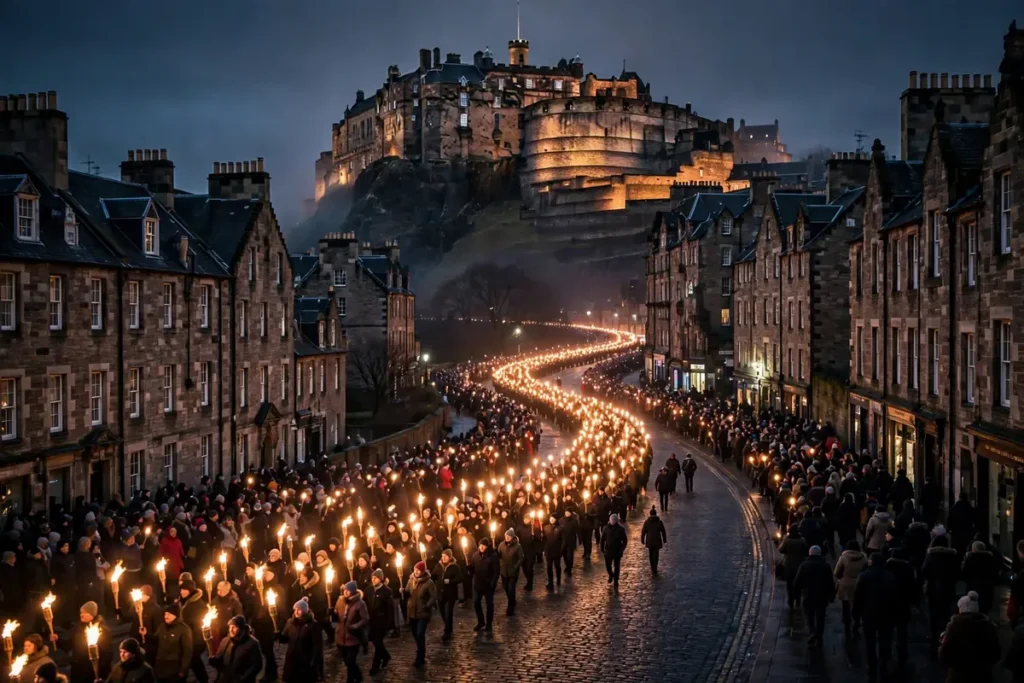
The Torchlight Procession winding through Edinburgh’s Old Town, a river of fire to open Hogmanay.
Watch: Edinburgh’s Hogmanay
Follow the Hogmanay Torchlight Procession through Edinburgh — the fiery start of the world’s most famous New Year festival.
At a Glance: Edinburgh’s Hogmanay
Edinburgh’s Hogmanay, day by day.
| Event | When | What to know |
|---|---|---|
| Torchlight Procession | Late December (opening night) | Thousands march with flaming torches through the Old Town to beneath the Castle, creating a “river of fire” rooted in Celtic and Norse tradition |
| Night Afore Party | 30 December | Concerts in West Princes Street Gardens keep the festival building toward the big night |
| Street Party | 31 December | Around 45,000 revelers fill Princes Street for live music, DJs, and street performers |
| Concert in the Gardens | 31 December | Headline concert beneath Edinburgh Castle, ending with the midnight fireworks |
| Midnight fireworks | 31 December, midnight | Pyrotechnics fired from the Castle ramparts, followed by the traditional mass singalong of “Auld Lang Syne” by Robert Burns |
| First Footin’ | 1 January | Free music trail across the city; the “first foot” tradition brings symbolic gifts of coal, shortbread, and whisky |
Frequently Asked Questions
What are the three days of Edinburgh’s Hogmanay?
December 30: the Torchlight Procession through the city. December 31: the Concert in the Gardens, the Street Party on Princes Street, and midnight fireworks from Edinburgh Castle. January 1: the Loony Dook at South Queensferry and a slow New Year’s Day in the city. Each day is ticketed or registered separately — check the official Edinburgh’s Hogmanay programme for the current year’s details.
Do you need tickets for Hogmanay?
Yes, for the main events: the Concert in the Gardens and the Street Party are ticketed, torch places for the procession are sold in advance, and Dook participants register. Watching the Torchlight Procession from the sidelines and spectating the Loony Dook are free. Tickets go on sale in autumn and the concert sells out — book early.
What is first-footing?
The Scottish tradition that the first person to cross a home’s threshold after midnight brings luck for the year. Traditionally a tall, dark-haired visitor bearing coal, shortbread, salt, and whisky — symbols of warmth, food, and good cheer. Modern first-footing is relaxed, but bringing a bottle and good humour remains the rule.
What is the Loony Dook?
Edinburgh’s New Year’s Day fancy-dress plunge into the Firth of Forth at South Queensferry. Hundreds of costumed “dookers” parade through the town and brave the ~7°C water, usually for charity. Spectating is free and highly entertaining; participants register in advance.
How cold is Edinburgh at New Year?
Typically 2–6°C, often wet and windy, with sunset around 3:30pm. Dress in full winter layers with waterproof outers — you’ll be standing outdoors for hours on Dec 31. The festival runs in all but extreme weather; check official channels on the day for any weather-related changes.
Where should you stay for Hogmanay?
The Old Town or New Town for walkability to all events — book in summer, as Hogmanay week sells out. Leith, the West End, and Stockbridge are good alternatives; towns on the rail lines work for the determined. Self-catering apartments suit the three-day format well.