Ask any dog what they want for their birthday and the answer is unanimous: games. Not the cake (okay, also the cake), not the hats — games. A dog birthday party without structured play is just a group of overexcited dogs rehearsing chaos in your backyard. These dog birthday party games are organized by energy level so you can build a party arc: burn the wild energy first, shift to brain games as tongues start lolling, and finish with calm group activities while everyone catches their breath. Every game includes the rules, the setup, and the all-important safety notes, because the only thing worse than a bored party is a trip to the emergency vet.
One universal rule before we start: every game needs a referee with treats and a whistle (or a loud “enough!”). Dogs do not understand turns, ties, or sportsmanship. Your job is to keep things moving, keep every dog included, and end each game while it is still fun — the golden rule is to stop at the peak, not after the peak.
Safety Briefing: Read Before Any Game
Know your guest list. Separate large and small dogs for any chase or wrestling-style game — a 90-pound Lab’s “gentle” body slam is a veterinary emergency for a 6-pound Chihuahua. Reactive or resource-guarding dogs should play parallel games (each with their own space and toys) rather than competitive ones.
Hydration stations are non-negotiable. Set out multiple water bowls in shaded spots, away from the main play area so they do not become trip hazards. In heat above 80°F (27°C), limit high-energy games to 10-minute bursts with mandatory rest, and watch for excessive panting, drooling, or disorientation — early signs of heatstroke.
Toy math. For any game involving toys or treats, bring at least 1.5 toys per dog. Scarcity creates conflict; abundance creates sharing (or at least parallel play). Remove any toy that becomes a guarding trigger immediately — no game is worth a scuffle.
Paws and surfaces. Hot pavement burns paw pads in minutes — test surfaces with your own bare hand. Wet grass is slippery; set up high-speed games on dry, even ground. Check the play area for foxtails, sharp sticks, and holes before guests arrive.
High-Energy Games: Burn It Off (1–6)
1. The Birthday Relay. Players: 4+ dogs, one handler each. Setup: two cones (or chairs) 30 feet apart. Rules: handlers line up at the start; on “go,” each team sprints to the far cone, circles it, and sprints back, then the next team goes. Fastest team wins — but every dog gets a treat at the finish regardless. Safety: run heats of similar-sized dogs; leashes stay on but loose, handlers run beside their dogs, never dragging them. This is the ultimate opener — it converts arrival chaos into focused sprinting in under five minutes.
2. Bubble Chase. Players: any number. Setup: 2–3 bottles of pet-safe, non-toxic bubbles (bacon or peanut butter scented bubbles exist and drive dogs wild). Rules: there are no rules — blow bubbles and let the dogs leap, snap, and spin. Award imaginary style points for the highest jump. Safety: use only pet-safe bubbles (standard soap bubbles irritate eyes and stomachs); avoid faces at close range. The photos from this game alone justify the party.
3. Flirt Pole Frenzy. Players: 1–2 dogs at a time. Setup: a flirt pole (a horse lunge whip works, or a PVC pipe with a rope and a toy tied on). Rules: drag the toy in wide circles just out of reach, letting the dog chase, pounce, and “catch” it every 20–30 seconds (constant losing frustrates dogs). Two-minute rounds, then rotate. Safety: keep circles wide to protect joints — no tight spinning; stop immediately if a dog starts obsessively fixating. This is the highest-intensity game on the list; use it sparingly and early.
4. Fetch Tournament. Players: 2+ dogs. Setup: a long hallway, yard, or field; one ball per dog plus spares. Rules: standard fetch, but with brackets — winners of each round (judged by fastest return, silliest retrieve, or crowd applause) advance. The final is judged entirely by audience cheer, which means the crowd favorite wins, which means everyone wins. Safety: throw away from other dogs to prevent mid-air collisions; use soft balls, not hard ones, around multiple dogs.
5. The Zoomie Course. Players: any number, one at a time. Setup: an oval “track” marked with cones around the yard. Rules: release one dog at a time onto the track and time a full lap — or just let them rip and award prizes for “most dramatic,” “fastest,” and “most confused by the concept of a track.” Safety: clear the track of obstacles; this game is pure sprinting, so flat, even ground is essential. Best played in the first 20 minutes when energy is volcanic.
6. Tug-of-War Teams. Players: 4+ dogs. Setup: long rope toys (one per pair). Rules: pair up similar-sized dogs for 60-second tug rounds; rotate partners each round so everyone plays everyone. No winners — the game is the reward. Safety: match by size and play style only; stop any round where a dog starts guarding rather than playing (stiff body, hard stare). Teach a “drop it” cue before starting — you will need it.

Brain Games: Tire the Mind (7–12)
Mental exercise tires dogs faster than physical exercise — 15 minutes of nose work equals an hour of walking. These games are your secret weapon for the party’s middle act.
7. Muffin Tin Puzzle. Players: 1 dog at a time (or parallel setups). Setup: a muffin tin, 12 tennis balls, treats. Rules: place treats in some cups, cover all cups with tennis balls; the dog must nose the balls off to find the treats. Time each dog or just let them work — the crowd loves watching the problem-solving. Safety: supervise so dogs do not chew the tennis balls; use large balls for large dogs. This brilliantly simple game is demonstrated step-by-step in the video below — it takes one minute to set up and entertains dogs far longer than you would expect.
8. The Great Treat Hunt. Players: any number. Setup: hide 30–50 small treats around the yard or a room while dogs wait elsewhere. Rules: release all dogs at once — “find it!” Chaos and cuteness ensue as every nose hits the ground. For a competitive version, dye a few “golden treats” (turmeric-dusted) worth bonus points. Safety: hide treats at nose height only — no climbing, no treats near the street or pool. Count treats in and estimate treats found; a few unfound ones just become tomorrow’s surprise.
9. Which Hand? Players: any number, tournament style. Setup: treats and two closed fists. Rules: the handler hides a treat in one fist, presents both; the dog noses the correct hand to win. Best-of-five rounds, winners advance. It sounds trivial — it is riveting to watch, because dogs take it extremely seriously. Safety: none needed; this is the gentlest game on the list. Perfect for seniors and puppies.
10. Cup Shuffle. Players: 1 at a time. Setup: three large plastic cups, treats. Rules: the classic shell game — treat under one cup, shuffle slowly (dogs are not fooled by speed, only by your poker face), let the dog choose. Advance to faster shuffles and more cups for the “championship round.” Safety: use cups too large to swallow and too light to hurt if batted. The crowd’s gasps when a dog tracks the right cup through a fast shuffle are a party highlight.
11. Snuffle Mat Relay. Players: 2+ teams. Setup: snuffle mats (or towels with treats folded into the folds), one per team. Rules: relay style — first dog on each team works the mat until all treats are found, then tags the next teammate. First team to clear all their mats wins. Safety: ensure mats are clean and dry; this is low-impact and ideal for the post-lunch energy dip.
12. Trick Showcase. Players: any number. Setup: a “stage” area (a rug or marked square). Rules: each dog-and-handler team gets 90 seconds to show their best tricks; the audience votes by applause for categories: “most impressive,” “funniest,” “most enthusiastic,” and “best attempt.” Safety: keep tricks the dogs already know — parties are not for debuting new skills. This game doubles as entertainment for the humans and works beautifully on video calls for virtual parties too.
Group Party Games: Everyone Plays (13–18)
13. Musical Sit. Players: 4+ dogs. Setup: music speaker, open space. Rules: the canine “musical chairs” — handlers walk their dogs in a circle while music plays; when it stops, every dog must sit. Last dog to sit is out (but gets a consolation treat and becomes a judge). Safety: keep the circle loose to avoid tangled leashes; this game is about impulse control, so praise calm behavior lavishly. Hilarious for spectators, genuinely good training.
14. Best in Show: Birthday Edition. Players: any number. Setup: a “runway” (a straight path marked with tape or cones). Rules: each dog parades down the runway in their birthday outfit while a volunteer MC announces them with absurd commentary. Award ribbons for “Most Regal,” “Funniest,” “Best Dressed,” and “Most Likely to Eat the Ribbon.” Safety: keep the runway clear and short; nervous dogs can skip the runway and pose at the start line instead. This is pure theater — lean into it.
15. Pin the Tail on the Birthday Pup. Players: humans + one very patient birthday dog. Setup: a large poster of a dog (drawn or printed) without a tail, paper tails with tape. Rules: exactly like the kids’ game — blindfolded humans attempt to place the tail while the real birthday dog “supervises” nearby (leashed, at a safe distance, being fed treats for tolerance). Safety: the dog is an honoree, not a prop — 5 minutes max, then they are released to play. This game is really for the humans; the dog’s unimpressed expression is the prize photo.
16. Doggy Limbo. Players: any number. Setup: a limbo bar (a broomstick across two chairs) or a pool noodle held by two volunteers. Rules: how low can they go? Dogs walk (or crawl, or army-scoot) under the bar; lower it each round. Dogs that jump over instead get style points and a separate prize. Safety: never force a dog under — luring with a treat is fine, pushing is not; senior dogs and long-backed breeds (dachshunds, corgis) should do a “token” low bar only to protect their spines.
17. The Howl-Along. Players: any number. Setup: a speaker and a playlist of siren sounds, harmonicas, or actual howling recordings. Rules: play the sound; award prizes for “first to howl,” “longest howl,” “most operatic,” and “most confused.” Safety: keep volume moderate — the goal is participation, not startling. Not every dog howls, and that is fine; the silent head-tilters get their own prize category.
18. Costume Relay Race. Players: 4+ dogs, teams of two. Setup: a pile of silly dog costumes at the halfway point. Rules: handler and dog run to the pile, the handler dresses the dog in one item, they run back, tag the next team. Fastest fully-“dressed” team wins — judging is entirely subjective and heavily biased toward comedy. Safety: costumes must be loose and quick to put on; nothing around the neck that could tighten. End this game the moment any dog shows stress — it is high-energy silliness, not a drill.
Water Games: Make a Splash (19–21)
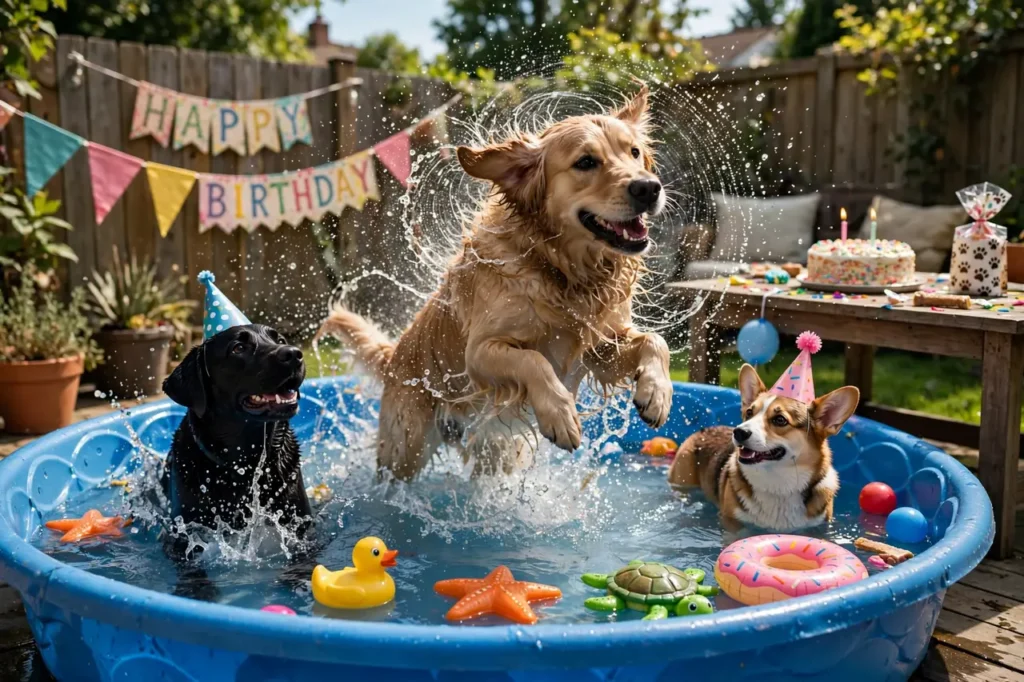
19. Bobbing for Treats. Players: 1–2 at a time. Setup: a kiddie pool with 3–4 inches of water and floating treats (carrot chunks, apple slices, or waterproof training treats). Rules: dogs bob for treats while the crowd cheers; most treats retrieved in 60 seconds wins. Safety: shallow water only; never leave dogs unattended near any water; dry ears afterward (moisture invites infection, especially in floppy-eared breeds). The snorting, splashing determination is unforgettable.
20. Splash Dash Relay. Players: 4+ dogs. Setup: a sprinkler or a line of kiddie pools forming a “splash zone” across the yard. Rules: teams race through the splash zone and back — every dog must pass through the water. Safety: only for water-confident dogs; provide an alternate dry route for the aqua-phobic. Hot-day exclusive — this game is as much about cooling off as competing.
21. Ice Block Treasure. Players: any number, parallel play. Setup: freeze treats and toys into large ice blocks (use mixing bowls or loaf pans) the night before. Rules: each dog gets a block and works to extract the treasures by licking, pawing, and nosing. First to free all treats wins — but every dog stays busy for 20+ minutes. Safety: supervise for ice-chewing (most dogs lick, some chomp — remove blocks from power chewers); this is the ultimate cooldown game for the party’s final act.
Rainy-Day Indoor Games (22–25)
22. Hallway Bowling. Players: 1 at a time. Setup: empty plastic bottles as pins at the end of a hallway, a soft ball. Rules: roll the ball toward the pins — but the dog “bowls” by nose-booping or paw-batting the ball down the hall. Count pins per round; gutter balls get a sympathy treat. Safety: clear the hallway of anything breakable; this game migrates chaos indoors, so embrace it.
23. Blanket Fort Treasure. Players: any number, small groups. Setup: build a blanket fort with treats hidden in its folds and tunnels. Rules: dogs explore the fort finding treats while humans watch the fabric wiggle with mysterious lumps. Safety: ensure the fort cannot collapse heavily — use chairs as the frame, never balance items overhead. Cozy, hilarious, and weirdly calming.
24. Stairway Treat Toss. Players: 1–2 dogs. Setup: a staircase and small treats. Rules: toss treats one step at a time up the stairs; the dog climbs, eats, and waits for the next. Reverse it coming down for the “championship descent.” Safety: only for dogs comfortable with stairs; carpeted stairs only; stop if any dog rushes — stair falls are serious. Surprisingly tiring for big energy in small spaces.
25. The Calm-Down Circle. Players: all remaining dogs. Setup: everyone sits in a large circle with their dogs. Rules: go around the circle — each dog gets 30 seconds of gentle massage and a frozen lick mat while the group shares their favorite thing about the birthday pup. Safety: none — this is the cool-down. End every party here: it transitions the pack from party mode to rest mode and gives humans a genuinely sweet closing ritual.
Game Planner: Match Games to Your Party
| Game | Dogs | Space | Energy | Best moment |
|---|---|---|---|---|
| Birthday Relay | 4+ | Large yard/field | Very high | Opening — burns arrival energy |
| Bubble Chase | Any | Any outdoor | High | Opening or mid-party lift |
| Flirt Pole Frenzy | 1–2 at a time | Medium yard | Very high | Early, in short rounds |
| Fetch Tournament | 2+ | Long space | High | First half |
| Zoomie Course | Any (one at a time) | Yard | Very high | First 20 minutes |
| Tug-of-War Teams | 4+ | Medium | High | First half |
| Muffin Tin Puzzle | Any (one at a time) | Small | Low (mental: high) | Mid-party transition |
| Great Treat Hunt | Any | Yard or house | Medium | Anytime crowd-pleaser |
| Which Hand? | Any | Tiny | Very low | Seniors, puppies, calm moments |
| Cup Shuffle | Any (one at a time) | Tiny | Very low | Spectator favorite |
| Snuffle Mat Relay | 4+ (teams) | Small-medium | Low | Post-meal dip |
| Trick Showcase | Any | Small | Low | Showcase / virtual-friendly |
| Musical Sit | 4+ | Medium | Medium | Mid-party |
| Best in Show | Any | Small-medium | Low | Pre-cake pageantry |
| Pin the Tail | Humans + 1 dog | Small | Very low | Human entertainment break |
| Doggy Limbo | Any | Medium | Medium | Mid-party laughs |
| Howl-Along | Any | Any | Low | Evening wind-down |
| Costume Relay | 4+ (teams) | Medium-large | High | Peak silliness |
| Bobbing for Treats | Any (1–2 at a time) | Pool area | Medium | Hot days |
| Splash Dash Relay | 4+ | Large yard | High | Hot days |
| Ice Block Treasure | Any | Any | Low | Final cooldown |
| Hallway Bowling | Any (one at a time) | Hallway | Medium | Rainy days |
| Blanket Fort Treasure | Small groups | Living room | Low-medium | Rainy days |
| Stairway Treat Toss | 1–2 | Staircase | Medium | Rainy days, small spaces |
| Calm-Down Circle | All | Any | Very low | Always last |
Sample 2-Hour Party Game Schedule
0:00–0:20 — Arrivals + Birthday Relay (burn the crazy). 0:20–0:35 — Bubble Chase + water break. 0:35–0:55 — Muffin Tin Puzzle tournament + Great Treat Hunt (brains take over as legs tire). 0:55–1:15 — Lunch for dogs and humans; Trick Showcase as background entertainment. 1:15–1:35 — Musical Sit + Doggy Limbo (group laughs). 1:35–1:50 — Cake ceremony (not a game, but the emotional peak). 1:50–2:00 — Calm-Down Circle. Notice the shape: energy descends all afternoon, and the last thing dogs remember is gentle praise in a circle of friends.
Watch: The Easiest Brain Game Ever (Muffin Tin Puzzle)
Of all 25 games, the muffin tin puzzle has the best effort-to-delight ratio in the business: one minute of setup, endlessly entertaining to watch, and genuinely enriching for the dogs. This short video shows exactly how to set it up and run it — steal it for your party with confidence.
FAQs About Dog Birthday Party Games
How many games should I plan for a dog birthday party?
Plan 4–6 games for a 2-hour party: one high-energy opener, two mid-party games (one physical, one mental), one water or novelty game, and the calm-down circle to close. Running fewer games well beats rushing through many. Leave 15-minute buffers between games for water breaks, sniffing, and the inevitable shoe-chewing incident.
What if some dogs do not want to play?
Let them opt out — forced participation creates stress and conflict. Set up a “chill zone” (a quiet corner with beds, water, and chew toys) where wallflower dogs can decompress. Many shy dogs join in once they have watched a round or two; the chill zone lets them warm up on their own terms. Never drag a reluctant dog into a game.
How do I prevent fights during competitive games?
Abundance and supervision: 1.5 toys per dog minimum, treats for every participant (not just winners), matched sizes in physical games, and a referee empowered to pause any game instantly. Watch for stiff bodies, hard stares, and hovering over resources — intervene before escalation by cheerfully redirecting with a treat toss.
Are these games suitable for puppies?
Most are, with modifications: shorten everything (puppy attention spans are 3–5 minutes), skip high-impact jumping for puppies under 12 months (growing joints), and favor brain games — Which Hand, Cup Shuffle, and the Treat Hunt are puppy-perfect. Puppies also need enforced nap breaks; an overtired puppy is a bitey puppy.
What about senior dogs?
Seniors shine at brain games (Muffin Tin, Cup Shuffle, Which Hand, Trick Showcase) and gentle group games (Howl-Along, Best in Show). Skip sprinting, jumping, and slippery surfaces. Give seniors the shady spot, the orthopedic bed, and the job of “judge” — they take the role very seriously.
How do I include the human guests in the games?
Pin the Tail, the Trick Showcase (handlers perform with their dogs), Best in Show (owners do the runway commentary), and the Howl-Along all center humans. The secret: humans enjoy watching dogs play more than playing themselves, so design most games as spectator sports with humans as referees, judges, and cheerleaders.
What prizes should I give?
Every dog gets treats for participating — no exceptions, no losers. For “winners,” add a small toy, a ribbon, or a spot in the photo booth’s winner’s circle. Keep prizes dog-focused; humans get bragging rights and photos. Avoid winner-take-all structures that leave any dog (or owner) feeling excluded.
Can I play these games at a dog park?
Some — Fetch Tournament, Bubble Chase, and the Treat Hunt work in parks, but competitive games with strange dogs are risky. Park parties are better as free-play socials with 2–3 structured low-key games. Always check park rules about food, toys, and group sizes first, and bring your own water.
How do I handle a dog that guards toys or treats?
Give that dog parallel-play versions: their own muffin tin at a distance, their own snuffle mat, their own treat hunt zone. Do not put a guarder in shared-resource games hoping they will “learn to share” — parties are not training sessions. Inform the owner privately and frame it positively: “Biscuit gets the VIP solo station!”
What is the best game for a very small party (2–3 dogs)?
The Great Treat Hunt (hide treats, release all dogs — scales perfectly), the Trick Showcase (intimate and charming with a tiny audience), and the Muffin Tin Puzzle run tournament-style. Small parties are actually ideal for brain games because every dog gets many turns without long waits.
How do I end games before dogs get overstimulated?
Watch for the signals: frantic (not joyful) movement, inability to respond to known cues, escalating vocalization, or play that tips from bouncy into pushy. End the game the moment you see them — cheerfully, with treats for everyone, and transition immediately to a sniff-based activity (treat scatter or snuffle mats), which physiologically calms dogs. Ending at the peak, while everyone still wants more, is the hallmark of a great party host.
Let the Games Begin
Twenty-five games, one arc: open big, think in the middle, splash or laugh through the peak, and land softly with the calm-down circle. The dogs will not remember the scores, the brackets, or who “won” — they will remember running, sniffing, and being celebrated. And the humans will remember the bubble-chase photos, the howl-along audio, and the sight of twelve dogs sitting (mostly) still for musical sit.
Keep the party inspiration flowing with our kids’ birthday party ideas (many games adapt beautifully for pups), borrow icebreakers from these party games for adults, and when the humans want their own turn, browse the best board games for kids. Game on — and happy birthday to the guest of honor.