Every holiday is a story a culture tells about what it values. Christmas tells of generosity, Thanksgiving of gratitude, Mother’s Day of maternal love. And Daughter’s Day? It tells one of the most quietly radical stories of all: that daughters — simply by existing, simply by being themselves — are worth celebrating. Understanding daughter’s day traditions and meaning transforms the day from a date on the calendar into something richer: a ritual of recognition, a statement of value, and an invitation to build traditions that echo for generations.
In this guide, we explore the day from the inside out: the meaning at its heart, the history of how it came to be, how different cultures and countries observe it, the traditions families have built around it, and the deeper “why” — what it means to celebrate daughters in a world still learning to value them fully. You will also find practical guidance for starting your own family traditions, because the most meaningful rituals are not inherited. They are invented, with love, by people like you.
The Meaning at the Heart of the Day
Strip away the cards and the hashtags, and Daughter’s Day means one simple thing: we see you, we cherish you, and we are glad you are ours. It is a day for parents to pause the machinery of daily life — the homework battles, the logistics, the distracted half-attention — and direct their full, deliberate appreciation at their daughters. Not for anything they have achieved. Not for good behavior or good grades. For being.
This distinction matters more than it might seem. Children are praised constantly for doing — for performing, achieving, behaving. Daughter’s Day is one of the rare occasions dedicated to celebrating being: her humor, her kindness, her particular way of seeing the world, the simple fact of her existence in your family. When a daughter internalizes that she is celebrated for who she is, not just what she does, it builds a foundation of self-worth that no report card can provide. Psychologists call this “unconditional positive regard,” and its effects on resilience and confidence are well documented. Daughter’s Day, celebrated well, is unconditional positive regard with cake.
The day also carries a collective meaning beyond any single family. Daughter’s Day emerged partly as a corrective — a joyful insistence on the value of girl children in cultures and eras where sons were prized more highly. Every family that celebrates is participating in that larger statement: daughters are not less than, not “as good as,” but fully, equally, radiantly worthy of honor. In that sense, the personal and the political intertwine beautifully. Your private celebration at the dinner table is also a small vote for a world that cherishes its daughters.
A Brief History of Daughter’s Day
Unlike ancient festivals, Daughter’s Day is a young observance — and its youth is part of its charm. There is no single founding moment, but rather a convergence of cultural currents that carried the idea into being over recent decades.
In the United States, the observance took shape as “National Daughters Day,” settling on the fourth Sunday of September — a late-summer/early-autumn date that gives families a celebration to look forward to as the school year begins. It grew organically, spread by social media, greeting card companies, and, most importantly, by parents who liked the idea of a day dedicated to their girls. There was no presidential proclamation, no act of Congress — just a good idea that resonated, which may be the most democratic origin story a holiday can have.
In India, Daughter’s Day (often called “Daughters’ Day”) found particularly fertile ground, observed on the fourth Sunday of September as well. Its resonance there connects to deeper cultural currents: in a society with a complex history around gender preference, a day explicitly celebrating daughters carries real social weight. Campaigns around girls’ education and welfare have embraced the day, and for many Indian families it has become a genuinely significant occasion — complete with gifts, outings, and heartfelt social media tributes.
Other countries mark similar observances on different dates — some on September 28, which is recognized in various places as a daughters’ day. The lack of a single universal date has not weakened the holiday; if anything, it has made it more personal. Families choose the date that works, or celebrate on the nearest weekend, and the flexibility keeps the focus where it belongs: on the daughter, not the calendar. What the day lacks in ancient pedigree it makes up for in living relevance — it is a holiday being invented in real time, by millions of families, right now. Including yours.

How the World Celebrates: Daughter’s Day Around the Globe
While the core sentiment is universal, the expression varies beautifully across cultures. Here is how Daughter’s Day — and its kindred observances — look around the world:
| Country / Region | Typical Date | How It Is Celebrated |
|---|---|---|
| United States | 4th Sunday of September | Family outings, gifts, social media tributes, special meals |
| India | 4th Sunday of September | Gifts, festive meals, blessings from elders, education-themed events |
| United Kingdom | 4th Sunday of September | Cards, flowers, family dinners, growing social media observance |
| Canada | 4th Sunday of September | Family celebrations, outdoor activities, heartfelt messages |
| Australia | 4th Sunday of September | Spring picnics, beach outings, family gatherings |
| Various (Sept 28) | September 28 | Observed as Daughters’ Day in several countries with local customs |
In India, the day often includes seeking blessings from elders — a touching tradition where daughters receive the good wishes (and sometimes gifts) of grandparents, reinforcing the extended family’s cherishing of its girls. Festive foods appear, new clothes are common, and the day’s social media fills with fathers’ tributes that regularly go viral for their tenderness.
In Western countries, the celebration tends toward the personal and experiential: a father-daughter date, a mother-daughter spa day, a family dinner with toasts. The American version, lacking formal tradition, has become a canvas for family creativity — which is why guides like this one exist. When a holiday has no script, every family writes its own, and the diversity of those scripts is the tradition.
What unites all these expressions is the impulse to mark the day — to do something that says “today is different because of you.” Whether that marking is a blessing, a feast, a gift, or a simple spoken sentence, the human need it serves is identical across every border: the need to be seen, cherished, and celebrated by the people who matter most.
Traditions Worth Borrowing
Because Daughter’s Day is young, its traditions are still being written — which means you are free to borrow the best ideas from anywhere. Here are traditions families have created that are worth stealing:
The annual letter. Perhaps the most widespread Daughter’s Day tradition: a handwritten letter, given every year, telling her who she is to you and what you have noticed about her growth. Kept in a bundle, these letters become a biography of her childhood written in a parent’s hand. Start this year; future you will be grateful.
The blessing. Borrowed from cultures where elders’ blessings anchor family occasions: gather the family, place hands on her shoulders (or hold her hands), and speak words of blessing over her coming year — for health, courage, joy, and the fulfillment of her dreams. It feels ancient because the impulse is ancient, and daughters describe it as profoundly moving.
The memory meal. Cook the same special dinner every Daughter’s Day — her favorite, or a recipe passed down through the family. The repetition is the point: year after year, the same table, the same dish, the same toast. Children find deep security in ritual repetition, and the meal becomes a time machine she will crave as an adult.
The wish walk. An evening walk on which she shares one wish for the coming year. You write it down. Next year, you revisit last year’s wish before she makes a new one. Over time, the wishes trace the arc of her growing up — from “I wish for a puppy” to “I wish I get into my dream school” — and the walk becomes sacred ground.
The giving tradition. Celebrate daughters by lifting up daughters: make a donation together to a girls’ education charity, volunteer at a relevant cause, or assemble care packages for girls in need. This tradition teaches her that her worth is connected to a larger sisterhood — and that celebration can be generous, not just receptive. Many families report this becoming their daughter’s favorite part of the day.
The photo ritual. The same spot, the same pose, every year — the front steps, her bedroom doorway, under the old tree. Compile the photos into an album or a wall collage. Watching herself grow, year by year, in the same frame, gives a daughter a visceral sense of her own story unfolding. Pair it with a few lines from our daughter quotes collection as captions, and the album becomes a treasure.
The Deeper Meaning: Why Daughters, Why Now
It is worth asking the question behind the holiday: why do daughters need a day? The answer is both simple and sobering — because for much of human history, in many parts of the world, they did not get one. They got less: less celebration of their births, less investment in their futures, less public cherishing. Daughter’s Day is, among other things, a joyful correction — a culture saying, out loud and on purpose, that girls are a blessing to be celebrated, not a circumstance to be managed.
This matters practically, not just symbolically. Girls who grow up feeling celebrated — whose families mark their existence with joy — carry that foundation into every room they enter. They negotiate harder, dream bigger, tolerate less diminishment. A father who takes his daughter on a Daughter’s Day date is not just having lunch; he is modeling, in the most concrete way possible, that she deserves time, attention, and delight. A mother who writes her daughter an annual letter is not just being sentimental; she is building an archive of worth the daughter will consult in hard times.
The day also invites reflection on the parent-daughter relationship itself — one of the most formative bonds in human life. Fathers shape their daughters’ expectations of how they deserve to be treated; mothers shape their understanding of womanhood itself. Daughter’s Day is a yearly prompt to examine that influence with intention: Am I showing her what respect looks like? Am I celebrating her strength as well as her sweetness? Am I listening as much as I am guiding? These are not comfortable questions, but they are the ones that make the day matter beyond the festivities.
And there is a forward-looking meaning too. Every Daughter’s Day celebration is a rehearsal for the future — for the day she parents her own children, leads her own teams, builds her own life. The traditions you start, the words you speak, the way you make her feel: all of it becomes her template. Celebrate her well, and you are not just honoring a daughter. You are shaping the ancestor she will become.

Starting Your Own Family Traditions
The most meaningful Daughter’s Day traditions are not found but founded — invented by your family, repeated with love, refined over years. Here is how to start:
Choose one anchor ritual. Do not try to establish five traditions at once; pick one — the letter, the meal, the walk, the photo — and commit to it for three years. Traditions need repetition to take root, and a single ritual done faithfully beats a smorgasbord done sporadically.
Write it down. Record the tradition somewhere permanent: a family journal, the inside cover of the photo album, a note in your phone. Write what you did, why, and how she reacted. This record is what allows the tradition to survive busy years, and it is what she will consult when she continues it with her own children.
Let her shape it. The best traditions evolve with the daughter. A scavenger hunt that thrilled her at seven might embarrass her at fifteen — so let her graduate the tradition, or co-design its next version. A tradition she helps shape is one she will keep; a tradition imposed is one she will abandon. Ask her: “What should we always do on Daughter’s Day?” Her answer might surprise you.
Include the wider circle. Traditions gain gravity from witnesses. Invite grandparents to the blessing, have siblings write the notes, let the whole extended family know “this is what we do.” A ritual observed by many becomes part of a child’s identity in a way a private habit cannot.
Connect it to values. The traditions that last are the ones tied to what your family believes: gratitude (the giving tradition), courage (the wish walk), love (the letter), heritage (the memory meal). When she understands why you do it, the ritual carries meaning even when the novelty fades — and meaning is what survives into adulthood.
For inspiration on the words that accompany rituals — toasts, blessings, letter language — our wedding day wishes for daughters and anniversary wishes for parents collections hold sentiments about family love that adapt beautifully to Daughter’s Day ceremonies.
Passing It On: When Daughters Become Mothers
There is a moment every parent waits for, sometimes without realizing it: the day your daughter — the one you wrote letters to, cooked special dinners for, photographed in the same doorway every year — becomes a mother herself, and starts Daughter’s Day traditions of her own. If you have built the rituals described in this guide, that moment will arrive with a particular sweetness: she will reach for the pattern you set, and the tradition will propagate itself into a new generation.
This is how traditions actually survive. Not through instruction — “you must do this” — but through imprinting. A daughter who grew up with the annual letter does not need to be told to write one to her own daughter; the absence of the ritual would feel wrong, like a room missing its furniture. A daughter who experienced the wish walk will find herself, years later, lacing up her shoes on a September evening with her own little girl, without quite remembering where the idea came from. That is the quiet miracle of family ritual: it reproduces itself through love, not obligation.
There is also a beautiful role reversal to anticipate. The Daughter’s Day celebrant becomes the celebrator — and often, she turns the day back toward you. Many mothers report that their adult daughters, having absorbed years of Daughter’s Day love, begin honoring them on the day too: a call, a gift, a note that says “thank you for all the Daughter’s Days.” The holiday becomes bidirectional, a mutual appreciation between women who understand, now from both sides, what the bond costs and what it gives. If you are lucky, you will one day receive the letter you spent years writing — and understand, finally, the full weight of what you started.
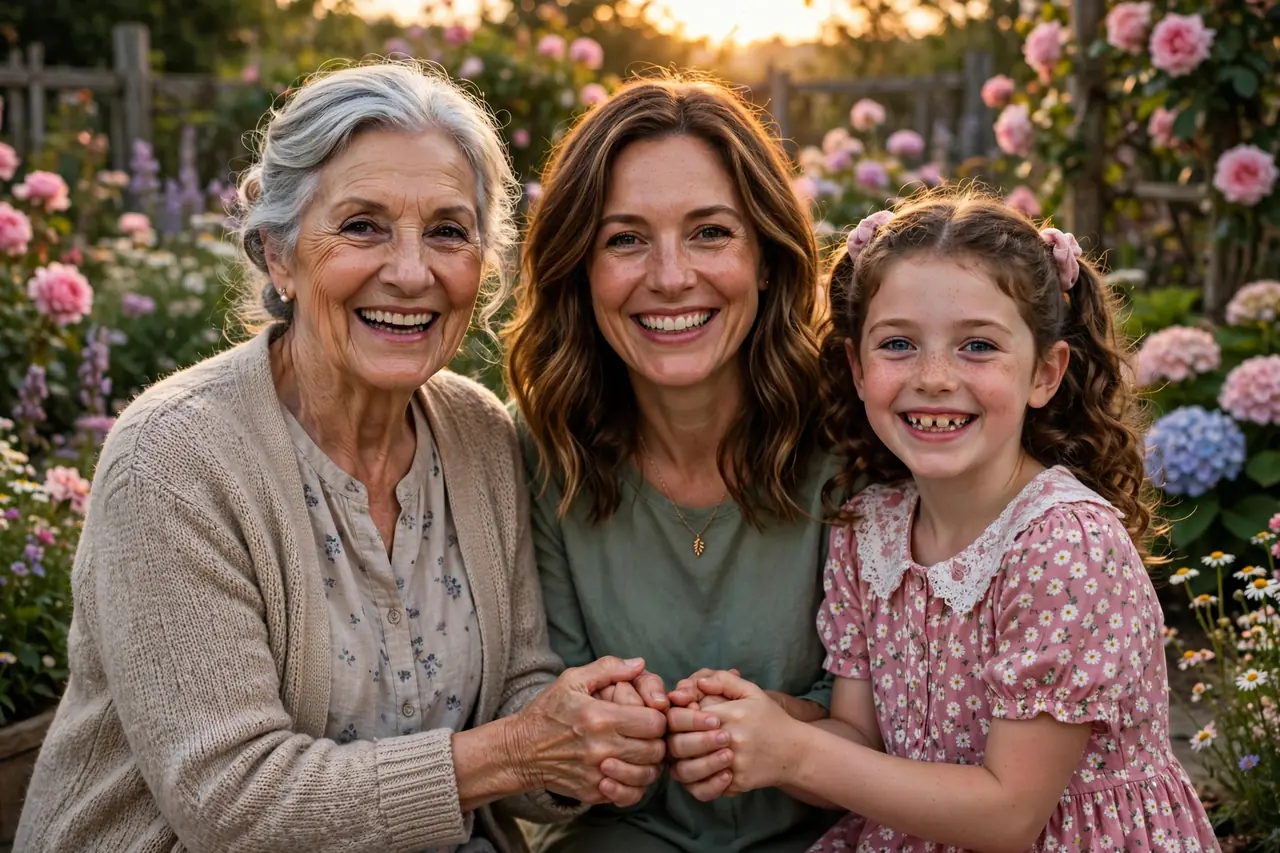
For grandmothers, the day takes on yet another dimension: the chance to bless across two generations at once. The grandmother who places her hands on both her daughter’s and granddaughter’s shoulders during the family blessing is performing one of humanity’s oldest ceremonies — the transmission of love down the line. If your family is fortunate enough to have three or four generations together on Daughter’s Day, prioritize that photograph above all others. It is the tradition made visible: love, handed down, hand to hand, heart to heart.
And for daughters who do not become mothers — by choice or circumstance — the tradition finds other channels. They become the beloved aunt who hosts the spectacular Daughter’s Day for her nieces. The mentor who takes a younger colleague for the celebratory lunch. The friend who remembers every one of her friends’ daughters’ milestones. The ritual’s essence was never really about motherhood; it was about cherishing — and cherishing, once learned, radiates outward to everyone in its path. The traditions you start today will travel further than you can imagine, carried by a daughter who learned, year after year, that she was worth celebrating — and who now cannot help but celebrate others.
Watch: A Celebration of Daughters
To feel the spirit of the day, watch this heartfelt tribute celebrating daughters — a reminder of why this observance resonates with millions of families and why your own celebration matters more than you know.
Frequently Asked Questions
What is the meaning of Daughter’s Day?
Daughter’s Day is a celebration of daughters and the parent-daughter bond. Its core meaning is recognition: a dedicated day to tell your daughter she is seen, cherished, and valued for who she is. It also carries a broader cultural meaning — an affirmation of the worth of girl children in a world that has not always celebrated them equally. Personally, it is about love; collectively, it is about value. Both meanings make the day worth observing with intention.
What are traditional ways to celebrate Daughter’s Day?
Because the holiday is young, traditions are still forming — but beloved ones are emerging: the annual handwritten letter, a special family meal, seeking blessings from elders (common in India), a father-daughter or mother-daughter date, a “wish walk” where she shares a wish for the coming year, an annual photo in the same spot, and charitable giving to girls’ causes. The most important tradition is the one your family repeats: choose an anchor ritual and commit to it for years, and it will become sacred.
When did Daughter’s Day start?
There is no single founding date — Daughter’s Day emerged organically over recent decades rather than being proclaimed by any authority. In the United States it coalesced as “National Daughters Day” on the fourth Sunday of September, spreading through social media and cultural adoption. In India it gained prominence on the same weekend, resonating with campaigns around girls’ welfare and education. Its grassroots origin is part of its character: it is a holiday the people chose, not one handed down.
Is Daughter’s Day celebrated in every country?
Not universally, but it is observed in many countries including the United States, India, the United Kingdom, Canada, and Australia — typically on the fourth Sunday of September, with some places marking September 28. Awareness is growing yearly, driven by social media and the diaspora. Even where it is not formally observed, the underlying impulse — setting aside time to honor daughters — is universal, and families everywhere can adopt the celebration regardless of local custom.
How is Daughter’s Day different from Mother’s Day or Father’s Day?
The direction of honor is reversed: on Mother’s and Father’s Day, children honor parents; on Daughter’s Day, parents honor their daughter. It is also younger and less commercialized, with fewer fixed expectations — which gives families more freedom to define it. The day is less about gifts and more about recognition: celebrating who she is becoming and the joy she brings to the family. Think of it as the family’s love flowing downstream for a day.
What is the most meaningful Daughter’s Day tradition to start?
The annual letter. It costs nothing, takes thirty minutes, and compounds in value every year — a growing archive of your love in your own handwriting that she will keep for the rest of her life. If you want a second tradition, add the annual photo in the same spot; together, words and images tell the complete story of her becoming. Start this year, repeat faithfully through every season of her childhood, and let time do the rest. Future generations of your family will thank you for the precious record you kept.
How can I start a meaningful Daughter’s Day tradition?
Pick one simple ritual and repeat it faithfully: a letter, a meal, a walk, a photo, a blessing. Write down what you do so it survives busy years. Let your daughter help shape it as she grows. Include extended family as witnesses. And tie it to a value your family holds — gratitude, courage, generosity, heritage. Traditions need only three ingredients to last: repetition, meaning, and love. You already have the love; supply the other two, and the tradition will take care of itself.
The Story Continues With You
Daughter’s Day is a young holiday with an old soul — a new ritual serving an ancient need: to look at our daughters and say, with our full hearts, you are a gift. Its traditions are still being written, its meaning still deepening, and every family that celebrates adds a line to the story. This year, add yours. Write the letter. Cook the meal. Take the walk. Speak the blessing. And know that in celebrating your daughter, you are part of something larger than any single family: a world learning, year by year, to cherish its daughters as they deserve. Happy Daughter’s Day — may your traditions be many, and your meaning deep.