Coptic Christmas in Egypt is one of the world’s most profound Christmas celebrations — and one of its least known in the West. On January 7th, while the rest of the world’s decorations are coming down, Egypt’s Coptic Orthodox Christians — some 10 million strong, one of the largest Christian communities in the Middle East — celebrate the birth of Christ with an all-night liturgy, a 43-day fast broken at dawn, and a Christmas dinner of fatta eaten in the early hours of the morning. It is ancient, joyful, and deeply moving: Christmas as the early church knew it.
What makes Coptic Christmas in Egypt so special is its combination of deep antiquity and living vibrancy. The Coptic Orthodox Church traces its founding to St. Mark the Evangelist in the 1st century, and its Christmas liturgy — chanted in Coptic, the liturgical descendant of the language of the pharaohs — connects today’s worshippers directly to the earliest centuries of Christianity. Yet the celebration is anything but a museum piece: Cairo’s Coptic neighborhoods blaze with lights, families feast with abandon, and the midnight liturgy draws worshippers by the thousands. This complete guide explains every tradition, from the Advent fast to the Christmas fatta.
Why January 7th? The Coptic Calendar and Christmas
Coptic Christmas in Egypt is celebrated on January 7th (Kiahk 29 in the Coptic calendar) because the Coptic Orthodox Church follows the ancient Alexandrian reckoning of Christmas, aligned with the Julian calendar’s December 25th. The Coptic calendar itself — one of the world’s oldest, with roots in pharaonic Egypt — runs 13 months, and its Christmas date has remained fixed while the Gregorian calendar drifted.
The Egyptian government recognizes the significance: January 7th has been an official public holiday in Egypt since 2003, a landmark acknowledgment of the Coptic community’s place in national life. On the day, greetings of “Eid Milad Majid” (Blessed Christmas, literally “Glorious Birth Feast”) are exchanged, and the country’s Coptic neighborhoods take on a festive air distinct from the December 25th celebrations of Egypt’s smaller Catholic and Protestant communities.
The 43-Day Advent Fast: A Season of Preparation
Like their Ethiopian Orthodox brethren, Coptic Christians observe a 43-day Advent fast before Christmas — beginning in late November and continuing until Christmas Eve. During the fast, observers abstain from all animal products: no meat, dairy, or eggs. The fast is a serious spiritual discipline, and Coptic households, restaurants, and even fast-food chains adapt with extensive vegan offerings — ful (fava beans), ta’ameya (Egyptian falafel), lentils, and vegetables become the staples of the season.
The fast intensifies on Christmas Eve (January 6th): many faithful abstain from food and water entirely until after the Christmas liturgy ends in the early hours of January 7th. This final fast makes the Christmas dinner — eaten at dawn — one of the most eagerly anticipated meals of the year. The discipline of the fast is central to understanding Coptic Christmas in Egypt: the joy of the feast is inseparable from the restraint that preceded it.
Christmas Eve: The All-Night Liturgy
The heart of Coptic Christmas in Egypt is the Christmas Eve Divine Liturgy, celebrated on the night of January 6th and continuing past midnight into January 7th. Churches across the country fill to capacity — and overflow into courtyards — as the faithful gather for hours of chanting, prayer, and communion.
The Papal Liturgy at the Cathedral
The most famous Christmas liturgy is led by the Pope of the Coptic Orthodox Church (the Pope of Alexandria). In recent years, this has been held at the Cathedral of the Nativity of Christ in Egypt’s New Administrative Capital — consecrated in January 2019 and among the largest churches in the Middle East — drawing thousands of worshippers, clergy, and dignitaries. The liturgy, with its ancient Coptic hymns, clouds of incense, and the Pope’s Christmas sermon, is broadcast across the Arab world, making it the most-watched Christmas service in the Middle East.
Previously centered at St. Mark’s Coptic Orthodox Cathedral in Cairo’s Abbasiya district — the historic seat of the papacy — the Christmas liturgy remains a profound national moment regardless of venue. The service typically begins in the evening of January 6th and concludes in the early hours of January 7th, ending with communion and the joyful dismissal: Christ is born.
What the Liturgy Is Like
The Coptic Christmas liturgy is chanted largely in Coptic (with Arabic and some English in diaspora churches), using hymns passed down through nearly two millennia. The melodies — some attributed to the earliest centuries of Egyptian Christianity — are haunting and distinctive, sung antiphonally by deacons in white robes. Incense fills the church; icons of the Nativity are venerated; and at the climax, the congregation receives communion, many having fasted all day in preparation. For the faithful, emerging from the church into the pre-dawn dark of January 7th, the fast broken and the feast awaited, is the emotional peak of the year.
The Christmas Dinner: Fatta at Dawn
After the liturgy ends — often around 2 or 3 in the morning — Coptic families return home to the Christmas dinner: the meal that breaks 43 days of fasting. The centerpiece is fatta, Egypt’s great celebratory dish: layers of rice and toasted bread soaked in rich meat broth, topped with tender boiled meat (usually lamb or beef) and a garlicky tomato-vinegar sauce. Rich, warming, and deeply satisfying, fatta is the taste of Christmas morning in Coptic Egypt.
The dawn feast is a joyous, slightly delirious affair — families eating heartily in the small hours, children (who may have napped through the liturgy) waking to the celebration, the 43-day fast a memory. Turkey, chicken, and other meats appear alongside the fatta; sweets and kahk (the powdered-sugar shortbread cookies also associated with Eid) are served; and the meal stretches into the morning. For more festive feast traditions from around the world, see our Christmas dinner ideas.
Decorating and Baba Noel: The Festive Face of Coptic Christmas
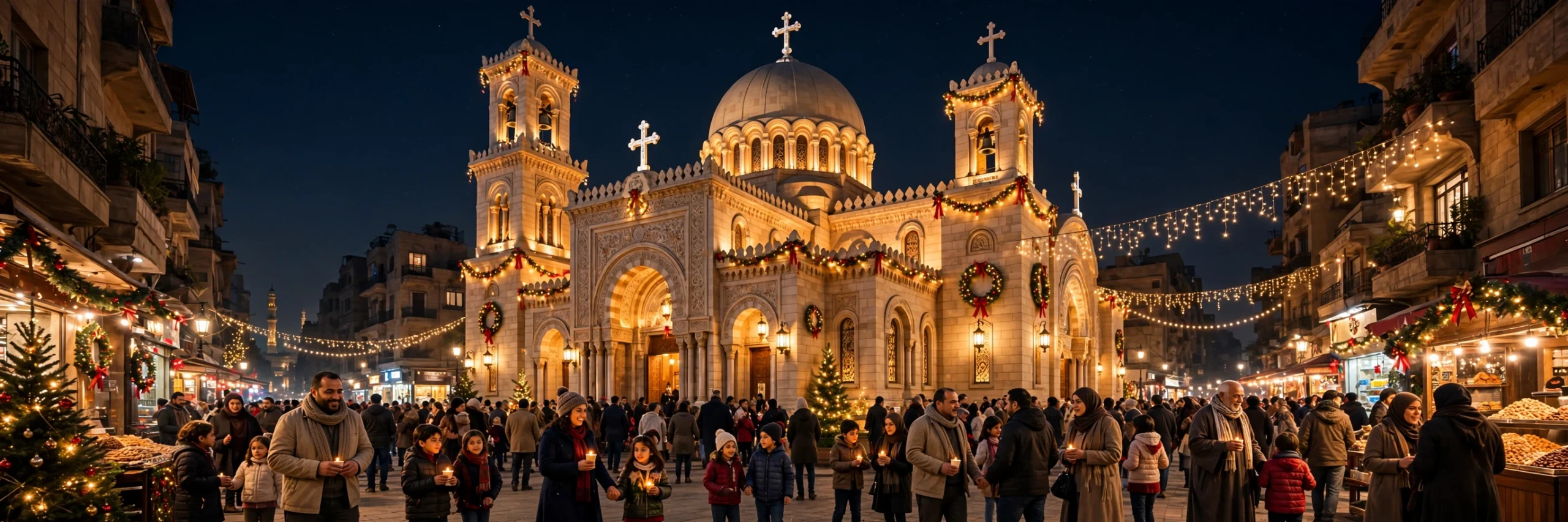
Coptic Christmas in Egypt has a festive public face to match its liturgical depth. In Coptic neighborhoods — Shubra in Cairo, and districts across Alexandria, Minya, Asyut, and Upper Egypt — streets and balconies blaze with Christmas lights, shops sell trees and ornaments, and churches mount elaborate illuminated displays. Christmas trees, often artificial, are universal in Coptic homes, dressed in lights and tinsel.
Baba Noel (Father Christmas) brings gifts to Coptic children, with presents exchanged on Christmas morning or after the Eve liturgy. Nativity scenes (maghara) hold pride of place in homes and churches. The decorations go up in December and stay through January 7th — giving Coptic neighborhoods a holiday season nearly twice as long as the West’s, and a distinctive rhythm: the world’s Christmas, then their own.
Christmas Day: Visiting, Feasting, and Rest
January 7th itself is a day of visiting and celebration. Families make the rounds — grandparents, aunts, uncles, godparents — exchanging greetings, gifts, and plates of kahk and Christmas sweets. The traditional greeting “Eid Milad Majid” is heard everywhere, and the response carries the joy of the feast. Children show off new clothes and toys; adults settle into the contentment of the fast completed and the liturgy fulfilled.
The day has a distinctly Egyptian warmth: the winter weather is mild, the streets are lively, and the sense of a community celebrating together is palpable. Muslim neighbors and colleagues commonly offer Christmas greetings to Coptic friends — a small but meaningful gesture of Egypt’s shared social fabric — and many join in the spirit by sharing kahk and sweets. For Copts, it is also a day of quiet pride — a public, national affirmation of their faith and heritage, celebrated openly in a Muslim-majority country with a public holiday to mark it.
Coptic Christmas Around the World: The Diaspora
Egypt’s large Coptic diaspora — in the United States, Canada, Australia, and Europe — celebrates Coptic Christmas with devotion. Coptic churches abroad hold the Christmas Eve liturgy on January 6th-7th (often with English alongside Coptic and Arabic); families observe the fast as best they can amid Western schedules; and the dawn fatta is recreated with ingredients from Middle Eastern groceries. In cities like Sydney, Toronto, and Los Angeles, Coptic Christmas is a major community event, with churches overflowing.
The diaspora celebration carries an extra poignancy: January 7th is a normal workday in the West, so many Copts take the day off or celebrate in the evening — a small sacrifice that underscores the feast’s importance. Like the Ethiopian Genna traditions described in our guide to Christmas traditions in Ethiopia, Coptic Christmas abroad is an anchor of identity: an ancient faith, kept faithfully, far from home.
Visiting Egypt for Coptic Christmas
Experiencing Coptic Christmas in Egypt firsthand is unforgettable — and January is one of the best times to visit the country, with mild weather ideal for sightseeing. Attending the Christmas Eve liturgy requires planning: the papal liturgy is a ticketed, high-security event, but parish churches across Cairo and Alexandria welcome respectful visitors to their own beautiful services. Dress modestly, arrive early, and observe quietly.
Beyond the liturgy, January in Egypt offers the country’s treasures at their best: the pyramids of Giza, Luxor’s temples, and Aswan’s Nile beauty, all in comfortable winter temperatures. Combine the spiritual experience of Coptic Christmas with Egypt’s ancient wonders, and you have a holiday trip like no other. Coptic Cairo itself — with the Hanging Church, the Church of St. Sergius (traditionally built over the Holy Family’s resting place), and the Ben Ezra Synagogue — is worth a dedicated day, and the festive lights of the Coptic quarters add a magical evening dimension to any January itinerary. For more extraordinary seasonal destinations, see our best places to spend Christmas.
The Ancient Roots: St. Mark and the Coptic Church
The Coptic Orthodox Church traces its founding to St. Mark the Evangelist, who tradition holds brought Christianity to Alexandria in the 1st century. Egypt became one of Christianity’s great early centers: the Desert Fathers pioneered monasticism in the Egyptian wilderness, Alexandrian theologians shaped the faith’s doctrines, and the Coptic language — the final stage of the Egyptian language of the pharaohs, written in Greek-derived script — became the church’s liturgical tongue.
This antiquity permeates Coptic Christmas in Egypt. The hymns sung on Christmas Eve include some of the oldest Christian music in existence; the fast reflects the early church’s discipline; and the January 7th date preserves the ancient Alexandrian Christmas. To celebrate Coptic Christmas is to touch the roots of Christianity itself — in the land where the Holy Family, by tradition, once sought refuge.
Kiahk: The Midnight Praises of the Christmas Month
One of the most beautiful and least-known aspects of Coptic Christmas in Egypt is the month of Kiahk — the Coptic month preceding Christmas — during which churches hold special midnight praises (Tasbeha) every night. These are not ordinary prayer services: the Kiahk praises are elaborate, musical, hours-long hymns dedicated to the Virgin Mary and the coming Nativity, sung by candlelight in the deep night.
The Kiahk Tasbeha draws devoted crowds — young people especially — who gather night after night through December, learning the intricate hymns by heart. The melodies are hauntingly beautiful, the atmosphere electric with anticipation. For participants, the nightly praises are the true countdown to Christmas: each midnight service brings the feast one day closer. Visitors to Egypt in December can attend these services at Coptic churches (they typically begin late in the evening and run past midnight) — a hauntingly beautiful introduction to the season’s spiritual depth.
Christmas Sweets: Kahk, Biscuits, and Festive Baking
The Coptic Christmas table groans with sweets, and the queen of them all is kahk — the delicate, powdered-sugar-dusted shortbread cookies that are Egypt’s great festive biscuit (shared with the Eid celebrations, where they’re equally beloved). Made with a rich dough of flour, ghee, and sometimes filled with date paste or nuts, stamped with traditional carved patterns, kahk melts in the mouth and is utterly addictive.
Alongside kahk come butter biscuits (bisco mis), date-filled ma’amoul-like cookies, and honey-soaked pastries. Coptic families bake in enormous quantities in the days before Christmas — and, crucially, the baking happens while still fasting, requiring heroic restraint as the house fills with the scent of butter and sugar. Plates of Christmas kahk are exchanged between families, delivered to neighbors (Muslim neighbors often receive them too, in a lovely gesture of shared festivity), and served to every visitor through the season.
Carols and Music: From Ancient Hymns to Arabic Christmas Songs
The music of Coptic Christmas in Egypt spans two worlds. In church, the ancient Coptic hymns dominate — the Kiahk praises, the Christmas liturgy melodies, chants in a language descended from the pharaohs. These are sacred, complex, and profoundly moving, representing one of the oldest continuous musical traditions in Christianity.
Outside church, the season has its popular soundtrack: Arabic Christmas songs and carols, played in Coptic homes, shops, and neighborhoods through December and early January. Egyptian Christian singers release Christmas music; church youth groups stage carol concerts and nativity plays; and the familiar melodies of the global Christmas repertoire — translated into Arabic — fill the air. The blend is characteristic of Coptic Christmas in Egypt: ancient and modern, sacred and cheerful, all at once. For a collection of the season’s most beloved films to accompany the music, see our best Christmas movies of all time.
Epiphany and Beyond: The Season’s Second Feast
Like their Ethiopian Orthodox kin, Coptic Christians follow Christmas with the Feast of the Theophany (Epiphany) on January 19th, commemorating Christ’s baptism. The eve of the feast brings another all-night liturgy, and on the morning, priests bless the waters — in a beautiful ritual, congregations gather as holy water is blessed and sprinkled over the faithful. In some communities, the blessed water is taken home in bottles, kept for the year as a blessing.
The Christmas-Epiphany season thus stretches nearly two months from the start of the Advent fast — a long, disciplined, joyful arc that gives Coptic Christmas in Egypt its distinctive depth. By the time the decorations come down in late January, the faithful have journeyed through fasting, midnight praises, the Nativity liturgy, the dawn feast, and the baptismal waters: a complete spiritual pilgrimage, renewed every year.
Gift-Giving and Family Customs
Gift-giving at Coptic Christmas in Egypt centers on family and generosity. Baba Noel brings presents for children — opened on Christmas morning, often after the dawn feast — while adults exchange gifts of food, sweets, and practical presents. New clothes for Christmas are a cherished tradition, especially for children, who show off their outfits at church and on family visits.
But the deepest gift custom is hospitality itself. The Christmas season obligates no Coptic home to turn away a visitor unfed: kahk and sweets are pressed on every guest, the fatta pot seems bottomless, and families compete in generosity. Godparents have a special role, traditionally giving gifts and new clothes to their godchildren. Charity, too, is central: churches and families distribute Christmas food parcels to the poor, ensuring that the feast’s joy reaches those who fasted without the prospect of a feast. In this, Coptic Christmas in Egypt embodies the season’s oldest meaning — that the Nativity is good news for everyone, especially the humble.
Christmas Shopping in Cairo: Markets and Festive Streets
December and early January transform shopping in Coptic districts. The streets of Shubra — Cairo’s great Coptic quarter — fill with vendors selling trees, ornaments, lights, and toys; the area’s shops stay open late, and the festive crowds give it a carnival atmosphere. Christmas markets and bazaars pop up in churches and community clubs, selling handmade crafts, icons, and holiday foods.
Beyond the Coptic quarters, Cairo’s malls and hotels mount their own Christmas displays (timed for December 25th, catering to tourists and Egypt’s Western-oriented communities), creating a city with two overlapping Christmases — a fascinating duality for visitors. The traditional souks, meanwhile, do brisk business in the season’s essentials: nuts and dried fruits for the feast, fabrics for new clothes, and ingredients for the great Christmas baking. For gift ideas with universal appeal, our best Christmas gifts guide offers inspiration.
In Pictures: Coptic Christmas in Egypt
Coptic Christmas comes on 7 January — after a 43-day fast, an all-night liturgy, and a dawn feast of fatta to break it.

Inside a Coptic Orthodox church at Christmas: candles glowing before ornate icons, priests in ceremonial robes, golden reverent light.
Watch: Coptic Christmas in Egypt
Africanews reports on Egypt’s Coptic Orthodox Christians attending the Christmas Eve mass — one of the world’s oldest Christian communities.
At a Glance: Coptic Christmas in Egypt
The Coptic season in brief.
| Tradition | Date | Key detail |
|---|---|---|
| The Nativity Fast | 25 Nov – 6 Jan | 43 days of fasting from meat and dairy before Christmas — prayer and preparation |
| Christmas Eve liturgy | 6 January | An all-night candlelit service — the grandest at St Mark’s Cathedral in Cairo |
| Fatta at dawn | 7 January | The fast breaks with fatta — rice, crisp bread and meat in a garlicky vinegar sauce |
| Kahk cookies | January | Shortbread cookies dusted with sugar, baked for the holiday |
| Baba Noel | 7 January | Egyptian Santa — gifts, trees and decorations join the ancient rites |
| National holiday | 7 January | Coptic Christmas is a public holiday for all Egyptians |
| Visiting & feasting | 7 January | Christmas Day is for family visits, feasts and rest — charity is part of the season |
Frequently Asked Questions
When is Coptic Christmas in Egypt?
Coptic Christmas is celebrated on January 7th (Kiahk 29 in the Coptic calendar), following the ancient Alexandrian reckoning of Christmas. January 7th has been an official public holiday in Egypt since 2003.
Why do Copts celebrate Christmas on January 7th?
The Coptic Orthodox Church follows the Julian calendar’s December 25th for Christmas, which corresponds to January 7th in the Gregorian calendar. This reflects the ancient Alexandrian computation of the feast, shared with other Oriental Orthodox churches including Ethiopia’s.
What is the Coptic Advent fast?
Copts observe a 43-day Advent fast before Christmas, abstaining from all animal products (meat, dairy, eggs) from late November until Christmas Eve. Many faithful also fast from all food and water on Christmas Eve day until after the Christmas liturgy ends in the early hours of January 7th.
What do Copts eat for Christmas?
The traditional Coptic Christmas dinner — eaten at dawn after the Christmas Eve liturgy — centers on fatta: layers of rice and bread soaked in rich meat broth, topped with lamb or beef. Kahk (powdered-sugar shortbread cookies), turkey, and festive sweets complete the feast that breaks the 43-day fast.
Where is the main Coptic Christmas liturgy held?
The papal Christmas Eve liturgy, led by the Pope of Alexandria, has in recent years been held at the Cathedral of the Nativity of Christ in the New Administrative Capital (consecrated January 2019), previously at St. Mark’s Cathedral in Cairo’s Abbasiya district. Parish churches nationwide hold their own all-night liturgies.
How do you say Merry Christmas in Coptic Egypt?
The traditional greeting is “Eid Milad Majid” (عيد ميلاد مجيد) — literally “Glorious Birth Feast” — exchanged throughout the Christmas season. Baba Noel (Father Christmas) is the gift-bringer for Coptic children, and the greeting is often shared warmly with Muslim neighbors and friends as well.