Christmas traditions in Spain run on a different clock than the rest of Europe. The season opens not with Advent calendars but with a national lottery draw watched by millions; Christmas Eve belongs to an enormous family dinner; New Year’s Eve demands twelve grapes at midnight; and the biggest gift day is not December 25 but January 6, when the Three Kings parade through every city. Spain’s Christmas is loud, late-night, sweet, and unapologetically its own.
This guide follows the Spanish Christmas timeline from El Gordo to the Roscón de Reyes — the lottery, the dinners, the grapes, the parades, and the regional customs from Catalonia’s pooping log to the Basque Country’s Olentzero. ¡Feliz Navidad!
How Christmas Traditions in Spain Begin: El Gordo, the December 22 Lottery
For most of the world, Christmas season starts with decorations. In Spain, it starts with a lottery draw. The Sorteo Extraordinario de Navidad — El Gordo (“The Fat One”) — held every December 22, is the world’s biggest lottery by total prize money, with billions of euros in prizes. The draw itself is a beloved national ritual: schoolchildren from Madrid’s San Ildefonso school sing the winning numbers in a hours-long televised ceremony, and the whole country watches, tickets in hand.
The lottery is deeply social — offices, bars, and families buy décimos (tenth-shares of tickets) together, so a win is shared across communities. Entire villages have won together, and the televised scenes of celebrating towns are as much a Christmas tradition as any carol. Spaniards will tell you the season hasn’t started until the children start singing the numbers. It is a wonderfully Spanish opening act: Christmas as collective hope, sung by schoolchildren.
Christmas Eve: Nochebuena, the Great Family Dinner
Nochebuena (Christmas Eve) is the heart of Christmas traditions in Spain — a massive family dinner that starts late (9 or 10 PM) and runs past midnight. The table varies by region but the structure is consistent: abundant starters, a showpiece main, and sweets that appear only at Christmas.
- Starters: jamón ibérico, seafood (prawns, clams, lobster for grand occasions), queso manchego, and embutidos (cured meats).
- Mains: roast lamb (cordero asado, the Castilian classic), suckling pig (cochinillo, Segovia’s pride), turkey (pavo), or seafood feasts on the coasts — besugo (sea bream) is the traditional Madrid Christmas fish.
- Sweets: turrón (almond nougat, hard Alicante or soft Jijona), polvorones (crumbly almond shortbreads), mantecados, and mazapán (marzipan, Toledo’s specialty).
- Drink: wine through dinner, cava (Spanish sparkling wine) for the toast — cava is as essential to Spanish Christmas as champagne is to the French Réveillon.
After dinner, many families attend La Misa del Gallo (Midnight Mass — the “Rooster’s Mass”), then return home for more sweets and cava. Gifts are traditionally not exchanged on Nochebuena — that waits for the Kings (though Santa Claus, Papá Noel, has made inroads, and many families now do both).
Christmas Day: A Quiet Second Act
Navidad (December 25) is, by Spanish standards, a restful day — the family lunch (la comida de Navidad), often leftovers elevated, long sobremesa (table conversation) stretching through the afternoon, and a general national exhale. In Catalonia, Christmas Day lunch has its own star: escudella i carn d’olla, the hearty Catalan stew, with the traditional galets (giant pasta shells) in broth. It is the calm between the feasts — because the season is only half over.
December 28: Día de los Santos Inocentes
Like Mexico, Spain turns Holy Innocents’ Day (December 28) into its April Fools’ — el Día de los Inocentes. Media outlets run fake stories, friends play pranks, and the traditional response to being fooled is “Inocente, inocente”. It is a day of sanctioned mischief wedged between the solemnities, and Spaniards embrace it fully.
New Year’s Eve: Nochevieja and the Twelve Grapes
Nochevieja (New Year’s Eve, “old night”) is one of Spain’s great national rituals. At midnight, the entire country eats twelve grapes — one for each chime of the clock — for luck in the twelve months ahead. The tradition centers on Madrid’s Puerta del Sol, where the clock’s bell (las campanadas) is broadcast to millions gathered in the square and watching at home, grapes in hand.
The grape tradition dates to the early 20th century (legend says a bumper grape harvest in 1909 prompted growers to market the custom) and is now iron law: supermarkets sell uvas de la suerte (lucky grapes) — tins of twelve seedless grapes — specifically for the occasion. Eating one grape per chime, without choking, while the whole country counts down, is a genuine skill. Red underwear for luck is the other Nochevieja essential, and cava flows at midnight as at no other moment of the year.
After the grapes, Spain parties until dawn — Nochevieja is a late night even by Spanish standards, with clubs and street parties running to sunrise. New Year’s Day is for recovery, the concierto de Año Nuevo on television, and the first roscón sightings in bakeries.
January 5–6: The Three Kings — Spain’s Real Christmas Morning
Here is the essential fact of Christmas traditions in Spain: the biggest gift day is January 6, el Día de los Reyes Magos (Three Kings Day). On the evening of January 5, every city and town holds the Cabalgata de Reyes — the Three Kings Parade — with Melchior, Gaspar, and Balthazar processing on floats, throwing candy (caramelos) to crowds of children. Barcelona’s and Madrid’s cabalgatas are spectacular; Alcoy’s, dating to the 19th century, is Spain’s oldest; and in many towns the Kings arrive by boat, helicopter, or camel.
Children leave their shoes out on the night of January 5 (with water and turrón for the camels), and wake on the 6th to the season’s main gifts. The day’s essential food is the Roscón de Reyes — a ring-shaped brioche decorated with candied fruit “jewels,” hiding a sorpresa (small figurine) and a haba (dried bean). Whoever finds the figurine is crowned king; whoever finds the bean pays for the roscón. Families, offices, and schools share roscones through the week — it is the sweet epilogue to the entire season.
Catalonia’s Caganer and Caga Tió: Christmas with a Wink
No tour of Christmas traditions in Spain is complete without Catalonia’s gloriously scatological customs. The caganer — literally “the pooper” — is a figurine of a peasant defecating, traditionally hidden in the nativity scene. Far from sacrilege, the caganer is folk tradition: he fertilizes the earth, brings good luck, and appears in every Catalan pessebre (nativity). Modern caganers depict celebrities, politicians, and footballers — finding them all is a beloved December game.
Even better known is the Caga Tió (“pooping log”) — a hollow log with a painted face, fed scraps of food by children from early December, then on Christmas Eve beaten with sticks while the family sings “Caga tió, caga torró” (“poop, log, poop nougat”) until it “excretes” candy and small gifts from under its blanket. It is absurd, ancient (with roots in rural winter-solstice customs), and utterly beloved. Catalan children defend the Tió’s honor fiercely against outsiders’ giggles.
The Basque Olentzero and Other Regional Gift-Bringers
Spain’s regions keep their own gift-bringers alongside the Kings. In the Basque Country, Olentzero — a burly, pipe-smoking charcoal burner — descends from the mountains on Christmas Eve bearing gifts for children, celebrated in parades and songs. In parts of Galicia, the Apalpador (a giant charcoal burner who feels children’s bellies to check they’re well fed) visits on December 24 or 31. Papá Noel (Santa) has joined the roster in recent decades, so many Spanish children now enjoy a double gift season: December 25 and January 6.
Belénes: Spain’s Nativity Art
The Spanish belén (nativity scene, from Bethlehem) is a serious art form. Families build elaborate scenes; cities mount monumental public belenes (Madrid’s Plaza Mayor belén, Barcelona’s, Seville’s); and competitions judge the finest. Like Naples, Spain populates its belenes with contemporary figures — and like Catalonia, with the caganer. The tradition of the living belén (belén viviente), with costumed villagers in historic settings, thrives across the country. For decoration ideas spanning traditions, see our Christmas decoration ideas.
Midnight Mass and Villancicos
La Misa del Gallo on Nochebuena remains well attended, and Spain’s villancicos (carols) are among the world’s loveliest — “Noche de Paz,” “Campana sobre campana,” “Los peces en el río,” and the zambomba-accompanied flamenco carols of Andalusia. The Escolanía del Valle de los Caídos and cathedral choirs broadcast the season’s music, and the Lotería children’s choir is, in its way, the season’s opening carol. Street pastoradas and neighborhood caroling with tambourines and zambombas (friction drums) keep the music communal.
How to Do a Spanish Christmas at Home
- Eat twelve grapes at midnight on New Year’s Eve. Buy seedless grapes, queue up a clock-chime video, and practice. It is harder than it looks.
- Hold a Nochebuena dinner. Start at 9 PM, serve jamón and seafood, roast lamb or suckling pig, turrón and polvorones, and toast with cava at midnight.
- Do the Roscón on January 6. Bake or buy a roscón de reyes, hide a figurine and a dried bean, and crown your king.
- Hide a caganer in your nativity. It is traditional, it is funny, and it will start conversations.
- Watch El Gordo on December 22. Stream the draw, buy a décimo from an online vendor if you like, and let the schoolchildren’s singing open your season.
- Wear red underwear on Nochevieja. When in Spain…
Travelers considering a Spanish December will find it high on our best places to spend Christmas list — and the season’s party spirit pairs well with our Christmas party ideas for your own Nochevieja.
The History: From Roman Saturnalia to the Kings
Spain’s Christmas layers two millennia of celebration. The Roman province of Hispania kept Saturnalia — the December festival of feasting, gift-giving, and role-reversal — and its DNA survives in the season’s indulgence and the Inocentes pranks. The Visigothic and medieval periods fixed the religious calendar: the Misa del Gallo, the belenes, the villancicos (the word originally meant any popular song, sacred or not). The Reyes Magos gift tradition is medieval in origin, rooted in the liturgical drama of Epiphany.
The early modern era gave Spain the zambomba carols of Andalusia and the great cathedral music schools. The 19th century added the Christmas tree (via European royal fashion), the lottery’s 1812 founding (the Sorteo de Navidad dates to the Napoleonic era), and Alcoy’s pioneering Cabalgata. The 20th century layered on Papá Noel, electric lights, and cava’s rise as the national celebration drink. Through it all, the deep structure held: Nochebuena’s dinner, the grapes, the Kings — a season that runs December 22 to January 6, longer and later than almost anywhere in Europe.
Christmas Markets and City Lights
Spain’s Christmas markets are lively rather than storybook: Madrid’s Plaza Mayor market (running since the 19th century) sells belén figures, wigs, and joke-shop novelties for Inocentes; Barcelona’s Fira de Santa Llúcia (dating to 1786) fills the cathedral square with nativity crafts, including the essential caganers; Seville, Valencia, and Bilbao host major markets. The great urban spectacle is the lights: Madrid’s Calle Serrano and Gran Vía, Barcelona’s Passeig de Gràcia, and above all Vigo — the Galician city whose millions of LED lights and giant tree have made it Spain’s self-declared Christmas-lights capital, drawing enormous crowds.
Markets typically open in late November and run through the Reyes (January 6) — Spain’s long season again. The food: roasted chestnuts, churros con chocolate (the essential winter treat), turrón by the slab, and vinos calientes in the colder cities.
Regional Tables: Christmas Across Spain’s Cuisines
- Castile and León: Roast suckling pig (cochinillo, Segovia) and roast lamb (lechazo) — the great roast-meat Christmas.
- Madrid: Besugo (sea bream) on Nochebuena, lombarda (red cabbage with apple and pine nuts), and turrón to finish.
- Catalonia: Escudella stew on Christmas Day, canelons (cannelloni, traditionally made with Sant Esteve’s leftovers on December 26 — St. Stephen’s Day is a Catalan holiday), turrón and neules (rolled wafers).
- Andalusia: Seafood feasts, mantecados and polvorones from Estepa (the great Christmas-sweet town), sherry with everything.
- Galicia: Shellfish extravaganzas — percebes, scallops, lobster — the Atlantic’s Christmas bounty.
- Basque Country: Txakoli wine, salt cod (bacalao al pil-pil), and the Olentzero’s rounds.
- Valencia: Seafood rice dishes, turrón de Jijona y Alicante from its homeland.
Greetings and Useful Words
¡Feliz Navidad! (Merry Christmas), ¡Felices fiestas! (Happy holidays), ¡Próspero Año Nuevo! (Prosperous New Year), and ¡Feliz Día de Reyes! (Happy Kings’ Day). Key vocabulary: la Nochebuena (Christmas Eve), la Nochevieja (New Year’s Eve), el belén (nativity scene), el turrón, las uvas de la suerte (lucky grapes), la Cabalgata (the Kings’ parade), el Roscón, and la sobremesa (the sacred post-meal conversation — budget hours for it). Toast with “¡Salud!” and mean it.
Visiting Spain at Christmas: Tips
Spain in December is superb: book the Puerta del Sol area early if you want the Nochevieja grapes in person (arrive hours ahead; it packs). The Cabalgatas on January 5 are family highlights — stake out a spot on the route early for the candy-throwing, and bring an upside-down umbrella for maximum caramelos. Note restaurant closures on December 25 and January 1 (reserve Nochebuena and Nochevieja dinners well ahead), and remember that Spain dines late — a 9 PM “early” dinner is normal. Weather: cold in Madrid and the interior, mild on the coasts — pack layers, and pack your red underwear.
The Cabalgata in Detail: January 5, Spain’s Biggest Parade Night
The Cabalgata de Reyes deserves a closer look, because for Spanish children it outranks every other night of the year — including Christmas Eve. On the evening of January 5, the Three Kings process through town on elaborate floats, accompanied by pages, musicians, dancers, and sometimes live camels. They throw tons of candy (caramelos) into the crowds — children bring umbrellas turned upside-down to catch the shower, a beloved technique.
Each city does it differently: Madrid’s cabalgata is a grand boulevard spectacle ending at Cibeles; Barcelona’s Kings arrive by boat at the port before processing through the city; Alcoy (Alicante) hosts Spain’s oldest, dating to 1866, with pages climbing ladders to deliver gifts to balconies; Seville’s Ateneo parade is an Andalusian institution. Television broadcasts the major cabalgatas live, and the excitement is total — this is the night Spanish childhood peaks. After the parade, children race home, leave out shoes (and treats for the camels), and try — usually unsuccessfully — to sleep.
New Year’s Day and the Roscón Week
New Year’s Day in Spain is for recovery and the roscón’s opening act — bakeries begin selling them in earnest, and the first office and family roscones are shared. The week between New Year and Reyes is a delicious limbo: decorations stay up, the sales (rebajas) begin on January 7 in many regions (traditionally after Reyes), and anticipation builds for the 5th. On January 6, after the morning’s gifts, families gather for the comida de Reyes (Kings’ lunch) and the ceremonial roscón-cutting — the person crowned king wears the paper crown for the day, and the bean-finder’s shame (and bill) is good-naturedly celebrated. Only then does Spain’s magnificent, late-night Christmas finally end.
The Turrón Deep-Dive: Spain’s Christmas Candy
Turrón is not one sweet but a universe. The two classics: turrón de Alicante (hard, with whole almonds in honey) and turrón de Jijona (soft, ground almond paste) — both from the Alicante region, both with centuries of history and protected status. Around them orbit turrón de chocolate, yema (egg yolk), and endless modern flavors. Spaniards buy turrón by the slab in December; offices gift it; families argue over hard vs. soft with the passion of a sports rivalry. No Spanish Christmas table is complete without at least three varieties — and the leftovers sweeten January.
In Pictures: Christmas in Spain
Spain’s Christmas runs from the El Gordo lottery to the Three Kings — Nochebuena feasts, twelve grapes at midnight, and belenes everywhere.
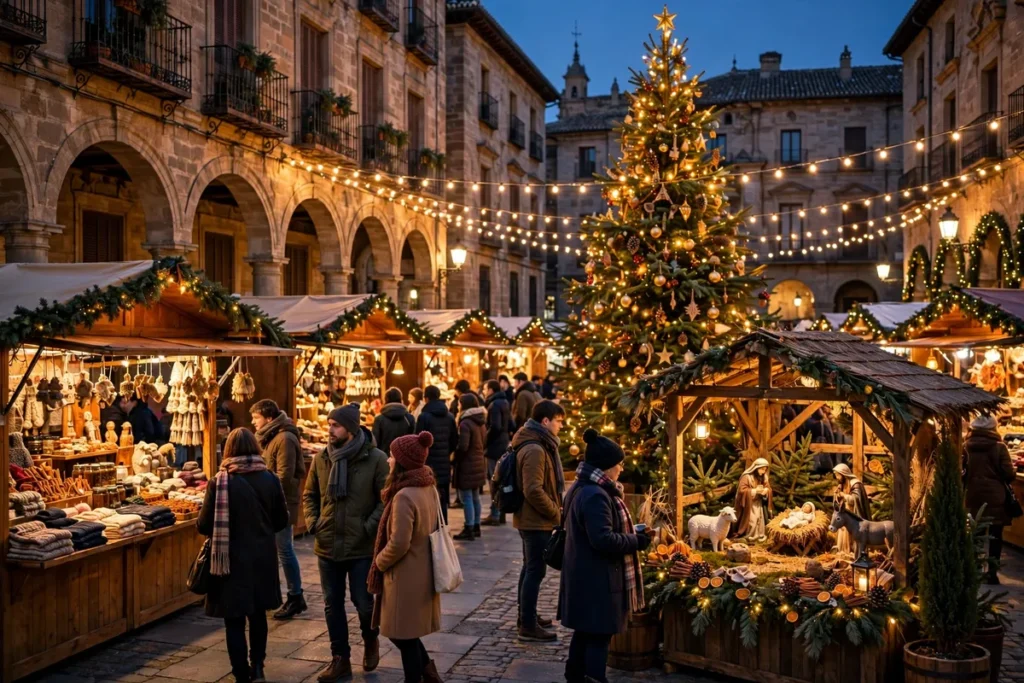
A Spanish Christmas market at night: festive stalls in a historic plaza, a towering decorated tree, and warm golden light on the cobblestones.
Watch: Christmas in Spain
A trip back to 1960s Spain — the nativity scene as the true star, the December 22nd lottery, Midnight Mass, the twelve grapes, and the magical night of the Three Kings.
At a Glance: Christmas in Spain
The long Spanish season, 22 December to 6 January.
| Tradition | Date | Key detail |
|---|---|---|
| El Gordo | 22 December | The world’s oldest lottery draw — all of Spain holds its breath as the golden balls roll |
| Nochebuena | 24 December | The great family dinner — followed by Misa del Gallo and hot chocolate with churros |
| Belén | December | The nativity scene outranks the tree — elaborate belenes fill churches and town squares |
| Día de los Inocentes | 28 December | Spain’s answer to April Fools — pranks and practical jokes nationwide |
| Twelve grapes | 31 December | One grape per midnight chime, eaten to the Puerta del Sol bells — luck for every month |
| Cabalgata de Reyes | 5 January | The Three Kings parade — floats, candy showers and the camels’ arrival at night |
| Roscón de Reyes | 6 January | The kings’ ring cake — the hidden figurine decides who wears the paper crown |
Frequently Asked Questions
What is El Gordo?
El Gordo (“The Fat One”) is Spain’s extraordinary Christmas lottery draw, held every December 22 — the world’s largest lottery by total prize money. Schoolchildren sing the winning numbers in a televised hours-long ceremony, and the draw unofficially opens Spain’s Christmas season.
Why do Spaniards eat twelve grapes on New Year’s Eve?
Eating twelve grapes — one per clock chime at midnight — is Spain’s Nochevieja tradition for luck in each month of the new year. Centered on Madrid’s Puerta del Sol clock, the custom dates to the early 1900s and is now observed by virtually the entire country.
When do Spanish children get Christmas gifts?
Traditionally on Three Kings Day (January 6), when the Reyes Magos leave gifts in children’s shoes overnight on January 5. Many families now also exchange gifts on December 25 with Papá Noel — a double gift season.
What is a Roscón de Reyes?
The Roscón de Reyes is the Three Kings ring cake eaten around January 6: brioche decorated with candied fruit, hiding a small figurine (finder is crowned king) and a dried bean (finder pays for the cake).
What is the Caga Tió?
Catalonia’s Caga Tió (“pooping log”) is a hollow log with a painted face that children “feed” through December, then beat with sticks on Christmas Eve while singing, until it produces candy and gifts. It is a beloved, ancient folk custom.
What is Midnight Mass called in Spain?
La Misa del Gallo — “the Rooster’s Mass” — traditionally held at midnight on Christmas Eve, after which families return home for sweets, cava, and celebration into the small hours.
Christmas traditions in Spain refuse the standard European script: the season opens with a lottery, peaks with grapes at midnight, and saves its biggest morning for the Kings. It is Christmas at Spanish hours — late, loud, sweet, and shared, from the first sung lottery number on December 22 to the last crumb of roscón on January 6. ¡Feliz Navidad y próspero Año Nuevo!