Christmas traditions in Lebanon blend French elegance, Middle Eastern warmth, and mountain-village charm into a celebration unlike any other. In this small Mediterranean country — where Christians and Muslims have shared the land for centuries — Christmas is a national season: streets glow with decorations, mountain towns disappear under snow, families gather for legendary Christmas lunches, and midnight Mass fills ancient stone churches with candlelight and song. It is Christmas with a Lebanese soul: generous, beautiful, and deeply family-centered.
What makes Christmas traditions in Lebanon so distinctive is their layered heritage. The French Mandate era left a love of the bûche de Noël and the réveillon feast; the Maronite, Greek Orthodox, and Melkite churches anchor the season in ancient liturgy; and Lebanese family culture — with its legendary hospitality and its insistence that no one eats alone — gives the holiday its beating heart. From the snow-dusted cedars to the glowing streets of Beirut, here are the traditions that define a Lebanese Christmas.
1. The Christmas Lunch: The Heart of the Holiday
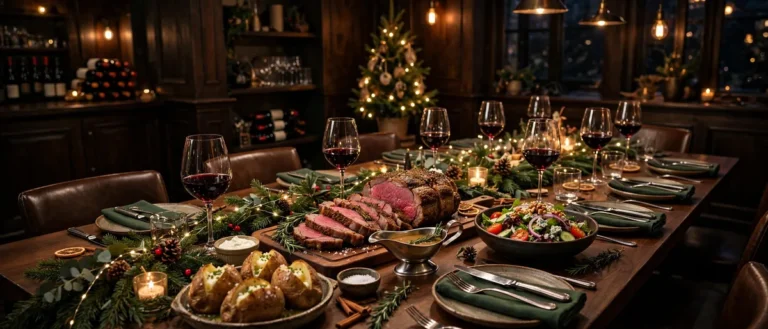
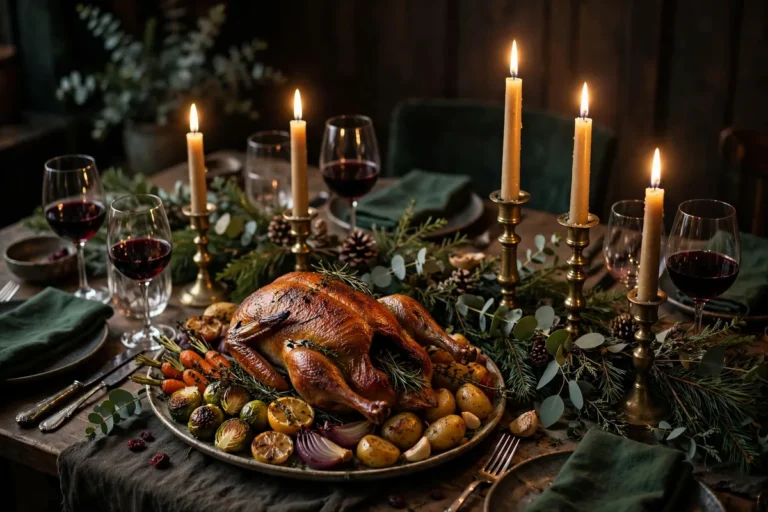
In Lebanon, the main Christmas celebration is not Christmas Eve dinner but the Christmas Day lunch — a lavish, multi-hour family feast that is the social centerpiece of the season. Extended families gather at the grandparents’ house (or the largest available home), and the table groans under the weight of the spread: roast turkey (dinde) or chicken, mezze platters of hummus, tabbouleh, and kibbeh, rice dishes, salads, and an array of Lebanese specialties.
The lunch unfolds leisurely over hours, with conversation, laughter, and multiple rounds of food. It’s common for the gathering to include three generations, with cousins, aunts, uncles, and in-laws all seated together. The Christmas lunch is less a meal than a reaffirmation: of family bonds, of Lebanese identity, of the love that holds the diaspora-connected clan together. For many Lebanese, this single meal is the emotional high point of the entire year.
2. Midnight Mass in Ancient Stone Churches
Christmas Eve midnight Mass is a cornerstone of Christmas traditions in Lebanon. Maronite Catholics — the largest Christian community — celebrate the liturgy in Syriac and Arabic, in churches that are often centuries old, their stone walls glowing with candles. Greek Orthodox and Melkite communities hold their own beautiful services, and the sound of ancient hymns in hillside villages is unforgettable.
The pilgrimage church of Our Lady of Lebanon at Harissa — the great Marian shrine overlooking the Bay of Jounieh — draws thousands for Christmas Masses, its hilltop glowing with lights visible for miles. In mountain villages, the walk to midnight Mass through crisp, possibly snowy air, the church bells ringing across the valley, is one of the season’s most atmospheric experiences.
3. The Crèche: Lebanon’s Beloved Nativity Scenes
The nativity scene — la crèche — holds pride of place in Lebanese homes, and families devote real artistry to it. Lebanese crèches are often elaborate affairs: multi-level landscapes with mountains, rivers, and villages, populated by dozens of figurines. Some families build them into elaborate grotto-like structures, and the tradition of the santons (hand-painted Provençal-style figurines, a French legacy) remains popular.
Public nativity scenes are equally impressive. Town squares, churches, and shopping districts compete with life-sized crèches, some with live animals. The care lavished on these scenes — rebuilt and expanded year after year, with children given charge of arranging the figures — reflects how seriously Lebanese Christians take the story at the heart of the season.
4. Bûche de Noël and the French Sweet Legacy
The French influence on Christmas traditions in Lebanon shines brightest in dessert. The bûche de Noël — the chocolate yule-log cake — is the essential Christmas sweet, ordered from the country’s excellent pâtisseries or made at home. Beirut’s French-style bakeries produce them by the thousand in December, in flavors from classic chocolate to chestnut, pistachio, and rose.
Alongside the bûche come petits fours, marrons glacés (candied chestnuts), and chocolate truffles. Lebanese pâtisserie — already world-class — outdoes itself at Christmas, and the dessert table at the Christmas lunch is a spectacle. This French sweet heritage connects Lebanon to the broader Francophone Christmas world; for the old-country roots of the réveillon feast, see our guide to the French Christmas dinner (réveillon) menu.
5. Papa Noël and Gift-Giving
Lebanese children receive their Christmas gifts from Papa Noël — the French legacy again — with presents exchanged on Christmas morning or after the Christmas lunch. Gift-giving emphasizes family: new clothes, toys for children, and thoughtful presents for adults. The tradition of the étrennes (New Year’s gifts) also persists in some families.
What distinguishes Lebanese gift-giving is its generosity of spirit: the season demands that no child in the extended family — and ideally, no child in the neighborhood — goes without. Churches and charities organize Christmas gift drives, and the Lebanese diaspora famously ships gifts home by the container-load. For inspiration, our best Christmas gifts guide has ideas for every budget.
6. Snow in the Mountains: A White Lebanese Christmas
One of Lebanon’s great Christmas secrets is that a white Christmas is entirely possible — in the mountains. Villages like Faraya, Bcharre, and the Cedars see regular December snow, and Lebanese families traditionally head to the mountains for a snowy Christmas experience: skiing by day, fireside gatherings by night. The image of snow-dusted cedars — the biblical Cedars of God at Bcharre, a UNESCO site — hung with Christmas lights is pure magic.
This mountain Christmas is a point of national pride: Lebanon is one of the few Middle Eastern countries where you can ski in the morning and swim in the Mediterranean in the afternoon (or so the famous saying goes). For city-dwelling Beirutis, a Christmas trip to the mountains — to see snow, visit family villages, and breathe the cedar air — is a beloved seasonal ritual.
7. Beirut’s Christmas Lights and Decorations
Downtown Beirut, the Zaitunay Bay waterfront, and the city’s shopping districts traditionally blaze with Christmas decorations — towering trees, light displays, and festive markets. In good years, Beirut’s Christmas lighting rivals any Mediterranean capital, and the city’s café culture means the season is celebrated outdoors, over coffee and sweets, in the mild winter weather.
It’s worth noting honestly that Lebanon has faced severe economic challenges in recent years, and the scale of public celebrations has varied with the country’s fortunes. Yet the Lebanese have a remarkable habit of celebrating anyway — Christmas lights appear even in hard years, strung with defiant joy. The decorations may be humbler, but the spirit, by all accounts, burns as bright as ever.
8. Byblos and the Christmas Villages
The ancient coastal city of Byblos (Jbeil) — one of the oldest continuously inhabited cities in the world — hosts one of Lebanon’s most charming Christmas celebrations, with its old souks and harbor dressed in lights and its Christmas market drawing visitors from across the country. Other towns mount their own Christmas villages: Batroun, Jounieh, and the mountain towns each add their flavor.
These Christmas villages blend the European market tradition with Lebanese hospitality: artisan crafts, local foods, mulled wine (or its Lebanese equivalents), and live music. For families, they’re a December weekend staple — an outing that combines shopping, dining, and the simple pleasure of strolling through lights with hot chocolate in hand.
9. The Réveillon: Christmas Eve Dinner
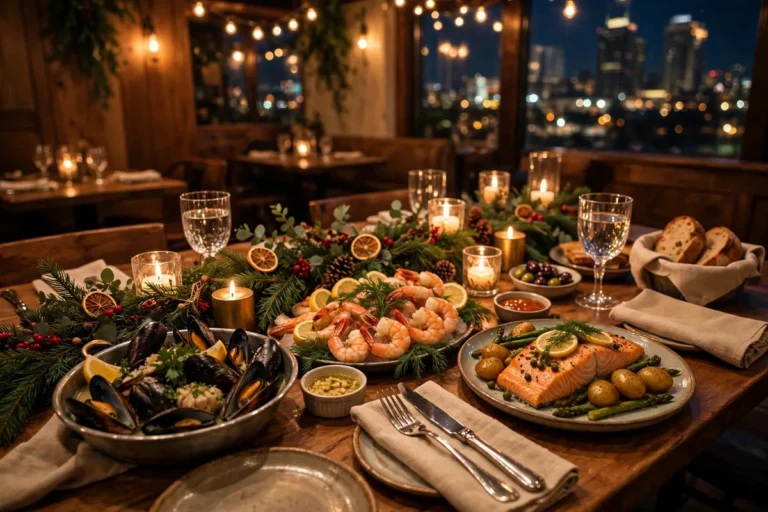
While Christmas lunch is the main event, Christmas Eve — le réveillon — has its own traditions. Many families share a festive Eve dinner before or after midnight Mass: lighter than the Christmas lunch but still celebratory, featuring seafood, mezze, and the first taste of the season’s sweets. In some families, the réveillon is when gifts are exchanged, building anticipation for the next day’s feast.
The Eve dinner reflects the French influence once more — the very word réveillon comes from the French Christmas tradition — adapted to Lebanese tastes and ingredients. Fresh fish from the Mediterranean, Lebanese wines from the Bekaa Valley, and French-style pastries: it’s a delicious synthesis.
10. Caroling and Christmas Music
Christmas music in Lebanon spans Arabic carols, French chants de Noël, and the ancient hymns of the Maronite and Orthodox liturgies. Church choirs perform Christmas concerts in the weeks before the holiday — beloved community events — and caroling groups visit homes and hospitals. Arabic Christmas songs, some composed by Lebanon’s great musicians, are as essential to the season as any Western carol.
The legendary Lebanese diva Fairuz — whose Christmas songs are national treasures — provides the season’s most beloved soundtrack. Her renditions of Christmas hymns and carols play in every Lebanese home in December, and for the diaspora, hearing Fairuz sing Christmas is the sound of home itself.
11. New Year’s Eve: The Season’s Second Celebration
Lebanese New Year’s Eve is nearly as grand as Christmas, with its own late-night feasts, parties, and midnight celebrations. Restaurants and hotels host gala dinners; families gather for festive meals; and at midnight, fireworks light up the coast. The traditional New Year’s lunch on January 1st mirrors the Christmas lunch in abundance — because in Lebanon, no major holiday passes without a legendary family meal.
Many Lebanese also observe the Armenian Christmas (January 6th) and Orthodox Christmas (January 7th) in solidarity with those communities — Beirut’s diversity means the season’s celebrations ripple across confessions, with greetings exchanged between neighbors of all faiths.
12. The Diaspora: Christmas Shipments and Summer Visits
Lebanon has one of the world’s largest diasporas relative to its population — millions of Lebanese live in Brazil, the United States, Canada, Australia, and West Africa — and Christmas is the season of reconnection. December sees a flood of visitors returning home, Beirut’s airport swelling with families, and an equally great flood of gift shipments going the other direction.
For Lebanese abroad, recreating the Christmas lunch is sacred: the turkey, the mezze, the bûche de Noël ordered from the local Lebanese bakery (or made from a grandmother’s recipe). In São Paulo, Sydney, and Dearborn, December tastes of Beirut. And for those who return, the homecoming Christmas — snow in the mountains, Mass in the village church, lunch at the family table — is the year’s emotional center.
13. Decorating the Lebanese Home
Lebanese Christmas decorating blends European and local touches. The Christmas tree — often large and lavishly dressed — is universal, but it’s joined by the crèche, strings of lights on balconies, and poinsettias (which grow well in Lebanon’s climate). Many families display the traditional Arabic coffee set in holiday dress, and the home is prepared with the thoroughness of a culture that takes hospitality as seriously as Lebanon’s.
The pre-Christmas deep clean is a ritual in itself — the house must shine for the season’s visitors — and new linens, new curtains, and fresh paint are common. For decorating inspiration that works in any home, our Christmas decoration ideas offer styles from classic to contemporary.
14. A Season of Giving: Charity at Christmas
Charity is woven into Christmas traditions in Lebanon. Churches organize Christmas food distributions; charities run toy drives for disadvantaged children; and the tradition of the “Christmas box” — food parcels delivered to poor families — is observed across communities. In a country that has endured economic collapse, this giving has taken on profound importance: Christmas charity in Lebanon is not decorative but essential, keeping the feast’s promise alive for those who need it most.
This spirit of giving — extended across confessional lines, with Muslim charities and individuals often participating in Christmas giving and Christians reciprocating at Eid — is one of Lebanon’s most beautiful traditions. It reflects the season’s deepest meaning: that Christmas is for everyone, and that no one should be left out of its joy.
The Village Christmas: Bcharre, Ehden, and Mountain Traditions
For the most atmospheric of Christmas traditions in Lebanon, head to the mountains. Villages like Bcharre (birthplace of Khalil Gibran, gateway to the Cedars), Ehden, and Faraya celebrate Christmas with a magic the cities can’t match: snow on stone roofs, woodsmoke in the air, church bells echoing across white valleys, and nativity scenes set against real winter landscapes.
The mountain Christmas follows old rhythms. Families return to ancestral village homes; the Christmas lunch features mountain specialties — hearty stews, preserved meats, and local wines; and evenings are spent around the fireplace with storytelling and card games. The midnight Mass in a mountain church, with the congregation in heavy coats and the hymns rising into the cold night air, is an experience of extraordinary beauty. Many Beirut families keep a village house precisely for these seasonal returns, and the Christmas migration to the mountains is one of Lebanon’s great annual movements.
Lebanese Christmas Drinks: Bekaa Wines and Festive Toasts
The Christmas table in Lebanon is a showcase for the country’s wines. The Bekaa Valley — one of the world’s oldest wine regions — produces excellent reds, whites, and rosés that anchor the Christmas lunch, and Lebanese families take pride in serving local vintages. Château Musar, the country’s most famous winery, is a particular point of pride, its aged reds saved for special occasions.
Arak — the anise-flavored spirit that is Lebanon’s national drink — appears at festive gatherings, served the traditional way with water and ice, alongside mezze. For the Christmas toast, champagne or sparkling wine is common, and hot drinks — sahlab (the warm orchid-root drink), hot chocolate, and spiced teas — warm the mountain evenings. The drinking culture is convivial and food-centered: wine as accompaniment to the feast, toasts to family, and long, unhurried enjoyment.
The Religious Mosaic: A Season Shared Across Communities
One of the most remarkable aspects of Christmas traditions in Lebanon is how the season crosses communal lines. Lebanon’s 18 officially recognized religious communities include Maronite, Greek Orthodox, Melkite, Armenian, and Protestant Christians alongside Sunni, Shia, and Druze Muslims — and Christmas, while a Christian feast, is widely treated as a national season of goodwill.
Muslim neighbors commonly exchange Christmas greetings with Christian friends; mixed neighborhoods share in the decorations and the festive atmosphere; and the season’s charitable giving crosses all lines. The Armenian community’s Christmas on January 6th and the Orthodox Christmas on January 7th extend the celebrations, with greetings flowing between communities. In a region often defined by division, Lebanon’s shared Christmas season — imperfect, but real — is a quiet testament to coexistence. The lights of Beirut at Christmas belong to everyone.
Visiting Lebanon at Christmas: A Traveler’s Guide
Experiencing Christmas traditions in Lebanon firsthand is magical — and the country’s compact size means you can combine coast, city, and snowy mountains in a single trip. Base yourself in Beirut for the lights, dining, and nightlife; day-trip to Byblos for its Christmas market and ancient harbor; and head to the mountains (Faraya or Bcharre) for snow and village atmosphere. The Cedars of God — the ancient cedar forest above Bcharre — dusted with snow and hung with lights, is unforgettable.
Practical notes: December weather is mild on the coast (15-20°C) and cold in the mountains (often below freezing, with snow). Book mountain accommodation early — Christmas-New Year is peak season. Roads to the mountains can require snow chains; check conditions. Beirut’s restaurant scene is superb in December, with special Christmas menus everywhere — reserve ahead. And be aware of the country’s economic situation: carry cash (US dollars widely accepted), and check current travel advisories before planning. For more remarkable holiday destinations, see our best places to spend Christmas.
Christmas Morning: Church, Coffee, and Family Visits
Christmas morning in Lebanon begins — for the devout — with Mass, as churches hold Christmas Day services filled with the season’s joy. Then comes the great visiting: families make the rounds of relatives’ homes, each visit marked by Arabic coffee, Christmas sweets, and the exchange of news and gifts. Children, in new clothes, are fussed over by every aunt and grandmother; the men gather for conversation and arak or wine; the women compare notes on the lunch preparations.
These morning visits are the social fabric of the Lebanese Christmas — a rolling celebration that moves from house to house, building toward the great lunch. By the time the family finally sits down together, the day already feels complete: a morning of love, laughter, and community, crowned by the feast. It’s a rhythm that captures everything beautiful about Christmas traditions in Lebanon — faith, family, food, and the Lebanese genius for turning every gathering into a celebration.
In Pictures: Christmas in Lebanon
Lebanon blends midnight mass in stone churches with French bûche, beloved nativity scenes, and snow in the mountains.

A Lebanese mountain village at Christmas dusk: the ancient stone church dusted with snow, warm lights in the square, and cedar-covered hills behind.
Watch: Christmas in Lebanon
A tour of Beirut’s Christmas — the mall tree lightings, Downtown’s festive stalls, and the lights, food and traditions of Lebanon’s capital.
At a Glance: Christmas in Lebanon
The customs at the heart of a Lebanese Christmas.
| Tradition | Date | Key detail |
|---|---|---|
| Midnight mass | 24 December | Families walk to ancient stone churches when the bells ring at midnight, dressed in their finest |
| The seed planting | About 2 weeks before | Wheat, chickpea and lentil seeds are sprouted in cotton wool and placed around the nativity manger |
| The crèche | December | Beloved nativity scenes in homes and public squares — the baby Jesus is only placed in the crib on Christmas Eve |
| Christmas lunch | 25 December | The holiday’s most important meal — turkey, kibbeh, tabbouleh and mezze at the grandparents’ house |
| Bûche de Noël & meghli | December | The French Yule log shares the table with meghli, the caraway rice-flour pudding made for newborns — and for Jesus |
| Papa Noël | 24–25 December | Papa Noël brings the gifts — often a family member in costume — with sugared almonds for Christmas morning visitors |
| Byblos & mountain snow | December | Byblos’s famous tree-lighting ceremony; snow in the mountains gives Lebanon a white Christmas |
Frequently Asked Questions
When do Lebanese celebrate Christmas?
Lebanon’s Catholic and Protestant communities celebrate Christmas on December 25th, with the Christmas Day lunch as the main event and midnight Mass on Christmas Eve. The country’s Armenian and Orthodox communities observe Christmas on January 6th-7th, extending the festive season.
What do Lebanese eat at Christmas?
The centerpiece is the Christmas Day lunch: roast turkey or chicken, extensive mezze (hummus, tabbouleh, kibbeh), rice dishes, salads, and Lebanese specialties. Dessert features the bûche de Noël (yule-log cake), petits fours, and festive pastries — reflecting Lebanon’s French pâtisserie heritage.
Does it snow in Lebanon at Christmas?
Yes — Lebanon’s mountain regions (Faraya, Bcharre, the Cedars) regularly see December snow, and a white Christmas in the mountains is a beloved Lebanese tradition. The coast (Beirut, Byblos) enjoys mild Mediterranean winter weather, making Lebanon one of the few places where you can ski and sightsee ancient ruins in the same Christmas week.
Who brings gifts at Christmas in Lebanon?
Papa Noël (Father Christmas) brings gifts to Lebanese children — a legacy of French influence — with presents typically exchanged on Christmas morning or after the Christmas lunch. The season also emphasizes charitable giving, with churches and organizations distributing food and toys to disadvantaged families.
What is special about Christmas in Beirut?
Beirut’s Christmas blends Mediterranean café culture with festive lights: downtown districts and the waterfront glow with decorations, outdoor dining continues in the mild winter, and the city’s French-style pâtisseries produce spectacular bûches de Noël. The city’s diversity means Christmas is celebrated across communities, with a shared festive atmosphere.
How does the Lebanese diaspora celebrate Christmas?
Lebanon’s vast diaspora recreates the Christmas lunch faithfully — turkey, mezze, bûche de Noël — wherever they are, and December brings a great homecoming as thousands return to Lebanon. For those abroad, Fairuz’s Christmas songs, the family recipes, and video calls home keep the traditions alive across the distance.