Christmas traditions in Denmark are the world-famous home of hygge — that untranslatable Danish art of coziness, warmth, and contentment — and December is when hygge reaches its absolute peak. Danes consistently rank among the world’s happiest people, and many credit their mastery of winter: when the days shrink to seven hours of pale light, Denmark responds with candles (Danes burn more candles per capita than any other nation), communal singing, elaborate Advent rituals, and a Christmas Eve celebration so cherished that the entire country essentially pauses for it. This guide is structured as a practical how-to: seven steps that walk you through celebrating Christmas the Danish way, from building your Advent rituals to dancing around the tree on juleaften. Whether you are Danish by heritage, planning a December trip to Copenhagen, or simply want to borrow the world’s coziest Christmas playbook, these are the traditions to know.
What Makes Danish Christmas Different
To follow the Christmas traditions of Denmark, you first need to grasp what sets them apart from the rest of Europe. Three things define the Danish jul. First, hygge as a discipline: coziness is not an accident in Denmark but a practice — candles lit at dusk, the good china brought out, phones put away, time deliberately made for togetherness. Second, Christmas Eve as the undisputed center: like its Scandinavian neighbors, Denmark celebrates on December 24, and the evening follows a beloved, near-universal script. Third, a calendar stuffed with small rituals: Advent in Denmark is not a quiet countdown but a daily practice of treats, songs, television, and candle-lighting that makes the whole month feel festive.
Denmark’s Christmas is also notably democratic in its joys. The traditions are not about extravagance but about repetition and participation: the same cookies baked every year, the same carols sung around the same tree, the same rice pudding dessert with its almond game. This how-to guide follows that spirit — practical, warm, and built around doing rather than buying. For the Scandinavian context, compare with our guides to Christmas traditions in Sweden and Christmas traditions in Norway, Denmark’s closest holiday cousins.
Step 1: Build Your Advent Calendar Ritual
Every Danish Christmas begins with the countdown, and Denmark takes Advent calendars to an art form. Start here:
The candle calendar. The julekalenderlys — a tall, dated candle marked with the numbers 1 through 24 — is a fixture in Danish homes. Each day of December, the family burns the candle down to the next number, often at breakfast or dinner. It is a small daily ceremony that gives December its rhythm, and children take the candle-burning duty very seriously.
The gift calendar. Danish children typically receive a julekalender of small gifts or chocolates, one to open each morning — and many adults keep the habit too, with calendars of beer, tea, or beauty products. The key Danish principle: the calendar is opened together, at a set moment, never rushed.
The television calendar. Like Sweden, Denmark has a beloved televised Christmas calendar series — DR’s annual julekalender, a 24-episode December drama for children that has run in various forms since the 1960s. Watching the daily episode is a national ritual, discussed at school and work the next day. If you are learning Danish, December episodes are a delightful (if challenging) immersion.
December 1st proper. Danes mark the start of December deliberately: the first candle-calendar lighting, the first calendar gift, often the first batch of Christmas baking. Do not let December sneak up on you — greet it.
Step 2: Light the Advent Wreath and Embrace Candle Culture
The Advent wreath (adventskrans) is the visual heart of the Danish December. Traditionally made of spruce with four candles — one lit on each of the four Sundays of Advent — the wreath sits on the dining table or hangs in the window, often decorated with red ribbons, dried orange slices, and small Danish flags. Making your own adventskrans from fresh greenery is a cherished pre-December activity; florists and garden centers sell kits, and families make an afternoon of it with gløgg.
Beyond the wreath, commit to the Danish candle habit. Denmark’s per-capita candle consumption is legendary — some estimates put it at around six kilos per person per year — and December is peak season. The rule is simple: as darkness falls (around 3:30–4 p.m. in December), light candles. In the windows, on the table, in the bathroom. Electric Advent candlesticks ( adventsstake) and glowing stars join the real flames. The cumulative effect, walking through a Danish residential street on a December evening, is pure magic: every window glowing warm against the blue dark.
This is also the moment to learn the Danish vocabulary of light: hyggelys (cozy light) is the goal of every Danish living room in December. Harsh overhead lighting is the enemy; pools of warm candlelight are the aim. Your electricity bill and your mood will both reflect the difference.
Step 3: Bake the Classics — Pebernødder, Klejner, and Æbleskiver
Danish Christmas baking is a serious December project, and the classics are non-negotiable. Here is your baking list:
Pebernødder (“pepper nuts”): tiny, crisp, spiced cookies flavored with cinnamon, cloves, cardamom, and a whisper of black pepper. Danes bake them by the hundreds — they are the cookie of the season, served to every guest, packed into tins as gifts, and eaten by the handful. The dough benefits from resting overnight, and the baking itself is a classic family production line.
Klejner: twisted, deep-fried pastries, crisp and golden, dusted with sugar. Klejner are old-fashioned and beloved, with a texture somewhere between a cookie and a doughnut. They keep well in tins, which is why they were historically baked in large batches for the whole season.
Æbleskiver: spherical pancake puffs cooked in a special dimpled pan, served hot with jam and powdered sugar. Technically more of a November–December treat than a Christmas Day food, æbleskiver appear at every Danish Christmas market and most December gatherings. Making them requires the special pan (æbleskivepande) and a little practice with the turning — traditionally done with a knitting needle.
Honningkage and brunkager: honey cake and dark, spiced “brown cookies” round out the traditional seven kinds of Christmas cookies that old-fashioned Danish households aimed to have ready. You do not need all seven — but pebernødder are mandatory.
For decorating inspiration to match your baking, our Christmas decoration ideas include Scandinavian styling tips that pair beautifully with a Danish December kitchen.
Step 4: Cook the Danish Christmas Dinner
The centerpiece of Christmas traditions in Denmark is the juleaften dinner on December 24, and it follows a classic formula. The traditional main course is roast duck (andesteg) or roast pork with crackling (flæskesteg) — many families serve both, because choosing is too painful. Goose appears on some tables. The roast is accompanied by boiled and caramelized potatoes (brunede kartofler — small potatoes glazed in sugar and butter, a dish that exists almost exclusively at Christmas), red cabbage (rødkål), and a rich brown gravy.
Before the main course, some families serve a starter — often a fish dish or soup — but the dinner’s emotional climax is dessert: risalamande. This is cold rice pudding folded with whipped cream, vanilla, and chopped almonds, served with warm cherry sauce (kirsebærsovs). Like its Scandinavian cousins, the Danish version hides a single whole almond in the bowl — whoever finds it wins the mandelgave (almond gift), traditionally a marzipan pig. The game is played with great ceremony and no small amount of cheating (grandparents are notorious for palming the almond to a grandchild).
Drinks follow the Nordic pattern: Christmas beer (julebryg — its early-November release, celebrated on “J-Day,” is a minor national holiday for beer lovers), snaps with the meal, and red wine. The Danish Christmas dinner is rich, unhurried, and eaten by candlelight — plan for several hours at the table.
If you are building a holiday menu with international influences, our Christmas dinner ideas collection offers dishes from dozens of countries to complement the Danish classics.
Step 5: Dance Around the Tree and Sing
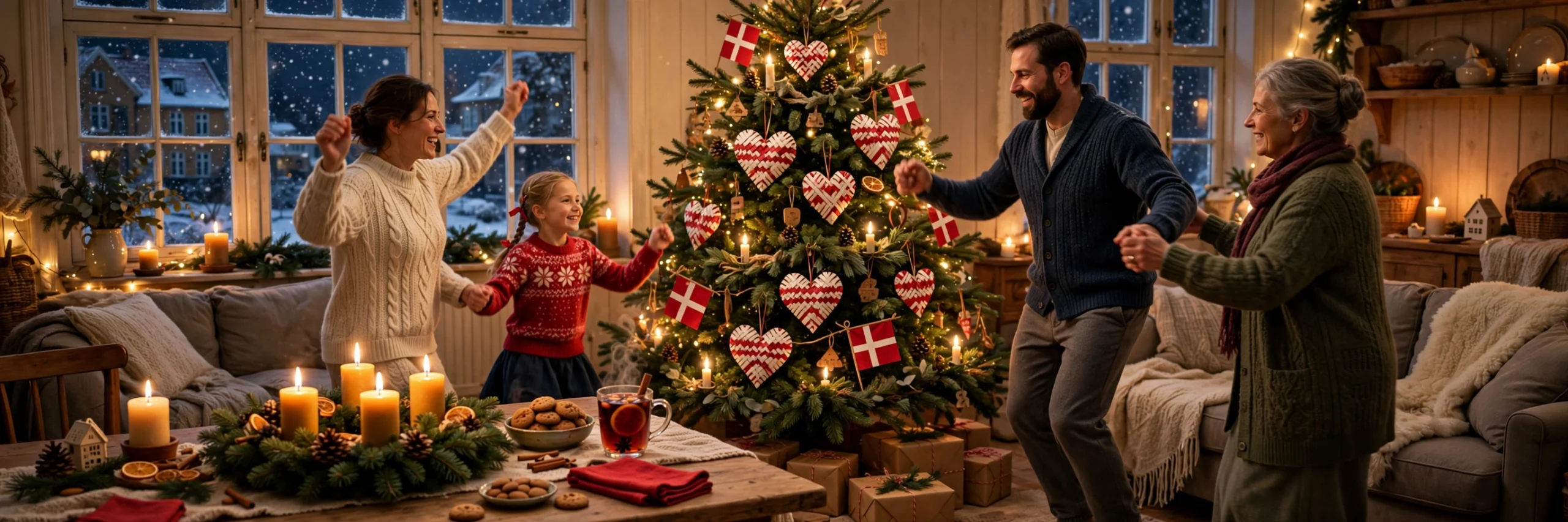
After dinner on juleaften comes one of the most joyful Christmas traditions in Denmark: the family joins hands and dances around the Christmas tree, singing carols. The Danish tree is traditionally a real spruce or fir, decorated with candles (increasingly electric for safety), Danish flags, paper hearts, and homemade ornaments — and the dancing is not a token gesture but a proper, room-circling procession through multiple songs.
The carol repertoire includes Danish classics like “Højt fra træets grønne top” (High from the Tree’s Green Top) — which narrates the tree’s own story and is sung while circling it — “Glade jul, dejlige jul” (the Danish Silent Night), and “Dejlig er den himmel blå.” Songbooks appear, harmonies are attempted, children are swung. It is gloriously unselfconscious, and it is the moment the evening tips from dinner into celebration.
The paper hearts. While dancing is the headline, the tree itself deserves attention: the woven paper heart (julehjerte), invented in its modern form by Hans Christian Andersen himself in the 1860s, is the iconic Danish ornament. Made from two interlaced strips of red and white paper forming a heart-shaped basket, julehjerter hang on every Danish tree, often filled with sweets. Learning to weave one is a rite of Danish childhood — and a lovely craft project for visitors. Our Christmas activities for families, kids, and couples includes more hands-on holiday crafts in this spirit.
Step 6: Celebrate Juleaften Like a Dane — The Full Evening Script
Here is how December 24 typically unfolds in a Danish home, so you can follow the script:
Afternoon: Final preparations. The tree — often decorated on December 23 (lillejuleaften, Little Christmas Eve) — gets its candles lit. Many families attend an afternoon church service; Danish churches are packed on juleaften, with services built around the Nativity story and beloved hymns.
Early evening: The Christmas dinner, served when everyone is gathered. Expect a long, candlelit meal with toasts and snaps songs.
After dinner: Dancing around the tree and carol singing, as described above.
Gifts: In Denmark, gifts are traditionally brought by julemanden (the Christmas man), Denmark’s Santa figure. In many families, the gifts are already under the tree, and the unwrapping follows the dancing — a reversal of the order in some other countries that makes the evening build to a crescendo.
Late evening: Dessert leftovers, coffee, and julegodter (Christmas sweets). Some attend midnight mass (midnatsgudstjeneste). The evening dissolves into hygge — conversation, candles burning low, the tree lights twinkling.
December 25 (juledag) and 26 (anden juledag) are public holidays: quiet days for family visits, long walks, and leftovers. The Danish Christmas does not end abruptly — it tapers, hyggeligt, into the new year.
Step 7: Master Danish Christmas Decor — Nisser, Hearts, and Kravlenisser
Danish Christmas decor has its own cast of characters. The nisse — Denmark’s version of the household gnome — appears everywhere in December: ceramic and wooden nisser on shelves, nisser peeking from behind curtains, nisse-themed everything. The kravlenisse (climbing nisse) is a particular Danish specialty: flat, painted paper nisser designed to be stuck climbing up walls, doorframes, and mirrors. Danish children adore them, and adults use them with surprising enthusiasm.
The color palette is classic: deep red, white, green, and gold, with natural materials — spruce, pinecones, dried oranges, cinnamon sticks — doing much of the work. Advent calendars in fabric with 24 pockets, the julekalenderlys candle, and the glowing window star complete the look. Danish Christmas decor is abundant but never gaudy; the guiding principle is that every object should earn its place by adding to the hygge.
Gift-giving note: Danes value thoughtful, often homemade gifts, and wrapping is an art — brown paper, red ribbon, a sprig of spruce. For inspiration on the giving side, our best Christmas gifts guide covers presents for everyone on your list.
Danish Christmas Markets and City Traditions: Tivoli and Beyond
No how-to on Christmas traditions in Denmark would be complete without Copenhagen’s Christmas markets — and above all, Tivoli Gardens. The historic amusement park’s Christmas season is legendary: millions of lights, market stalls in wooden huts, the smell of æbleskiver and gløgg, ice skating, and fireworks displays. It is one of Europe’s great Christmas experiences and the anchor of any December trip to Copenhagen.
Beyond Tivoli: the Christmas market at Nyhavn, with its colorful harbor houses strung with lights; the market at Kongens Nytorv; and Julemarked events at castles and manor houses across the country, where stalls sell handicrafts, smoked foods, and Christmas beer. In Aarhus, Den Gamle By (The Old Town open-air museum) stages a 19th-century Christmas complete with costumed interpreters — a living window into how Danes celebrated generations ago.
Timing tip: Danish Christmas markets typically run from mid-November through late December, with exact dates varying by venue — check official sites for 2026 schedules before planning. Markets are busiest on December weekends; weekday afternoons offer the same atmosphere with breathing room.
Common Mistakes to Avoid
A few pitfalls for the aspiring Danish Christmas practitioner:
Don’t rush December. The Danish Christmas is a slow build. Lighting every candle on day one, opening the whole calendar at once, or serving the Christmas dinner early misses the point. Savor the countdown.
Don’t skip the singing. Visitors sometimes feel shy about the dance-around-the-tree tradition. Don’t be — participation matters more than pitch. The Danes will love you for joining in.
Don’t underestimate gløgg. Danish gløgg (mulled wine with raisins, almonds, and often a shot of rum or cognac) is stronger than it tastes. Pace yourself at the Christmas market.
Don’t expect Christmas Day to be the main event. Like the rest of Scandinavia, Denmark’s celebration centers on December 24. Plan accordingly — restaurants and shops largely close on the 24th afternoon through the 26th.
Don’t buy the almond game. If a Danish grandmother “finds” the almond in her risalamande three years running, she is cheating for the grandchildren. This is tradition. Accept it.
Danish Christmas Music: Carols, Concerts, and the December Soundtrack
Music is the heartbeat of Christmas traditions in Denmark, and December has its own distinct soundtrack. The classic Danish carols — “Dejlig er den himmel blå” (Lovely Is the Blue Heaven), “Højt fra træets grønne top” (sung while dancing around the tree), “Glade jul, dejlige jul” (the Danish “Silent Night”), and “Nu tændes der stjærner” — are sung in homes, schools, and churches throughout the month. Most Danes know them by heart, harmonies included.
December is also concert season. Copenhagen’s churches — from the grand Vor Frelsers Kirke to tiny parish chapels — host candlelit Christmas concerts nightly, many of them free or low-cost. The DR Pigekoret (Danish National Girls’ Choir) and local choirs perform the beloved repertoire, and the tradition of Lucia concerts on December 13th fills churches with candlelit processions of singing children. For a visitor, an evening Christmas concert in a Danish church is one of the most atmospheric (and affordable) experiences of the season — check local listings, as popular performances sell out.
On the popular side, Danish Christmas pop — from Kim Larsen’s classics to modern releases — provides the secular soundtrack, played in shops and at parties all month. The Danish approach to Christmas music mirrors the holiday itself: communal, melodic, and meant to be sung together rather than merely heard.
New Year’s Eve the Danish Way
The Danish Christmas season flows naturally into New Year’s Eve (nytårsaften), celebrated with rituals as beloved as Christmas itself. The evening traditionally begins with the Queen’s New Year speech — broadcast at 6 p.m. and watched by the vast majority of Danes, a moment of national reflection. (With Denmark’s monarchy, the speech is a cherished institution regardless of who delivers it.)
Dinner is festive — often lobster, cod, or a grand roast — followed at midnight by champagne, fireworks, and the traditional kransekage: a tower of concentric almond-meringue rings, decorated with flags and crackers, served with champagne. Jumping off a chair at midnight (hoppe ind i det nye år — “jumping into the new year”) is the classic Danish midnight ritual, practiced with gleeful commitment across the country.
Fireworks are a massive Danish New Year’s tradition — Denmark has historically had liberal fireworks laws, and the midnight sky over Copenhagen is spectacular. Note that regulations have been tightening in recent years, with ongoing public debate about restrictions; check current local rules if you plan to participate. The Danish holiday season thus ends as it began — with light against the darkness, this time explosive.
In Pictures: Christmas in Denmark
Hygge, hand-woven paper hearts, and a dinner that ends with dancing around the tree — Danish Christmas is arguably the coziest in Europe.

A Danish Christmas living room at dusk: the tree hung with woven paper hearts and little Danish flags, advent candles glowing, and warm treats steaming on the table.
Watch: Copenhagen Denmark Magical Christmas Lights 2025 | Tivoli Gardens in 4K
Archive travel footage of Copenhagen and Tivoli Christmas lights in 2025. It shows the setting rather than current opening dates or a complete account of Danish traditions.
Video by my delicious trips. Watch on YouTube.
At a Glance: Christmas in Denmark
The rituals that make Juleaften the peak of the Danish year.
| Tradition | Date | Key detail |
|---|---|---|
| Juleaften (Christmas Eve) | 24 December | The undisputed peak of Danish Christmas, celebrated at home with the immediate family |
| Christmas dinner | 24 December evening | Roast pork (flæskesteg), roast duck or goose, with caramelized potatoes, red cabbage and brown gravy |
| Risalamande | 24 December, dessert | Cold rice pudding with hot cherry sauce; a whole almond is hidden inside — the finder wins the mandelgave, traditionally a marzipan pig |
| Dancing around the tree | 24 December, after dinner | The family joins hands and circles the juletræ, singing carols like “Nu er det jul igen” before opening presents |
| Lillejuleaften | 23 December | “Little Yule Eve” — families eat risengrød (rice porridge), and leftovers may become the next day’s risalamande |
| Church on Christmas Eve | 24 December afternoon | The Christmas Eve service, focused on Luke 2, is the most heavily attended church service of the year in Denmark |
| Nisser and the julenisse | December | Mischievous household elves of folklore; the julenisse is left a bowl of risengrød with extra butter on Christmas Eve |
Frequently Asked Questions
What is hygge and how does it relate to Danish Christmas?
Hygge is the Danish concept of coziness, warmth, and contented togetherness — and Christmas is its peak season. Danish Christmas traditions like candlelight, communal singing, long family dinners, and Advent rituals are essentially hygge in its most concentrated form. Many Danes say December is when they feel most Danish.
Do Danes celebrate Christmas on December 24 or 25?
Danes celebrate primarily on December 24 (juleaften), with the Christmas dinner, dancing around the tree, and gift-giving all happening on Christmas Eve. December 25 and 26 are public holidays for rest and family visits.
What do Danes eat for Christmas dinner?
The traditional Danish Christmas dinner is roast duck (andesteg) and/or roast pork with crackling (flæskesteg), served with caramelized potatoes, red cabbage, and gravy. Dessert is risalamande — cold rice pudding with whipped cream, almonds, and warm cherry sauce, featuring the hidden-almond game.
What are pebernødder?
Pebernødder (“pepper nuts”) are small, crisp Danish Christmas cookies spiced with cinnamon, cloves, cardamom, and black pepper. They are the quintessential Danish Christmas cookie, baked in huge quantities every December and served to every guest.
What is a julehjerte?
A julehjerte is a woven paper heart ornament, made from two interlaced strips of paper (traditionally red and white) forming a heart-shaped basket. The design was popularized by Hans Christian Andersen in the 1860s, and julehjerter hang on virtually every Danish Christmas tree.
When do Danish Christmas markets run?
Danish Christmas markets, including the famous Christmas season at Copenhagen’s Tivoli Gardens, typically run from mid-November through late December. Exact dates vary by venue each year, so check official websites for current schedules before visiting.
Christmas traditions in Denmark are, at their core, a masterclass in making darkness delightful. Light the candles, learn the carols, bake the pebernødder, and give December the slow, warm, communal attention the Danes insist it deserves. Glædelig jul — Merry Christmas, the Danish way.