Christmas traditions in Canada are a study in beautiful extremes: the country that does winter best does Christmas biggest. From Newfoundland’s mummering traditions to Quebec’s Réveillon, from Ontario’s small-town Santa Claus parades to the Prairies’ Ukrainian Christmas feasts and British Columbia’s Festival of Lights, Canada layers British, French, Indigenous, and immigrant customs over a landscape built for the holiday — snow, ice, and long dark nights made for candles and gathering.
This guide tours Canada province by province, covering the national customs (the parade, the tourtière, the polar bear dip) and the regional traditions that make Canadian Christmas unlike any other. Joyeux Noël and Merry Christmas — bundle up.
Christmas Traditions in Canada: The National Customs Everyone Shares
Several Christmas traditions in Canada are genuinely national. The Santa Claus Parade — Toronto’s, running since 1905, is one of the world’s oldest and largest, broadcast nationally — kicks off the season in mid-November in cities across the country. Christmas trees are a point of pride: Canada is one of the world’s great Christmas-tree producers (Nova Scotia’s balsam firs are exported worldwide), and the national Christmas tree on Parliament Hill in Ottawa is lit in early December.
Boxing Day (December 26) is a holiday across much of Canada, with the sales, the hockey, and the leftovers. New Year’s Eve brings fireworks in every major city — Niagara Falls’ display over the falls is spectacular. And December 25 itself is the family day nationwide: gifts in the morning, the big dinner in the afternoon or evening, and — in many households — the Christmas stockings hung by the chimney with care, North American style.
Quebec: Réveillon, Tourtière, and French-Canadian Christmas
Quebec keeps the most distinctive Christmas traditions in Canada — a direct inheritance from France. The Réveillon (Christmas Eve feast, from the French tradition) is the centerpiece: after Midnight Mass, families sit down to tourtière (the spiced meat pie — pork, sometimes game — that is Quebec’s defining Christmas dish), ragoût de boulettes (meatball stew), cretons, and bûche de Noël for dessert. The table groans; the night runs long.
Quebec City’s German Christmas Market (Marché de Noël allemand) in the old town is among North America’s most atmospheric, and the city’s winter carnival spirit starts early. La Fête des Neiges traditions, the bonhomme imagery, and the chansons de Noël in French complete the picture. New Year’s Eve (le Jour de l’An) is huge in Quebec — historically bigger than Christmas itself, with the Guignolée (a traditional begging-collection for the poor, now a major food-bank drive) and la tournée (visiting rounds) on New Year’s Day. Our Christmas traditions in France guide covers the Réveillon’s Old World roots.
Ontario: Parades, Small Towns, and the Capital’s Lights
Ontario sets the English-Canadian template. Toronto’s Santa Claus Parade (mid-November) is the season’s official start, drawing hundreds of thousands. Ottawa’s Christmas Lights Across Canada illuminates Parliament Hill and landmarks nationwide. The Distillery District’s Christmas Market (Toronto) is a beloved December destination.
Small-town Ontario keeps the Victorian Christmas alive: Niagara-on-the-Lake’s Dickensian decorations, Elora’s small-town charm, and the Festival of Lights in Niagara Falls. The Ontario table: roast turkey with all the trimmings (inherited from Britain — see our traditional British Christmas dinner), butter tarts (the great Ontario dessert debate: with or without raisins?), and Nanaimo bars (technically BC’s, adopted nationally).
The Atlantic Provinces: Mummering, Kitchen Parties, and the Sea
Newfoundland and Labrador keeps Canada’s oldest and strangest Christmas custom: mummering — costumed revelers (faces hidden, often in outlandish disguise) going door to door between Christmas and January 6, performing and demanding hospitality. The host must guess each mummer’s identity; the mummers dance, play music, and drink. The tradition, rooted in English and Irish mumming, was once so rowdy it was briefly outlawed — today it’s celebrated, with the Mummers Festival in St. John’s reviving it joyfully.
The Atlantic Christmas also means the kitchen party — impromptu gatherings with fiddles, accordions, and step-dancing — and the Christmas Day swim (polar bear dips are a coast-to-coast tradition, but the Atlantic takes it seriously). Nova Scotia, the balsam-fir capital, sends Boston its annual Christmas tree — a thank-you for the city’s aid after the 1917 Halifax Explosion — lit on Boston Common every year. The Maritime lobster supper and fish chowder appear on many Atlantic Christmas tables alongside the turkey.
The Prairies: Ukrainian Christmas and Twelve Meatless Dishes
The Prairies (Manitoba, Saskatchewan, Alberta) hold Canada’s great Eastern European Christmas traditions, brought by Ukrainian immigrants. Ukrainian Christmas Eve (Sviata Vecheria, January 6 on the Julian calendar — though many families celebrate December 24 too) centers on twelve meatless dishes: kutia (wheat-berry pudding with honey and poppy seeds), varenyky (perogies), holubtsi (cabbage rolls), baba (Easter-like bread), pickled herring, and uzvar (dried-fruit compote). Hay under the tablecloth recalls the manger; the first star in the sky signals dinner can begin.
The Prairies also do winter at its most serious: Winnipeg’s deep-freeze Christmases, Edmonton’s Candy Cane Lane (a whole street of synchronized lights), and Calgary’s Zoolights. The cold is not a bug but a feature — skating, tobogganing, and ice festivals are the season’s outdoor life.
British Columbia: Lights, Rain, and Pacific Christmas
BC‘s Christmas is the mildest in Canada — Vancouver’s December is rainy rather than snowy, and the traditions adapt. The VanDusen Festival of Lights and Capilano Suspension Bridge’s Canyon Lights are the great illumination events; the Vancouver Christmas Market brings German style to the Pacific. Nanaimo bars (the chocolate-coconut-custard squares named for the Vancouver Island city) are BC’s gift to the national dessert table.
The polar bear swim tradition is strongest here — Vancouver’s Polar Bear Swim in English Bay on New Year’s Day (running since 1920) draws thousands of costumed plungers. And BC’s ski-country Christmas (Whistler’s snowy celebrations) offers the alpine alternative for those who want the full snow globe.
The North: Christmas Under the Northern Lights
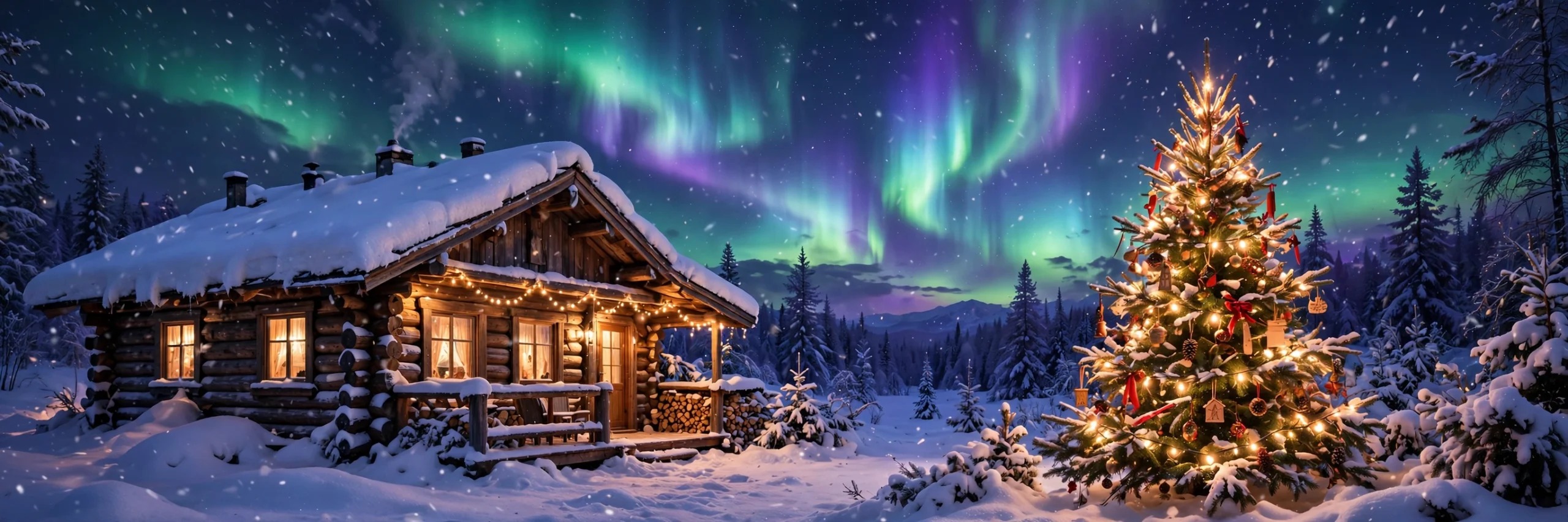
Canada’s Territories (Yukon, Northwest Territories, Nunavut) celebrate Christmas in near-total darkness — and make it magical. Yellowknife and Whitehorse host winter festivals; Inuit and First Nations communities blend Christmas with traditional winter gatherings, feasts of country food, and drum dancing. The northern lights (aurora borealis) are the season’s great natural spectacle — Christmas under the aurora, in -30°C, is the most extreme and unforgettable Christmas in the country. Dog sledding, ice roads, and community feasts complete a Christmas unlike any other on Earth.
The Canadian Christmas Table: Tourtière to Butter Tarts
The national Christmas menu is a fusion map: roast turkey with stuffing (the English-Canadian default), tourtière (Quebec), ragout, butter tarts (Ontario), Nanaimo bars (BC), lobster and seafood (Atlantic), Ukrainian twelve-dish supper (Prairies), salmon and Pacific seafood (BC), and maple everything — maple-glazed ham, maple pie, maple candy. The Christmas cracker survives from Britain; eggnog (with rum, properly) is the season’s drink; and ice wine (Ontario and BC’s great winter wine) is the connoisseur’s pour. For broader holiday menu ideas, our Christmas dinner ideas roundup spans traditions.
Hockey, Skating, and the Outdoor Christmas
Winter is the Canadian Christmas venue. The outdoor rink — backyard, neighborhood, or the Rideau Canal in Ottawa (the world’s largest skating rink when frozen) — is where December happens. Shinny (pickup hockey) on Christmas morning is a national ritual; the World Junior Hockey Championship (starting December 26) is appointment television; and the NHL’s holiday break structures the sports calendar.
Beyond hockey: tobogganing, cross-country skiing, snowshoeing, and the great tradition of the Christmas Day walk (inherited from Britain, upgraded with better snow). The cold is embraced — the saying goes there’s no bad weather, only bad clothing — and the season’s outdoor life is the envy of warmer countries.
Multicultural Christmas: The New Traditions
Modern Canada’s immigration has layered new customs onto the season: Filipino Simbang Gabi Masses in Toronto and Vancouver (see our Christmas traditions in the Philippines), Italian Feast of the Seven Fishes dinners, Chinese-Canadian Christmas banquets, South Asian fusion feasts, and Caribbean Christmas parties with sorrel drink and black cake. The Toronto Christmas Market and similar festivals now reflect this diversity — and the “Canadian Christmas” is increasingly a mosaic, which suits the country perfectly. In many households, the December table now holds tourtière and perogies and spring rolls — the edible map of modern Canada.
Greetings and the Bilingual Season
Canada’s Christmas is officially bilingual: “Merry Christmas” and “Joyeux Noël” appear together on federal greetings, in stores, and on the Parliament Hill tree. In Quebec, “Joyeux Noël et Bonne Année” is standard; elsewhere, “Merry Christmas and Happy New Year.” The Christmas card tradition is strong, and the office party season runs through December with the usual Secret Santa (échange de cadeaux) rituals.
Visiting Canada at Christmas: Tips
Canada in December is magnificent and demands preparation: dress for real cold (layers, insulated boots, -20°C is normal on the Prairies), book the great experiences early (Quebec City’s market, Niagara Falls’ Festival of Lights, Vancouver’s Canyon Lights all draw crowds), and embrace the darkness — the long nights are the point, made for lights, fires, and gathering. Travel can be disrupted by snowstorms; build buffer days into itineraries. And if you get the chance, see the northern lights — Yellowknife in December is the world’s most reliable aurora viewing, and Christmas under the aurora is a once-in-a-lifetime holiday.
The History: How Canada Built Its Christmas
Canadian Christmas is a layered construction. The French brought the Réveillon and Midnight Mass to New France in the 1600s — the first Christmas Mass in North America was celebrated in the early 1600s in what is now Canada. The British brought the tree, the turkey, the crackers, and Boxing Day after 1763. The 19th century added the Victorian package (cards, carols, Santa) via both empires. Then came the great immigration waves: Irish mummering to Newfoundland, Ukrainian twelve-dish suppers to the Prairies, Italian and Portuguese feasts to the cities, and in recent decades Filipino, South Asian, and Caribbean customs.
The through-line is winter itself: every wave of newcomers adapted their traditions to the cold and dark, and the cold shaped the holiday as much as any culture. The result is a Christmas that is simultaneously French and British, Indigenous and immigrant, ancient and brand-new — a mosaic that mirrors the country’s self-image. No single tradition defines Canadian Christmas; the layering is the tradition.
Christmas Markets and Winter Festivals
Canada’s December festival calendar is packed:
- Toronto Distillery District Christmas Market: The country’s most famous — cobblestone lanes, mulled wine, artisan stalls, and the great tree.
- Quebec City’s German Christmas Market: Old-World atmosphere in North America’s most European city.
- Vancouver Christmas Market: German-style market with Pacific flair.
- Niagara Falls Winter Festival of Lights: Millions of lights along the falls and parkway — one of North America’s great illumination events, running mid-November to early January.
- Ottawa’s Christmas Lights Across Canada: Parliament Hill and national landmarks lit in unison.
- Yellowknife’s Snowking Winter Festival (March, but the winter-festival spirit starts in December) and Quebec’s Carnaval (February) bookend the season.
Markets typically open mid-to-late November and run through Christmas Eve or New Year’s. The Canadian versions lean hearty: poutine at the market stalls, maple taffy on snow, and caribou (the Quebecois spiced wine drink) warming the crowds.
Decorating the Canadian Way
Canadian Christmas decorating embraces the winter: outdoor light displays are a competitive sport (Edmonton’s Candy Cane Lane, Vancouver’s neighborhoods, and countless small-town main streets), ice sculptures grace festivals, and the wreath on the door is universal. Inside: the tree (often a real balsam fir — Canada grows some of the world’s finest), stockings on the mantel, and the advent calendar for the kids.
Distinctive touches: hockey-themed ornaments (mini sticks, team logos), maple-leaf decorations, Indigenous art ornaments (increasingly popular and beautiful), and the luminaria-lined driveway in snowy suburbs. For styling ideas that work in any climate, our Christmas decoration ideas roundup covers natural, elegant looks.
Indigenous Winter Traditions and the Season
Long before Christmas arrived, Indigenous peoples across Canada marked the winter solstice with ceremony, storytelling, and feasting — and those traditions continue alongside and within the Christmas season. First Nations, Métis, and Inuit communities celebrate Christmas with church services (many communities are Christian), community feasts featuring country food (caribou, Arctic char, bannock), drum dancing, and the sharing central to winter survival cultures.
In the North, Christmas coincides with the darkest weeks of the year — in some Arctic communities the sun doesn’t rise for weeks — making the lights, candles, and gatherings profoundly meaningful. The Inuit Christmas games, community gift exchanges, and feasts are highlights of the Arctic year. Recognizing these traditions is part of understanding the full Canadian Christmas: the holiday as celebrated across the entire land, not just its cities.
The Great Canadian Christmas Vacation
For many Canadians, Christmas traditions include the holiday trip — and the options are spectacular. Quebec City for the European-style market and the ice hotel (Hôtel de Glace, rebuilt every winter — the only ice hotel in North America). Banff and Whistler for the alpine ski Christmas. Niagara Falls for the Festival of Lights. Yellowknife for the aurora. Or the classic: home to the family farm, wherever that is, for the multi-generational gathering.
The cottage (Ontario) or cabin (West) Christmas is a beloved format: the whole extended family in a snowy lakeside property, wood stove going, skating on the lake, and the big dinner in a room built for exactly this. Winter road trips demand preparation — winter tires, emergency kits, buffer days — but the reward is the country’s most beautiful season at its peak.
New Year’s Eve and New Year’s Day
Canada’s New Year’s Eve is a tale of two solitudes: in English Canada, fireworks and parties (Niagara Falls’ display is the flagship); in Quebec, le Jour de l’An is historically the bigger holiday — with la Guignolée food drives, New Year’s Day levees (the Governor General’s and military levees are formal traditions), and family tournées. New Year’s Day brings the polar bear dips (Vancouver’s since 1920), the World Juniors hockey, and the slow descent into January — with decorations traditionally coming down after Epiphany (January 6) or the Ukrainian Christmas for those who observe it.
The Soundtrack: Canadian Christmas Music
Canada’s Christmas music blends the familiar with the national. The Huron Carol (“Twas in the Moon of Wintertime”) — written in 1643 by the Jesuit Jean de Brébeuf in the Huron (Wendat) language — is Canada’s oldest Christmas carol and one of the most beautiful: the nativity story retold with foxes and beavers instead of sheep, in a winter forest. It is sung in churches across the country every December and remains a genuinely Indigenous-European fusion, four centuries old.
Alongside it: the French chansons de Noël (“Il est né, le divin Enfant”), the Newfoundland folk carols, the Ukrainian koliadky (carols sung door to door on Christmas Eve), and the modern canon — from Bing Crosby’s “White Christmas” (the best-selling single of all time, by a singer of partly Canadian heritage debates aside) to contemporary Canadian artists’ holiday albums. The CBC’s Christmas programming — concerts, specials, and the beloved Christmas with the Barra MacNeils (Cape Breton’s Christmas institution) — is the broadcast soundtrack of the season.
Giving Back: The Season of Generosity
Canadian Christmas has a strong charitable streak. The Santa Claus Fund (Toronto Star’s, running since 1906) delivers gift boxes to children in need; the Guignolée in Quebec is one of the country’s great food-bank drives; food bank donations surge every December; and the Salvation Army’s Christmas Kettle Campaign — the bell-ringers outside every store — is a national fixture. Toy drives (notably firefighters’ and police toy drives), adopt-a-family programs, and volunteer shifts at shelters round out a season where generosity is as traditional as the turkey. For many Canadians, the kettle donation is as fixed a ritual as the tree.
In Pictures: Christmas in Canada
Canada's Christmas stretches from a 1905 Toronto parade to disguised mummerers knocking on Newfoundland doors.
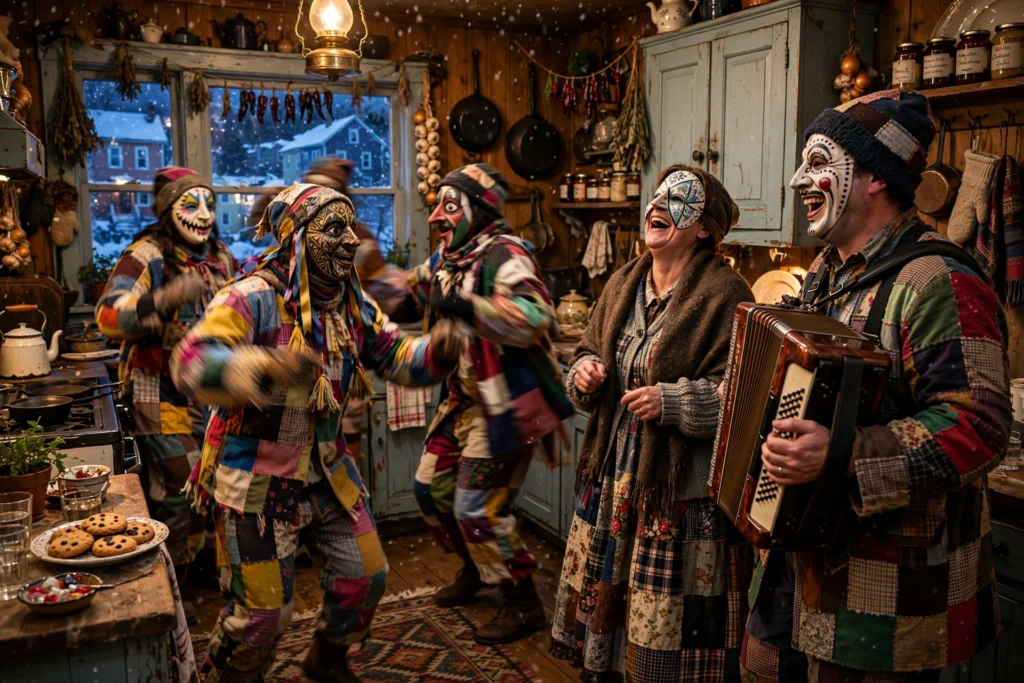
A Newfoundland mummering house visit: disguised revelers in patchwork costumes dancing in a snow-lit kitchen as the host laughs along.
Watch: Christmas in Canada
Global News covers mummering — Newfoundland and Labrador's distinctive disguised house-visiting tradition — as it roars back.
At a Glance: Christmas in Canada
Canada's Christmas traditions, province by province.
| Tradition | Date | Key detail |
|---|---|---|
| Toronto Santa Claus Parade | Mid-November | First held on 2 December 1905 and sponsored by Eaton's; one of the world's oldest and largest Santa parades |
| Nova Scotia's tree to Boston | Every December | An annual thank-you for Boston's aid after the 6 December 1917 Halifax Explosion; the tree is lit on Boston Common |
| Huron Carol | Written 1642/1643 | Jesuit Jean de Brébeuf wrote it in Huron/Wendat ('Jesous Ahatonhia') — Canada's oldest Christmas carol |
| Vancouver Polar Bear Swim | 1 January | Held since 1920 at English Bay; thousands plunge into the icy water in costumes |
| Ukrainian Christmas Eve (Sviata Vecheria) | 6 January (Julian calendar) | Twelve meatless dishes honouring the twelve Apostles; dinner begins only after the first star appears |
| Mummering | 25 December – 6 January | Costumed, disguised house-visiting in Newfoundland and Labrador, revived through St. John's Mummers Festival |
Frequently Asked Questions
What is tourtière?
Tourtière is Quebec’s traditional Christmas meat pie — spiced ground pork (sometimes with game) in a flaky crust, served at the Réveillon (Christmas Eve feast) after Midnight Mass. It is the defining dish of French-Canadian Christmas.
What is mummering in Newfoundland?
Mummering is Newfoundland’s costumed house-visiting tradition: disguised revelers go door to door between Christmas and January 6, performing music and dance until hosts guess their identities. Rooted in English and Irish mumming, it’s celebrated today with St. John’s Mummers Festival.
When is Ukrainian Christmas in Canada?
Ukrainian Christmas Eve (Sviata Vecheria) falls on January 6 (Julian calendar), celebrated with twelve meatless dishes including kutia, varenyky, and holubtsi. Many Ukrainian-Canadian families observe both December 24 and January 6.
What is the Santa Claus Parade in Toronto?
Running since 1905, Toronto’s Santa Claus Parade is one of the world’s oldest and largest — a mid-November spectacle of floats, bands, and Santa himself, broadcast nationally and marking the season’s start.
Do Canadians celebrate Boxing Day?
Yes — December 26 is a public holiday in Ontario and federally, with the sales, hockey (World Juniors), and leftovers. In Quebec the emphasis shifts to New Year’s (le Jour de l’An) traditions.
What is the Polar Bear Swim?
The New Year’s Day (or Christmas Day, in some towns) tradition of plunging into icy water — Vancouver’s English Bay swim, running since 1920, is the most famous, drawing thousands of costumed swimmers.
Christmas traditions in Canada are winter’s greatest hits played at full volume: the Réveillon’s tourtière and the Prairies’ twelve dishes, mummering in St. John’s and the aurora over Yellowknife, the parade in November and the pond hockey on Christmas morning. From the Huron Carol’s 1643 winter forest to the Boxing Day Test’s roaring crowds, it is a holiday four centuries deep and still being written — by every wave of newcomers, every snowy December. It is the longest, coldest, brightest Christmas in the Western world — and Canadians wouldn’t have it any other way. Merry Christmas — Joyeux Noël — from coast to coast to coast!