There is a particular sound that defines Children’s Day on any school ground in the world: hundreds of children chanting, laughing, and cheering themselves hoarse while their friends race, tumble, and triumph. A sports day celebration channels the wildest energy of childhood into something glorious — and it gives every student, not just the athletic stars, a chance to run, play, and be celebrated.
This guide brings you more than twenty-five children’s day sports day ideas, from timeless races to hilarious novelty events to full team tournaments. You will find race-by-race instructions with equipment lists, a scoring system that keeps things fair across ages, a ready-made rotation schedule for the whole school, organizing and safety checklists, and answers to the questions every sports-day coordinator asks. Whether you have a full athletics field or just a modest courtyard, there is a celebration format here that fits.
Why a Sports Day Makes the Perfect Children’s Day
Children’s Day celebrates children as they are — energetic, competitive, joyful, and gloriously physical. Nothing honors that quite like a day built around movement. Unlike stage performances, which spotlight a rehearsed few, sports day events can include literally every student: heats and rotations mean the shyest child still gets to race, and novelty events reward silliness as much as speed.
The developmental case is strong too. Racing teaches children to handle both winning and losing in public — emotional skills that matter far beyond the finish line. Team events build cooperation under pressure. And the sheer physical exertion burns off the fizzy excitement of a special day, so students actually enjoy the prize ceremony instead of vibrating through it.
Practically, sports days are among the easiest large events to run. Most events need minimal equipment, rules can be explained in thirty seconds, and senior students make excellent marshals and scorers. Parents love attending, photographs are spectacular, and the whole event doubles as the school’s annual fitness celebration. It is the rare school event that is simultaneously fun, healthy, photogenic, and easy to organize.
Classic Races: The Timeless Lineup
These are the foundation events of children’s day sports day ideas everywhere. Run them as heats by age group, with finals for heat winners.
Sprint Races (50m and 100m)
The purest race: run fast in a straight line. Organize by age and gender categories, run heats of six to eight, and advance the top two from each heat to finals. Mark lanes with chalk or cones.
You need: marked track, whistle, stopwatch, finish-line judges. Tip: For younger children, shorten to 25–30 meters — the race should last under fifteen seconds or they lose steam (and interest).
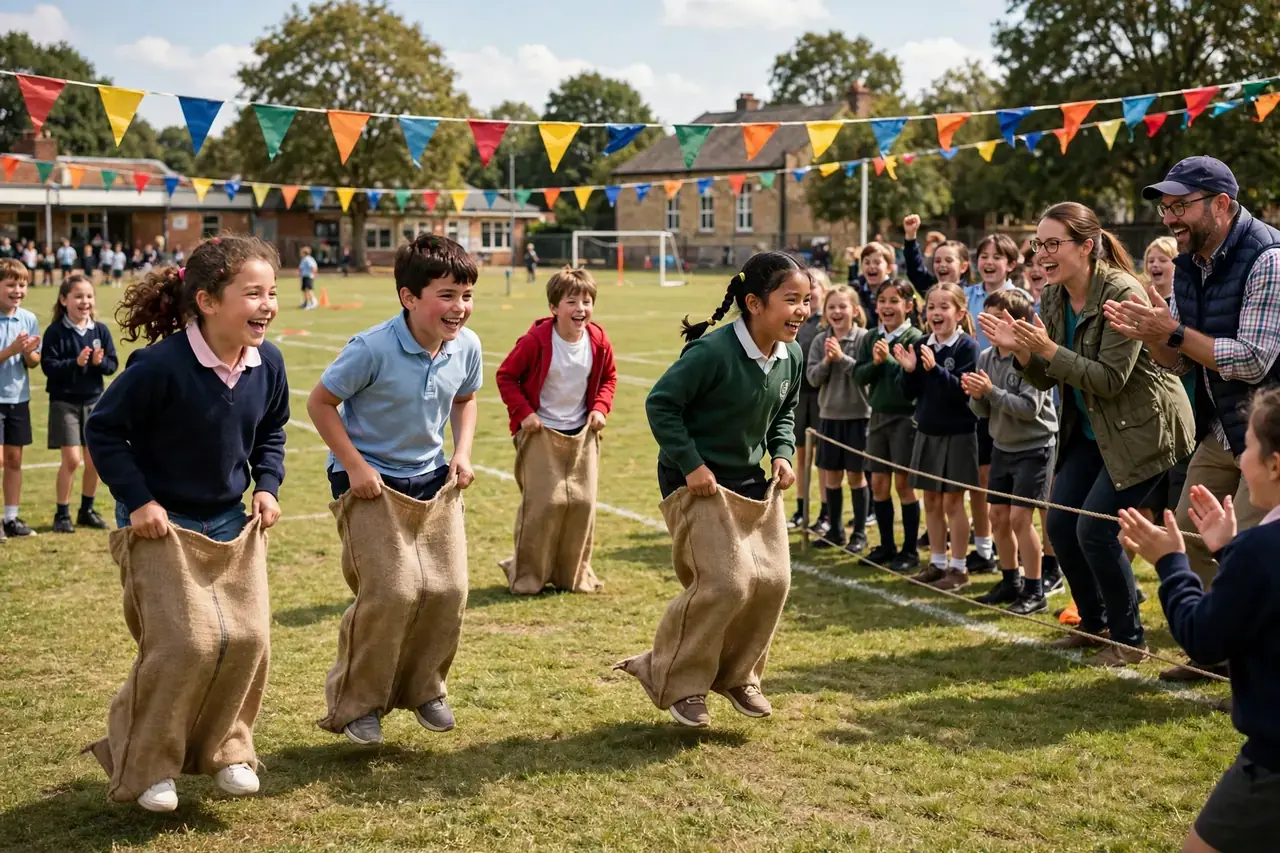
Sack Race
Racers hop inside sacks or sturdy pillowcases to the finish line. It looks easy and is hilariously hard, which is precisely the appeal. Run heats of six.
You need: sacks or pillowcases, start/finish markers. Tip: Inspect sacks for holes beforehand, and have racers hold the sack at waist height — gripping too low causes the classic face-plant.
Lemon and Spoon Race
Balance a lemon (or table-tennis ball) on a spoon held in the mouth and walk briskly to the finish. Dropped lemon? Pick it up and continue — or restart, for stricter older categories.
You need: spoons, lemons or balls. Tip: Table-tennis balls survive drops better and work indoors too. For a team version, run it as a relay.
Three-Legged Race
Partners tie adjacent legs together and race in sync. The negotiation (“left, right, left!”) is half the entertainment. Let students choose partners, tie with soft cloth at the ankle, and allow a practice walk first.
You need: soft ties, markers. Tip: Mixed-age pairs (senior with junior) are adorable and build lovely mentorship moments.
Relay Races (4x50m)
Teams of four, baton handoffs, pure adrenaline. Relays are the marquee track event — save the senior relay final for just before the prize ceremony when the crowd is biggest.
You need: batons (or rolled magazines), lane markers. Tip: Practice handoffs! More relays are lost at the exchange zone than on the track.
Obstacle Race
Crawl under a table, hop through hoops, balance on a beam line, toss a beanbag into a bucket, sprint home. Design the course for your space — corridors, courtyards, and fields all work.
You need: tables, hoops, beanbags, buckets, cones. Tip: Walk the course with the youngest racers first; what looks obvious to adults confuses six-year-olds.

Novelty Races: Where the Laughter Lives
Novelty events are the soul of a Children’s Day sports day — they reward creativity and comedy over athleticism, so every child has a real chance to shine.
Balloon-Between-Knees Waddle
Racers hold a balloon between their knees and waddle to the finish without using hands or dropping it. The waddle is unavoidably funny, and popped balloons just mean grabbing a spare and continuing.
Dress-Up Dash
At the starting line sits a pile of oversized clothes — shirt, hat, sunglasses, shoes. Racers must put everything on before running, then strip at the finish for the next teammate in relay form. Zero athletic advantage; maximum comedy.
Water Sponge Relay
Teams race to soak a sponge at one end, run it to a bucket at the other, and squeeze. Fullest bucket after three minutes wins. Gloriously wet — schedule it for the hottest part of the day.
Crab Walk Race
Racers move on hands and feet, belly-up, like crabs. It is harder than it looks and funnier than it sounds. Short distances only — twenty meters is plenty.
Book-Balance Walk
Walk to the finish with a book balanced on the head. Dropped book? Freeze for a five-count, replace, continue. Elegant, funny, and surprisingly tense in the final meters.
Tug of War Tournament
The ultimate team event: class versus class, or the legendary students-versus-teachers finale. Best of three pulls, mixed teams for fairness, and a soft landing zone behind each line. Few school moments match the roar of a tug-of-war final.
Novelty formats keep working long after the medals are awarded — many adapt perfectly to family gatherings, as in our family game night ideas collection.
Team Tournaments and Ball Games
For older students who want real competition, add one or two mini-tournaments to the day.
Football/Cricket Penalty Shootout
Not a full match — a shootout. Five kicks per player, most goals wins. It delivers the drama of the sport in fifteen minutes per round and lets dozens of students participate.
Dodgeball Tournament
Class teams, soft foam balls, simple elimination rules. Fast, loud, and beloved. Use foam balls only, enforce the “no headshots” rule strictly, and have a teacher referee every match.
Kabaddi or Kho-Kho Exhibition
Traditional team chase games need no equipment and showcase strategy alongside speed. A short exhibition match between the senior teams, with commentary over the speaker, feels like a championship final.
Captain’s Ball / Throwball
Simple throwing-and-catching team games that need only a ball and two teams. They are inclusive (no complex rules), quick to organize, and work in smaller spaces than full field sports.
Events for the Littlest Athletes (Ages 3–6)
Preschoolers need their own mini-Olympics: short distances, soft equipment, and events where everyone finishes a hero.
- Beanbag toss: Toss beanbags into buckets from a short distance. Move the line closer until everyone succeeds.
- Mini sack hop: Pillowcase hops over ten meters, with teachers jogging alongside.
- Balloon tap race: Tap a balloon along a short course without letting it touch the ground.
- Ring toss: Throw soft rings over cones. Every successful toss earns a cheer from the whole class.
- Parachute games: Make waves, lift and run under, bounce balls on top — pure cooperative joy.
- Participation medals for all: At this age, every finisher gets a medal or ribbon. No exceptions, no rankings.
For more gentle, age-appropriate formats, our things to do with kids guide has active play ideas that suit the youngest children.
Fair Scoring System for Multi-Age Sports Days
When classes compete for an overall trophy, you need a scoring system that is simple, transparent, and fair across age groups. This one works for most schools:
| Placement | Points (Individual Events) | Points (Team Events) | Notes |
|---|---|---|---|
| 1st place | 5 points | 10 points | Team events count double — they involve more students |
| 2nd place | 3 points | 6 points | — |
| 3rd place | 2 points | 4 points | — |
| Participation | 1 point per entrant | 2 points per team | Rewards classes that enter everyone, not just stars |
| Novelty events | Participation points only (no placement points) | Keeps fun events fun, not cutthroat | |
| Best cheer squad | 5 bonus points | Judged by teachers; rewards sportsmanship | |
Publish the scoring before the day so every class understands it. Award participation points generously — the class that enters forty children in novelty events should feel that effort counted. Announce running totals over the speaker between events; the unfolding leaderboard is half the drama.
Sample Whole-School Rotation Schedule
For schools where every class cannot watch every event, run parallel stations and rotate. Here is a model for a three-hour sports morning with four stations:
| Time | Station A (Track) | Station B (Field) | Station C (Court) | Station D (Fun Zone) |
|---|---|---|---|---|
| 9:00–9:20 | March-past + warm-up (all) | — | — | — |
| 9:20–9:50 | Sprints (Jr) | Sack race (Sr) | Dodgeball (Sr) | Balloon waddle (Jr) |
| 9:50–10:20 | Sprints (Sr) | Sack race (Jr) | Dodgeball (Jr) | Dress-up dash (Sr) |
| 10:20–10:40 | Snack + water break (all stations pause) | |||
| 10:40–11:10 | Relays (Jr) | Tug of war (Sr) | Shootout (Sr) | Sponge relay (Jr) |
| 11:10–11:40 | Relays (Sr) | Tug of war (Jr) | Shootout (Jr) | Crab walk (Sr) |
| 11:40–12:00 | Grand finals: senior relay + students-vs-teachers tug of war (whole school watches) | |||
| 12:00–12:20 | Prize ceremony + closing cheer | |||
Jr = junior school, Sr = senior school. Each class rotates through all four stations; station marshals stay put and become experts at their events. Blow a whistle for rotations — children learn the signal within one round.
Watch: Field Day Games That Kids Love
Seeing events run with real children is the best preparation. This video demonstrates seven field day activities — death ball, battleship, king pin, human tic-tac-toe, tug of war variations — with tips for teaching games to large groups and recruiting parent volunteers.
Share it with your station marshals a few days before the event — a ten-minute watch saves an hour of confused explaining on the morning.
Organizer’s Checklist
- Two weeks before: Finalize the event list, assign station marshals (teachers + senior student volunteers), and order or gather equipment. Confirm the sound system and first-aid arrangements.
- One week before: Publish the schedule and scoring system to all classes. Take entries per event per class. Brief marshals on rules and safety.
- Three days before: Walk the entire venue. Mark tracks, stations, spectator areas, and no-go zones. Check the ground for hazards.
- Day before: Set up stations, test the speaker and whistle signals, prepare the score sheets and medals, and confirm the water and shade arrangements.
- Morning of: Final safety sweep, marshal briefing (fifteen minutes, run-sheet in hand), first-aid kit at the main station, and a printed master schedule with the chief coordinator.
- After: Publish results the same day, thank every volunteer by name, and photograph the winning class with the trophy — then file the run-sheet for next year. Future you will be grateful.
Safety Rules for Sports Day
- Warm up properly: A ten-minute led warm-up before events prevents most strains and pulled muscles. Make it fun — music-led stretches, not drills.
- Hydration stations: Water available at every station, with mandatory drink breaks every thirty minutes in warm weather. Schedule the most intense events in the cooler morning hours.
- Right equipment: Foam balls for dodgeball, soft ties for three-legged races, inspected sacks, and a rope with no fraying for tug of war. Check everything the day before.
- Clear zones: Spectators behind marked lines, run-off areas beyond finish lines (children cannot stop instantly), and no-go zones around equipment storage.
- Sun protection: Hats or caps for long outdoor sessions, sunscreen available, and shade tents at rest stations.
- First aid ready: A stocked kit plus one designated first-aider at the main station. Most sports day injuries are minor scrapes — being prepared keeps them minor.
- Know when to stop: Any child who feels dizzy, unwell, or in pain sits out immediately, no questions, no pressure. Their health outranks any race.
Weather contingency matters too — if rain forces parts of the day indoors, our rainy-day activities collection has active indoor games that keep the sports-day spirit alive under a roof.
March-Past and Opening Ceremony Ideas
A sports day should open like it means business. The march-past — classes parading with banners behind a student band or drum line — instantly makes the day feel important, and children take enormous pride in marching smartly for their class.
- Class banners and chants: Each class designs a banner and a two-line chant. The chants echo across the ground all morning and become part of school lore.
- Flag bearers and torch run: Senior athletes carry the school flag and a ceremonial “flame” (a decorated torch, unlit for safety) around the track while the school cheers.
- Oath ceremony: A student leader reads a short sportsmanship oath — play fair, respect opponents, celebrate effort — with the whole school repeating line by line. It sets the ethical tone for the day.
- Balloon or ribbon release: Each class releases biodegradable balloons (or waves ribbons) as their name is announced. Photograph from an elevated spot for a spectacular shot.
- Guest of honor: Invite a local athlete, an alumnus, or even a fit grandparent to declare the meet open. A two-minute inspirational address from a real sportsperson electrifies young athletes.
Keep the ceremony under twenty-five minutes. Children are eager to compete; a long ceremony tests the patience the events will need.
Indoor Backup Events for Bad Weather
When rain or extreme heat forces the celebration inside, the sports day spirit can survive with adapted events. These work in halls, corridors, and large classrooms:
- Table-tennis ball spoon relay: The lemon-and-spoon race works perfectly indoors — shorter course, same tension.
- Balloon volleyball tournament: Class teams, a string net, and balloons. Surprisingly competitive and completely safe indoors.
- Paper-plane distance contest: Each student folds one plane; longest flight from the hall’s throwing line wins. Add a “most creative design” category.
- Cup stacking speed trials: Plastic cups, one minute, tallest stable tower or fastest stack-and-unstack cycle. Hypnotically watchable.
- Indoor obstacle course: Crawl under tables, hop through floor-tape hoops, balance a beanbag on the head through a slalom of chairs.
- Quiz-sports hybrid: Teams answer sports trivia; correct answers earn “meters” toward a virtual race projected on a screen. Silly, loud, and educational.
Decide your weather call the evening before and communicate it clearly — a confident indoor plan beats a hopeful outdoor gamble every time.
Prize Ceremony Ideas That Celebrate Everyone
The ceremony is the emotional finale — get it right and the whole day glows in retrospect.
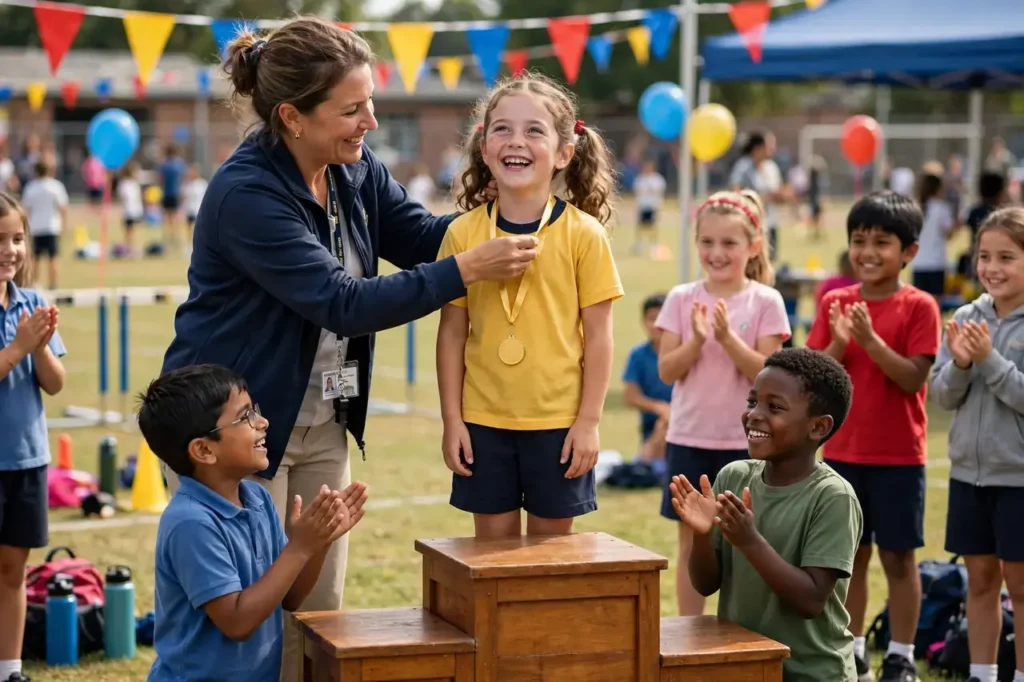
- Podium moments: Even a makeshift podium (painted boxes) makes medal ceremonies feel official. Play a fanfare from the speaker as winners mount it.
- Applause for all: After individual medals, call every participating class to stand for a thirty-second ovation. The roar for the “everyone” moment often exceeds the one for winners.
- Fun awards: Best cheer squad, funniest tumble (with the tumbler’s proud permission), best team spirit, most improved athlete. These awards tell children that character counts alongside speed.
- Victory lap: The winning class takes a slow lap of honor while the school claps them around. Simple, ancient, thrilling.
- Thank the invisible crew: Publicly thank marshals, scorers, first-aiders, and ground staff by name. Children’s Day belongs to everyone who made it happen.
- Close with the school song: One song, whole school, arms around shoulders where friendships allow. Then dismiss with sweets — the day ends on unity, not rivalry.
Fun Themes for Your Sports Day
A theme ties the whole day together and makes decorations, chants, and even events feel cohesive. Pick one and commit:
- Olympics: Country-named teams, medal ceremonies with anthems, a torch run. The classic for a reason.
- Superheroes: Events renamed (“Flash Sprint,” “Hulk Tug of War”), capes for marshals, comic-style banners.
- Around the world: Each class represents a country; learn one traditional game from that country and include it in the program.
- Retro games day: Only traditional games — kabaddi, kho-kho, gilli-danda demonstrations, sack races. Nostalgia for parents, novelty for children.
- Color war: Teams are colors, not classes; face paint, colored powder (skin-safe) at the finish line, and a rainbow group photo to end.
Announce the theme a week ahead so classes can prepare banners and chants — anticipation is half the fun.
Frequently Asked Questions
How many events should a Children’s Day sports day include?
Eight to twelve events for a three-hour program is the sweet spot: four to six classic races, three to four novelty events, and one or two team tournaments, plus the opening march-past and closing ceremony. Fewer events with full participation beat a packed schedule where half the children only watch. Always prepare two backup novelty events — something always finishes early.
What if our school has only a small courtyard, not a field?
Adapt, don’t cancel. Run short-format events: 25-meter sprints, standing novelty races (book balance, balloon waddle), tug of war across the courtyard, and station-based activities (beanbag toss, ring toss, target throwing). Stagger classes so only two or three are active at once. Some of the most joyful sports days happen in small spaces — constraints breed creativity.
How do we make sports day inclusive for non-athletic children?
Novelty events are the great equalizer — dress-up dashes and sponge relays reward comedy over speed. Offer non-racing roles with real status: official photographer, scorekeeper, cheer squad captain, medal presenter. Use participation points in scoring so every entrant contributes to their class total. And consider “personal best” certificates alongside placement medals, so improvement gets celebrated too.
Should we invite parents to the sports day?
Yes — parent spectators transform the atmosphere, and many schools add a parents’ race (sprint or sack race) as the comedy highlight of the day. Manage it: designated spectator zones, a clear schedule shared in advance, and a firm rule that only marshals enter event areas. The parents’ race consistently produces the day’s most-shared photographs.
What prizes work best for sports day?
Medals or ribbons for 1st–3rd in each event, participation certificates or stickers for every entrant, a rotating house/class trophy for the overall winners, and special awards: best sportsmanship, funniest moment, best cheer squad. Keep individual prizes modest and the ceremony warm — on Children’s Day, the taking part genuinely matters as much as the winning.
How do we handle ties and disputes fairly?
Decide the rules before the day: photo-finish judges for sprints (two judges per finish line, majority decides), rerun finals for dead heats in short races, and shared gold medals for genuinely inseparable novelty events. Publish a simple appeals process (team captain speaks to the chief coordinator within ten minutes). Most disputes dissolve when the rules were clear in advance — ambiguity, not competition, causes arguments.
What is the best time of day for a Children’s Day sports day?
Morning, without question: 9:00 AM to noon. Temperatures are cooler, children are fresh, and energy is highest. Avoid midday heat entirely — it is unsafe and miserable. If your climate demands it, split the program: track events in the morning, indoor novelty events and the ceremony after lunch.
Can we combine sports day with other Children’s Day activities?
Absolutely — many schools run sports in the morning and cultural programs (assembly, art, class parties) after lunch. The physical morning burns energy so children actually enjoy the quieter afternoon. Just protect the transition: thirty minutes for lunch, rest, and changing out of sports kits keeps the afternoon pleasant instead of sweaty and chaotic.
How do we keep score accurately with dozens of simultaneous events?
Station-based scoring is the answer: each station marshal carries a simple score sheet (event, class, 1st/2nd/3rd, participants) and hands it to a central scoring desk after every rotation. The desk — two organized senior students with a master sheet — updates running totals announced over the speaker. Keep the sheets dead simple; complex forms get filled wrong in the excitement. Photograph each completed sheet as backup before it leaves the station.
What food and refreshments should we arrange?
Water is the non-negotiable — arrange more than you think necessary, with cups or bottles at every station. Add glucose drinks or nimbu pani (lemonade) for energy, bananas or energy bars for quick refueling, and the traditional post-ceremony sweets. Avoid heavy meals mid-program; they slow children down. If parents run a refreshment stall, position it away from event areas to prevent crowding, and brief them on hygiene basics.
A great Children’s Day sports day is organized chaos at its finest — whistles, cheers, flying balloons, and children discovering what their bodies can do. Plan the stations, brief the marshals, stock the water, and then let the day run. When the final tug-of-war rope drops and the whole school is chanting together as one family, you will know exactly why this tradition endures year after year. Happy Children’s Day!