Photographing a dog’s birthday is about energy. Photographing a cat’s birthday is about patience, light, and the art of being ready when the moment happens. These 29 cat birthday photoshoot ideas are built around how cats actually behave — their love of sunbeams, their suspicion of new things, their refusal to perform on command, and their devastating photogenicity when they decide to cooperate. Master the mindset, set the stage with the backdrops and lighting below, and let the cat do the rest. By the end, you will know how to turn an uncooperative feline into a portfolio of portraits.
The Cat Photographer’s Mindset
Forget everything you know about directing subjects. Cat photography has its own philosophy.
You do not pose the cat; you prepare the scene. The fundamental shift: instead of placing the cat and commanding “stay,” you create an irresistible setup — a sunbeam, a cozy nest, an interesting backdrop — and wait for the cat to inhabit it. The best cat photos look unposed because they are. Your job is set design and readiness, not direction.
Patience outperforms equipment. A phone camera and an hour of patient waiting beats a DSLR and a rushed ten minutes. Cats operate on their own schedule; fighting it produces stressed photos, while flowing with it produces magic. Plan for a long, relaxed session with no agenda beyond “be ready.”
Learn feline body language. Ears forward and whiskers relaxed: the cat is content — shoot. Slow blinks: the cat is happy — shoot. Tail flicking, skin rippling, ears flattening, pupils dilating: the cat is done — stop. Pushing past a cat’s limits does not get you the shot; it gets you a cat who hides for the rest of the day. Respect the signals and you will be invited back tomorrow.
Embrace the candid. The mid-yawn, the blep, the judgmental stare, the box-sitting — these unposed moments are what make cat photos beloved. Posed cat portraits are lovely, but candid cat photos are legendary. Keep the camera ready during the whole party, not just the “shoot” — the best frame often arrives unannounced.
Setting the Stage: Backdrop Ideas (1–8)
Create inviting scenes and let the cat discover them.
1. The window light studio. Clear a windowsill or place a small table by a large window, drape it with a white or cream cloth, and let natural daylight do the work. Window light is the most flattering light in photography, and cats are magnetically drawn to windows. This setup essentially photographs itself — place the cat’s favorite blanket there an hour before and wait.
2. The cozy nest. Pile soft blankets and cushions in a basket or box (cats and boxes — use it), add a small birthday garland draped nearby (not on the cat), and let the birthday cat settle in. The nest looks adorable, the cat is genuinely comfortable, and comfort photographs as contentment. Shoot slightly from above for the full cozy effect.
3. Pastel paper backdrop. Tape large sheets of pastel paper (lavender, peach, mint) to the wall curving onto the floor for a seamless studio sweep. Pastels flatter every fur color and read as unmistakably “birthday.” Keep the paper pristine — cats will walk on it, so have spare sheets for the hero shots.
4. The floral frame. Arrange pet-safe flowers (or high-quality faux) around the edges of the shooting area, creating a natural frame. Shoot through the flowers with a wide aperture for dreamy foreground blur. The cat sits in the clear center, royalty among blooms. Stunning for spring birthdays.

5. Balloon corner (secured). A cluster of pastel balloons tied to a heavy weight in one corner, with a blanket in front. The balloons signal “birthday” while the cat does whatever cats do nearby. Keep balloons well-secured and never leave the cat unsupervised with them — batting is inevitable, popping is the concern.
6. The “throne” setup. A small armchair, decorated cushion, or elevated cat bed styled as a throne, with a mini garland behind it. Regal cats will claim it immediately; the resulting portraits have a natural majesty that suits the birthday narrative. Add a tiny crown prop nearby for the brave.
7. Outdoor catio session. If you have a secure catio or supervised yard access, shoot there: natural light, interesting textures, and the cat’s genuine curiosity about the outdoors. Morning light in a catio is some of the prettiest cat photography light available. Keep the session short and the cat secure.
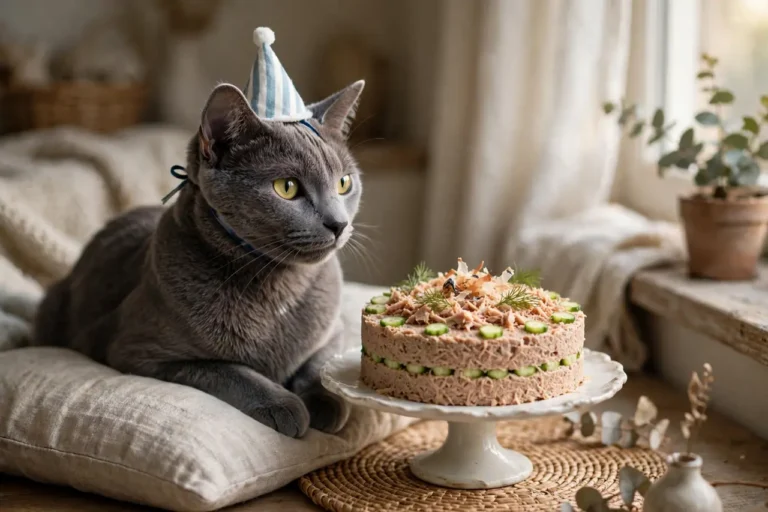
8. The birthday table scene. Style a small table with the cat’s “cake” (savory, of course), a few decorations, and the birthday cat’s place set. Shoot the cat investigating the spread — the sniffing, the tentative paw, the decision. These lifestyle shots tell the party story better than any posed portrait.
Props Cats Actually Tolerate (9–14)
Low-interference props win. The best cat props are the ones the cat does not notice.
9. The breakaway bow tie. A lightweight bow tie on a breakaway collar — safe, comfortable, and photographically transformative. Most cats accept bow ties with minimal complaint, especially with treat support. It is the single highest-success cat birthday prop.
10. Flower crown (brief). A small, lightweight flower crown resting (not tied) on the cat’s head for the photo moment. Some cats sit regally; most shake it off in seconds — shoot fast. Faux flowers avoid pollen and chewing concerns. The resulting photos are worth the ninety-second window.
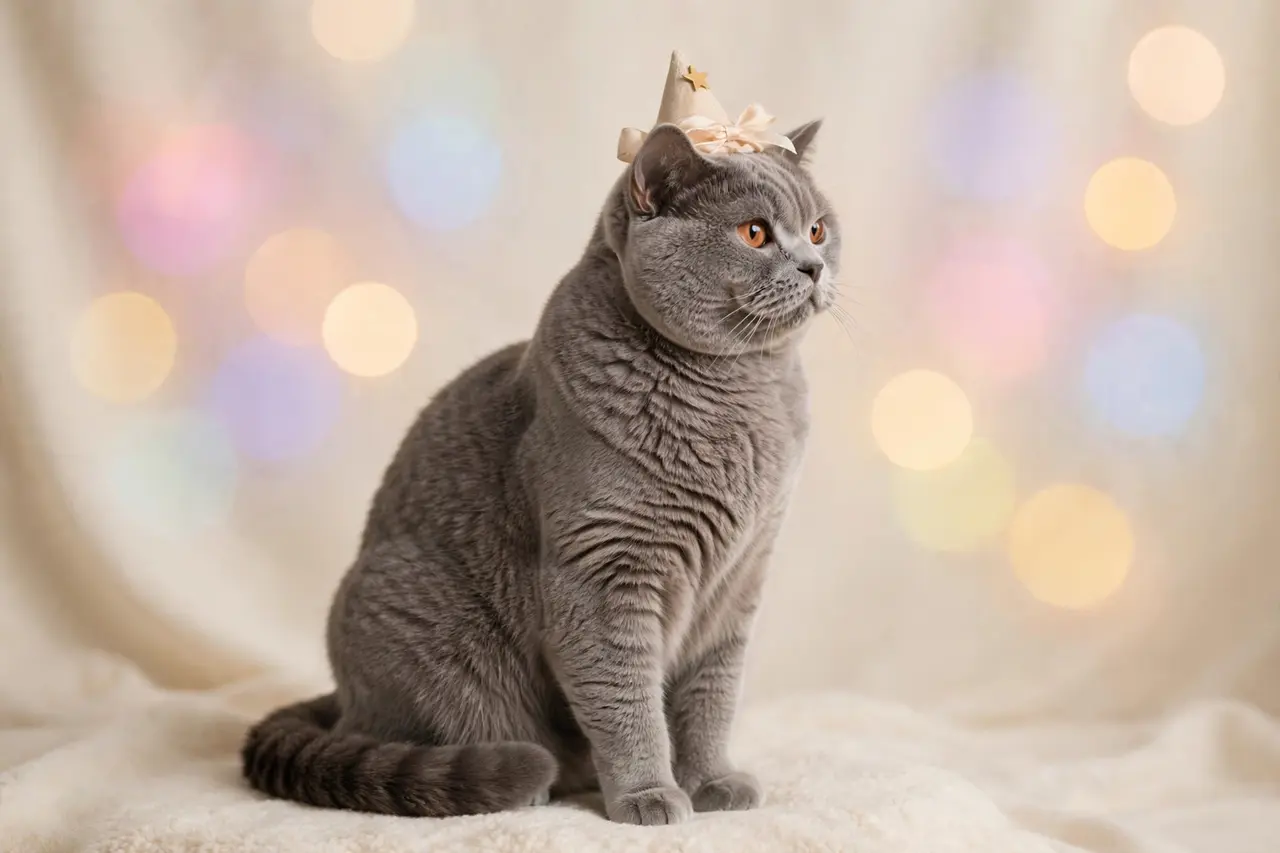
11. The tiny party hat (held). Like the dog version: a helper holds the hat just above the cat’s head, out of frame. In the photo, it looks worn. This avoids the entire hat-rejection drama while delivering the birthday look. Every cat birthday album needs at least one party-hat photo, real or artfully faked.
12. Fish and toy props nearby. Place favorite toys, a toy fish, or a new birthday toy in the scene — not on the cat, just nearby. They add birthday context and give the cat something interesting to interact with. Action shots of a cat discovering a new toy are pure gold.
13. The milestone sign. “[Name] is 5!” on a small chalkboard propped in the scene. It documents the occasion without touching the cat at all — the lowest-interference prop possible. Include the date for future nostalgia. These signs make photos shareable and meaningful.
14. The birthday blanket. A special blanket in party colors that becomes “the birthday blanket” — used for the shoot, then kept as the cat’s own. It is a prop and a gift in one, and the cat’s genuine comfort on a beloved blanket photographs beautifully. Wash it first so it looks fresh.
For caption ideas for your finished portraits, our photo caption ideas adapt wonderfully to pet birthday posts.
Light: The Cat Photographer’s Superpower (15–18)
Cats and beautiful light are a match made in heaven. These four lighting approaches cover every situation.
15. Window light portraits. Position the setup near a large window with the cat facing the light (or at a 45-degree angle for gentle modeling). The soft, directional illumination reveals fur texture beautifully and creates luminous eyes. This is the technique behind most stunning cat portraits you have admired — it is not expensive gear, it is a window.
16. The sunbeam ambush. Note where sunbeams land in your home and at what time, then place an attractive blanket or bed in tomorrow’s sunbeam location. When the cat inevitably claims the warm spot, you are ready. Sunbeam photos — the glowing fur edges, the blissful squint — are among the most beloved cat images. Patience and observation are the only requirements.

17. Soft evening lamp light. For evening shoots, use a warm table lamp (shade on, positioned to the side) rather than overhead lighting. The warm, low light is flattering and cozy, suiting the intimate mood of a cat’s birthday. Turn off competing overheads to avoid mixed color temperatures. It will not be bright — embrace the moodiness.
18. Never use direct flash. Phone and camera flash creates harsh light, green demon eyes, and startled cats. It is the fastest way to ruin both the photo and the cat’s mood. If light is truly insufficient, increase ISO, find a brighter spot, or accept the moody darkness. No photo is worth the flash.
Techniques for Uncooperative Models (19–24)
Every cat is uncooperative sometimes. These techniques work with feline nature instead of against it.
19. The treat trail. Place treats leading to (and on) the photo spot. The cat follows the trail, arrives at the setup, and eats while you shoot. It is bribery, and it works beautifully. Use high-value treats — this is a special occasion — and keep the trail short so the cat does not wander off mid-shoot.
20. The feather wand director. Have a helper wave a feather wand just above the camera lens. The cat’s gaze locks onto the feathers — right into your lens. This is the professional cat photographer’s primary tool, responsible for an enormous percentage of great cat portraits. Every “looking at camera” cat photo you love was probably feather-wanded.
21. The box magnet. Place an open box or paper bag in the shooting area. The cat will enter it — this is physics. Shoot the cat in, on, and emerging from the box. Box photos are inherently charming and the cat is genuinely happy. Decorate the box’s exterior for birthday context.
22. The nap ambush. Some of the most beautiful birthday portraits are sleeping cats: the peaceful face, the curled paws, the utter contentment. When the birthday cat naps in a pretty spot, shoot quietly without disturbing them. These serene images balance the party’s energy shots and become favorites.
23. The play-then-shoot. Engage the cat in vigorous play for five minutes, then shoot during the calm aftermath — the relaxed, happy, slightly panting contentment. Post-play cats are also more likely to settle into nests and laps. Time the shoot for the ten-minute window after play ends.
24. The two-day shoot. If day one fails — the cat hides, the light is wrong, patience runs out — try again tomorrow. There is no rule that birthday photos happen on the birthday. A relaxed second attempt beats a forced first attempt every time. Keep the backdrop up overnight if you can; familiarity with the setup often makes day two dramatically easier. The photos do not know what day it is.
The Birthday Moment Shots (25–29)
The specific moments that make it a birthday shoot, not just a cat shoot.
25. The cake investigation. Present the savory “cake” and photograph the full investigation sequence: the approach, the sniff, the tentative lick, the verdict. The sequence tells a story; shoot it as one. Most cats engage for about ninety seconds — be ready from the first moment.
26. The gift opening. Wrap a new toy loosely in paper and let the cat “open” it. The shredding, the discovery, the first play — candid joy in its purest form. Use minimal tape (cats and tape are a bad mix) and let the cat’s natural curiosity drive the action.
27. The family portrait. The birthday cat with their favorite humans. These are the photos that matter most over time — the relationship, documented. Have one human hold the camera (or a tripod with timer) while the others cuddle the cat. Imperfect and genuine beats polished and stiff.
28. The party atmosphere. Wide shots showing the decorated space, the treats, the guests — with the cat somewhere in frame, participating or judging from afar. These establish the scene and become the “remember when” photos. Shoot a few at the party’s peak energy.
29. The quiet coda. After the party: the birthday cat asleep among the decorations, or curled up with a new toy. The peaceful ending to the celebration story. These tender photos often become the most treasured — the day, distilled to its essence: a loved cat, at rest, home.
For more at-home photography techniques, our photoshoot ideas guide covers lighting and composition that work for every subject.
Cat Photoshoot Troubleshooting
| Problem | Why It Happens | Fix |
|---|---|---|
| Cat will not look at camera | No motivation to engage | Feather wand above lens; treat trail; accept candid profiles |
| Cat hides the whole session | Overstimulated or stressed | Stop, try tomorrow; shoot in the hiding spot’s vicinity quietly |
| Photos are blurry | Low light + movement | Move to window light; increase shutter speed; use burst mode |
| Cat knocks over the setup | Normal cat behavior | Weight everything; use the box magnet; shoot fast |
| Harsh shadows on face | Overhead or direct light | Switch to window light; shoot in open shade outdoors |
| Cat leaves every setup | Setup is boring to the cat | Add treats, catnip (briefly), a warm blanket, or a box |
| Green eye shine | Flash or direct light angle | Never use flash; change shooting angle slightly |
Editing Cat Photos: Quick Phone Fixes
Cat photos benefit from a light editing touch. Ten minutes in your phone’s editor makes a real difference.
Crop for intimacy. Tighter crops suit cats — a face filling the frame, whiskers sharp, eyes luminous. Remove distracting background clutter and center the cat’s gaze. Most cat photos improve with a closer crop than you think; do not be shy about going tight.
Enhance the eyes. The eyes are everything in cat portraits. A slight brightness and sharpness boost to the eye area brings them alive — most editors let you brush adjustments onto specific areas. Do not overdo it; the goal is luminous, not alien. Catchlights (the little light reflections) are what make eyes sparkle; if they are missing, the photo will feel flat no matter what you do.
Handle fur tones. White cats often blow out to pure white — pull highlights down slightly to recover fur texture. Black cats disappear into shadow — lift shadows gently to reveal the coat. Orange cats photograph beautifully with a touch of added warmth. Adjust white balance if indoor lighting gave everything a yellow or green cast.
Keep it natural. Heavy filters fight with fur — they posterize the subtle gradients that make cat photos beautiful. Aim for “how it looked, slightly better.” Save a preset if you love a look, apply it consistently across the shoot, and share the best three to five. Restraint is the hallmark of good pet photo editing.
Building a Birthday Tradition: The Annual Shoot
One birthday shoot is lovely. A yearly tradition is priceless.
The same setup, every year. Photograph your cat in the same spot, with the same milestone sign updated annually: “Whiskers is 3!”, “Whiskers is 4!” The consistency creates a visual timeline that becomes profoundly moving over the years. Future you will treasure the series more than any single photo.
Document the changes. Kittens become cats; sleek adults become distinguished seniors. The annual shoot captures the arc — the bright-eyed youngster, the prime-of-life hunter, the grey-muzzled sage. These progressions are the real story of a life shared, and the birthday shoot is how you record it.
Involve the family. The annual shoot is also the annual family portrait — humans age alongside their cats, and the series documents everyone. In ten years, the photos will show not just the cat’s life but yours. Take the group shot every year, even when it is chaotic. Especially when it is chaotic.
Start this year. Whatever age your cat is now is the perfect age to begin. Do not wait for a “better” camera or a “better” setup — the best birthday tradition is the one that starts today, with the phone in your pocket and the cat on the windowsill. Year one starts now.
Watch: Pet Photography Tips and Techniques
Master the fundamentals — patience, lighting, and attention techniques for both dogs and cats — in this professional pet photography tutorial, and apply them to your cat’s birthday shoot.
Frequently Asked Questions About Cat Birthday Photoshoots
How do I get my cat to cooperate for birthday photos?
You do not — you work around it. Set up inviting scenes (sunbeams, nests, boxes, treat trails), use the feather-wand-above-the-lens trick for eye contact, keep sessions relaxed and short, and embrace candids. The cats who “cooperate” best are the ones whose humans stopped trying to direct them. Patience, treats, and well-timed readiness outperform every posing technique ever invented for cats.
What is the best lighting for cat photos?
Natural window light, without competition. Position your setup near a large window, turn off overhead lights, and shoot with the cat facing the light. Morning light is softest; afternoon light is warmest. Avoid direct flash always, and avoid harsh midday sun. If you remember one thing: a ten-dollar white cloth near a good window outperforms a thousand dollars of studio gear used badly.
Should I hire a professional pet photographer for my cat’s birthday?
It depends on your cat. Confident, social cats often do well with professionals — and the results can be stunning. Anxious cats may stress with a stranger and equipment in their territory; for them, DIY with patience usually produces better (and kinder) results. If hiring, choose a photographer experienced specifically with cats, keep the session short, and stay present — your presence is the cat’s security.
How do I photograph a cat who hates the camera?
Some cats react to the camera itself — the lens looks like a staring eye, which is threatening in cat language. Try shooting from further away with zoom, use a phone (smaller, less intimidating) rather than a big camera, and desensitize over days by pairing the camera’s presence with treats. Or skip “camera-aware” shots entirely: candid photos taken while the cat is relaxed and unaware are often the best portraits anyway.
What props are safe for cat photoshoots?
The safest props do not touch the cat: milestone signs, nearby toys, decorated backgrounds, and held-near (not worn) hats. If the cat wears something, use breakaway collars and lightweight items, keep wear time to minutes, and supervise constantly. Avoid small detachable parts, anything with strings or ribbons near the cat, and anything scented. When in doubt, the bow tie on a breakaway collar is the gold standard of safe cat props.
Can I use flash for cat birthday photos?
No. Flash startles cats, creates harsh unflattering light and green eye shine, and can damage the trust you have built for the session. If light is low, move to a window, increase your camera’s ISO, use a wider aperture, or embrace the moody darkness. Every professional cat photographer agrees on this one: natural light only.
How long should a cat birthday photoshoot last?
Follow the cat, not the clock. Some cats give you a glorious twenty minutes; others give you four perfect frames and then retire. Plan for a relaxed hour of “being ready” rather than a structured session — the best shots often happen between planned moments. Never push past stress signals. You can always try again tomorrow; the birthday photos do not expire.
What are the best poses for cat birthday photos?
The cat chooses the poses; you choose the moment. That said, the most beloved cat “poses” include: the loaf (paws tucked, regal), the stretch (mid-yawn especially), the window gaze (profile against light), the box sit (inevitable and adorable), and the slow blink (captured mid-blink). Set up the scene, wait, and shoot the behavior as it happens. Burst mode ensures you catch the peak of each moment.
How do I include my cat’s birthday photos on social media?
Choose three to five best shots (not thirty), edit lightly for light and crop, and write a caption with personality — our birthday quotes collection has lines worth borrowing. Post the hero portrait first, follow with candids. Tag relevant pet communities if you like. And remember: the internet loves cats, but your cat loves you — take the photos, then put the phone down and enjoy the party.
What if my cat sleeps through their entire birthday shoot?
Congratulations — you have the easiest model in photography. Sleeping cats are gorgeous: the peaceful face, the twitching whiskers, the utter trust. Shoot quietly without flash, try different angles, and capture the details — paws, ears, the rise and fall of breathing. Some of the most treasured pet portraits ever taken are of sleeping animals. A nap is not a failed shoot; it is a gift.
How do I take birthday photos of a senior cat?
Gently and briefly. Senior cats deserve the dignity of a calm, short session: their favorite resting spot, soft window light, minimal props, and zero stress. Focus on the details that tell their story — the grey muzzle, the wise eyes, the paws that have kneaded a thousand blankets. These portraits carry emotional weight that no amount of styling can manufacture. Keep treats soft and easy to eat, keep the session under ten minutes, and treasure every frame.
Cat birthday photography is an exercise in humility: you prepare meticulously, and then the cat does whatever the cat wants — and somehow the photos are perfect anyway. Set the stage with good light and inviting scenes, keep the feather wand ready, respect the signals, shoot through it all, and start the annual tradition this year. The blurry ones get deleted; the magic ones get framed. And the magic ones always come when you stopped trying so hard. Happy shooting — and happiest of birthdays to your magnificent, uncooperative, utterly photogenic feline.