

If you shop the holiday sales every year, you have probably asked yourself the same question each November: in the battle of black friday vs boxing day sales, which event actually saves you more money? Both are global retail landmarks, both promise some of the year’s deepest discounts, and both arrive within a month of each other — yet they work in very different ways, reward different kinds of shoppers, and dominate in different parts of the world.
Black Friday 2026 falls on November 27, launching a long weekend of deals that now stretches across the entire month in many countries. Boxing Day, on December 26, is the traditional post-Christmas clearance event beloved in the United Kingdom, Canada, Australia, New Zealand, and across the Commonwealth. If you live somewhere that celebrates both — Canada and the UK are the classic examples — the smart move is not to pick a favorite blindly but to understand what each sale does best, then split your shopping list between them.
This guide compares the two events head to head: their history and timing, how discounts differ by product category, the pros and cons of each, and a practical strategy for deciding what to buy in November and what to hold for December. Whether you are shopping from London, Toronto, Sydney, or anywhere else in the world, you will finish with a clear plan.
What Is Black Friday?
Black Friday is the Friday after the American Thanksgiving holiday, and it has grown from a single US shopping day into a worldwide retail phenomenon. In 2026 it lands on November 27. The event traditionally marked the moment retailers moved “into the black” — from operating at a loss (in the red) to turning a profit — as holiday shopping began in earnest.
What makes Black Friday distinctive is its structure. Retailers treat it as a planned promotional event: discounts are negotiated with brands months in advance, doorbuster deals are advertised in flyers and apps, and inventory is ordered specifically for the day. That is why electronics, appliances, and big-ticket items see their most aggressive pricing of the year — retailers are competing for your attention in a concentrated window, and they use headline deals as bait to pull you into their stores and websites.
Over the past decade, Black Friday has also stretched far beyond a single Friday. “Black Friday week” deals now commonly begin one to two weeks early, and Cyber Monday — November 30 in 2026 — extends the event online for another full day. In many countries, from Germany to Brazil to the UAE, local retailers now run their own Black Friday promotions even though Thanksgiving means nothing there. The result is a genuinely global sale season anchored to late November.
The character of Black Friday deals tends to be front-loaded and competitive: limited-stock doorbusters, timed lightning deals, and bundle offers designed to create urgency. Prices on featured items are often the lowest you will see before Christmas, but the trade-off is crowds, website crashes, and the risk of popular items selling out within minutes.
What Is Boxing Day (and Its Sales)?
Boxing Day is December 26, a public holiday in the UK, Canada, Australia, New Zealand, South Africa, and several other Commonwealth countries. Historically, it was the day employers gave servants and tradespeople a “Christmas box” of gifts or money. Today, for shoppers, it means one thing: the biggest clearance sale of the year.
Unlike Black Friday, Boxing Day sales are fundamentally clearance-driven. Retailers are not primarily ordering special stock for the day — they are trying to empty their shelves of Christmas inventory: unsold gift sets, seasonal clothing, holiday decorations, and overstocked electronics. That changes the psychology of the discounts. Where Black Friday is about planned promotions, Boxing Day is about retailers accepting thinner margins to move volume before the new year.
This clearance character is Boxing Day’s greatest strength and its main limitation. On the strength side, discounts on remaining stock can be extremely deep, especially on seasonal items retailers never want to store: winter coats, party wear, Christmas gift sets, and holiday-themed home goods. Markdowns often continue into the first week of January, with prices dropping further as retailers get desperate. On the limitation side, selection is whatever is left over. If you want a specific model, color, or size, Boxing Day is a gamble — the popular stuff sold during the Christmas rush.
Geography matters enormously here. Boxing Day sales are a major event in the UK, Canada, Australia, and New Zealand, with both high-street and online retailers participating heavily. In the United States, December 26 sales exist but are smaller and less culturally central. If you are shopping from outside the Commonwealth, Boxing Day may barely register on your local retailers’ calendars — while Black Friday almost certainly will.
Black Friday vs Boxing Day Sales: Head-to-Head Comparison
Here is how the two events compare across the dimensions that matter most to shoppers:
| Factor | Black Friday (Nov 27, 2026) | Boxing Day (Dec 26, 2026) |
|---|---|---|
| Timing | Before Christmas — ideal for gift buying | After Christmas — ideal for self-purchases and clearance |
| Deal structure | Planned promotions, doorbusters, advertised specials | Clearance markdowns on leftover holiday stock |
| Geographic reach | Truly global — US, Europe, Latin America, Middle East, Asia | Strongest in UK, Canada, Australia, NZ, South Africa |
| Electronics | Usually the year’s best prices on featured models | Good on remaining stock; limited selection |
| Fashion | Strong, especially on autumn/winter collections | Often deeper on winter and party wear clearance |
| Stock levels | High — retailers prepare inventory in advance | Variable — depends on what Christmas left behind |
| Shopping experience | High urgency, timed deals, sellout risk | More relaxed, but popular sizes sell out early |
| Online vs in-store | Both, with Cyber Monday (Nov 30) extending online deals | Both, with continued markdowns into January |
| Gift suitability | Excellent — arrives in time for Christmas | Poor for Christmas gifts — best for January needs |
The table reveals the core insight: these are not really competing events. Black Friday is a buying sale — you purchase with intent, for gifts and planned upgrades. Boxing Day is a finding sale — you browse for bargains among the leftovers. Shoppers who treat them as interchangeable tend to be disappointed by one or the other.
Category-by-Category Breakdown
Discount depth varies enormously by product type, and each event has categories where it reliably outperforms the other.
Electronics and Tech
Black Friday wins electronics decisively in most years. Retailers negotiate promotional pricing with manufacturers specifically for the event, and the deals are structured around hero products: big-screen TVs, laptops, tablets, headphones, and smart-home devices. Because inventory is planned, you can research the exact model you want in advance and pounce when the price drops. If a new TV or laptop is on your list, November is almost always the better bet than waiting for December leftovers.
Boxing Day electronics deals do exist, but they are opportunistic rather than planned. You might find an excellent price on a soundbar or a previous-generation tablet that did not sell through at Christmas — but the specific model you researched in November may be long gone. One exception: accessories and peripherals (cases, chargers, cables) often get marked down aggressively in post-Christmas clearance.
Fashion and Apparel
This is Boxing Day’s home turf. Winter coats, boots, knitwear, and party-season clothing that did not sell before Christmas get cleared at deep markdowns, and retailers would rather discount heavily than carry seasonal stock into spring. If you are buying winter clothing for yourself, waiting until December 26 can genuinely beat Black Friday pricing — provided your size is still available.
Black Friday fashion deals are still strong, particularly on autumn collections and giftable items like sweaters, scarves, and accessories. But the discounts are promotional rather than clearance-driven, which means they are typically shallower than what the same item might reach in a January clearance — with far better size availability as the trade-off.
Home Goods and Appliances
Large appliances — refrigerators, washing machines, ovens — are classic Black Friday territory. Retailers use them as headline deals because the ticket prices are high and the discounts look dramatic, and delivery can usually be scheduled before the holidays. Small kitchen appliances (stand mixers, coffee machines, air fryers) also see aggressive November pricing as gift-oriented promotions.
Boxing Day can be surprisingly good for home goods of a different kind: Christmas decorations, seasonal bedding, candles, and entertaining ware all get cleared. Furniture is a mixed bag — January is traditionally the bigger furniture-sale month in many countries, so Boxing Day furniture deals are often just the opening act.
Toys and Gifts
Black Friday dominates toys for one simple reason: timing. Parents and gift-givers need toys before Christmas, so November is when toy retailers compete hardest. The hottest toys of the season are discounted in November and frequently sell out; by Boxing Day, the popular ones are gone and the discounts apply to whatever remains.
That said, if you are buying toys for birthdays in the new year — or you are comfortable with last season’s hits — Boxing Day clearance can be excellent value. Just do not expect to find the year’s must-have toy on December 26.
Travel Deals
Travel is an interesting special case. Black Friday has become a meaningful event for flight and hotel deals, with airlines and booking platforms running November promotions for travel in the new year. Boxing Day is also a traditional travel-sale moment in the UK and Canada, where tour operators and airlines launch January-travel campaigns. If a trip is on your wishlist, compare both — and check our guides to Black Friday flight deals and Black Friday hotel deals for the November side of the equation.
Timing and Strategy: When to Buy What
The winning strategy for shoppers with access to both events is to split the list. Buy in November everything that must arrive before Christmas or that benefits from planned promotions: electronics, appliances, the hottest toys, and gifts for others. Then shop Boxing Day for yourself: winter clothing, clearance home goods, and opportunistic tech bargains.
This split-list approach also protects you from the biggest psychological trap of the season: buying in November out of urgency, then seeing the same item cheaper on December 26 and feeling regret. The antidote is to decide in advance which items are November buys and which are December gambles. An item you need as a gift cannot wait; an item you merely want can.
Price protection policies add another layer. Some retailers offer price adjustments if an item you bought drops in price within a set window — check which stores offer Black Friday price matching and our guide to Black Friday price adjustment policies before you buy. If your November purchase is covered and the price falls on Boxing Day, you may be able to claim the difference without rebuying.
One more timing consideration: the gap between the two events is nearly a month, and in that month, new models can launch and prices can shift for unrelated reasons. A TV discounted on Black Friday might be superseded by a new model announcement in early December, making the Boxing Day price on the older model genuinely lower — but it is last year’s technology. Always compare like with like: model numbers, not just screen sizes.
Pros and Cons of Each Event
Black Friday Advantages
- Planned inventory: retailers stock up specifically for the event, so the item you want is likely available.
- Gift timing: late November leaves plenty of time for Christmas delivery — see our Black Friday shipping deadlines guide.
- Global reach: celebrated by retailers on nearly every continent.
- Best electronics prices: manufacturer-backed promotions concentrate here.
- Research-friendly: deals are advertised in advance, so you can compare before buying.
Black Friday Disadvantages
- Urgency pressure: timed deals and sellout risk push impulse buying — our biggest Black Friday shopping mistakes guide covers how to resist.
- Crowds and crashes: both stores and websites strain under demand.
- Derivative models: some headline TV deals are sale-specific variants — read the cheap TV trap explained before buying.
Boxing Day Advantages
- Clearance depth: retailers clearing seasonal stock can discount very aggressively.
- Relaxed pace: less manufactured urgency than Black Friday.
- Continuing markdowns: prices often fall further into January.
- Self-gifting season: perfect for winter wardrobe and home refreshes.
Boxing Day Disadvantages
- Limited selection: you are shopping leftovers; popular models and sizes vanish fast.
- Too late for Christmas: useless for gift buying.
- Weaker outside the Commonwealth: a minor event in the US and much of Europe and Asia.
- Final-sale risk: clearance items sometimes carry stricter return terms — always check the policy.
Which Sale Should You Shop?
Match the event to your mission. Shop Black Friday if you are buying Christmas gifts, upgrading electronics or appliances, hunting a specific model you have researched, or shopping from a country where Boxing Day is not a major retail event. Shop Boxing Day if you are refreshing your winter wardrobe, furnishing or decorating on a budget, hunting opportunistic bargains, or buying for yourself with flexible timing.
Shop both if you live in the UK, Canada, Australia, or New Zealand — and do it with a split list. November for gifts and planned tech; December for clearance fashion and home goods. Shoppers who plan this way consistently report spending less overall than those who treat either event as a one-day free-for-all.
If you are still deciding whether the November event deserves your energy at all, our honest assessment is Black Friday worth it walks through the math. And if you want the full seasonal calendar, browse the Black Friday category for strategy guides covering every angle of the sale season.
Regional Differences Worth Knowing
How these two events play out depends heavily on where you live, and worldwide shoppers should calibrate their expectations accordingly. In the United Kingdom, both events are major: Black Friday has been enthusiastically adopted by British retailers over the past decade, and Boxing Day remains the traditional cornerstone of the winter sale season, with high-street markdowns continuing into January. British shoppers genuinely get two full-scale events.
In Canada, the dynamic is similar but with an American twist — cross-border shopping and US-owned retailers mean Black Friday is huge, while Boxing Day holds its own as a point of national retail pride. Australia and New Zealand flip the seasons: December is summer, so Boxing Day sales focus on summer fashion, outdoor gear, and end-of-year clearance rather than winter coats. Their Black Friday participation has grown rapidly, driven by global e-commerce.
Across continental Europe — France, Germany, Spain, Italy — Black Friday is now firmly established, but Boxing Day (December 26 is a public holiday in several European countries, known as St. Stephen’s Day) is a quieter retail moment, with the bigger winter clearance traditionally landing in January. In Asia, the Middle East, Latin America, and Africa, Black Friday is the event that matters; Boxing Day is largely irrelevant to local retail calendars. Shoppers in these regions should put all their planning energy into November.
The practical takeaway: if your country celebrates both, run the split-list strategy. If it celebrates only one, you are not missing out — you are simply spared the dilemma. Either way, the global nature of e-commerce means you can often participate in the other event online, as long as you factor in international shipping costs and delivery times before assuming a foreign bargain is really a bargain.
In Pictures: Black Friday vs Boxing Day Sales
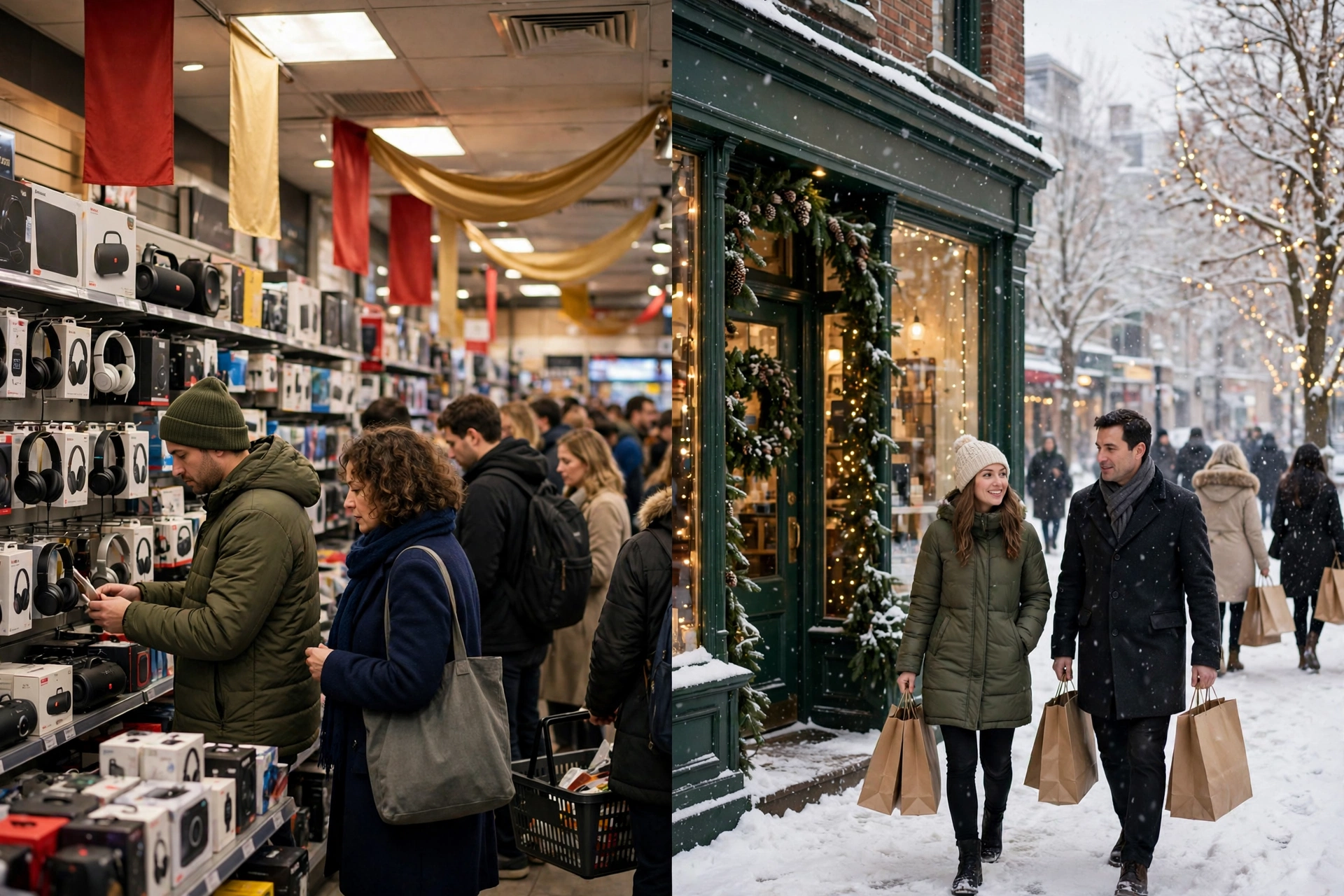
November's engineered frenzy against December's honest clearance — the two events discount for opposite reasons.

Shoppers stroll a festively decorated British high street the morning after Christmas, bags in hand, sale posters glowing in the windows. Boxing Day is the Commonwealth's answer to Black Friday — post-holiday clearance rather than pre-holiday theater.
At a Glance: Black Friday vs Boxing Day Sales
One analysis of Australian sales put average discounts at roughly 30% on Black Friday versus 28% on Boxing Day — close, but the categories that win differ sharply.
| Aspect | Black Friday | Boxing Day |
|---|---|---|
| Date | Late November (Nov 27 in 2026) | December 26 |
| Why the discount exists | To win sales that have not happened yet | To clear stock retailers do not want to store into January |
| Strongest categories | Technology, electricals and home appliances | Fashion, homeware and seasonal clearance |
| Stock levels | Built up deliberately; full catalogues | Whatever failed to sell; narrow and shrinking daily |
| Gift timing | Ideal — a month before Christmas | Too late for gifting; best for self-purchases and gift-card spending |
| Where it matters most | The US, and increasingly everywhere | The UK, Canada, Australia and Commonwealth countries |
Frequently Asked Questions
Is Black Friday or Boxing Day cheaper overall?
Neither is universally cheaper — it depends on the category. Black Friday typically offers better prices on electronics, appliances, and giftable items because promotions are planned and manufacturer-backed. Boxing Day often wins on winter fashion, seasonal home goods, and clearance items because retailers are desperate to clear holiday stock. For any specific product, compare the actual model and price rather than assuming one event always wins.
Can I find Boxing Day deals online if I do not live in a Commonwealth country?
Sometimes. Large UK and Canadian retailers ship internationally, and global marketplaces may run “Boxing Day” promotions worldwide. But selection, shipping costs, and delivery times can erode the savings. If you are outside the UK, Canada, Australia, or New Zealand, treat Boxing Day as a bonus rather than a plan — Black Friday and Cyber Monday are the more reliable global events for you.
Should I wait for Boxing Day if I miss a Black Friday deal?
It depends on the item. For electronics and hot toys, waiting is risky — popular models sell out in November and may not reappear. For winter clothing, seasonal decor, and general home goods, waiting can pay off as clearance markdowns deepen. A good rule: if the item is a gift needed before Christmas, do not wait; if it is a flexible self-purchase, waiting is a reasonable gamble.
Do prices drop further between Black Friday and Boxing Day?
On remaining stock, yes — clearance markdowns in late December and January can undercut November prices. But “remaining stock” is the key phrase: the specific model, color, or size you wanted may be gone. November prices are for the item you chose; December prices are for whatever is left. They are not directly comparable unless the exact item is still available.
Is Cyber Monday better than Boxing Day for online deals?
For online shoppers, Cyber Monday (November 30, 2026) is the stronger event: it is planned, global, and focused on e-commerce, with inventory prepared in advance. Boxing Day online deals are an extension of in-store clearance. If you shop primarily online, prioritize Cyber Monday and treat Boxing Day as a secondary clearance opportunity.
Conclusion
The black friday vs boxing day sales debate has no single winner, because the two events are built for different jobs. Black Friday is the precision instrument: planned promotions, deep research, gifts bought on time. Boxing Day is the treasure hunt: clearance chaos, flexible timing, and the thrill of a bargain found rather than targeted. The smartest shoppers in the UK, Canada, Australia, and beyond do not choose between them — they calendar both, split their lists, and let each event do what it does best. Start your November list now, keep a separate December wishlist, and you will capture the best of both worlds without the regret of either.


