Few creatures belong to Halloween the way vampires do. For more than a century, filmmakers have been sinking their teeth into the legend — from silent-era shadows to brooding romantics to laugh-out-loud mockumentary roommates. The best vampire movies for a Halloween marathon span every mood October can offer: gothic dread, tragic romance, grindhouse action, and pitch-black comedy. This guide gives you the definitive viewing order, from the 1922 classic that started it all to the 2024 masterpiece that proved the genre still has bite.
Below you will find 18 essential vampire films arranged in a marathon-friendly sequence, plus four ready-made marathon schedules depending on how much time — and how much darkness — you can handle. Whether you are hosting a Halloween movie party or settling in for a solo October weekend, this is your complete fang-to-fang itinerary.
How This Marathon Is Organized
Rather than ranking these films best-to-worst, we have arranged them chronologically by era, because watching vampire cinema evolve is half the fun. You will see the monster transform across a century: the silent-era plague-bringer, the suave 1930s count, the Hammer horror seducer, the 1980s leather-jacket rebel, the 1990s tragic romantic, and the 21st-century arthouse drifter. Each era reflects the anxieties of its time — disease, aristocracy, youth rebellion, AIDS-era fears of blood, modern alienation — which makes a vampire marathon secretly one of the most fascinating film-history lessons you can give yourself.
Every entry below includes the year, director, a spoiler-free synopsis, and a note on where it fits in your marathon. We have kept descriptions free of major plot twists so you can read ahead safely.
Era One: The Birth of the Screen Vampire (1922–1958)
Start your marathon at the beginning. These are the films that created the visual language of the vampire — and they are far more watchable than their age suggests.
1. Nosferatu (1922) — Directed by F. W. Murnau
The one that started everything. This unauthorized German adaptation of Bram Stoker’s Dracula — so unauthorized that Stoker’s widow sued and nearly had every print destroyed — stars Max Schreck as Count Orlok, a rat-like, plague-carrying nightmare whose shadow climbing a staircase remains one of the most imitated images in cinema. Silent, black-and-white, and over a century old, it is nonetheless genuinely eerie, and watching it first gives every later film on this list a foundation to build on. Start your marathon here for maximum appreciation of how far the genre has come — and how much it still owes this film.
2. Dracula (1931) — Directed by Tod Browning
Bela Lugosi’s star-making performance as Count Dracula defined the vampire for generations: the Hungarian accent, the evening cape, the hypnotic stare, the immortal line “I bid you welcome.” This Universal Pictures classic is stagey and theatrical by modern standards, but Lugosi’s charisma is undeniable, and the film’s fog-drenched atmosphere set the template for every gothic horror that followed. Watch it second and you will feel the genre finding its voice — the monster is no longer a feral creature but a seductive aristocrat, a shift that shaped vampire fiction for the next ninety years.
3. Horror of Dracula (1958) — Directed by Terence Fisher
Hammer Films rebooted Dracula for the Technicolor age, and Christopher Lee’s towering, feral, blood-drinking count — all fangs and fury — shocked 1950s audiences. Where Lugosi was suave, Lee is animalistic; where the 1931 film suggested horror, this one shows it in vivid red. Peter Cushing’s Van Helsing is the perfect foil, turning the climax into a genuinely thrilling duel. This is the film that made Dracula sexy and dangerous for the modern era, and it plays beautifully as the third course of your marathon: the moment the vampire becomes a full-blooded movie monster. The Hammer sequels are fun, but this original is the essential one.
Era Two: Rebels, Outcasts, and Small-Town Terror (1967–1987)
By the late 1960s, vampires started reflecting youth culture — and by the 1980s, they were wearing leather jackets and riding motorcycles.
4. The Fearless Vampire Killers (1967) — Directed by Roman Polanski
A palate cleanser before the darkness deepens. Polanski’s horror-comedy follows a bumbling professor and his assistant to a Transylvanian castle for a vampire hunt that goes charmingly, hilariously wrong. It lovingly spoofs every gothic trope the earlier films established while delivering genuinely gorgeous winter cinematography. Think of it as the sorbet course of your marathon — light, witty, and a reminder that vampire stories can be playful. It also sets up the tonal variety to come: from here on, the genre refuses to stay in one lane.
5. Salem’s Lot (1979) — Directed by Tobe Hooper
Stephen King’s small-town vampire epic, adapted as a television miniseries by The Texas Chain Saw Massacre director Tobe Hooper, is arguably the scariest thing on this list. A writer returns to his Maine hometown to find a centuries-old vampire quietly taking over the town, victim by victim. The horror here is slow, methodical, and deeply unsettling — vampires as a spreading infection rather than a single charismatic monster. It is long (originally over three hours), so treat it as the centerpiece of an evening rather than a quick watch. The floating vampire boy at the window is one of horror’s all-time great images.
6. The Lost Boys (1987) — Directed by Joel Schumacher
The ultimate 1980s vampire movie and a perfect Halloween party film. Two brothers move to a California beach town that turns out to be the murder capital of the world — because a gang of impossibly cool vampire teens, led by Kiefer Sutherland at his most magnetic, is preying on the boardwalk. The fashion, the soundtrack (echoing saxophone solos and all), and the comic-book-store vampire hunters played by the two Coreys make this pure joyful 80s excess. It reinvented the vampire as a youth-culture rebel and remains endlessly rewatchable. Schedule it when your marathon needs an energy boost.
7. Near Dark (1987) — Directed by Kathryn Bigelow
Released the same year as The Lost Boys but from a completely different universe. Kathryn Bigelow’s neo-western follows a young man seduced into a nomadic pack of vampires who roam the American Southwest in stolen cars, living like outlaws. Gritty, sun-bleached, and romantic in a doomed outlaw-couple way, it treats vampirism as addiction and drift rather than glamour. Bill Paxton steals the film as the pack’s psychotic enforcer. Pairing it back-to-back with The Lost Boys makes a fascinating double feature: two 1987 films, two totally different visions of what a vampire could be.
Era Three: The Romantic Nineties (1992–1999)
The 1990s gave the vampire a soul — tormented, poetic, and impossibly beautiful.
8. Bram Stoker’s Dracula (1992) — Directed by Francis Ford Coppola
Coppola’s lavish, operatic take on Stoker’s novel is the most visually extravagant vampire film ever made, shot almost entirely with in-camera practical effects as a tribute to early cinema. Gary Oldman plays Dracula as a centuries-heartbroken warrior searching for his reincarnated lost love, and the film’s costumes, sets, and score are pure gothic maximalism. It is lush, erotic, and unapologetically romantic — the vampire as tragic lover rather than monster. Winona Ryder and Keanu Reeves co-star, and the film won three Academy Awards for its craft. A feast for the eyes and the essential centerpiece of any 90s vampire night.
9. Interview with the Vampire (1994) — Directed by Neil Jordan
Anne Rice’s beloved novel comes to life with Tom Cruise’s career-redefining Lestat and Brad Pitt’s melancholy Louis, two vampires recounting two centuries of love, loss, and ennui to a modern interviewer. The film spans eras and continents — from 18th-century New Orleans to a vampire theater in Paris — and treats immortality as both a gift and a curse with unusual philosophical seriousness. A young Kirsten Dunst steals scenes as the eternally childlike Claudia in one of the great child performances. This is the thinking person’s vampire epic, and it pairs beautifully with Coppola’s Dracula as a 90s romantic double bill.
10. From Dusk Till Dawn (1996) — Directed by Robert Rodriguez
Time for a gear shift. Written by Quentin Tarantino, this film starts as a crime thriller about two fugitive brothers and abruptly mutates — famously, at almost exactly the halfway mark — into a full-throttle vampire siege movie set in a Mexican truck-stop bar. George Clooney and Tarantino star, Salma Hayek delivers an iconic entrance, and the second half is pure grindhouse mayhem with Rodriguez’s kinetic direction. It is violent, sweaty, and enormous fun — the midnight-movie jolt your marathon needs after the 90s romances. Best for viewers who like their vampires feral and their action relentless.
11. Blade (1998) — Directed by Stephen Norrington
Before the modern superhero era, there was Blade: Marvel’s half-vampire “daywalker,” played with ice-cold charisma by Wesley Snipes, hunting the vampire nation that murdered his mother. The film’s techno-goth nightclub opening — blood raining from sprinklers onto a raving dance floor — is one of the great action-horror set pieces, and the film essentially invented the modern comic-book movie template that X-Men and Spider-Man would follow. Stylish, violent, and endlessly quotable, it closes the 90s era by pointing the vampire toward the 21st century: less monster, more antihero.
Era Four: The Global and Arthouse Vampire (2007–2014)
The 2000s and 2010s took the vampire international and artful, producing some of the genre’s finest films.
12. 30 Days of Night (2007) — Directed by David Slade
What if vampires attacked an Alaskan town during the month-long polar night? This brutally efficient horror film answers with a pack of shark-like predators who treat humans the way humans treat cattle — no seduction, no romance, just slaughter. Based on the comic series, it strips away a century of romantic varnish and returns the vampire to pure predator. It is the most intense film on this list, so schedule it when your audience is ready for genuine scares. The contrast with everything before it is the point: this is what the vampire looks like with the glamour removed.
13. Let the Right One In (2008) — Directed by Tomas Alfredson
This Swedish masterpiece is many critics’ pick for the greatest vampire film ever made. In a snowbound Stockholm suburb in 1982, a bullied 12-year-old boy befriends the strange girl who moves in next door — a girl who only comes out at night. It is a vampire film, a coming-of-age story, and one of the most tender love stories ever filmed, all wrapped in hushed Scandinavian stillness. The horror is quiet and devastating rather than loud, and the swimming-pool climax is unforgettable. Watch it with full attention; this is arthouse horror at its absolute peak and a million miles from Hollywood’s fanged clichés.
14. Thirst (2009) — Directed by Park Chan-wook
South Korea’s master of operatic cinema (Oldboy) delivers a vampire film like no other: a Catholic priest who volunteers for a medical experiment, dies, and is revived by a transfusion of vampire blood, then falls into a tormented affair that tests his faith to destruction. It is erotic, blasphemous, darkly funny, and visually stunning — a vampire film as theological crisis. Park’s direction is endlessly inventive, and the film’s exploration of guilt and desire gives the genre genuine philosophical weight. For viewers who want their marathon to go to challenging, unforgettable places.
15. Only Lovers Left Alive (2013) — Directed by Jim Jarmusch
Jim Jarmusch imagines vampires as they would actually be after centuries: not predators but weary, cultured aesthetes — underground musicians and scholars drowning in ennui, mourning a world that keeps disappointing them. Tilda Swinton and Tom Hiddleston play Adam and Eve, centuries-married lovers reuniting in a decaying Detroit, and their chemistry is languid perfection. There is almost no horror here at all; instead it is a hangout movie, a love story, and a meditation on art and time. The perfect late-marathon comedown film — beautiful, funny, and sad in equal measure.
16. What We Do in the Shadows (2014) — Directed by Taika Waititi and Jemaine Clement
Every marathon needs a comedy break, and there is none better than this mockumentary about four vampires sharing a flat in Wellington, New Zealand. Viago the dandy, Vladislav the torturer, Deacon the young rebel, and Petyr the ancient Nosferatu-like basement dweller bicker over dishes, struggle with modern technology, and feud with the local werewolves (“werewolves, not swearwolves”). It is the funniest film on this list and a loving encyclopedia of vampire lore played for laughs. It also spawned a beloved TV series. Schedule it when the marathon needs laughter — it will recharge the whole room.
17. A Girl Walks Home Alone at Night (2014) — Directed by Ana Lily Amirpour
Billed as “the first Iranian vampire western,” this black-and-white stunner follows a skateboarding, hijab-wearing vampire who stalks the streets of a fictional Iranian ghost town, preying on the men who prey on others. It is feminist, stylish, romantic, and unlike anything else in the genre — part spaghetti western, part art film, part love story. The vampire here is both avenger and lonely soul, and the film’s stark monochrome photography makes every frame look iconic. A bold, essential pick that proves vampire cinema still has new territory to explore.
18. Nosferatu (2024) — Directed by Robert Eggers
End your marathon where it began — with Orlok. Robert Eggers’ remake of the 1922 classic is a triumph: Bill Skarsgård disappears into grotesque prosthetics as a truly repulsive Count Orlok, Lily-Rose Depp gives a fearless physical performance, and every frame drips with 19th-century dread. It honors Murnau’s original while building something entirely its own, and it bookends the marathon perfectly: watch the 1922 Nosferatu first and this one last, and you will have witnessed a full century of vampire cinema in a single sitting. The definitive closing film.
Four Ready-Made Marathon Schedules
Eighteen films is a lot of vampire. Here are four curated schedules for different appetites — pick the one that fits your October.
The Classic Night (3 films, ~6 hours)
For purists and first-timers: Nosferatu (1922) → Dracula (1931) → Horror of Dracula (1958). You will watch the vampire evolve from plague-demon to aristocrat to Technicolor terror in a single evening, and you will understand the entire foundation of the genre. Serve red wine and dark chocolate; keep the lights low.
The 80s Party Night (3 films, ~5.5 hours)
For maximum fun: The Lost Boys → Near Dark → From Dusk Till Dawn. Leather, neon, and attitude — this is the marathon as rock concert. Encourage costumes (vampire mullets optional but encouraged), crank the volume, and do not be surprised if your guests start quoting dialogue for weeks. If you are pairing the night with a trip to one of the best haunted houses in the USA, this is the pre-game.
The Arthouse Weekend (5 films across two nights)
Night one: Let the Right One In → Only Lovers Left Alive. Night two: Thirst → A Girl Walks Home Alone at Night → Nosferatu (2024). This is vampire cinema as world cinema — Swedish snow, Korean passion, Iranian noir, Jarmusch cool, and Eggers dread. Best for cinephile friends who think they have seen everything. Discuss over strong coffee the next morning; you will need it.
The Full Immersion (all 18, one epic weekend)
For the truly committed: Friday evening covers Era One and Era Two (films 1–7, with dinner between Salem’s Lot and The Lost Boys). Saturday covers Era Three and Era Four (films 8–18), with What We Do in the Shadows scheduled as the afternoon comedy break and Nosferatu (2024) as the midnight finale. Build in walks, real meals, and at least one nap. This is the marathon your friends will talk about for years — the Halloween party equivalent of running a marathon, except the only thing running is the blood.
Vampire Marathon Snacks and Atmosphere
The right spread elevates any marathon. Lean into the theme: a “blood bar” with cherry soda, pomegranate juice, and red velvet cupcakes; garlic-bread bites as a cheeky nod to vampire repellent; black-and-red charcuterie with dark berries and cured meats. For the arthouse weekend, go elegant — wine, cheese, dark chocolate. For the 80s night, go nostalgic — pizza rolls, popcorn, and candy from the era.
Atmosphere matters as much as food. Candles (real or LED) beat overhead lighting for every era, and a simple black-and-red color scheme ties the room together. Between films, keep a running scorecard where guests rate each movie — it sparks the best debates. And if your marathon inspires a taste for real-world frights, New Orleans ghost tours and Los Angeles Halloween events make excellent follow-up outings.
In Pictures: Best Vampire Movies for a Halloween Marathon
The marathon runs four eras — silent-era gothic, ’80s rebels, romantic ’90s, and the arthouse age — pick one film from each for the perfect night.
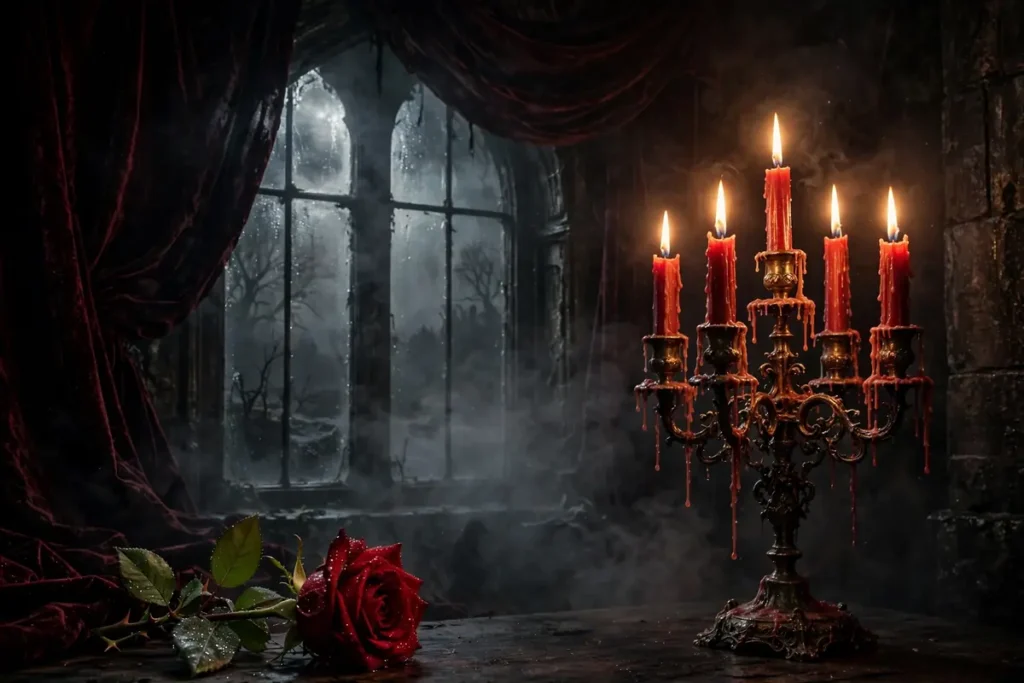
Gothic atmosphere: a candelabra with red candles, a single rose, and fog outside the window — the vampire marathon mood.
Watch: Best Vampire Movies for a Halloween Marathon
The top 10 vampire movies of all time — from Nosferatu (1922) to Sinners, with the Lost Boys, Let the Right One In, and Bram Stoker’s Dracula.
At a Glance: Best Vampire Movies for a Halloween Marathon
The marathon by era.
| Era | Period | Must-watch film |
|---|---|---|
| The Birth of the Screen Vampire | 1922–1958 | Nosferatu (1922) |
| Rebels and Small-Town Terror | 1967–1987 | The Lost Boys (1987) |
| The Romantic Nineties | 1992–1999 | Bram Stoker’s Dracula (1992) |
| The Global and Arthouse Vampire | 2007–2014 | Let the Right One In (2008) |
Frequently Asked Questions
What is the best order to watch vampire movies in?
Chronological by era is the most rewarding order: start with Nosferatu (1922) and move forward through the decades to Nosferatu (2024). This lets you watch the vampire myth evolve from silent-era monster to modern antihero, and each film gains meaning from the ones before it. Our four schedules above offer shorter alternatives if 18 films sounds ambitious.
What is the scariest vampire movie on this list?
Salem’s Lot (1979) and 30 Days of Night (2007) are the two genuine scare-fests — the former is slow-burn dread, the latter is relentless predator horror. Nosferatu (2024) is the most atmospherically terrifying. If you want the marathon’s horror peak in one film, any of those three delivers.
Are there any funny vampire movies for a lighter marathon?
Yes — What We Do in the Shadows (2014) is the essential comedy pick, and The Fearless Vampire Killers (1967) is a charming earlier spoof. Both work as palate cleansers between heavier films, and a comedy-only double feature of the two makes a great low-key Halloween night on its own.
Which vampire movies are best for international cinema fans?
Let the Right One In (Sweden, 2008), Thirst (South Korea, 2009), and A Girl Walks Home Alone at Night (Iranian-American, 2014) form a superb international triple feature. Each reimagines the vampire through a completely different cultural lens, and together they prove the legend belongs to the whole world, not just Transylvania.
How long would it take to watch all 18 vampire movies?
Roughly 32–34 hours of screen time, which is why we recommend spreading the full immersion across a three-day weekend with generous breaks. The shorter schedules — Classic Night, 80s Party Night, or Arthouse Weekend — deliver a complete experience in one or two evenings.
The best vampire movies for a Halloween marathon remind us why this monster never dies: every generation finds a new fear, a new desire, or a new joke in the figure of the vampire. From Murnau’s shadow on the staircase to Eggers’ plague-bringer, the fangs keep finding fresh necks. Pick your schedule, dim the lights, and enjoy a century of the undead.