Few gifts carry the romance of February 14th quite like chocolate. A beautifully chosen box of chocolates says “I thought about you” in a way few other gifts can — but with hundreds of options lining shelves and online shops every Valentine’s season, picking the right one takes a little know-how. This guide to the best Valentine’s Day chocolates: chocolate gift boxes worth giving walks you through everything from truffle craftsmanship to budget-friendly picks, so whatever you choose tastes as good as it looks.
Chocolate gifting has a long and genuinely romantic history. Cacao was prized by the Maya and Aztec civilizations centuries before it ever reached Europe, and by the 1800s, chocolatiers in Europe began crafting the first boxed assortments specifically for Valentine’s Day — a tradition that has only grown more elaborate since. Today, the global chocolate market is worth well over $100 billion, and Valentine’s Day remains one of its biggest selling occasions worldwide. That means choice is abundant, but it also means quality varies wildly.
The good news: you don’t need to be a connoisseur to give a box that impresses. You need to know a handful of things — how to read a chocolate label, which styles suit which tastes, how fresh the chocolate is likely to be, and how much you should realistically spend. We’ll cover all of that below, plus pairing ideas, storage tips, and answers to the questions shoppers ask most.
What Makes a Chocolate Gift Box Worth Giving
Not all chocolate boxes are created equal, and the difference between a memorable gift and a forgettable one comes down to a few concrete qualities. First is the cacao content and ingredient quality. Good chocolate lists cacao mass or cacao butter near the top of the ingredients; cheaper confections lean heavily on vegetable oils, artificial flavorings, and excess sugar. You don’t need to memorize percentages, but a quick glance at the label tells you whether you’re holding real chocolate or a chocolate-flavored imitation.
Second is freshness. Filled chocolates, truffles, and pralines have a relatively short prime — typically two to four weeks for fresh ganache-based pieces, longer for solid bars. A box with a clear “best by” or production date is a good sign; a box with no date information at all is a reason to hesitate, especially close to the holiday when some retailers discount last season’s stock.
Third is presentation. On Valentine’s Day, the unboxing is half the experience. A sturdy rigid box, neat compartments that keep pieces from migrating, an attractive sleeve or ribbon, and a card with the box all signal care. You can absolutely elevate a mid-range box by transferring pieces to your own gift box with tissue paper — a simple upgrade that costs almost nothing.
Finally, consider match to the recipient. A dark-chocolate devotee handed a box of milk-chocolate creams may smile politely and quietly regift it. If you know the person loves bitter, intense chocolate, buy bitter and intense. If they have a sweet tooth, lean toward milk chocolate, caramels, and nut pralines. When in doubt, an assortment with variety covers more ground than a single-flavor box — and most premium chocolatiers design their signature assortments exactly for this purpose.
The Best Valentine’s Day Chocolates by Style
Chocolate gift boxes generally fall into a few broad styles. Understanding them helps you shop with confidence instead of grabbing the prettiest package and hoping for the best.
Classic Truffle and Assorted Boxes
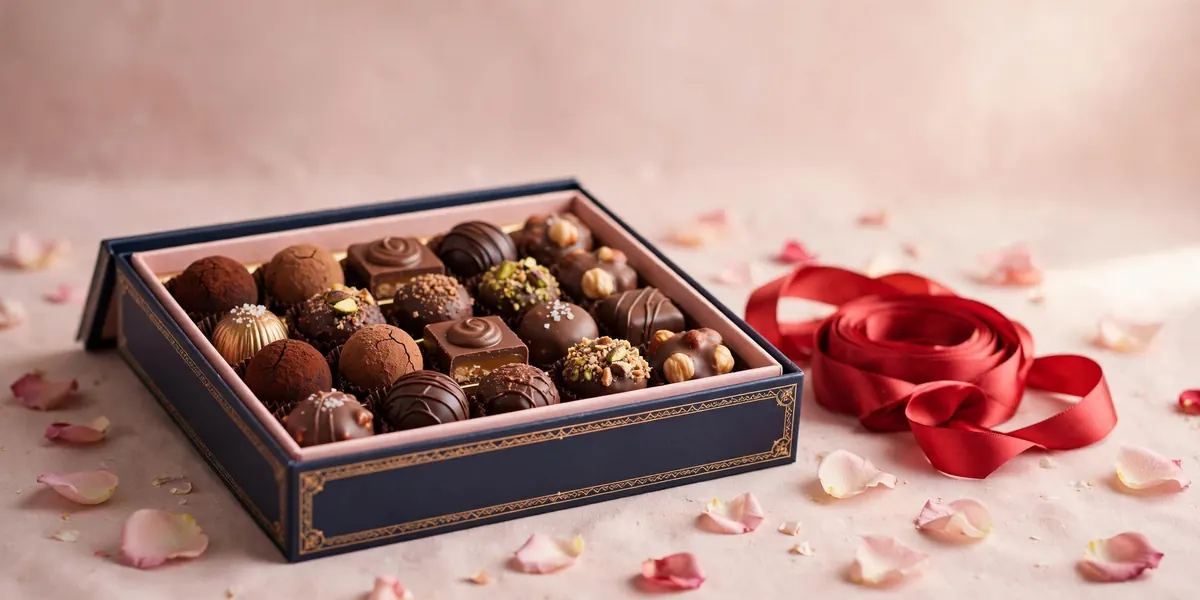
The signature assortment — a curated selection of truffles, ganaches, caramels, and pralines — is the safest and most popular choice for Valentine’s Day, and for good reason. A well-made assortment offers textural variety (silky ganache, crunchy nut, chewy caramel) and flavor variety (dark, milk, fruit, coffee, spice), which means nearly every piece will find a fan. Look for boxes from dedicated chocolatiers rather than generic candy companies; the difference in ganache smoothness and flavor balance is immediately noticeable.
Truffles deserve a special mention because “truffle” on a label can mean different things. True chocolate truffles are ganache centers (chocolate plus cream) rolled in cocoa, nuts, or a chocolate shell. Mass-market “truffles” are sometimes just molded chocolate shells with sugary fillings. Both can be pleasant, but if you’re paying premium prices, you want genuine ganache. Price ranges for quality assortments typically run from about $15–$30 for a small box of 9–12 pieces to $40–$80 for larger 24–36 piece collections. Gift boxes above $100 generally buy you larger counts, elaborate packaging, or rare single-origin cacao.
When presenting a truffle box, keep it cool but not cold — chocolate served straight from the refrigerator tastes muted because cold suppresses aroma. Let the box sit at room temperature for 20–30 minutes before it’s opened for the full flavor experience.
Dark Chocolate Gift Boxes
For the serious chocolate lover, a dark chocolate box is the connoisseur’s choice. Dark chocolate typically contains 50–90% cacao, and quality makers will note the cacao’s origin — Ecuador, Madagascar, Ghana, and Venezuela are among the well-known growing regions, each with a subtly different flavor character. Fruity and bright, earthy and deep, nutty and mellow: origin matters more than most gift-givers realize.
If your recipient already loves dark chocolate, consider a single-origin tasting set, where several small bars or pieces from different regions can be compared side by side. It turns the gift into an experience rather than just a treat. Price ranges for good dark chocolate gift sets run roughly $20–$60, with single-origin tasting collections sometimes reaching $70–$100.
One caution: don’t buy ultra-dark (85%+) for someone whose tastes you don’t know well. Intensity that thrills one person can taste harsh to another. A box in the 60–72% range is the sweet spot for most dark-chocolate fans — complex but still approachable.
Milk Chocolate, Caramels, and Nut Pralines
For recipients with a sweeter tooth — and for anyone who grew up loving classic candy-shop boxes — milk chocolate assortments with caramels, nougats, and nut pralines are the crowd-pleasers of the chocolate world. There’s no snobbery needed here: well-made milk chocolate with real caramel and roasted nuts is genuinely delicious, and these boxes photograph beautifully for the holiday.
Sea-salt caramels have become a modern staple, and quality varies enormously. Good ones use real butter and cream with a clean salt finish; cheap ones taste mostly of sugar and corn syrup. Similarly, nut pralines should taste of roasted hazelnuts or almonds first, chocolate second. Expect to pay roughly $12–$35 for a respectable box in this style, with premium artisan versions reaching $50–$70.
These boxes are also the most shareable — a practical consideration if the gift will be opened at an office or family gathering. If you’re pairing chocolate with another gift, a milk-chocolate assortment is the most universally safe companion choice.
Chocolate-Covered Treats: Strawberries, Pretzels, and More
Chocolate-covered strawberries are the Valentine’s Day icon, and they’re best given fresh — ideally ordered for delivery or pickup on February 13th or 14th, since dipped berries are at their prime for only about 24–48 hours. Many local chocolatiers and bakeries take pre-orders for the holiday; ordering ahead is wise because the best ones sell out.
Beyond strawberries, chocolate-covered pretzels, biscotti, dried fruits, and nuts offer longer shelf lives (often several weeks) while still feeling festive. These make excellent add-ons: a small box of chocolate-dipped pretzels alongside a truffle box turns a single gift into a little tasting spread. Prices for a dozen dipped strawberries typically range from about $25–$60 depending on size and decoration; pretzel and fruit assortments generally run $10–$30.
If you’re ordering dipped fruit online, check the delivery window carefully — “arrives by Valentine’s Day” and “arrives fresh on Valentine’s Day” are different promises. For more on timing your gift so it actually lands on time, see our guide to last minute Valentine’s Day gifts.
Vegan and Dairy-Free Chocolate Boxes
Dairy-free chocolate has improved dramatically in recent years. Where vegan chocolate once meant waxy, joyless bars, today’s best dairy-free options use oat, coconut, or rice-based alternatives that genuinely satisfy — and dark chocolate is naturally dairy-free in many cases (always check the label for milk fat or milk powder, which cheaper dark chocolates sometimes include).
If you’re buying for someone vegan or lactose-intolerant, look for boxes explicitly labeled vegan rather than assuming. Dedicated vegan chocolatiers now produce truffles, caramels (using coconut cream), and assortments that rival their dairy counterparts. Expect prices roughly $20–$55 for a quality vegan box. This is one category where buying from a specialist pays off noticeably.
Sugar-Free and Reduced-Sugar Options
For recipients managing diabetes or simply reducing sugar, sugar-free chocolate boxes sweetened with alternatives like stevia, erythritol, or allulose are widely available. Quality varies — some sugar-free chocolates have a noticeable cooling aftertaste — so if this matters, it’s worth buying from a maker that specializes in reduced-sugar products rather than grabbing the first “sugar-free” box at the drugstore.
A thoughtful approach: pair a smaller sugar-free box with something non-edible, like a candle or a book, so the gift doesn’t feel defined by the restriction. Prices are comparable to conventional chocolate, roughly $12–$35 for a gift-worthy box.
How to Choose the Right Box for Your Person
Matching the chocolate to the recipient is where good gifting becomes great gifting. Start with what you actually know. Does she reach for dark chocolate after dinner? Our guide to Valentine’s Day gifts for her pairs beautifully with a chocolate choice tailored to her taste. Does he prefer sweet milk chocolate and nuts? See Valentine’s Day gifts for him for companion ideas that round out the gift.
Consider these quick profiles:
- The purist: single-origin dark chocolate or a minimalist truffle box from a craft chocolatier. Skip the novelty shapes.
- The sweet tooth: milk chocolate assortments, caramels, chocolate-covered pretzels and fruit.
- The adventurer: boxes with unusual flavors — chili, sea salt, espresso, passion fruit, matcha. Many artisan makers offer “adventurous” assortments.
- The traditionalist: a classic heart-shaped box with a mixed assortment. The heart shape is cliché for a reason: it reliably delights.
- The health-conscious: high-cacao dark chocolate (70%+), which contains less sugar, or a smaller box of exceptional quality rather than a large box of average.
When you’re unsure, a mid-size mixed assortment (16–24 pieces) from a reputable chocolatier is the highest-percentage play in chocolate gifting. It offers variety, looks generous, and suits nearly every palate.
Valentine’s Day Chocolate Gift Boxes by Budget
You don’t need to spend lavishly to give chocolate well. Use this quick comparison to match a style to your budget and recipient:
| Gift type | Budget range | Best for |
|---|---|---|
| Classic truffle assortment | $25–$50 | Most recipients; the safest all-round choice |
| Single-origin dark chocolate set | $20–$60 | Dark-chocolate lovers and connoisseurs |
| Milk chocolate and caramels | $12–$35 | Sweet tooths; boxes meant for sharing |
| Chocolate-covered strawberries | $25–$60 | Romantic gestures; order fresh for the day |
| Vegan chocolate box | $20–$55 | Vegan or lactose-intolerant recipients |
| Sugar-free chocolate box | $12–$35 | Reduced-sugar and diabetic-friendly gifting |
Here’s what each tier realistically buys:
- $10–$25: A solid small box (9–16 pieces) from a good commercial chocolatier, a bag of quality chocolate-covered pretzels or nuts, or a single excellent bar presented beautifully. Presentation matters most at this tier — put it in a gift bag with tissue and a handwritten card.
- $25–$50: The sweet spot for most gift-givers. This buys a generous 16–24 piece assortment from a respected chocolatier, a dozen fresh chocolate-covered strawberries, or a curated tasting set.
- $50–$100: Premium territory — large assortments (24–48 pieces), single-origin tasting collections, or boxes from renowned artisan makers with elaborate packaging.
- $100+: Grand-gesture boxes: very large collections, limited-edition Valentine’s releases, or chocolate paired with champagne or wine in a gift hamper.
Whatever your budget, freshness beats size. A small, fresh box from a local chocolatier will outshine a large, stale box every time.
Pairing Ideas That Elevate Chocolate Into an Experience
Chocolate is wonderful on its own, but pairing it thoughtfully turns a gift into an occasion. A few combinations that work reliably:
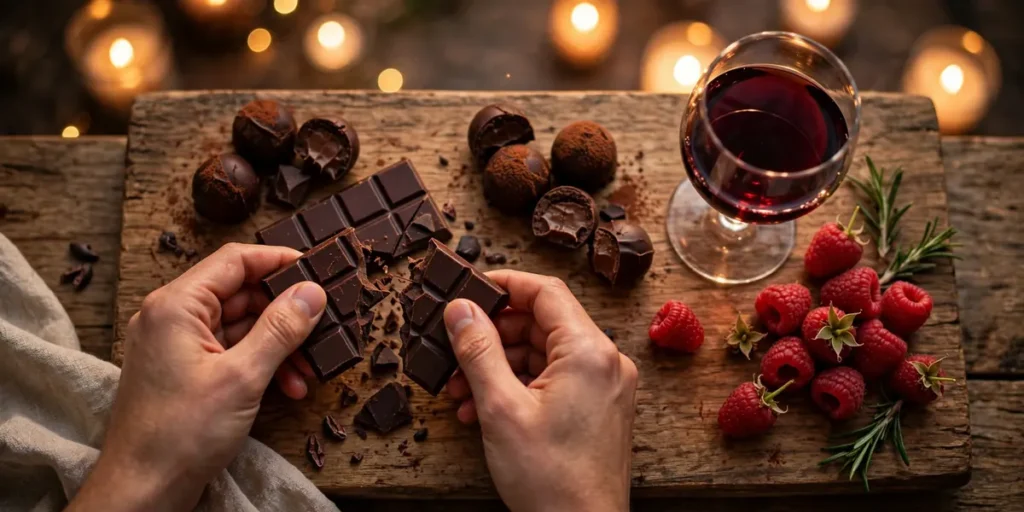
- Chocolate + wine or champagne: Dark chocolate loves bold reds; milk chocolate pairs with sweeter wines or sparkling rosé. Include a simple pairing note — it shows thought.
- Chocolate + coffee or tea: A bag of good coffee beans or loose-leaf tea alongside a truffle box makes a cozy evening gift.
- Chocolate + flowers: The classic duo. A small truffle box tucked beside a bouquet multiplies the romance of both. For flower ideas that go beyond the expected dozen roses, see our guide to Valentine’s Day flowers beyond roses.
- Chocolate + an experience: Pair the box with a planned evening — a home-cooked dinner, a movie night, or a reservation. Our Valentine’s Day date ideas roundup has 60+ ways to build the night around the gift.
- Chocolate + a keepsake: A handwritten letter or a small piece of jewelry alongside the box gives the perishable gift a permanent companion.
Timing, Freshness, and Storage Tips
Chocolate is a fresh product, and a little care preserves its quality. Buy filled chocolates and truffles no more than a week or two before Valentine’s Day, and store them in a cool, dry place — ideally 60–68°F (15–20°C). Avoid the refrigerator if possible; cold causes condensation and can draw out cocoa butter, creating a whitish “bloom” on the surface. Bloom is harmless but dull-looking.
If you must refrigerate (in warm climates, say), seal the box in an airtight bag first and let it return to room temperature before opening to minimize condensation. Never store chocolate near strong odors — it absorbs them readily. And order online early: shipping cutoffs for Valentine’s delivery typically fall several days before the 14th, and cold-pack shipping (worth paying for in warm regions) adds a day or two of lead time.
Chocolate Gifting Etiquette: Small Rules, Big Difference
A few unwritten rules separate polished chocolate gifting from the awkward kind. First, mind the message the box sends in professional settings. A modest box of chocolates for the office is a generous gesture; an extravagant, heart-shaped, ribbon-draped box for one specific coworker can create exactly the wrong impression. Keep workplace chocolate shareable and neutral — think a general assortment for the break room rather than a personal gift for one person.
Second, respect dietary needs without making a production of it. If you know the recipient is vegan, lactose-intolerant, diabetic, or allergic to nuts, choose accordingly — and quietly. Drawing attention to the restriction (“I got you the sugar-free ones!”) can make the gift feel clinical. A beautiful box that happens to suit their needs is far more gracious than one that announces its accommodations.
Third, don’t regift visibly seasonal chocolate. Chocolate with a Valentine’s sleeve from two years ago, or a box whose “best by” date has passed, is worse than no gift at all. If you receive chocolate you won’t eat, pass it along quickly while it’s fresh — or simply share it.
Fourth, consider the card. A box of chocolates with a handwritten note — even two sincere sentences — consistently outperforms a more expensive box with no message. The note is what gets kept; the chocolate, delicious as it is, gets eaten. This holds true across every relationship: romantic partners, friends, parents, and teachers alike.
Finally, when giving chocolate as part of a larger gift, let it play a supporting role gracefully. Tucking a small, excellent box into a gift bag alongside the main present, or presenting it at the end of a home-cooked Valentine’s dinner, gives chocolate its best stage: the sweet finish rather than the whole show.
Watch: How to Choose Boxed Chocolates Like a Pro
Still deciding between all those tempting boxes? This taste-test breakdown from Wirecutter’s editors explains what separates luxury boxed chocolates from standard supermarket candy — including what to look for on the label, why premium boxes cost more, and smart options for dietary restrictions:
Frequently Asked Questions
How much should I spend on Valentine’s Day chocolates?
Most gift-givers spend between $25 and $50, which buys a genuinely good box from a respected chocolatier. Under $25, focus on smaller boxes from quality makers rather than large boxes of mediocre chocolate. Over $50, you’re paying for larger counts, artisan craftsmanship, or elaborate presentation. The recipient will notice quality far more than quantity.
How far in advance should I buy chocolate for Valentine’s Day?
For boxed assortments and bars, one to two weeks ahead is ideal — fresh stock, full selection, and no last-minute markup. For chocolate-covered strawberries, order for pickup or delivery on February 13th or 14th, since they’re best within 24–48 hours of being dipped. Online orders should be placed at least a week before the holiday to account for shipping cutoffs.
What’s the difference between a chocolatier and a candy company?
A chocolatier makes chocolate confections from couverture (high-quality chocolate), typically in smaller batches with attention to ganache texture and flavor balance. Large candy companies produce at scale, often with more sugar, vegetable oils, and preservatives. Neither is “bad,” but for a gift meant to impress, a chocolatier’s box generally delivers noticeably better eating quality.
Are heart-shaped boxes lower quality?
Not necessarily — many excellent chocolatiers release Valentine’s assortments in heart-shaped boxes. But the shape alone tells you nothing about quality, so apply the same checks: ingredient list, freshness date, and the maker’s reputation. A heart-shaped box from a good chocolatier is a lovely gift; a heart-shaped box of unknown origin from a discount rack is a gamble.
What chocolate is best for someone with a nut allergy?
Look for boxes explicitly labeled nut-free and made in nut-free facilities — cross-contamination is common in chocolate production, so “no nuts in the ingredients” isn’t enough for a serious allergy. Many artisan chocolatiers offer dedicated nut-free lines; when in doubt, solid chocolate bars from nut-free facilities are the safest choice.
Can I give chocolate as a Valentine’s gift to a friend or coworker?
Absolutely — chocolate is one of the most versatile Valentine’s gifts precisely because it suits romantic and platonic giving alike. For friends, a fun or playful box works well; see our Valentine’s Day gifts for best friends for more ideas. For coworkers, keep it modest and shareable — a box the whole team can enjoy avoids any awkwardness.
However you choose, remember that the best Valentine’s Day chocolates are the ones chosen with a specific person in mind. Match the style to their taste, buy fresh, present it with care, and the box will do the rest of the talking.