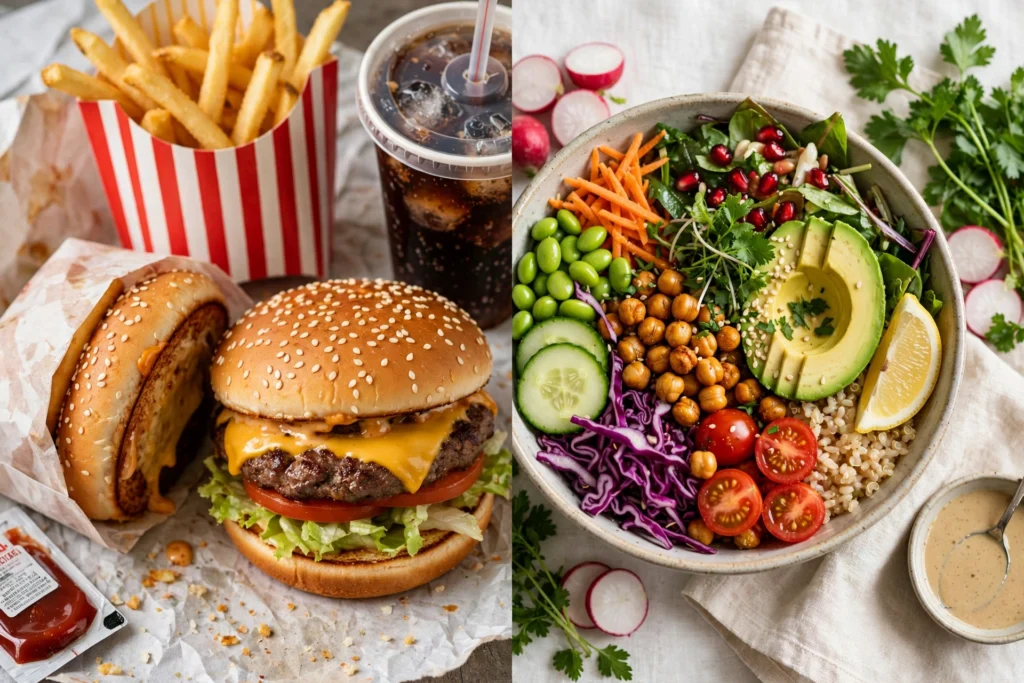
Paying full price at a fast food restaurant in 2026 is a choice — and usually the wrong one. The best fast food deals app rewards have turned the drive-thru into a game where the informed eater wins: free fries every Friday, buy-one-get-one sandwiches, birthday freebies, points that quietly accumulate into free meals. The chains are practically begging you to download their apps, and the discounts they offer in return are the steepest in the industry’s history.
This guide breaks down the rewards programs and deal strategies at ten major chains, with a comparison table of how each program works, the weekly deals worth knowing, and the stacking tactics that turn a $12 meal into a $6 one. Everything reflects programs as of 2026 — these change often, so we focus on the structural strategies that survive any single promotion.
The core insight: the app is the deal. Walk-up prices are the “I did not plan” tax. Nearly every chain reserves its best prices — sometimes 30–50% off — for app orders. Downloading the apps of the three or four chains you visit most is the single highest-value move in this entire guide.
How Fast Food Rewards Programs Work
Most programs follow the same basic model: you earn points per dollar spent, points convert to free items at tiered levels, and the app serves you personalized offers on top. The differences that matter:
- Earning rate: how many points per dollar (typically 10 per $1).
- Redemption value: what your points actually buy — this varies wildly.
- Bonus offers: the weekly deals (free fries Friday, BOGO Tuesdays) are often worth more than the points themselves.
- Tier perks: some programs unlock better rewards as you spend more.
- Expiration: points and offers expire — usually within 30–60 days for offers.
The golden rule: never let a paid order go unlogged. If you are buying food anyway, the points are free money. The only cost is the 30 seconds to scan or order ahead.
The 10 Programs, Ranked by Value
1. McDonald’s — The Deal Machine
The McDonald’s app is the most aggressive deal platform in fast food. Free fries Friday (with minimum purchase), constant BOGO offers, $1 drink deals, and points (100 per dollar) that convert to free items starting at 1,500 points. The personalized “just for you” deals are often shockingly good — 20–40% off your usual order. No other app discounts as deeply or as often.
Best play: check the deals tab before every order; the Friday fries offer alone is worth the download. Watch out: deals vary by location and franchisee participation.
2. Taco Bell — Rewards Royalty
Taco Bell Rewards earns 10 points per dollar, with free items unlocking at reasonable thresholds. The real value is the constant stream of app-exclusive offers — discounted boxes, BOGO crunchwraps, early access to new items. Taco Bell’s limited-time items often come with app-only pricing that beats the menu board by dollars.
Best play: the app-exclusive boxes and challenges (buy X get Y free) are the deepest discounts. Watch out: points expire after 12 months of inactivity.
3. Chick-fil-A — Points With Perks
Chick-fil-A One earns 10 points per dollar, with tiered membership (Member, Silver, Gold, Signature) that increases earning rates up to 13 points per dollar. Points convert to free sandwiches, nuggets, and more. The birthday reward is generous, and the app occasionally drops surprise freebies. The food is pricier, so the points feel proportionally valuable.
Best play: the tier system rewards loyalty — concentrate your chicken spending here. Watch out: redemption values are higher than competitors’, reflecting menu prices.
4. Wendy’s — Straightforward and Frequent
Wendy’s Rewards is simple: 10 points per dollar, free items starting at modest thresholds, and a steady cadence of BOGO and discount offers. The breakfast deals are particularly good. No tiers, no complexity — just consistent value.
Best play: the app’s breakfast offers are among the best morning deals in fast food. Watch out: fewer surprise freebies than McDonald’s.
5. Burger King — The Coupon King Goes Digital
Burger King’s app inherited the chain’s coupon legacy: aggressive digital coupons, frequent BOGO Whopper deals, and the Royal Perks program (10 crowns per dollar). The “offers” tab is essentially a digital coupon book, and the deals are consistently among the deepest — 2-for deals, $5 meal bundles, and more.
Best play: check the offers tab like a coupon book; the bundle deals are the best value. Watch out: the app experience is clunkier than competitors’.
6. Popeyes — Spicy Deals
Popeyes’ app offers points plus regular BOGO sandwich deals and discounted family bundles. The deals skew toward the chicken sandwich and tenders — the items you want anyway. Limited-time offers tied to new items are frequent and generous.
Best play: the BOGO chicken sandwich offers are the headline value. Watch out: fewer locations means fewer chances to use it.
7. Domino’s — Piece of the Pie
Domino’s Piece of the Pie rewards (10 points per order over $10, free pizza at 60 points) is simple and the free pizza comes relatively fast for regulars. The weekly carryout and delivery deals ($7.99 carryout pizzas, etc.) are the real value — the points are a bonus on top of already-cheap pizza.
Best play: the $7.99 carryout deal plus points accumulation is the cheapest pizza night in America. Watch out: delivery fees and tips erode the value of delivery orders.
8. Panera — Unlimited Sip Club
Panera’s MyPanera program is decent, but the Unlimited Sip Club — a monthly subscription for unlimited coffee, tea, and fountain drinks — is the standout deal for daily visitors. If you buy coffee more than a few times a week, the math is overwhelmingly in your favor. The rewards program itself earns credit toward free items.
Best play: the Sip Club pays for itself in about a week for daily coffee drinkers. Watch out: it is a subscription — cancel if your habits change.
9. Shake Shack — Shack App Simplicity
The Shack app is less deal-heavy than competitors, but it offers order-ahead convenience, occasional freebies, and a clean loyalty experience. The value proposition is weaker — Shack does not do deep discounts — but the app removes the line, which at a busy Shack is worth real money in time.
Best play: order ahead to skip the line; watch for limited-time freebies. Watch out: do not expect McDonald’s-level discounting.
10. Starbucks — The Gold Standard (Honorable Mention)
Not fast food, but the benchmark: Stars on every purchase, free customizations, birthday rewards, and double-star days. Included because its program design is what every fast food chain is chasing.
Rewards Comparison Table
| Chain | Points per $1 | Free item threshold | Standout deal | App rating |
|---|---|---|---|---|
| McDonald’s | 100 | 1,500 pts | Free Fries Friday | ★★★★★ |
| Taco Bell | 10 | Varies | App-exclusive boxes | ★★★★★ |
| Chick-fil-A | 10–13 | Varies by tier | Tiered earning | ★★★★ |
| Wendy’s | 10 | Low | Breakfast offers | ★★★★ |
| Burger King | 10 crowns | Varies | Digital coupons | ★★★★ |
| Popeyes | Varies | Varies | BOGO sandwiches | ★★★ |
| Domino’s | 10/order $10+ | 60 pts | $7.99 carryout | ★★★★ |
| Panera | Credit-based | Varies | Sip Club subscription | ★★★ |
| Shake Shack | N/A | Promotional | Order-ahead | ★★★ |
The Stacking Playbook: How to Combine Deals
Stack 1: App offer + points redemption. Most apps let you apply a deal offer AND earn points on the same order — and some let you redeem points while using an offer. Always check: the combo of “20% off” plus “free fries with points” is the holy grail.
Stack 2: The birthday circuit. Nearly every chain gives a birthday freebie. Space your sign-ups and you can eat free for a week around your birthday. Chick-fil-A, Wendy’s, Burger King, and Panera all participate.
Stack 3: Survey receipts. Many receipts include survey codes for free items (McDonald’s, Burger King, Wendy’s). Two minutes of feedback for a free sandwich is an excellent hourly rate.
Stack 4: The refer-a-friend loop. Several apps offer referral bonuses — free items for you and your friend. Coordinate with a partner or friend group and everyone eats.
Stack 5: Day-of-week rituals. Free Fries Friday (McDonald’s), Taco Tuesdays (various), BOGO deals tied to specific days — build these into your routine and the savings compound.
Stack 6: The new-app bonus. Chains periodically offer outsized bonuses for first orders or app downloads. When trying a new chain, always download first — the welcome offer is usually the best deal you will ever get there.
Weekly Deal Calendar (Typical)
- Monday: Start-of-week BOGO offers (Burger King, Popeyes)
- Tuesday: Taco deals (Taco Bell, various)
- Wednesday: Midweek points multipliers (McDonald’s, Chick-fil-A)
- Thursday: Breakfast deals (Wendy’s, McDonald’s)
- Friday: Free Fries Friday (McDonald’s) — the flagship weekly deal
- Weekend: Family bundle deals (Domino’s, Popeyes, KFC)
Deals to Avoid (Traps)
The “deal” that requires overspending. A “free item with $20 purchase” is not a deal if you only wanted $8 of food. Never spend extra to unlock a discount worth less than the extra spend.
Delivery app markups. Third-party delivery apps often charge menu prices 15–30% above in-store, plus fees and tips. A “deal” on a delivery app can still cost more than walking in. Order pickup through the chain’s own app instead.
Points hoarding. Points expire. Offers expire. Hoarding 10,000 points “for later” while weekly freebies lapse is leaving money on the table. Redeem regularly.
The subscription you forgot. Panera’s Sip Club and similar subscriptions are great if you use them, expensive if you do not. Audit quarterly.
Why Chains Give Food Away: The Economics
The deals are not charity — they are customer acquisition math. Acquiring a new customer through traditional advertising costs chains $10–$20 per person. Giving you a free sandwich that costs them $1.50 in food cost is dramatically cheaper — and it comes with your data, your order history, and a direct marketing channel to your phone. The app is the most cost-effective advertising ever invented for restaurants.
What this means for you: the deals are best when chains are competing hardest for your attention — new app launches, new menu items, competitive markets, and economic downturns. The current value war is the best deal environment in years. Take advantage while it lasts, because the generosity correlates with competition, not kindness.
The data trade: you are trading order data for discounts. For most people, this is an excellent trade — the data is anonymized-ish and the savings are real. If it bothers you, use the deals without the loyalty program where possible (many offers work without full enrollment).
Beyond the Apps: Other Deal Sources
Coupon aggregators: RetailMeNot, Slickdeals, and similar sites track printable and digital coupons — Burger King’s paper-coupon legacy lives on digitally. Check before big orders.
Social media: chains announce flash deals on X, Instagram, and TikTok — often with only hours of notice. Following your top three chains catches the limited drops.
Email lists: old-fashioned but effective — birthday offers, new-item announcements, and location-specific deals still go to email first.
Receipt surveys: the two-minute survey for a free sandwich is the highest-ROI activity in fast food. McDonald’s, Burger King, Wendy’s, and others all run these programs.
Student and military discounts: many locations offer 10% off with ID — always ask. The policies vary by franchise, but the discount is real where offered.
Senior discounts: McDonald’s, Burger King, Wendy’s, and others offer senior discounts or free coffee — typically 55+ or 60+, varying by location.
Gift Card Hacks
Discounted gift cards are free money: warehouse clubs (Costco, Sam’s) regularly sell fast food gift card bundles at 15–25% off face value. Raise, CardCash, and similar marketplaces sell discounted cards year-round. Buy the cards for chains you already visit, then stack the gift card payment with app deals and points — the discounts compound. A 20%-off gift card plus a 20%-off app deal is effectively 36% off.
The 30-Day Deal Challenge
Want to systematize the savings? Try this month-long rotation:
- Week 1: download the apps for your top 4 chains; claim all welcome offers.
- Week 2: map the weekly deal calendar (Free Fries Friday, taco Tuesdays, etc.) and hit each one once.
- Week 3: complete receipt surveys from week 2’s visits; redeem the freebies.
- Week 4: audit — which apps earned their home-screen space? Delete the rest, keep the winners.
Most people save $30–$60 in the first month without changing what they eat — just how they order it.
The Psychology of “Deals”
A final caution: deals are designed to make you spend more, not less. “Free fries with $10 purchase” works because most people add $4 of food they did not want to get $2 of free fries. The defense is simple — only chase deals on food you were already buying. The best deal is the discount on your usual order, not the freebie that reorganized your dinner plans. Stay disciplined and the apps are pure profit; get FOMO-driven and you are the product.
App-by-App Quick Reference
The essentials, one line each:
- McDonald’s: check deals tab every order; Free Fries Friday; 100 pts per $1.
- Taco Bell: app-exclusive boxes; early access to new items; 10 pts per $1.
- Chick-fil-A: tiered earning up to 13 pts per $1; generous birthday reward.
- Wendy’s: best breakfast offers; simple 10 pts per $1, no tiers.
- Burger King: digital coupon book; bundle deals; Royal Perks crowns.
- Popeyes: BOGO sandwich alerts; family bundle deals.
- Domino’s: $7.99 carryout + Piece of the Pie points; fastest free pizza.
- Panera: Sip Club for daily drinkers; MyPanera credit rewards.
The minimalist setup: if you only keep three apps, make it McDonald’s (deepest deals), Chick-fil-A (best loyalty), and Taco Bell (most creative offers). These three cover the highest-value scenarios for most eaters.
The Deal Hunter’s Code
Five principles for a lifetime of never overpaying:
- The app is the price. Walk-up prices are for emergencies. The real menu lives in the app.
- Loyalty compounds. Concentrate spending on 3–4 chains instead of spreading it across ten — tiers and points reward focus.
- Redeem, do not hoard. Points and offers expire. A redeemed freebie beats a lapsed fortune.
- Stack everything. Offer + points + gift card + survey reward — the layers multiply.
- Never chase. If a deal requires spending you would not otherwise spend, it is not a deal — it is marketing.
Follow the code and fast food becomes one of the great value propositions in American life: hot, fast, and far cheaper than it looks.
Frequently Asked Questions
Which fast food app has the best rewards?
McDonald’s offers the deepest and most frequent discounts; Chick-fil-A’s tiered program rewards loyalty best; Taco Bell’s app-exclusive pricing is the most creative. Download all three.
Do fast food points expire?
Usually, yes — points typically expire after 6–12 months of inactivity, and promotional offers expire much faster (days to weeks). Redeem regularly.
Can I use deals and earn points at the same time?
Usually yes — most apps let you apply an offer and earn points on the same order. Some also allow point redemption alongside offers. Always try; the worst case is the app says no.
Are fast food apps worth the storage space?
If you visit a chain even twice a month, yes — the deals will save you more than the inconvenience costs. Keep the 3–4 you actually use; delete the rest.
What is the best day for fast food deals?
Friday — McDonald’s Free Fries Friday anchors the week, and most chains load weekend offers on Thursdays and Fridays. Check your apps every Friday morning; it is the highest-value habit in this guide.
Do fast food deals work on delivery orders?
Sometimes — chain-app pickup deals are the most reliable. Third-party delivery apps run their own promotions, but menu markups often erase the savings. For the best price, order pickup through the chain’s own app.
What is the best fast food birthday freebie?
Chick-fil-A’s birthday reward (a free sandwich or nuggets, tier-dependent) and the various free-dessert offers are the standouts. Sign up at least a few weeks before your birthday.
The Bottom Line
The best fast food deals and app rewards reward one behavior above all: planning ahead by about ninety seconds. Check the app, apply the offer, earn the points, redeem before they expire. The chains have built a system where the informed customer pays dramatically less than the walk-up customer — sometimes half. Download the apps for your top three chains, learn the weekly rhythms, and never pay full price again.