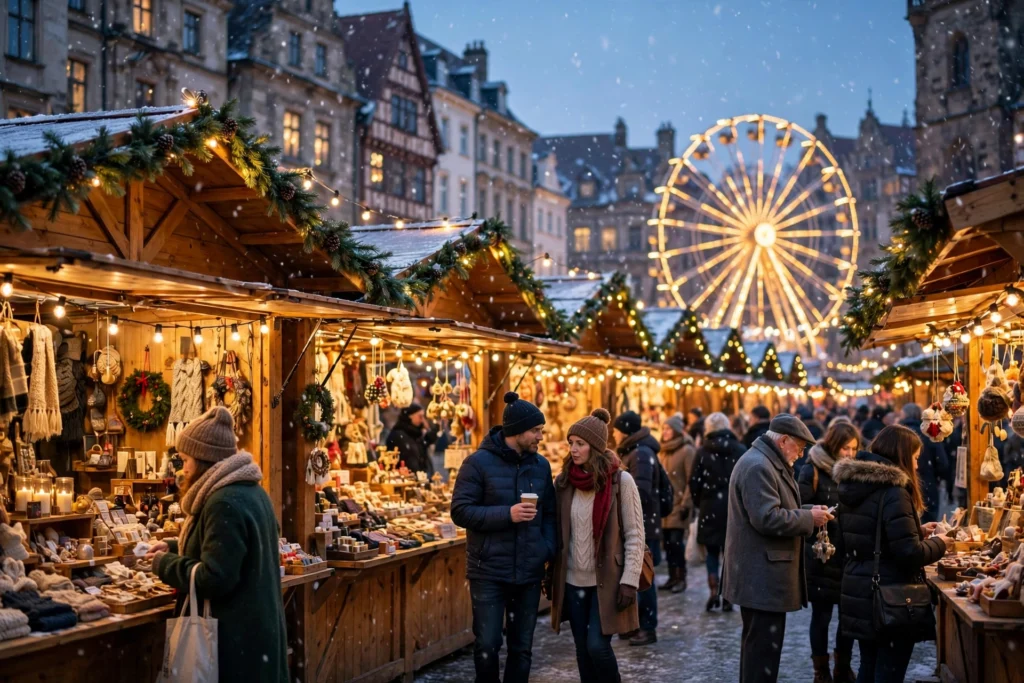
From the first candlelit verse of “Silent Night” to the opening sleigh bells of a pop classic, Christmas music is the soundtrack of the season — and building the perfect playlist is a December ritual in itself. These best christmas songs — carols of all time — span eight centuries, from medieval processionals to modern chart-toppers, each carrying a story worth knowing.
This guide is part history, part playlist manual. You will meet the carols by era — medieval, Victorian, and modern — learn the true stories behind the most beloved songs, discover global Christmas music traditions, and get ready-made playlist formulas for every occasion: the dinner party, the gift-wrapping session, the quiet Christmas Eve, and the big family singalong.
For the words and backstory of the most famous carol of all, see our christmas carol lyrics and history: Silent Night deep dive.
The Medieval Roots: Carols Before Christmas Was Christmas
The word “carol” originally meant a dance in a circle — not a Christmas song at all. Early carols were pagan and seasonal folk songs; the church gradually absorbed the form, and by the 13th century, Franciscan friars were writing joyful vernacular songs about the Nativity to make the story accessible to ordinary people.
“O Come, O Come, Emmanuel” (12th century, translated 1851)
Among the oldest in the canon: a haunting Advent chant built from ancient antiphons, each verse addressing Christ by a different Old Testament title. Its minor key gives it a yearning quality unlike the cheer of later carols — the sound of waiting, which is what Advent is.
“Gaudete” (16th century)
A Finnish-Swedish carol published in 1582, its single-word refrain (“Rejoice!”) carried by a driving rhythm. It became a surprise UK hit in the 1970s via the band Steeleye Span — proof that medieval music can still chart.
“Coventry Carol” (16th century)
The lullaby from the medieval Coventry mystery plays, sung by mothers to the infants threatened by Herod’s decree. Heartbreakingly beautiful and genuinely mournful — a reminder that the Christmas story has shadows, which is why it resonates.
“The Holly and the Ivy” (traditional, published 19th century)
A carol of pagan-Christian fusion: holly and ivy, ancient winter symbols, reimagined with Christian meanings for every berry and leaf. It carries the oldest DNA of the season’s music.
The Victorian Carol Boom
The Christmas we recognize — trees, cards, carols sung door to door — was largely invented in the 19th century, and its soundtrack was written then too. Victorian hymn-writers and collectors created or popularized most of the carols sung today.
“Silent Night” (1818)
Composed in a single evening in Oberndorf, Austria, by a priest (Joseph Mohr) and an organist (Franz Gruber) — legend says because the church organ was broken and they needed something for guitar. From that humble origin it became the most translated carol in history, sung in over 300 languages, and famously sung by opposing trenches during the 1914 Christmas Truce.
“O Holy Night” (1847)
Originally the French “Cantique de Noël,” with music by Adolphe Adam. Its soaring “Fall on your knees” climax makes it the great vocal showpiece of Christmas — the carol singers attempt to prove they can still hit the high note.
“Hark! The Herald Angels Sing” (1739/1840)
Charles Wesley’s words married a century later to a melody by Mendelssohn (who reportedly thought his tune was too secular for sacred words — history disagreed). The descant on the final verse is the moment every choir waits for.
“O Come, All Ye Faithful” / “Adeste Fideles” (18th century)
Possibly by John Francis Wade, this Latin-English processional is the sound of the midnight service itself — triumphant, communal, and built for a full congregation at full volume.
“In the Bleak Midwinter” (1906)
Christina Rossetti’s poem set unforgettably by Gustav Holst (and separately by Harold Darke — choirs argue over which setting is definitive). Bleak, tender, and quietly devastating: “What can I give Him, poor as I am?”
“Good King Wenceslas” (1853)
Based on a real 10th-century Bohemian duke, with words by John Mason Neale set to a 13th-century spring carol tune. The story — a king braving the snow to feed a peasant — makes it the carol of Christmas charity, which is why it pairs so naturally with christmas volunteering and give-back ideas.
The 20th Century Songbook: Standards That Became Carols
The American songbook era (1930s–1960s) produced the secular Christmas canon — songs written for radio, film, and records that are now as traditional as any hymn.
“White Christmas” (1942)
Irving Berlin’s masterpiece, introduced by Bing Crosby in the film Holiday Inn. It remains one of the best-selling singles of all time — a wistful dream of snow written, poignantly, by a Jewish songwriter who defined the secular American Christmas.
“Have Yourself a Merry Little Christmas” (1944)
Written for Judy Garland in Meet Me in St. Louis, its original lyric (“…it may be your last”) was softened at her request — and the gentler version became timeless. The definitive bittersweet Christmas song.
“The Christmas Song (Chestnuts Roasting)” (1945)
Written on a sweltering summer day by Mel Tormé and Bob Wells, trying to “stay cool by thinking cool.” Nat King Cole’s velvet recording is the gold standard — the aural equivalent of a fireplace.
“Rudolph the Red-Nosed Reindeer” (1949)
Began as a Montgomery Ward coloring-book giveaway written by Robert L. May, turned into a song by his brother-in-law Johnny Marks, and made immortal by Gene Autry. A story about the misfit who saves the day — no wonder children claimed it.
“Rockin’ Around the Christmas Tree” (1958)
Brenda Lee was 13 when she recorded it. Sixty-plus years later it still soundtracks every party — the blueprint for the upbeat Christmas pop song.
“It’s Beginning to Look a Lot Like Christmas” (1951)
Meredith Willson’s inventory of seasonal sights, revived for new generations by Michael Bublé’s recording. The official song of the decorations-going-up weekend.
The Modern Classics (1960s–Today)
“Last Christmas” (1984)
Wham!’s synth-pop heartbreak is the most-played modern Christmas song in many countries — and the center of “Whamageddon,” the annual game of avoiding it until Christmas Eve. George Michael wrote, produced, and played every instrument on it.
“All I Want for Christmas Is You” (1994)
Mariah Carey’s juggernaut returns to the charts every December, breaking streaming records annually. Written in about 15 minutes, it proves that joy — not complexity — is the formula.
“Fairytale of New York” (1987)
The Pogues and Kirsty MacColl’s bittersweet duet is Ireland and Britain’s perennial favorite — romantic, rowdy, and achingly sad by turns. The rare Christmas song about real, complicated love.
“Merry Christmas Everyone” (1985)
Shakin’ Stevens’ Welsh rock-and-roll stomper — pure party energy and a reminder that Christmas music is a global, working-class tradition too.
“Feliz Navidad” (1970)
José Feliciano’s bilingual classic — nineteen words, endlessly singable, and the gateway carol for millions of Spanish-English households. Proof that simplicity wins.
“Christmas (Baby Please Come Home)” (1963)
Darlene Love’s Phil Spector-produced wall of sound — the be-all of Christmas longing, and the traditional closer of a famous late-night TV Christmas show for decades.
Christmas Music Around the World
The canon above is Anglo-American; the world’s Christmas playlists are far richer:
- Puerto Rico & Latin America: Aguinaldos and parrandas — troubadour groups roam neighborhoods singing traditional songs, expecting to be fed. Christmas music as a social event.
- Philippines: Caroling (pangangaroling) by children with handmade instruments is ubiquitous through the world’s longest Christmas season (September–January).
- Germany: “Stille Nacht” in its homeland, plus the great Bach Christmas Oratorio — Christmas music as high art.
- Caribbean: Parang (Trinidad) and Jonkonnu music blend African, European, and Indigenous traditions into Christmas street music.
- Nigeria & Ghana: Highlife and Afrobeats Christmas songs dominate December airwaves — a joyful, danceable canon entirely separate from the Western one.
- Japan: Where Christmas is a romantic holiday, pop ballads and the ubiquitous “Christmas Eve” by Tatsuro Yamashita define the season’s sound.
Playlist Formulas for Every Occasion
The Dinner Party (3 hours, background)
Start with jazz and crooner standards (Nat King Cole, Ella Fitzgerald, Dean Martin), move to acoustic carols during the main course, and lift the energy with modern pop as dessert arrives. Keep volume low enough for conversation — the music should be discovered, not announced.
The Gift-Wrapping Session (2 hours, upbeat)
All energy: Brenda Lee, Mariah Carey, Wham!, Shakin’ Stevens, and the rock-and-roll end of the canon. Tempo matters more than taste — you need songs that keep scissors moving.
Christmas Eve, Late (90 minutes, reflective)
Choir carols: King’s College-style “O Holy Night,” “In the Bleak Midwinter,” “Silent Night” (the original German version at midnight is traditional in many families). This is the playlist for the quiet after the excitement.
The Family Singalong (1 hour, participatory)
Only songs everyone knows: “Jingle Bells,” “Rudolph,” “Feliz Navidad,” “We Wish You a Merry Christmas,” “Deck the Halls.” Print lyric sheets — confidence doubles the volume. End, always, with “We Wish You a Merry Christmas,” because tradition.
The Morning Unwrapping (1 hour, joyful)
Bright and happy: “It’s Beginning to Look a Lot Like Christmas,” “Rockin’ Around the Christmas Tree,” instrumental jazz carols for the first sleepy minutes. Match the energy of the room as it wakes up.
How to Build a Playlist That Lasts All Season
The 60/30/10 rule: 60% beloved familiar songs (the canon above), 30% personal favorites and discoveries, 10% new finds each year. This keeps the playlist comforting but fresh — and the annual “what’s our new song this year?” debate becomes its own tradition.
Sequence matters: Open strong (a favorite), alternate eras and tempos, and close with intention — “Have Yourself a Merry Little Christmas” or “Silent Night” are closers, not openers. Length: Build 4–5 hours; looping a 90-minute playlist breeds contempt by week two. Collaborate: Make it a shared playlist and let every family member add five songs — the teenagers’ picks will surprise you.
More Stories Behind the Songs
Every great Christmas song has a backstory. These five are worth knowing — they make excellent dinner-party conversation and deepen the listening.
“Do They Know It’s Christmas?” (1984)
Written by Bob Geldof and Midge Ure in response to the Ethiopian famine, recorded in a single day by Britain’s biggest pop stars as Band Aid, and released to become the UK’s best-selling single ever at the time. It invented the charity supergroup single and has been re-recorded for subsequent crises — a Christmas song that is genuinely about giving, not just romance.
“Happy Xmas (War Is Over)” (1971)
John Lennon and Yoko Ono’s protest lullaby, recorded with the Harlem Community Choir, whose children’s voices carry the chorus. Written as an anti-Vietnam War statement, it has outlived its moment to become a universal plea — proof that Christmas songs can carry weight beyond tinsel.
“Driving Home for Christmas” (1988)
Chris Rea wrote it years earlier, inspired by a miserable drive home through snow after being denied a first-class train seat. Its slow build from quiet piano to full-band warmth mirrors the journey itself — which is why it soundtracks millions of actual drives home every December 23rd.
“Step Into Christmas” (1973)
Elton John and Bernie Taupin’s glam-rock Christmas stomper was a deliberate attempt to write a holiday hit — and it worked, returning to the charts nearly every year since. The music video’s over-the-top festivity set the template for the modern Christmas pop spectacle.
“Mary’s Boy Child” (1956/1978)
Written by Jester Hairston, a hit for Harry Belafonte in the 1950s, then reborn as Boney M.’s disco version — one of the best-selling singles of all time in the UK. Few songs have lived two completely different lives; both versions still fill dance floors.
How to Organize a Neighborhood Caroling Night
Caroling is the most rewarding Christmas music tradition — and the easiest to start. Recruit: 6–15 people of any ability; enthusiasm matters more than talent. Invite via the street’s group chat with a fixed date (a weekend evening, 6–8 p.m.) and a rain-or-shine plan. Repertoire: 8–10 songs everyone knows — “Jingle Bells,” “Rudolph,” “Silent Night,” “We Wish You a Merry Christmas,” “Deck the Halls,” “O Come All Ye Faithful,” “Hark! The Herald Angels Sing,” “Feliz Navidad.” Print lyric sheets (large font, laminated if rain threatens). Route: Plan 8–12 houses, prioritizing elderly neighbors and families with young kids — the audiences who cherish it most. Knock, sing two songs, wish them well, move on. Logistics: Bring lanterns or phone flashlights, dress warmly, and end at the organizer’s house with mulled cider and mince pies. One caroling night creates more neighborhood goodwill than a year of polite waves — and children remember it for decades.
Christmas Music for Kids: Songs They Will Love
Children’s Christmas music is its own joyful genre. Beyond the obvious (“Rudolph,” “Frosty the Snowman,” “Jingle Bells”), seek out: call-and-response songs (“Must Be Santa,” “The Twelve Days of Christmas” — assign each child a verse), action songs (“I’m a Little Snowman,” sung to “I’m a Little Teapot”), funny songs (“I Want a Hippopotamus for Christmas,” “The Chipmunk Song”), and gentle lullabies (“Away in a Manger,” “Silent Night” for bedtime). Make a dedicated kids’ playlist for car rides and craft time — and let them control the shuffle; ownership doubles the joy. For lyrics and history to share while you listen, our Silent Night guide is written to be read aloud.
Christmas Number Ones: A Brief Chart History
The UK Christmas number one single is a cultural institution — and its history mirrors the evolution of Christmas music itself:
- The early years: Traditional carols and crooners dominated the first Christmas charts of the 1950s, reflecting the post-war reverence for the season.
- 1973–74: Slade’s “Merry Xmas Everybody” and Wizzard’s “I Wish It Could Be Christmas Everyday” — glam rock’s twin assault — established the modern template: loud, joyful, and released to dominate December.
- 1984: Band Aid’s “Do They Know It’s Christmas?” became the best-selling single in UK history at the time and proved Christmas songs could carry serious purpose.
- The novelty era: The 1990s and 2000s saw novelty and reality-TV winners take the spot — to the dismay of traditionalists, who responded with campaigns for “proper” Christmas songs.
- The streaming era: Classics re-enter annually now: Mariah Carey’s “All I Want for Christmas Is You” returns to number one in multiple countries each December, and Wham!’s “Last Christmas” finally reached UK number one in 2021 — 36 years after release — a testament to slow-burn love.
The chart battle is half the fun: pick your horse each December, follow the race, and argue about it at dinner. It is the most British of Christmas traditions, and entirely exportable.
Christmas Music Trivia for Parties
Arm yourself for the season’s quizzes with these verified gems:
- “Silent Night” has been translated into more than 300 languages and dialects.
- Brenda Lee was 13 when she recorded “Rockin’ Around the Christmas Tree.”
- “White Christmas” remains the best-selling physical single of all time (Bing Crosby’s version).
- George Michael wrote, produced, and performed every part of Wham!’s “Last Christmas.”
- “The Christmas Song” was written in a heatwave, as the writers tried to “stay cool by thinking cool.”
- “Fairytale of New York” took two years to write and was almost abandoned multiple times.
- José Feliciano’s “Feliz Navidad” uses only 19 distinct words (plus its repeated refrain).
- The “Hallelujah” chorus from Handel’s Messiah — premiered in 1742 — is still performed in thousands of Christmas concerts every December, making it the oldest continuously performed Christmas music in the canon.
Frequently Asked Questions
What is the most popular Christmas song of all time?
By sales, Bing Crosby’s “White Christmas” remains the best-selling single of all time. By modern streaming, Mariah Carey’s “All I Want for Christmas Is You” dominates every December, returning to number one in multiple countries annually. By longevity, “Silent Night” — translated into 300+ languages and sung continuously since 1818 — has the deepest roots. Each measures a different kind of popularity, and each has a fair claim.
What is the oldest Christmas carol still sung today?
“O Come, O Come, Emmanuel” draws on 12th-century (and older) Advent chants, making it among the oldest. “Gaudete” dates to a 1582 Finnish songbook. But many “ancient” carols use old tunes with newer words — “Good King Wenceslas” pairs 19th-century words with a 13th-century melody. The carol tradition is a palimpsest: old music, new words, endlessly renewed.
Why do we sing carols at Christmas?
Caroling descends from medieval wassailing and mystery plays — communities singing the Nativity story door to door. The Victorians formalized it into the practice we know, with printed carol collections and organized choirs. At its heart, caroling is communal storytelling: the Christmas narrative set to melodies simple enough for everyone to join. That participatory quality is why carols outlast every other form of Christmas music.
What are good Christmas songs for a party playlist?
Upbeat, universally known, and singable: “Rockin’ Around the Christmas Tree,” “All I Want for Christmas Is You,” “Last Christmas,” “Merry Christmas Everyone,” “Feliz Navidad,” “Jingle Bell Rock,” and Michael Bublé’s catalog. Avoid the slow, reflective carols until the party winds down — read the room, and keep the tempo matched to the energy. Our christmas karaoke songs playlist is the natural next step when the party wants to sing along.
What is the story behind “Silent Night”?
On Christmas Eve 1818 in Oberndorf, Austria, assistant priest Joseph Mohr brought a poem to organist Franz Gruber, who composed the melody that evening — tradition says the church organ was broken, requiring a guitar-accompanied piece. It was first performed that midnight Mass. Traveling folk singers spread it across Europe, and it was translated into English in the 19th century. Its most famous moment: the 1914 Christmas Truce, when opposing trenches sang it together across no-man’s-land. See our Silent Night lyrics and history guide for the full story.
How do I find Christmas music from other cultures?
Search streaming platforms for terms like “aguinaldo,” “parranda,” “Noël,” “Weihnachtslieder,” or “Christmas highlife” to open whole new canons. YouTube is rich with regional Christmas music traditions. And ask: colleagues, neighbors, and friends from other backgrounds often love sharing their family’s holiday songs — music is the easiest cultural exchange there is, and it pairs beautifully with learning how to say merry christmas in different languages.
The best christmas songs and carols of all time endure because they do what the season asks: they gather people, hold memory, and make the dark a little brighter. Build your playlist with intention, learn the stories behind the songs, and sing — badly, loudly, together. That is what carols are for.