

Chasing the best Black Friday smart home deals 2026 is one of the highest-value hunts of the sale season — not because any single gadget is life-changing, but because smart home gear is bought in multiples. A starter kit becomes five bulbs, two speakers, a thermostat and a doorbell faster than anyone plans, and Black Friday’s bundle pricing is designed exactly for that accumulation. The catch: the smart home market is a maze of competing ecosystems, protocols and subscription traps. Buy the wrong ecosystem and your “bargains” become a collection of gadgets that refuse to talk to each other. This guide gives you the ecosystem strategy first, then the device-by-device buying advice, so every discounted gadget you buy actually works together.
Black Friday 2026 is Friday, November 27, with Cyber Monday on November 30. Smart home deals start early — late October — and run in two flavors: aggressive discounts on individual devices (bulbs, plugs, speakers) and bundle pricing on starter kits that gets better as November progresses. The deepest ecosystem-level discounts historically land in Black Friday week, when platform owners subsidize hardware to win your household. That makes November the ideal moment to commit to an ecosystem — but commit deliberately, because switching later means replacing everything.
We never claim a specific device is on sale at a specific retailer. Instead: the ecosystem decision framework, device guides, tiered buying plans, worldwide shopping advice and discount verification. For the season overview, see our best Black Friday deals hub and Black Friday 2026 shopping guide.
Step one: choose your ecosystem before you buy anything
This is the most important decision in smart home shopping, and most buyers make it accidentally — by buying whatever is cheapest and ending up with three incompatible apps. The major ecosystems (built around the big voice assistants and smart home platforms) each offer broad device support, but cross-ecosystem compatibility, while improving thanks to the Matter standard, is still imperfect. Before Black Friday, answer three questions:
- What phones do you use? Households deep in one phone ecosystem usually get the smoothest experience staying in the matching smart home lane.
- What voice assistant do you already use? If everyone talks to the same assistant daily, that is your ecosystem — voice is the primary smart home interface.
- What do you already own? Audit existing devices (TV streaming platforms, doorbells, thermostats) and favor the ecosystem that absorbs them with the least friction.
Once chosen, buy within it. A discounted gadget from a rival ecosystem is not a bargain — it is a future headache. The Matter standard is gradually making devices interoperable regardless of platform, and Matter-certified devices are worth prioritizing in 2026 because they protect you against ecosystem shifts. When comparing two similar discounted devices, the Matter-certified one is the safer long-term bet.
The starter, mid-range and whole-home tiers
Smart home buying works best as a planned progression, not a random accumulation. Here are the three tiers and what belongs in each.
| Tier | Budget mindset | Typical devices | Best for |
|---|---|---|---|
| Starter | Dip a toe in | Smart speaker, 2–4 smart bulbs, smart plug | Renters, the curious, single-room upgrades |
| Mid-range | Automate daily routines | Thermostat, video doorbell, more bulbs, smart lock | Homeowners building real convenience |
| Whole-home | Integrated living | Security cameras, sensors, shades, full lighting | Enthusiasts, new builds, renovators |
Starter tier: the Black Friday sweet spot
A smart speaker plus a few bulbs and a plug is the classic entry point, and Black Friday is when these items hit their lowest prices of the year — speakers in particular are routinely discounted as ecosystem loss-leaders. This tier answers the real question: do you actually enjoy living with smart home tech? Buy here, live with it for a month, and let experience — not marketing — decide whether you expand. Total starter cost during sales is modest, and everything remains useful even if you stop expanding.
Mid-range tier: where the value lives
This is where smart homes start paying back daily: a smart thermostat trimming heating bills, a video doorbell answering the door from anywhere, a smart lock ending key anxiety, lighting scenes for evenings. Black Friday bundle deals shine here — multi-device kits from one ecosystem at package prices. Plan purchases around routines you actually want automated (morning, away-from-home, bedtime, movie night) rather than buying gadgets speculatively.
Whole-home tier: plan like an integrator
Full-home automation — cameras, sensors on every door, automated shades, whole-house lighting — rewards planning and punishes impulse buying. If this is the goal, use Black Friday to buy the infrastructure (the hub or backbone devices, the camera system) and expand room by room through the year. Consistency matters more than discounts at this tier: one ecosystem, one protocol preference, one app family. Mixed-protocol whole homes become maintenance burdens.
Device-by-device buying guide
Smart speakers and displays
The command center of most smart homes. Speakers are the cheapest entry point and get the deepest Black Friday discounts — they are ecosystem trojan horses, priced to win your household. Smart displays add visual info, video calls and camera monitoring. Buy the speaker for the ecosystem you chose; sound quality differences at the budget end are minor, and the assistant’s competence matters more than the audio. One per main living area is plenty to start; whole-home audio is a later luxury.
Smart bulbs and lighting
Bulbs are the most satisfying smart home purchase — lighting scenes transform evenings. Two decisions: white-only versus color (color costs more; white tunable is the value pick for most rooms), and hub versus WiFi-direct (hub systems are more reliable at scale; WiFi bulbs are simpler for a few rooms). Black Friday multi-packs are the economical way to do a room. Check brightness (lumens) against the bulbs you are replacing — dim “smart” bulbs disappoint. And keep one physical switch strategy: smart bulbs need constant power, so households need to agree not to flip the wall switch, or use smart switches instead.
Smart plugs
The unsung heroes: they make any dumb device (lamps, fans, coffee makers) smart for very little money. Perfect for renters who cannot rewire anything. Black Friday multi-packs are absurdly cheap. Check the power rating against what you will plug in — high-draw appliances like space heaters need appropriately rated plugs, and some should never be on a smart plug at all.
Smart thermostats
The rare smart home device with a measurable payback — heating and cooling are most homes’ biggest energy costs. Compatibility is the hurdle: check your HVAC system’s wiring (the C-wire question) before buying, using the manufacturer’s compatibility checker. Learning models adapt to your schedule; simpler programmable models suit predictable routines. Black Friday discounts plus potential energy-rebate programs (check local utilities) can make the effective price very low.
Smart locks
Keyless entry, guest codes, auto-lock — genuinely life-improving for families. The buying considerations are mechanical: confirm your door’s deadbolt type and thickness compatibility, decide between full replacement and retrofit (retrofit keeps your existing key as backup), and check battery life and low-battery behavior. Security-wise, buy from established brands with strong track records; a lock is not the place for an unknown brand’s bargain.
Video doorbells and cameras
Covered in depth in our dedicated guides — see our Black Friday video doorbell guide and Black Friday home security camera guide — but the smart-home angle matters: buy cameras in the same ecosystem as everything else for unified notifications and a single app, and factor subscription costs for cloud recording into the total price before the discount seduces you.
The subscription trap: total cost of ownership
Smart home subscriptions are the industry’s favorite margin, and Black Friday hardware prices are designed to make you forget them. Cameras and doorbells often need monthly plans for cloud recording and smart alerts; some advanced automation features sit behind subscriptions too. Before buying any discounted device, look up its subscription: what is free forever, what requires payment, and what the annual cost is. A cheap camera with a mandatory subscription costs more over three years than a pricier camera with free local storage. Prefer devices with local storage options and generous free tiers — they keep working even if you never pay a cent, and they keep working if the manufacturer changes its pricing later.
Renters vs homeowners: different playbooks
Renters should build a no-modification smart home: smart speakers, bulbs, plugs, and battery-powered sensors and cameras that mount with adhesive. Everything should be removable in an afternoon. Avoid wired thermostats, wired doorbells and anything requiring drilling — or get written landlord permission first. The good news: a renter’s smart home is fully achievable and moves with you.
Homeowners can invest in wired infrastructure: wired doorbells and cameras (more reliable than battery), smart thermostats, smart switches (better than smart bulbs for multi-bulb fixtures — one switch controls them all and wall switches keep working), and sensor networks. If renovating, run Ethernet and neutral wires to switch boxes — boring, invisible, and the highest-value smart home investment possible.
The smart home buyer’s checklist
- Choose the ecosystem first. Phone platform, voice assistant habit, existing devices — decide, then buy only within it.
- Prefer Matter-certified devices. Future-proofs against ecosystem shifts; the tiebreaker between similar discounts.
- Map the subscription cost. Look up what is free vs paid before buying; compute three-year total cost.
- Check WiFi capacity. Dozens of smart devices strain weak networks — our Black Friday WiFi router guide covers the upgrade if needed.
- Renters: no-modification rule. Battery, adhesive and plug-in devices only, unless the landlord agrees in writing.
- Thermostat compatibility. Run the manufacturer’s HVAC wiring checker before buying — the C-wire question is real.
- Lock mechanics. Confirm deadbolt type, door thickness and retrofit vs replacement before ordering.
- Bulb brightness. Match lumens to the bulbs being replaced; check color vs tunable-white needs per room.
- Household agreement. Smart homes need buy-in — agree on voice assistant usage, switch discipline and app access.
- Security basics. Unique passwords, two-factor authentication on the smart home account, and firmware updates enabled.
Where to shop for smart home deals worldwide
In the US, Amazon, Best Buy, Walmart and Target all discount smart home heavily — Amazon in particular uses first-party devices as loss leaders — see our Amazon Black Friday guide, Best Buy Black Friday guide, Walmart Black Friday guide and Target Black Friday guide. Manufacturer-direct stores run ecosystem bundle deals worth comparing. In the UK, Amazon UK, Currys and Argos lead; across Europe, MediaMarkt, Saturn, Fnac and Amazon’s national stores; in Australia, JB Hi-Fi, Officeworks and Harvey Norman. Smart home gear is also a warehouse-club staple in multi-packs. Wherever you shop, bundle pricing within one ecosystem usually beats cherry-picking across stores.
Verifying the discount
Smart home devices see some of the most inflated list prices in tech — speakers and bulbs routinely carry lofty MSRPs they rarely sell at. Use CamelCamelCamel and Keepa for Amazon price history to find the true historical low, and Honey for coupons elsewhere. Track from October: smart home prices fluctuate constantly, and Black Friday week is genuinely the annual low for most devices — but only versus their real street price, not the fantasy MSRP. Bundle math deserves its own check: price the bundle’s components individually at their sale prices to confirm the bundle actually saves money.
Privacy and security: the unskippable section
Smart home devices are microphones and cameras in your most private spaces — buy accordingly. Prefer brands with clear privacy policies, local processing options and a history of security updates. Put IoT devices on a separate guest WiFi network if your router supports it, so a compromised bulb cannot reach your computers. Disable features you do not use (do you really need voice purchasing enabled?), review voice recordings and camera sharing settings quarterly, and remember that the cheapest no-name camera is cheap because your data is the product. Security is part of the purchase price — budget for reputable brands.
Energy savings: the honest math
Smart home marketing loves energy-saving claims, so here is the realistic version. Smart thermostats genuinely save money — heating and cooling dominate home energy use, and automated setbacks, away modes and learning schedules cut waste without cutting comfort. The payback period is typically one to three heating seasons depending on climate and energy prices, which makes a Black Friday-discounted thermostat one of the few gadgets that literally pays for itself. Smart lighting saves less than people expect: LEDs already sip power, so automating them trims pennies rather than dollars — buy smart lighting for convenience and ambiance, not savings. Smart plugs with energy monitoring can identify vampire loads (the old TV box drawing power 24/7), which is genuinely useful detective work. The honest summary: thermostat, yes, real money; everything else, buy for the lifestyle and treat any savings as a bonus.
Automations worth setting up on day one
Devices are only half the smart home; automations are the other half — and they are free. Set these up in the first week and the system starts earning its keep immediately. Good morning: lights fade up gradually before the alarm, the thermostat nudges to daytime temperature, and the speaker reads the day’s calendar and weather. Leaving home: a single command or geofence trigger turns off all lights, sets the thermostat to away mode, locks the door and arms cameras. Coming home after dark: porch and hallway lights turn on as you approach — the single most appreciated automation in most households. Movie night: one command dims the living room lights, and optionally pauses notifications. Bedtime: all lights off, doors locked, thermostat to sleep temperature. Start with two or three routines tied to things you already do daily; complexity can come later. The automations that survive are the boring, reliable ones — not the elaborate party tricks. And name everything clearly in the app (“Living Room Lamp,” not “Bulb 3”) or voice commands become a guessing game.
Gifting smart home gear: the compatibility briefing
Smart home devices are popular gifts and terrible surprise gifts — unless you do reconnaissance first. The golden rule: never gift a device for an ecosystem the recipient does not use. A speaker for the wrong assistant becomes clutter; a camera requiring a subscription becomes a bill. Before buying, find out (subtly) which voice assistant they use, which phone they carry, and whether they already have any smart devices — then buy within that ecosystem. The safest smart home gifts are ecosystem-neutral or universally useful: smart plugs (work everywhere, no commitment), quality smart bulbs in the right ecosystem, or a gift card to the recipient’s platform store with a note suggesting what to get. For the tech-curious with no existing setup, a starter bundle from the ecosystem matching their phone is the perfect on-ramp — just include a cheerful note offering to help set it up, because the setup afternoon is part of the gift. And buy early in November: the popular bundles sell out, and a smart home gift that arrives in January misses the moment.
One last tip: the January test
After the holidays, audit what you bought: which devices get used daily, which were novelty purchases? Return or repurpose the duds within the return window, double down on what works, and let real usage — not sale excitement — guide any further expansion. The best smart home is the one shaped by your routines.
Frequently asked questions about Black Friday smart home deals
When do Black Friday smart home deals start in 2026?
Smart home discounts typically begin in late October and build through November, with the deepest ecosystem bundle pricing in Black Friday week — Black Friday is November 27, 2026, Cyber Monday November 30. Individual devices (bulbs, plugs, speakers) see rolling discounts all month; starter-kit bundles peak late.
Which smart home ecosystem should I choose?
Follow your household’s existing reality: the phone platform everyone uses, the voice assistant you already talk to, and the devices you already own. Consistency beats theoretical superiority — a single-ecosystem home with an assistant you like outperforms a “best of breed” collection that needs four apps. Prefer Matter-certified devices to keep future options open.
Do smart home devices need subscriptions?
Some do, some do not — and this is the critical pre-purchase check. Cameras and doorbells commonly charge for cloud recording; speakers, bulbs, plugs and most sensors are usually subscription-free. Always look up the free-vs-paid feature split and compute the multi-year total before letting a hardware discount decide for you.
Can renters build a smart home?
Absolutely — with a no-modification approach: smart speakers, bulbs, plugs, and battery-powered sensors and cameras on adhesive mounts. Everything removable, everything portable to the next apartment. Just avoid wired devices without written landlord permission.
How many devices can my WiFi handle?
Dozens of low-bandwidth smart devices are fine on a decent modern router, but a weak or aging router will buckle — symptoms include devices dropping offline and slow responses. If your network is already flaky, upgrade the router before adding twenty new gadgets; our router guide covers the timing.
Are cheap no-name smart devices safe to buy?
For non-critical devices like plugs and bulbs from well-reviewed value brands, generally yes. For anything with a camera or microphone, or anything controlling access (locks) — stick to established brands with real security track records. Your privacy is worth more than the savings.
Conclusion: ecosystem first, routines second, gadgets last
The best Black Friday smart home deals 2026 go to shoppers who plan backwards: choose the ecosystem, define the routines you want automated, then buy the devices — at verified historical lows, in bundles, within one platform. Start small, prove the value to yourself, and expand deliberately. A thoughtfully built smart home fades into the background and just makes life smoother; a random collection of discounted gadgets becomes a tech-support hobby. Choose the former.
Expand into security with our Black Friday home security camera guide and Black Friday video doorbell guide, and keep our best Black Friday deals hub bookmarked for standouts across every category.
In Pictures: Black Friday Smart Home Deals 2026
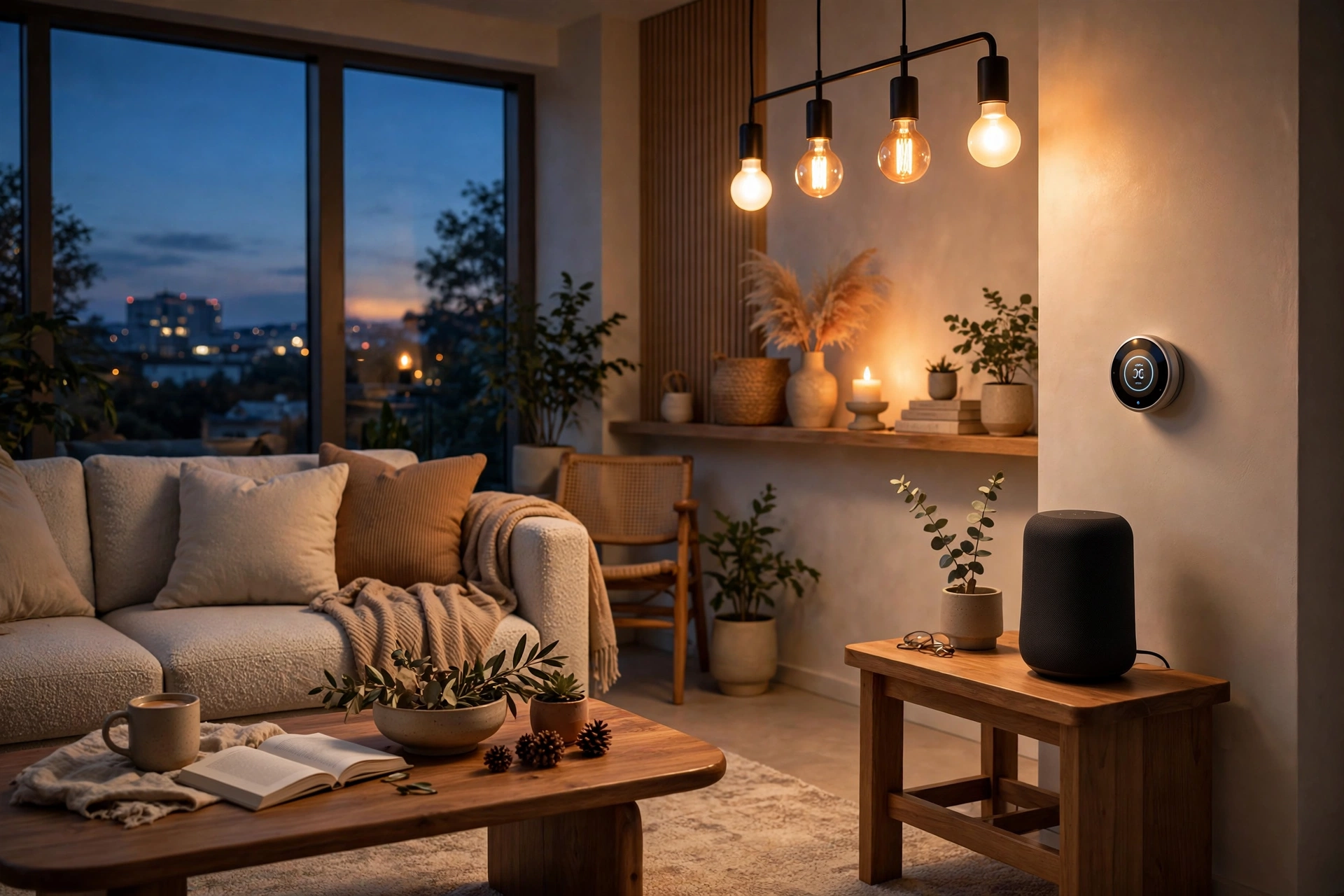
Smart-home gear is at its cheapest when bought as starter kits on Black Friday — and Matter has finally made the ecosystem wars optional. The connected home, at dusk.

A smart home living room at dusk — glowing smart bulbs, a video doorbell by the front door, a wall display showing the home dashboard. Start with one ecosystem and one room; the houses that work best grew one device at a time.
Watch: Black Friday Smart Home Deals 2026
The 10-product smart-home starter stack — the devices to buy first if starting from zero today, from a HomePod mini hub and Hue lighting to sensors, locks and cameras — chosen to avoid the biggest beginner mistakes.
At a Glance: Black Friday Smart Home Deals 2026
Ecosystem first, then the tiers — and the subscription trap to watch.
| Step | What to buy | Why |
|---|---|---|
| 1. Choose the ecosystem | Alexa, Google Home, or Apple HomeKit | Everything else hangs off this choice — pick the one matching the phones and speakers you already own |
| 2. Starter tier | Smart speaker + 2–4 smart bulbs + a smart plug | Under $100 on Black Friday; delivers the daily 'wow' of voice-controlled lighting |
| 3. Mid tier | Video doorbell + smart thermostat + a camera | Security and energy savings — the thermostat often pays for itself within two years |
| 4. Whole-home tier | Smart lock + sensors + shades + mesh Wi-Fi | Only after the basics prove themselves — and only on a solid network (see the router guide) |
| Matter standard | Most 2026 devices are Matter-certified and work across ecosystems — but verify the logo on the box; older stock may predate it | |
| Subscription trap | Many cameras charge monthly for cloud recording — factor 2–3 years of fees into the 'deal' price, or choose local-storage models | |
| Electronics peak discount (Adobe, 2025 season) | 30.9% measured peak — smart-home bundles (Hue starter kits, Ring + Echo combos) historically deliver the best Black Friday value | |


