An art history timeline is the single best tool for making sense of thousands of years of human creativity. Without a timeline, art history feels like a jumble of names — da Vinci, Picasso, Monet, Warhol — floating free of context. With one, you can see the conversation: how the Renaissance answered the Middle Ages, how the Impressionists rebelled against the academies, and how each movement set the stage for the next. This complete art history timeline walks you through every major period and movement from prehistoric cave paintings to contemporary art, with dates, defining characteristics, key artists, and landmark works — everything you need to understand where any artwork fits in the story.
Art History Timeline: The Complete Overview
Use this master table as your map. Each period below gets its own section with the full story.
| Period / Movement | Dates | Defining Trait | Key Artists |
|---|---|---|---|
| Prehistoric Art | c. 40,000–4,000 BCE | Cave painting, ritual, survival | Unknown |
| Ancient Art | c. 4,000 BCE–500 CE | Egyptian, Greek, Roman monumentality | Unknown / Phidias |
| Medieval Art | 500–1400 | Religious devotion, Byzantine to Gothic | Giotto |
| Renaissance | 1400–1600 | Humanism, perspective, realism | da Vinci, Michelangelo, Raphael |
| Mannerism | 1527–1580 | Elongated elegance, artifice | El Greco, Pontormo |
| Baroque | 1600–1750 | Drama, light and shadow, grandeur | Caravaggio, Rembrandt, Rubens |
| Rococo | 1700–1780 | Playful ornament, pastel lightness | Watteau, Fragonard |
| Neoclassicism | 1750–1850 | Classical order, moral seriousness | David, Ingres |
| Romanticism | 1780–1850 | Emotion, nature, the sublime | Delacroix, Turner, Friedrich |
| Realism | 1848–1900 | Unvarnished everyday life | Courbet, Millet |
| Impressionism | 1865–1885 | Light, fleeting moments, broken color | Monet, Renoir, Degas |
| Post-Impressionism | 1885–1910 | Structure, emotion, symbolism | Van Gogh, Cézanne, Seurat |
| Modernism (Fauvism, Cubism, Surrealism) | 1905–1945 | Abstraction, the unconscious | Matisse, Picasso, Dalí |
| Abstract Expressionism & Pop Art | 1940s–1960s | Gesture, mass culture | Pollock, Warhol, Rothko |
| Contemporary Art | 1970–present | Global, conceptual, digital | Kusama, Banksy, Ai Weiwei |
Prehistoric Art (c. 40,000–4,000 BCE)
Every art history timeline begins in caves. The paintings at Lascaux (France) and Altamira (Spain) — herds of bison, horses, and aurochs rendered in ochre and charcoal — are not primitive doodles but sophisticated images, often painted to exploit the rock’s natural contours for three-dimensional effect. The Venus of Willendorf, a small limestone figurine, suggests art’s earliest role was ritual: fertility, hunting magic, marking sacred space. Key insight: from the very beginning, art was tied to belief and community survival, not decoration.
Ancient Art (c. 4,000 BCE–500 CE)
Ancient civilizations invented art as power. Egyptian art followed strict conventions for 3,000 years — profile heads, frontal torsos, hierarchical scale — because its job was to preserve cosmic order and glorify pharaohs. The Greeks broke the mold, pursuing idealized human beauty and inventing contrapposto (the naturalistic weight-shift stance); the Parthenon sculptures remain the benchmark of classical form. Rome absorbed Greek art and deployed it as imperial propaganda — triumphal arches, portrait busts, vast frescoed villas. Landmark works: the Pyramids of Giza, the Parthenon, the Laocoön group.
Medieval Art (500–1400)
After Rome’s fall, art served the Church almost exclusively. Byzantine art gave us glittering gold-ground mosaics and solemn icons (Hagia Sophia in Istanbul is the supreme example). Romanesque churches (c. 1000–1200) carried massive stone sculpture programs teaching biblical stories to illiterate congregations. Gothic art (c. 1200–1400) — soaring cathedrals like Chartres, luminous stained glass, and the first stirrings of naturalism in Giotto’s frescoes — pointed toward the Renaissance. Key insight: medieval artists were anonymous craftsmen serving God; the idea of the artist as individual genius had not been invented yet.
Renaissance (1400–1600)
The Renaissance — “rebirth” of classical learning — is the hinge of every art history timeline. In Florence, Brunelleschi invented linear perspective, Donatello revived freestanding sculpture, and Masaccio painted the first fully perspectival frescoes. The High Renaissance (c. 1490–1527) produced the trinity: Leonardo da Vinci (Mona Lisa, The Last Supper), Michelangelo (Sistine Chapel ceiling, David), and Raphael (School of Athens). Northern Europe had its own Renaissance in Jan van Eyck’s oil-painting revolution and Albrecht Dürer’s prints. The period’s creed was humanism: the belief that human beings, their bodies, and their reason were worthy subjects of the highest art.
Mannerism (1527–1580)
After the High Renaissance’s perfection, younger artists deliberately broke its rules. Mannerists like Pontormo, Parmigianino, and El Greco stretched bodies into elegant distortions, used acidic, unnatural colors, and composed crowded, ambiguous scenes. Long dismissed as a decadent interlude, Mannerism is now appreciated as the first self-consciously “stylish” movement — art about artifice rather than nature. El Greco’s stormy, elongated saints directly prefigure Expressionism three centuries later.
Baroque (1600–1750)
Baroque art is theater: sweeping diagonals, intense chiaroscuro (light-dark contrast), and emotion dialed to maximum. Caravaggio’s street-tough saints, painted from Roman laborers and lit like stage spotlights, shocked and thrilled Rome. Rubens turned Baroque energy into Flemish opulence; Rembrandt internalized it into the most psychologically searching portraits ever painted (The Night Watch); Bernini made marble seem to breathe in the Ecstasy of Saint Teresa. The Catholic Church weaponized Baroque splendor during the Counter-Reformation — grandeur as persuasion.
Rococo (1700–1780)
If Baroque was opera, Rococo was champagne: pastel palettes, playful mythologies, aristocratic flirtation. Watteau’s dreamy fêtes galantes, Boucher’s pink-cheeked goddesses, and Fragonard’s The Swing defined the French court’s taste for pleasure as the Revolution approached. Rococo’s lightness made it an easy target for moralists — which is partly why Neoclassicism’s stern virtue swept it away.
Neoclassicism (1750–1850)
Spurred by the rediscovery of Pompeii and the ideals of the Enlightenment, Neoclassicism demanded moral seriousness, clean lines, and classical subjects. Jacques-Louis David became the French Revolution’s official painter (The Death of Marat) and then Napoleon’s propagandist. Ingres carried the style’s icy precision into portraiture. Key insight: Neoclassicism shows how art history moves in reactions — every generation defines itself against its parents’ taste.
Romanticism (1780–1850)
Romanticism was Neoclassicism’s emotional opposite: feeling over reason, nature over order, the individual over the state. Delacroix’s Liberty Leading the People turned revolution into myth; Turner’s storms dissolved ships into pure light and atmosphere; Caspar David Friedrich’s lonely figures before vast landscapes invented the visual language of the sublime. Romanticism’s worship of emotion and nature echoes through art to this day.
Realism (1848–1900)
Gustave Courbet scandalized Paris by painting stone-breakers and peasant funerals at the heroic scale previously reserved for kings and gods. Realism insisted that ordinary labor and unvarnished contemporary life were worthy subjects — a democratic revolution in subject matter that paved the way for Impressionism. Millet’s gleaners and Daumier’s satirical lithographs extended the movement’s social conscience.
Impressionism (1865–1885)
The most beloved movement on any art history timeline began as an insult: a critic sneered at Monet’s Impression, Sunrise, and the name stuck. Monet, Renoir, Degas, Pissarro, and their circle abandoned studios for plein-air painting, capturing fleeting light with broken brushstrokes and unmixed color. Rejected by the official Salon, they staged their own exhibitions starting in 1874. Within decades, Impressionism went from scandal to the world’s most popular art — proof that the art establishment is reliably wrong about the future. For the full story, see our guide to the best cultural attractions in the USA, many of which hold major Impressionist collections, and our list of the best street art destinations in the USA for art that still rebels today.
Post-Impressionism (1885–1910)
Post-Impressionists kept Impressionism’s bright palette but rejected its formlessness. Van Gogh poured raw emotion into swirling impasto (The Starry Night); Cézanne rebuilt nature from cylinders, spheres, and cones, declaring he wanted to “make of Impressionism something solid and durable”; Seurat systematized color into pointillist dots (La Grande Jatte); Gauguin fled to Tahiti in search of the “primitive.” Cézanne’s structural experiments directly launched Cubism — making him the bridge between the 19th and 20th centuries.
Modernism: Fauvism, Expressionism, Cubism, Surrealism (1905–1945)
The early 20th century compressed more revolutions into forty years than the previous four centuries combined. The Fauves (“wild beasts”) — Matisse foremost — unleashed non-naturalistic color. German Expressionists (Munch, Kirchner) externalized inner turmoil. Then came the earthquake: Picasso and Braque’s Cubism (1907–1914) shattered objects into simultaneous viewpoints, arguably the most radical break in the entire art history timeline. Dada mocked art itself after WWI’s horrors; Surrealism (Dalí, Magritte, Miró) mined dreams and the unconscious. By WWII, Paris had yielded the avant-garde crown to New York.
Abstract Expressionism and Pop Art (1940s–1960s)
Postwar New York invented two opposite answers to modern art’s future. The Abstract Expressionists — Pollock’s drip paintings, Rothko’s hovering color fields, de Kooning’s slashing gestures — made painting about the act of creation itself, heroic and existential. Pop Art — Warhol’s soup cans, Lichtenstein’s comic panels — answered with cool irony, embracing mass media and consumer culture. Together they define the American century in art.
Contemporary Art (1970–Present)
Contemporary art has no single style — that is its defining trait. Minimalism and Conceptual Art dematerialized the art object; feminist artists (Judy Chicago, Cindy Sherman) rewrote the canon; street art (Basquiat, Banksy) moved from subways to auction houses; and globalization brought artists like Yayoi Kusama, Ai Weiwei, and El Anatsui to center stage. Digital art, NFTs, and AI-generated imagery are the current frontier. The art history timeline is still being written — and for the first time, it is genuinely global.
Key Terms Every Beginner Should Know
| Term | What It Means | Example |
|---|---|---|
| Chiaroscuro | Dramatic contrast of light and dark | Caravaggio’s paintings |
| Sfumato | Soft, smoky blending without outlines | Mona Lisa |
| Perspective | Technique for creating depth on a flat surface | Masaccio’s Trinity |
| Plein air | Painting outdoors to capture natural light | Monet’s landscapes |
| Impasto | Thickly applied paint with visible texture | Van Gogh’s Starry Night |
| Contrapposto | Naturalistic stance with weight on one leg | Michelangelo’s David |
| Avant-garde | Artists pushing beyond accepted norms | Cubists, Dadaists |
| Canon | The accepted list of “great” artists and works | Debated and revised constantly |
How to Use This Art History Timeline
- Before a museum visit: Check which periods the collection covers, then read those sections here — you will recognize movements on sight.
- For students: Memorize the master table above; most art history exams test period identification and key artists.
- For travelers: Match destinations to periods — Florence for Renaissance, Amsterdam for the Dutch Golden Age, Paris for Impressionism. Our guide to the best cities for arts and culture in the USA covers the American side.
- For the curious: Follow the “reactions” — each movement rebels against the last. Spotting the rebellion is the fastest way to understand any period.
Frequently Asked Questions
What are the major periods in art history?
The major periods in this art history timeline are Prehistoric, Ancient (Egyptian, Greek, Roman), Medieval, Renaissance, Mannerism, Baroque, Rococo, Neoclassicism, Romanticism, Realism, Impressionism, Post-Impressionism, Modernism (including Cubism and Surrealism), Abstract Expressionism and Pop Art, and Contemporary art.
How long does the art history timeline span?
About 40,000 years — from the cave paintings of Lascaux (c. 17,000 BCE, with earlier examples elsewhere) to art being made today. Western art history as a formal discipline usually starts with ancient Egypt and Greece.
What is the difference between Baroque and Rococo?
Baroque (1600–1750) is dramatic, grand, and emotionally intense, often with religious or state power themes. Rococo (1700–1780) is its lighter, playful descendant — pastel colors, aristocratic leisure, and decorative charm. Think Caravaggio versus Fragonard.
Why does Impressionism matter so much in art history?
Impressionism broke the academy system’s monopoly on taste, invented modern plein-air painting techniques, and proved that rejected outsiders could redefine art. Nearly every 20th-century movement descends from the freedom Impressionism won.
Is contemporary art part of art history?
Yes — the art history timeline extends to the present. “Contemporary” generally means art made from the 1970s onward, though the boundary shifts as time passes. Today’s contemporary art is tomorrow’s art history.
The Bottom Line
This art history timeline is a map, not the territory — every period contains glorious exceptions, and scholars constantly redraw the boundaries. But with these periods, dates, and key figures in mind, you will never again feel lost in a museum. You will see the conversation across centuries: each generation answering, rebelling, and building on the last. That conversation is still going on, in galleries, on streets, and on screens — and now you can follow it.
Art History Timeline: Frequently Asked Questions
What are the major periods of art history in order?
The standard Western sequence runs: prehistoric and ancient art (cave painting through Egypt, Greece, and Rome), medieval art (Byzantine, Romanesque, Gothic, roughly 500–1400), the Renaissance (1400s–1500s), Baroque (1600s), Rococo and Neoclassicism (1700s), Romanticism and Realism (early-to-mid 1800s), Impressionism (1870s–1880s), Post-Impressionism (1880s–1900s), and then the cascade of modern movements — Fauvism, Cubism, Futurism, Dada, Surrealism, Abstract Expressionism, Pop Art, Minimalism — through the 20th century, followed by contemporary and digital art today. These labels are conveniences, not walls: movements overlap, artists defy categories, and non-Western traditions (Chinese ink painting, Islamic geometric art, pre-Columbian sculpture, Japanese ukiyo-e) run on their own rich timelines that intersect with the Western story at many points.
Why does art history matter for a casual museum visitor?
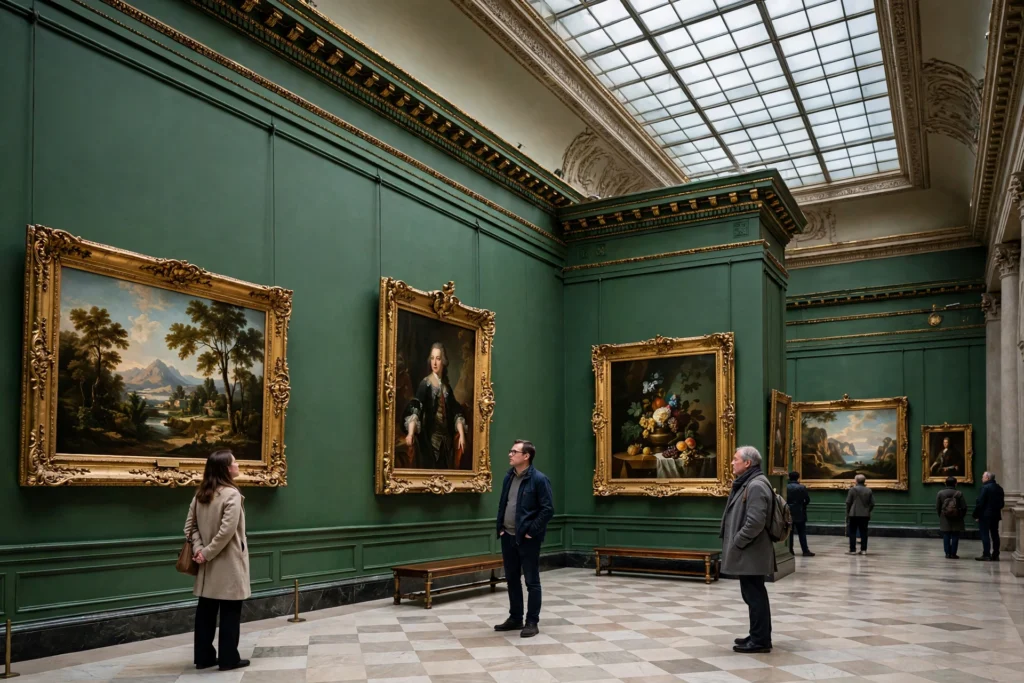
Context turns looking into seeing. Knowing that Impressionism was a rebellion against the stuffy Salon system makes Monet’s loose brushwork feel daring rather than merely pretty. Recognizing Baroque drama as the Catholic Church’s answer to the Protestant Reformation explains why Caravaggio’s saints look like street people caught in a spotlight. You don’t need a degree — just one fact per movement gives you a thread to follow through the galleries. Museum wall labels are written for exactly this purpose, and audio guides turn a two-hour visit into a story. The timeline in this guide is designed to be that one fact per period, so your next museum trip feels like following a plot instead of wandering through pretty rooms.
How do art historians decide where one movement ends and another begins?
Mostly retroactively, and often messily. Movements are named by critics, dealers, or the artists themselves, and the boundaries are drawn decades later by historians looking for patterns. Impressionism got its name from a mocking review of Monet’s “Impression, Sunrise.” Cubism was a term of derision before it became a badge. Some “movements” were really just a handful of friends exhibiting together for a few years. The dates in textbooks are approximations — Post-Impressionism bleeds into Fauvism, which bleeds into Cubism, and plenty of artists worked across the supposed borders. Treat period labels as useful maps, not territories: they help you navigate, but the real art always spills over the edges.
What is the best way to start learning art history as an adult?
Start with what you like and work outward. Love a painting? Learn about its movement, then the movement before it and after it — you’ve just built a three-period timeline anchored to something you genuinely enjoy. Museums are the best classrooms: most major museums offer free days, and their websites now host enormous digital collections you can browse by period. Pair visits with one good survey — a documentary series, a well-illustrated book, or a structured online course — and give yourself permission to skip what bores you. Art history rewards curiosity more than completeness. The person who deeply understands Impressionism gets more from museums than the person who memorized fifty movement names and loves none of them.
Does non-Western art fit into the standard timeline?
The standard timeline is really a Western timeline, and treating it as universal does real damage to understanding. Chinese landscape painting reached extraordinary sophistication while Europe was in the medieval period; Islamic art developed geometric and calligraphic traditions of stunning complexity with no figurative tradition at all; the art of the Americas, Africa, and Oceania is ancient, diverse, and historically marginalized by Western institutions. Modern art history increasingly teaches these as parallel traditions rather than footnotes. When you visit encyclopedic museums, spend as much time in the African, Asian, and Islamic wings as in the European galleries — you’ll come away with a far richer sense of what art has been across human civilization.