
Last updated: September 26, 2026. Official information checked on this date. DayZora is an independent editorial publisher, not a FIFA or club partner.
The FIFA Women’s World Cup 2027 will take place in Brazil from June 24 to July 25, 2027, with 32 teams playing 64 matches across eight host cities. The opening match and final are assigned to Rio de Janeiro’s Maracanã. As of this review, FIFA lists 18 qualified teams; the remaining places are still being decided. The final draw is scheduled for December 11, 2026, so a complete set of named group opponents cannot yet be published. This guide separates the tournament’s confirmed structure from unfinished qualification and details still to come. Use the schedule to understand the travel windows, then use our Brazil host cities and stadiums guide to choose a practical base. A stadium allocation is useful for planning, but it is not the same thing as a ticket, a kickoff time or a confirmed team-versus-team fixture.
Confirmed: Brazil; June 24–July 25; 32 teams; 64 matches; eight venues; final draw on December 11 in Rio.
Qualification in progress: 18 of 32 teams confirmed. Fourteen places remain.
To be determined: the complete groups, most named fixtures, kickoff times, final squads and tournament-specific stadium access arrangements. Brazil is assigned to Group A.
FIFA Women’s World Cup 2027 at a glance
| Item | Confirmed information |
|---|---|
| Host | Brazil — the first Women’s World Cup held in South America |
| Edition | 10th FIFA Women’s World Cup |
| Dates | June 24–July 25, 2027 |
| Field | 32 teams |
| Matches | 64 |
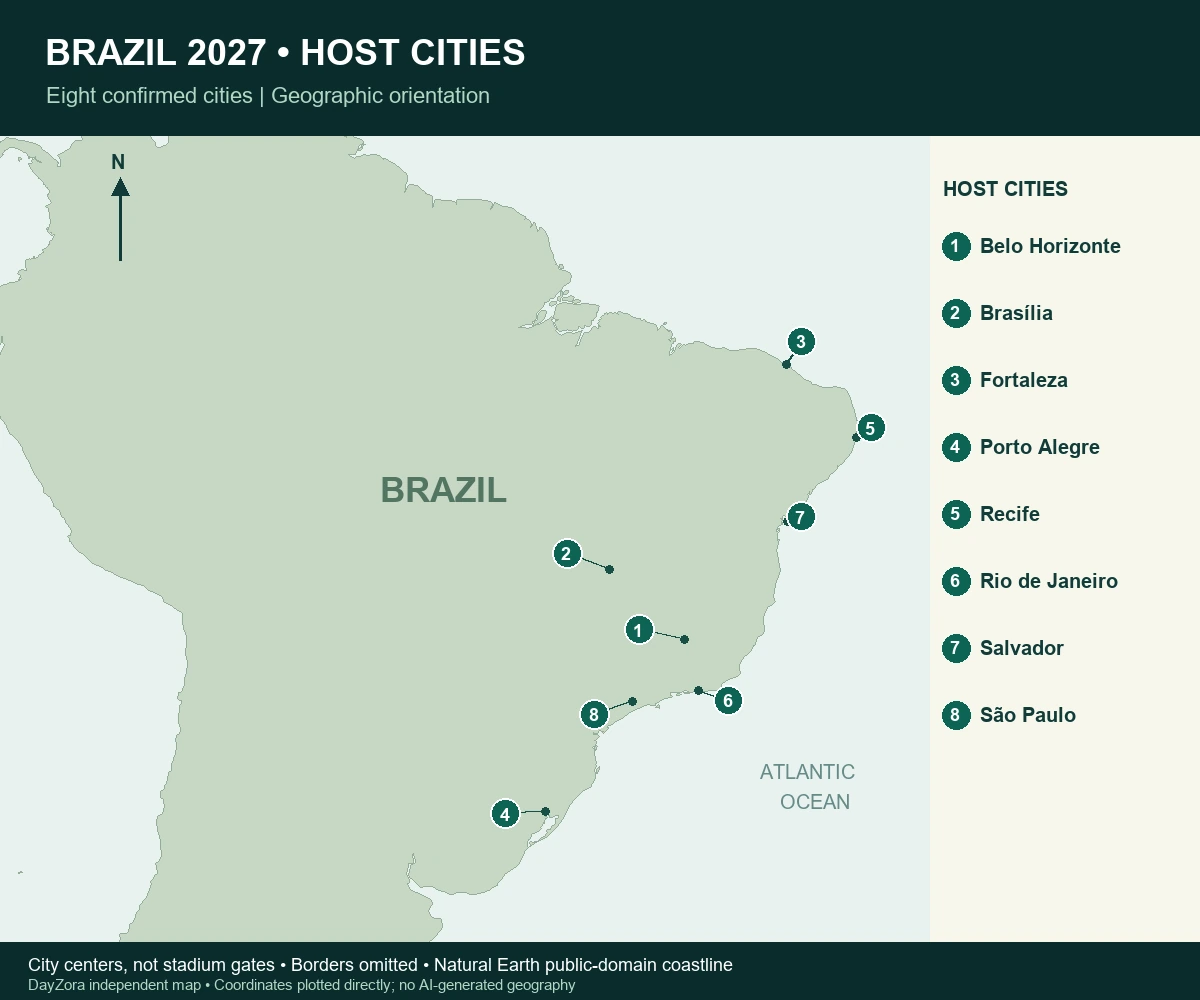
| Host cities | Belo Horizonte, Brasília, Fortaleza, Porto Alegre, Recife, Rio de Janeiro, Salvador and São Paulo |
| Opening match | June 24 — Maracanã, Rio de Janeiro; Brazil in Group A |
| Final | July 25 — Maracanã, Rio de Janeiro |
| Final draw | December 11, 2026 — Museum of Modern Art (MAM Rio), Rio de Janeiro |
How the tournament format works
The 32 teams will be divided into eight groups of four. Each team plays the other three teams in its group. The top two teams from every group advance to the round of 16; third place does not provide a route into the knockout rounds. From there, the competition proceeds through the quarter-finals and semi-finals to the final. The losing semi-finalists play for third place.
That structure produces 48 group matches and 16 knockout-stage matches, including the third-place match. A finalist plays seven games. The practical implication for supporters is that a group-stage ticket plan and a knockout-stage ticket plan are different purchases: qualifying from a group does not mean a team stays in the same host city. The group position determines the next bracket slot.
For example, a schedule entry marked “1A v 2B” means the winner of Group A against the runner-up of Group B. It is a confirmed bracket pairing, not two confirmed countries. Brazil’s allocation to Group A does not guarantee that Brazil will win the group or reach that particular knockout game. Keep the distinction when reading ticket listings or planning flights.
FIFA match schedule and bracket
Qualified teams: 18 confirmed, 14 places remaining
The table below contains only teams listed by FIFA as qualified for the finals on September 26, 2026. It excludes countries that have merely reached a regional qualifying event or the intercontinental play-off tournament. The qualification route is included to make that difference visible; this is not a ranking of the teams.
| Team | Confederation | Qualification route |
|---|---|---|
| Brazil | CONMEBOL | Host nation |
| Australia | AFC | 2026 Women’s Asian Cup quarter-final winner |
| China PR | AFC | 2026 Women’s Asian Cup quarter-final winner |
| Japan | AFC | 2026 Women’s Asian Cup quarter-final winner |
| Korea DPR | AFC | Asian qualifying play-off winner |
| Korea Republic | AFC | 2026 Women’s Asian Cup quarter-final winner |
| Philippines | AFC | Asian qualifying play-off winner |
| Algeria | CAF | 2026 Women’s Africa Cup of Nations semi-finalist |
| Cameroon | CAF | 2026 Women’s Africa Cup of Nations semi-finalist |
| Malawi | CAF | 2026 Women’s Africa Cup of Nations semi-finalist |
| Morocco | CAF | 2026 Women’s Africa Cup of Nations semi-finalist |
| Argentina | CONMEBOL | South American qualifying competition |
| Colombia | CONMEBOL | South American qualifying competition |
| New Zealand | OFC | OFC qualifying winner |
| Denmark | UEFA | European qualifying League A group winner |
| France | UEFA | European qualifying League A group winner |
| Germany | UEFA | European qualifying League A group winner |
| Spain | UEFA | European qualifying League A group winner |
FIFA’s live list of qualified teams
Four direct Concacaf places, seven additional direct European places and three intercontinental play-off places remain. Those totals account for all 14 vacancies. The United States, Canada, England and other familiar names must not be inserted simply because they appeared at previous World Cups. Qualification is earned through the relevant 2026 competition, not through reputation or an earlier tournament finish.
A useful way to follow the remaining field is to track countries in three separate categories: qualified for Brazil, still competing in regional qualification, or qualified for the intercontinental play-off. Only the first belongs in the finals table. The last category still involves matches that can eliminate a team.
Groups: draw still to come
Groups: to be determined following the official FIFA draw. FIFA has announced December 11, 2026, at MAM Rio as the date and venue. Brazil’s Group A assignment is already confirmed, but the complete group membership has not been drawn. We are therefore not filling eight group tables with predictions or placeholders that resemble official results.
After the draw, the same page can carry the eight confirmed groups and an updated fixture table. Until then, it is sensible to compare host cities, accommodation cancellation terms and the date ranges for each round. It is premature to book a complicated route on the assumption that a particular unqualified team will play in a particular stadium.
The final draw and final squad announcements are separate events. A country can qualify well before its coach names the players who will travel. Injuries, selection and eligibility can change the personnel, so our 2027 stars-to-watch feature is an editorial watchlist rather than a list of confirmed World Cup participants.
Confirmed Women’s World Cup 2027 schedule
FIFA has published the competition’s date and venue framework. The table groups those allocations into useful planning windows. Kickoff times and most named opponents remain to be confirmed. Dates below refer to Brazil’s tournament calendar; use the eventual official kickoff listing to convert a match to your own time zone.
| Stage or match | Date in 2027 | Venue information |
|---|---|---|
| Opening match | June 24 | Maracanã, Rio de Janeiro; Brazil in Group A |
| Group stage | June 24–July 8 | All eight host cities |
| Brazil’s second group match | June 29 | Arena Itaquera, São Paulo |
| Brazil’s third group match | July 4 | Estádio Nacional, Brasília |
| Round of 16 | July 10–13 | Eight matches across the six allocated cities |
| Quarter-finals | July 16–17 | Belo Horizonte, Rio de Janeiro, Fortaleza and São Paulo |
| Semi-final 1 | July 20 | Arena Itaquera, São Paulo |
| Semi-final 2 | July 21 | Maracanã, Rio de Janeiro |
| Third-place match | July 24 | Arena Itaquera, São Paulo |
| Final | July 25 | Maracanã, Rio de Janeiro |
There are no round-of-16 games allocated to Maracanã or Mineirão in the published schedule. A trip built around either venue can therefore contain a gap between its group games and quarter-final. That gap may be welcome sightseeing time, but it should not be mistaken for a missing fixture. Similarly, Brasília’s published programme ends at the round of 16; it is not a semi-final destination.
Supporters following Brazil already have a three-city group-stage outline: Rio de Janeiro, then São Paulo, then Brasília. That is useful information, but the onward journey after July 4 depends on results. Build flexibility into a team-following itinerary and avoid buying a last-flight connection immediately after a knockout match, which can run beyond normal time.
The eight confirmed venues
| Host city | FIFA venue name | Matches | Latest allocated round |
|---|---|---|---|
| Belo Horizonte | Estádio Mineirão | 8 | Quarter-final |
| Brasília | Estádio Nacional | 7 | Round of 16 |
| Fortaleza | Arena Castelão | 9 | Quarter-final |
| Porto Alegre | Estádio Beira-Rio | 7 | Round of 16 |
| Recife | Arena Pernambuco | 7 | Round of 16 |
| Rio de Janeiro | Estádio do Maracanã | 9 | Final |
| Salvador | Arena Fonte Nova | 7 | Round of 16 |
| São Paulo | Arena Itaquera | 10 | Third-place match; also a semi-final |
FIFA stadium guide and city-by-city allocations
The tournament uses names that may differ from the commercial names on club websites, maps and taxi apps. Arena Itaquera, for example, is the Corinthians ground commonly called Neo Química Arena. Arena Pernambuco is in São Lourenço da Mata in metropolitan Recife, rather than in Recife’s beachfront hotel districts. Our host-city travel guide explains those distinctions, airport choices and suggested lengths of stay.
Do not use a stadium’s normal club capacity as the number of World Cup tickets available. Media positions, hospitality, access arrangements and the final tournament seating plan can alter the sellable inventory. The number of matches allocated to a city also says nothing about ticket availability for a specific game.
How qualification works and the next key dates
| Confederation | Direct finals places, including host | Intercontinental play-off entrants |
|---|---|---|
| AFC | 6 | 2 |
| CAF | 4 | 2 |
| Concacaf | 4 | 2 |
| CONMEBOL | 3, including Brazil | 2 |
| OFC | 1 | 1 |
| UEFA | 11 | 1 |
| Total | 29 | 10 teams compete for the final 3 places |
The direct places and play-off entries are different allocations. Ten countries reaching the play-off tournament does not expand the finals to 39 teams: those ten compete for just three places alongside the 29 direct qualifiers. FIFA’s qualifying-team register is the reference point for the completed field.
Europe: two rounds still to play
Denmark, France, Germany and Spain have secured the four League A group-winner places. UEFA’s remaining qualifying play-offs are scheduled for October 7–13 and November 26–December 5, 2026. Thirty-two teams enter the two-round, two-legged process. Of the eight eventual winners, the seven highest under the applicable overall qualifying ranking qualify directly; the other proceeds to the intercontinental play-off.
UEFA qualifying format and play-off dates
Concacaf: four direct places in Texas
Concacaf’s latest schedule announcement, dated September 8, places its 2026 W Championship on November 27–December 5 in Mansfield and Houston, Texas. The eight participants are the United States, Canada, Costa Rica, El Salvador, Haiti, Jamaica, Mexico and Panama. The four quarter-final winners qualify directly for Brazil. The losing quarter-finalists enter play-in matches that determine two intercontinental play-off entrants.
Concacaf’s September 8 schedule update
An older overview may still show a November 24 start. This guide follows the later announcement from the competition organizer. Tickets advertised for that championship are tickets for the qualifier in Texas, not tickets for the World Cup in Brazil.
Intercontinental play-off: a separate qualifying event
FIFA’s qualified-team article identifies Chinese Taipei, Ecuador, Ghana, Papua New Guinea, South Africa, Uzbekistan and Venezuela among the play-off entrants already known. None should be counted among the 18 finals qualifiers. The preliminary phase is scheduled for late 2026, with the final qualifying phase in February 2027. Consult FIFA’s current play-off information for the definitive match dates, draw and venues before making travel plans.
FIFA qualification and play-off status
Tickets, travel and what to book first
Start at FIFA’s official ticket page for ticket announcements and registration information. Do not infer that general World Cup ticket sales have opened from an unofficial resale listing, a hospitality advertisement or a qualifier’s ticket announcement. A published fixture framework is not a ticket-sale notice.
For a city-based trip, select one host city and a cluster of match dates, then compare accommodation with a workable stadium journey. For a team-based trip, wait for the group allocation before committing to multiple domestic flights. In either case, read the exact cancellation conditions: a refundable hotel and a non-refundable flight do not create a fully flexible trip.
Brazil’s host cities cover a large area. A map can show a tidy line between two cities while concealing an airport transfer, baggage check-in and a connecting flight. Treat intercity journeys as travel days. Avoid choosing a morning arrival in a distant city solely because the match will probably be at night; the kickoff may not yet have been announced.
Before buying travel, use DayZora’s first international trip checklist to organize documents and arrival arrangements. Our travel budget guide helps separate match tickets, accommodation, flights and daily spending. Check entry requirements with the relevant official authorities for your passport; this article does not assume that one rule applies to every nationality.
Fans with access requirements should plan the entire journey, including the route from transport to their entrance and the way home. A venue offering accessible seats does not by itself confirm an accessible shuttle or a step-free route from every hotel. Ask for the tournament’s actual arrangements when they are released.
Building a realistic tournament itinerary
One city: five to seven nights
A single-base trip is the simplest option for a first visit or a family group. Choose a city you want to explore even if the eventual match pairing is not your first choice. Fit one or two ticketed matches around cultural visits, food and rest. This approach reduces domestic flights and makes it easier to recover from a delayed international arrival.
Before selecting dates, check the venue schedule for a useful combination of fixtures. Two matches several days apart can create a pleasant city break; two consecutive travel-heavy match days can do the opposite. Keep the day before an important match relatively light.
Two cities: ten to fourteen nights
Rio and São Paulo are a natural comparison for a first Brazil trip, with different urban experiences and many flight-search options. A north-east pairing can also work, but select it using the actual fixtures and transport available. Geographic proximity on a national map does not guarantee a convenient same-day connection.
Assign a dedicated transfer day. Count the whole journey from hotel checkout to the next hotel, not just the flight duration. Allow for airport travel, baggage and possible delays. Avoid a domestic flight on the morning of a match you would be very disappointed to miss.
Following Brazil’s group stage
The confirmed host-team route is Rio on June 24, São Paulo on June 29 and Brasília on July 4. A trip covering all three is a substantial multi-city itinerary. It offers time between matches, but it also requires three accommodation bookings and two domestic transfers. Opponents and kickoff details still need to be added after official confirmation.
If this route exceeds your time or budget, choose one or two of the cities. Attending fewer matches can leave more time to experience Brazil rather than spending the trip in airports. Do not book a presumed knockout continuation as though qualification and bracket position were guaranteed.
Flights, accommodation and budget
Compare an open-jaw international itinerary—arriving in one city and departing from another—with a return flight to a single gateway. The cheaper airfare may require an extra domestic leg and hotel night. Check baggage allowances on every flight, particularly when international and domestic sectors are booked separately.
For hotels, compare the actual neighborhood, transit connection, cancellation deadline and full room cost. A refundable booking can protect an early plan, but record when it becomes nonrefundable. Do not reserve a chain of cities solely because a team might play there without understanding those deadlines.
Build a budget with international travel, domestic flights, hotels, tickets, city transport, meals and a contingency. Brazil is too varied for one accurate universal daily figure. Use real quotes for your dates and compare totals in a consistent currency. The budget-travel guide offers a framework for deciding where flexibility is worth paying for.
Frequently asked questions
When is the 2027 Women’s World Cup?
June 24 to July 25, 2027. The opening match and final are at Maracanã in Rio de Janeiro.
How many teams have qualified?
FIFA lists 18 as of September 26, 2026. Fourteen places remain; qualification and the play-off tournament will complete the 32-team field.
Are the groups available?
No. The final draw is scheduled for December 11, 2026. Brazil is assigned to Group A, but the full groups are still to be determined.
Is there a complete fixture list?
There is an official date, venue and bracket framework. Most named opponents and kickoff times are still to come. Read the published allocations as a framework, not as an already completed draw.
Where will Brazil play in the group stage?
Rio de Janeiro on June 24, São Paulo on June 29 and Brasília on July 4. Opponents remain to be drawn.
Does reaching the intercontinental play-off mean a team has qualified?
No. The play-off produces the last three finals qualifiers. Its participants are kept out of the qualified-team table until they earn a finals place.
Will all eight cities host knockout matches?
Yes. The published allocations give every host city at least one knockout match, but the final rounds are concentrated in fewer cities.
Should I book a trip before the draw?
A flexible city-based trip can be planned around confirmed dates. Following a specific team across Brazil is much easier after the draw. No hotel, flight or third-party ticket listing guarantees that your team will reach a particular round.
Update record and next review points
September 26, 2026: checked FIFA’s qualified-team list, venue and schedule announcements, final-draw notice, UEFA play-off information and Concacaf’s latest schedule. The next material update points are the European play-offs, Concacaf championship, final draw, intercontinental play-off and FIFA’s ticket and kickoff announcements. New confirmed information belongs on this same URL; no separate near-duplicate groups-update page is needed.
Explore more in DayZora Soccer.
For other major events, explore our 2027 sports calendar.
Pingback: Women’s World Cup 2027 Stadiums & Brazil Host Cities