
City information last reviewed: September 26, 2026.
Los Angeles is a collection of useful travel bases rather than one compact sightseeing center. A morning at the beach, an afternoon in a Downtown museum and an evening above Hollywood may look attractive on a list, but the journeys between them can become the main activity. The better first trip groups nearby experiences and chooses accommodation around the part of LA you most want to enjoy.
This Los Angeles travel guide helps first-time visitors make those choices. It covers the coast, Downtown, Hollywood and nearby independent cities such as Santa Monica, West Hollywood and Beverly Hills, explaining what each adds and what it costs in travel time. You will find ten major experiences, neighborhood comparisons, a practical transport discussion, food ideas and a geographically grouped three-day outline. Use the map before booking a hotel, select one major reservation per day, and keep the beach and museum portions flexible for weather and opening days. A longer California journey belongs in the linked itinerary and road-trip guides, rather than in an overfilled LA weekend.
Los Angeles at a Glance
On mobile, swipe the table sideways to see every column.
| Planning question | DayZora recommendation |
|---|---|
| Best for | Film culture, art, varied dining, coastal time and neighborhood exploration |
| Ideal stay | 4–5 nights for a first visit; three days requires selective choices |
| Best time to visit | Spring and fall often balance outdoor time and crowds; conditions vary |
| Main airports | LAX; Hollywood Burbank (BUR) can be useful for Valley/Hollywood plans |
| Getting around | A planned mix of Metro, buses, walking within areas, rideshare or car |
| Car needed | Depends on lodging and itinerary; neither universally necessary nor universally avoidable |
| Budget level | Moderate to high, with lodging, parking and long rides affecting totals |
| First-time bases | Santa Monica for coast; Hollywood for selected sights; Downtown for rail and arts |
City Map and Geographic Planning
Swipe within the map or open the full-size map. Numbers identify locations, not a visit sequence.
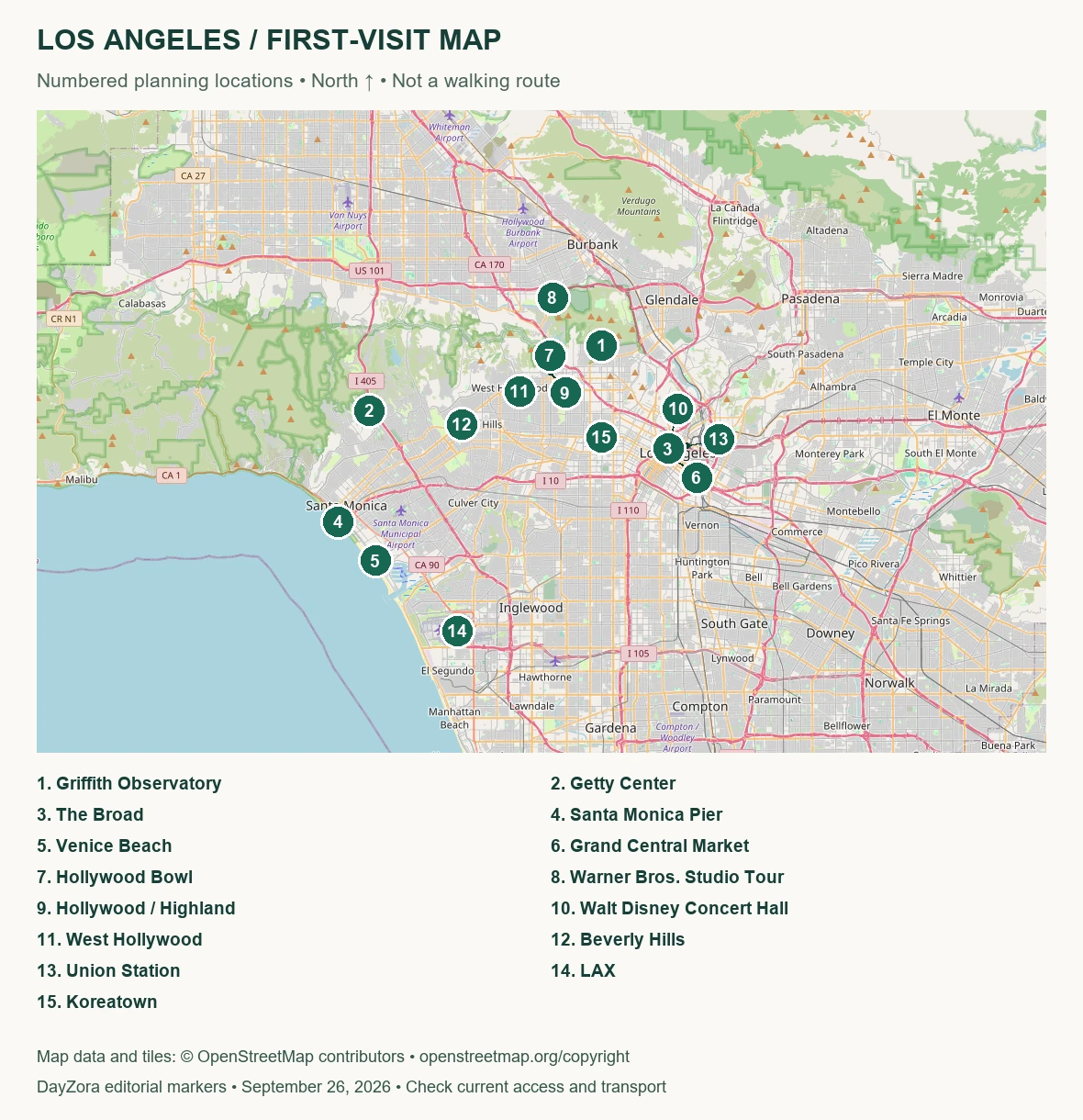
The map shows representative locations across a large area. It is not an instruction to connect them all in one day. Downtown and Santa Monica can form separate days; Griffith Observatory belongs with Hollywood or nearby neighborhoods; the Getty Center warrants its own travel allowance. West Hollywood and Beverly Hills are separate cities within the wider visitor region. Their familiar names do not mean they share a single walkable center with Hollywood.
Best Things to Do in Los Angeles
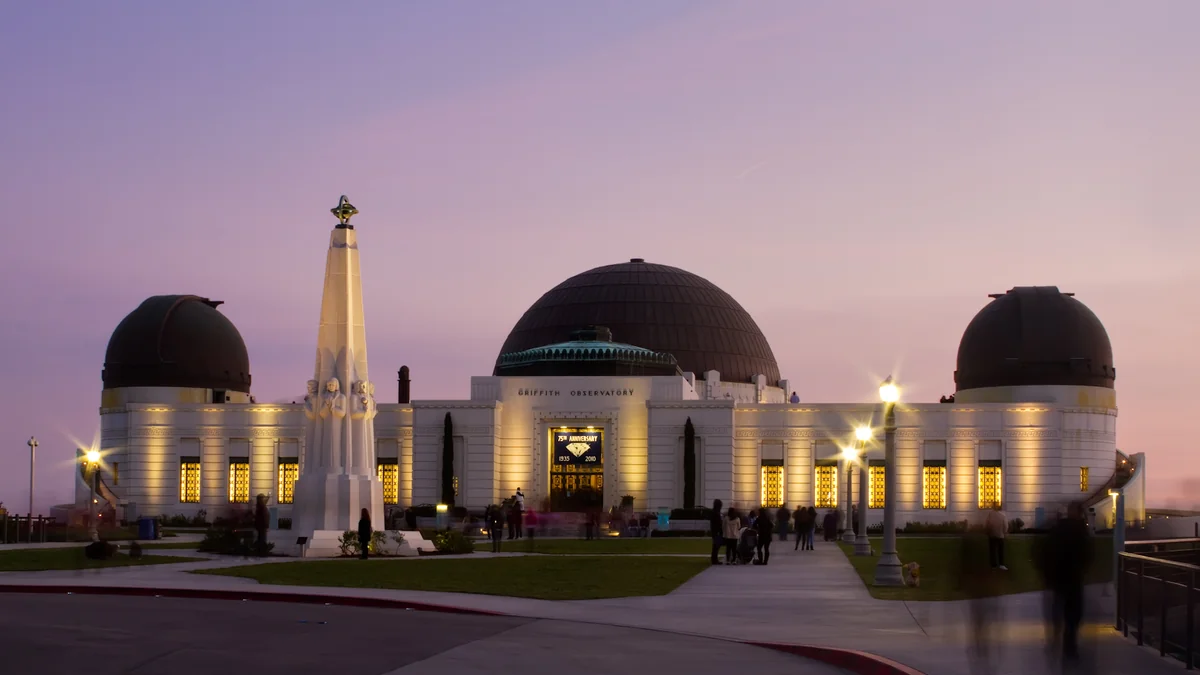
1. Visit Griffith Observatory
The Observatory combines astronomy exhibits with a hillside setting overlooking the city. It can be rewarding even without a planetarium performance, particularly for visitors interested in the relationship between the basin, hills and skyline. Sunset draws crowds, so choose between that atmosphere and a potentially calmer earlier visit. Reaching the building is part of the plan: the uphill location makes “near a Metro station” an incomplete transport instruction.
Best for: City views, astronomy and families. Time: 2–3 hours plus access. Area: Griffith Park above Los Feliz/Hollywood. Tickets: Building and grounds admission is free; planetarium shows and nearby parking cost extra. The building closes Mondays. Check official hours, access and notices before traveling.
2. Spend a focused half day at the Getty Center
The Getty Center combines art, architecture, gardens and views in a hilltop complex. Its location means it works best as a deliberate visit, not a quick stop between distant commitments. Choose a few collection areas, then allow time outside when conditions suit. It can appeal to a mixed-interest group because someone less interested in galleries may still enjoy the setting and architecture.
Best for: Art, design and an unhurried cultural day. Time: 3–4 hours. Area: Brentwood area, west of central LA. Tickets: Admission is free but a timed reservation is required; parking is generally paid, with the current Saturday-after-6-p.m. exception. Some galleries are closed for renovation. This is the Getty Center, not the separate Getty Villa Museum. Confirm current reservations and access on the Getty visitor page.
3. Explore contemporary art at The Broad
The Broad provides a strong Downtown anchor without requiring a whole day. Start with the collection rather than assuming a particular installation will be available. Popular special experiences can have their own booking process or capacity rules. It pairs naturally with nearby architecture and a Downtown lunch, giving the day a compact structure that is often missing from an overambitious LA plan.
Best for: Contemporary art and a manageable indoor visit. Time: 1½–2½ hours. Area: Downtown, Grand Avenue. Tickets: General admission is free, with advance reservations recommended; special exhibitions or experiences may differ. The museum closes Mondays. Expansion works currently affect Hope Street and the pedestrian bridge from the nearby Metro station; follow the posted approach to Grand Avenue. Check The Broad's official visitor information for the exact ticket and current access.
4. Combine Santa Monica Pier with beach time
The pier is an easy-to-recognize coastal landmark, but the larger pleasure is a day that includes the beach, a meal and time to walk without rushing back across the city. Decide whether you want rides or simply the setting. An afternoon here should not automatically include an inland dinner reservation that forces an early departure into traffic.
Best for: First-time coastal sightseeing, families and a relaxed half day. Time: 2–4 hours, longer for a beach day. Area: Santa Monica, a separate coastal city. Tickets: Walking on the pier and visiting the public beach are free; rides, attractions, parking and rentals cost extra. Verify facilities through the Santa Monica Pier.
5. Walk the Venice waterfront
Venice offers a different coastal experience from Santa Monica, with the promenade, outdoor activity and nearby streets providing plenty to observe. Choose a short section rather than treating the full coast as an effortless stroll. Cyclists and pedestrians use different spaces along portions of the waterfront; follow signs and be attentive at crossings. Swimming conditions and an enjoyable promenade walk are separate questions.
Best for: People-watching, coastal atmosphere and an outdoor afternoon. Time: 1½–3 hours. Area: Venice Beach. Tickets: Public beach and promenade access are free; parking, rentals and individual activities are extra. Check LA's official visitor resources for current beach information and local access. Do not enter the water on the assumption that warm air means calm surf.
6. Make Grand Central Market a Downtown meal stop
This food market is useful for a group with different tastes and for building a meal into a Downtown sightseeing day. Treat it as a place to eat rather than another long attraction to check off. Look at the current vendor directory, decide on a fallback if queues are long, and avoid assuming that seating will be immediately available at peak meal times.
Best for: Food exploration and mixed-preference groups. Time: 45–90 minutes. Area: Downtown, Broadway. Tickets: No general browsing ticket; food and purchases cost extra. Verify vendors and hours through Grand Central Market. Pair it with nearby sights rather than a separate cross-city journey.
7. Choose a performance at the Hollywood Bowl
The Bowl makes sense when the scheduled performance interests you, not simply because the venue is famous. An evening here includes arrival, finding your seat and getting away afterward. Those logistics can be as important as choosing the concert. Build dinner and transport around the performance rather than trying to arrive directly from a distant beach at the last moment.
Best for: Music lovers and a memorable evening outdoors. Time: Most of an evening. Area: Hollywood Hills. Tickets: Paid and performance-specific; season, food rules and transport arrangements vary by event. Check the official calendar and visitor information and consider the venue's available transport options.
8. Take Warner Bros. Studio Tour Hollywood
The studio tour offers a film-and-television experience distinct from a theme park. It is a working studio environment, so specific sets and access can change. Book it for an interest in production and screen history rather than a promise to see a celebrity or a particular live filming. A family should check minimum ages and the selected tour format before building the day around it.
Best for: Film/television fans and appropriately aged children. Time: Allow roughly 3 hours for the standard experience plus arrival logistics; formats vary. Area: Burbank, in the Valley. Tickets: Paid reserved tours. Review official tour inclusions and restrictions. Do not combine it with several distant timed attractions.
9. Give Hollywood Boulevard a selective visit
The Walk of Fame and theater district offer a recognizable piece of movie-city imagery, but they need not occupy an entire day. Choose the few landmarks that matter, then continue to a more substantial experience such as a performance or Griffith Observatory. This is a busy commercial street rather than a studio backlot. Keep expectations specific and do not treat unsolicited sales pitches as official guidance.
Best for: First-time film landmarks and a short orientation walk. Time: 45–90 minutes. Area: Hollywood Boulevard around Hollywood/Highland. Tickets: Public sidewalk viewing is free; theater tours and attractions charge separately. Use Discover Los Angeles to identify current official visitor options.
10. See Walt Disney Concert Hall's architecture—or a performance
The concert hall adds a strong architectural stop to a Downtown day. Looking at the exterior and attending a performance are different experiences with different time commitments. If music is the priority, choose a program and seat first. If architecture is the priority, check whether tours are offered on your date rather than assuming unrestricted interior access.
Best for: Architecture and orchestral music. Time: 20–40 minutes for exterior viewing, longer for a tour or performance. Area: Downtown, Grand Avenue. Tickets: Exterior viewing from public areas is free; performances are paid and tours have their own arrangements. Consult the LA Phil for the current calendar and access.
Best Neighborhoods and Areas to Explore
On mobile, swipe the table sideways to see every column.
| Area | Main appeal | Good fit and tradeoff |
|---|---|---|
| Downtown | Museums, concert hall, food market and rail connections | Arts-focused stays; exact block and evening plan matter |
| Hollywood | Film landmarks, Bowl access and selected Metro connections | Landmark-focused first visits; tourism bustle varies by street |
| West Hollywood | Dining, nightlife and design | Evening-focused adults; many journeys require bus or road transport |
| Beverly Hills | Shopping, architecture and upscale hotels | Luxury stays; not a beach base |
| Santa Monica | Beach, pier and a walkable central area | Families and coast priorities; far from some inland sights |
| Venice | Waterfront, cafés and local browsing | A coastal day with a different pace; parking can add effort |
| Koreatown | Food and selected nightlife | Dining-focused trips; check your exact station and evening route |
Downtown is most useful when you want a concentrated cultural day and access to Union Station or Metro connections. The Broad, Grand Avenue and the food market can be grouped without repeatedly crossing the region. Hotel surroundings vary block by block; inspect the route you expect to use after dinner rather than relying on a broad neighborhood reputation.
Hollywood can work for travelers whose priorities include the Bowl, Boulevard and Griffith Park. The presence of a Metro station is helpful, but it does not put every attraction at street level beside that station. Families should choose the actual hotel and room layout carefully, with enough time to return for a break.
West Hollywood offers a different dining and nightlife base from Hollywood itself. It suits a trip organized around evenings and selected nearby venues. Do not assume a short line on a map translates into a comfortable walk across every road. Compare rideshare and bus options before choosing accommodation entirely for a restaurant list.
Beverly Hills fits travelers prioritizing an upscale hotel experience, shopping and dining. It can be pleasant to explore a compact central area, but other LA attractions remain separate journeys. A luxury stay makes more sense when the trip leaves time to use what the hotel offers rather than spending every day far away.
Santa Monica and Venice support a coast-centered visit, yet they are not interchangeable. Santa Monica's central area and Metro access can make a practical first base; Venice is often better planned around a specific waterfront or dining outing. With children, minimizing inland travel can be more valuable than adding another famous museum.
Koreatown deserves a food-focused visit rather than being treated only as a cheaper hotel search area. Restaurants, cafés and evening venues vary, and a trip centered here can still require considerable travel to beaches. Use the official LA visitor guide for neighborhood orientation, then verify individual venues.
Where to Stay in Los Angeles
For first-time sightseeing, choose between Hollywood and Downtown according to your must-do list. For families or beach access, Santa Monica can reduce the daily transport burden if the coast is the main interest. For nightlife, West Hollywood may be a useful base, provided the particular venues and return journeys align. For luxury, Beverly Hills and selected coastal areas offer different experiences; decide whether service, shopping access or the sea matters most.
For budget-conscious travel, compare the full cost of a reasonably connected room with a cheaper room that requires long daily rides. A transit-adjacent hotel can help, but “near Metro” is meaningful only if the lines serve your destinations. An airport hotel is convenient for an early flight, not automatically for a full sightseeing stay.
Relative labels $ through $$$$ describe budget-oriented to luxury styles, not average nightly rates. Compare room total, taxes, mandatory fees, parking, breakfast and cancellation terms on the same dates. If you rent a car, ask about self-parking versus valet and in/out privileges. Confirm usable beds and occupancy rather than assuming a sofa or connecting room is guaranteed.
What to Eat in Los Angeles
LA's food is a reason to plan by neighborhood. Mexican food, Korean cooking, Japanese dining and many other traditions are part of the region's everyday life, not a set of isolated novelty stops. A Downtown market lunch, a Koreatown dinner and a coastal café meal can give a short trip variety without turning every meal into a long drive.
Choose a dining district that fits the day. Grand Central Market is convenient for a Downtown group; Koreatown merits its own evening; other food-focused explorations are better saved for a longer visit if they require crossing the region. Avoid claiming that one restaurant represents an entire cuisine or that a famous address is always the best value.
For a special meal, reserve first and keep the afternoon nearby. For an ordinary day, leave room for a casual stop and check operating days before traveling. LA distances mean that the cost of reaching a restaurant belongs in the decision. A celebrated low-cost dish may no longer be a budget meal once two long rides are included.
Getting Around and Airport Arrivals
LA can be manageable without a car when your hotel and activities align with Metro and a few planned rides. It can also be frustrating when the itinerary scatters across places with indirect connections. Use Metro's current maps and schedules to test actual journeys before booking. Rail and bus trips often require a last walking or bus segment; station proximity is not the same as doorstep access.
LAX is the main international gateway. As checked September 26, 2026, Metro's LAX visitor guidance directs travelers between the LAX/Metro Transit Center and airport terminals using a free shuttle. Do not assume an airport people-mover connection is operating merely because an older announcement forecast a date. Confirm the current terminal instructions shortly before arrival. Road pickup arrangements also change, so follow official LAX information for taxis and rideshare.
Hollywood Burbank Airport can be useful for a trip centered on the Valley or Hollywood, depending on available flights. Compare the complete journey and schedule rather than choosing solely by airport size. The airport's official site lists current ground-transport options. Neither airport should be paired with a guaranteed short drive to every hotel.
A rental car offers flexibility for widely spread stops and day trips, but adds parking, navigation and traffic. Consider renting only for the days it helps. Rideshare can reduce parking effort but becomes expensive when each day includes several cross-city journeys. Walking is rewarding within selected areas; it is not a sensible plan for connecting every famous neighborhood. Cycling also requires a route chosen for actual facilities and comfort rather than map distance alone.
Best Time to Visit
On mobile, swipe the table sideways to see every column.
| Season | Weather pattern | Crowds and cost considerations | Best use |
|---|---|---|---|
| Spring | Variable warmth; coastal cloud possible | Holiday and event demand varies | Museums, neighborhood walks and flexible coast time |
| Summer | Inland heat; coast can feel different | Popular beach and family-travel period | Early outdoor starts and coast-focused stays |
| Fall | Warm periods can continue; conditions vary | Event demand and weekends matter | Outdoor/cultural balance with alert checks |
| Winter | Cooler days and possible rain | Holidays differ from other weeks | Arts, food and flexible outdoor plans |
Do not equate “Southern California” with guaranteed beach weather. Coastal cloud, inland heat, smoke or storm impacts can change the experience. Check the National Weather Service Los Angeles office and local access notices before hikes or coastal trips. For seasonal activities, start with our Los Angeles Halloween guide and verify individual event calendars.
3-Day Los Angeles Itinerary
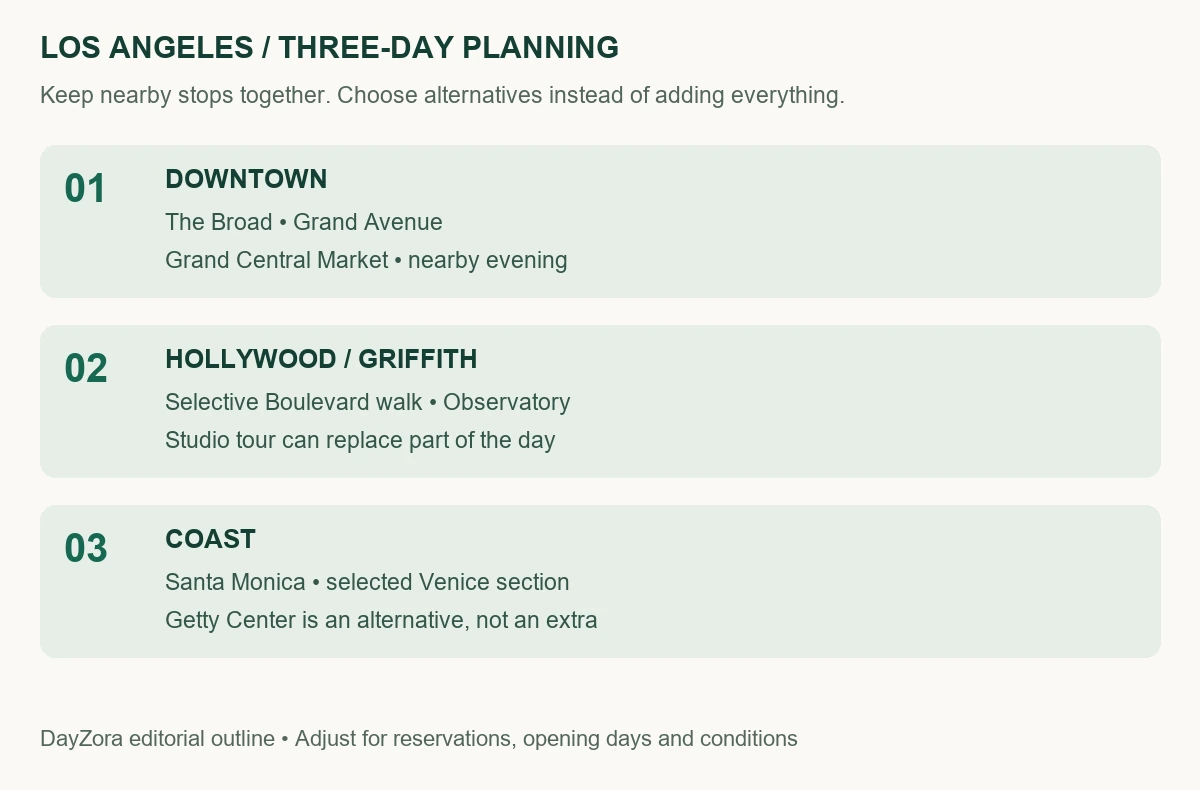
Day 1 — Downtown arts and food
Morning: The Broad, using the appropriate ticket. Afternoon: Walt Disney Concert Hall exterior or a verified tour, followed by Grand Central Market and a short Downtown walk. Evening: Dinner nearby or a booked performance. Keep this day in the same general area.
Day 2 — Hollywood and Griffith
Morning: A selective Hollywood Boulevard visit. Afternoon: Griffith Observatory with time for transport and a break. Evening: A Bowl performance if scheduled and feasible, or a relaxed dinner. If the studio tour matters more, replace part of this day with Burbank rather than add it to an already full plan.
Day 3 — Santa Monica and Venice
Morning: Santa Monica Pier and beach. Afternoon: Continue to a selected Venice waterfront section if energy and transport allow. Evening: A coastal dinner. Choose the Getty Center instead if art is the priority or conditions do not suit beach time; it is a replacement, not an effortless extra.
For the journey beyond LA, use the 7-day California itinerary and California road-trip guide.
Trip Budget: Include the Cost of Distance
On mobile, swipe the table sideways to see every column.
| Expense | Budget-oriented | Mid-range | Higher-end |
|---|---|---|---|
| Accommodation | Connected base with modest room | Area that reduces daily travel | Premium hotel and room category |
| Food | Casual neighborhood meals and simple breakfast | A reserved meal plus casual stops | Destination restaurants and private dining |
| Transport | Metro with a few planned rides | Rideshare or selective car rental | Frequent private transport and valet |
| Attractions | Free-admission art, public coast and parks | One or two ticketed experiences | Premium tours, performances or seats |
This is a decision framework, not a table of invented daily averages. Enter real lodging quotes and official ticket prices, then estimate transport for the actual routes. Free admission can still involve paid parking or a long ride. A more expensive base may cost less overall if it removes repeated cross-city transfers.
Best Free Things to Do
- Explore Griffith Observatory's building and grounds during open hours; planetarium and parking are extra.
- Visit the Getty Center with the required free reservation; parking remains paid.
- See The Broad's general collection using its current admission arrangements; special exhibitions may differ.
- Walk Santa Monica Pier and the public beach; rides and parking cost extra.
- Explore Venice's public waterfront.
- View Hollywood's Walk of Fame from public sidewalks.
- See Walt Disney Concert Hall's exterior from public areas.
Official visitor links and the relevant exclusions appear in the attraction profiles above. “Free” describes the stated activity, not every part of getting there.
Visiting Los Angeles With Kids
Pick a coast, science or film emphasis and keep the days short enough to enjoy it. Santa Monica can simplify a beach-centered trip; Griffith Observatory and a selected museum can provide variety. Check studio-tour minimum ages and performance rules before promising a particular experience. A hotel break is useful only if the hotel is close enough to reach without a lengthy journey. Compare broader choices in our family vacation destinations and family beach vacations guides.
Los Angeles for Couples
Plan a coastal evening, a concert or a museum-and-dinner day around one area. A sunset view at Griffith can be memorable, but the crowd and transport deserve attention. Reserve the meal or performance you care about and avoid surrounding it with more timed bookings. For a slower alternative, compare our romantic weekend getaways.
Best Day Trips from Los Angeles
Distances and times are broad one-way planning estimates from central LA; the departure neighborhood and traffic can change them substantially.
On mobile, swipe the table sideways to see every column.
| Destination | Approximate allowance | Best for | Car needed? |
|---|---|---|---|
| Pasadena | Roughly 15 miles; allow 30–60 minutes or a planned Metro journey | Architecture, dining and a compact change of scene | Not necessarily; use Visit Pasadena and Metro |
| Long Beach | Roughly 25–30 miles; allow 45–90 minutes or a longer rail journey | Waterfront and a focused attraction visit | Optional; consult Visit Long Beach |
| Malibu | Roughly 30–45 miles depending on beach; allow 1–2 hours | A selected coastal stop | Car often useful; check city notices and beach access before departure |
Anaheim theme parks are full-day destinations with separate admission and substantial travel from many LA bases. San Diego, Joshua Tree and farther coastal stops deserve more time if the aim is an enjoyable trip rather than hours of driving. Do not add them to a three-day city plan simply because they share a regional map.
Practical Los Angeles Travel Tips
- Put your must-do locations on a map before choosing a hotel.
- Keep Downtown, the coast and Hollywood as separate planning clusters.
- Check museum closing days and free-ticket reservation requirements.
- Confirm the current LAX terminal connection rather than using a predicted opening date.
- Include parking and the last walk from a garage in appointment times.
- Treat a studio tour as a substantial visit and verify age rules.
- Check event-specific Bowl transport and entry policies.
- Compare a Metro journey door to door, including transfers and walking.
- Check coastal and hillside access after severe weather or fire impacts.
- Leave room for a missed stop; crossing the city to recover it can undo the rest of the day.
Frequently Asked Questions
Do I have to rent a car in Los Angeles?
No single answer fits everyone. A connected hotel and geographically grouped itinerary can work with Metro and occasional rides. Widely spread stops and some day trips may make a car more useful.
Should I stay in Hollywood or Santa Monica?
Choose Hollywood for nearby film landmarks and inland plans; choose Santa Monica when the coast is central to the trip. Neither is convenient for every attraction in this guide.
Is three days enough?
Three full days can cover three selected areas. Four or five nights provide more breathing room for a studio tour, museum or beach day without constant transfers.
Are the Getty Center and Getty Villa the same place?
No. They are separate sites with different locations and visitor arrangements. This itinerary recommends the Getty Center; check the correct reservation before traveling.
Can I visit LA as part of a California road trip?
Yes, but park the driving itinerary for a few nights and plan the city in local clusters. The linked California guides cover the larger route and its tradeoffs.
More DayZora planning resources
Compare other city guides or use our travel planning tips for the practical steps around a U.S. trip.
How this guide was researched
DayZora reviewed official attraction, transit, airport, tourism and government information and added editorial neighborhood comparisons, suggested visit durations and a selective itinerary. Recommendations are research-based, not claims of firsthand visits. Approximate travel allowances are planning estimates, not live schedules or traffic predictions. Linked operator pages provide current prices and conditions; recheck them before booking and before travel.
Pingback: 20 Best Places to Visit in California | DayZora
Pingback: Super Bowl 2027: Date, SoFi Stadium & Fan Travel Guide