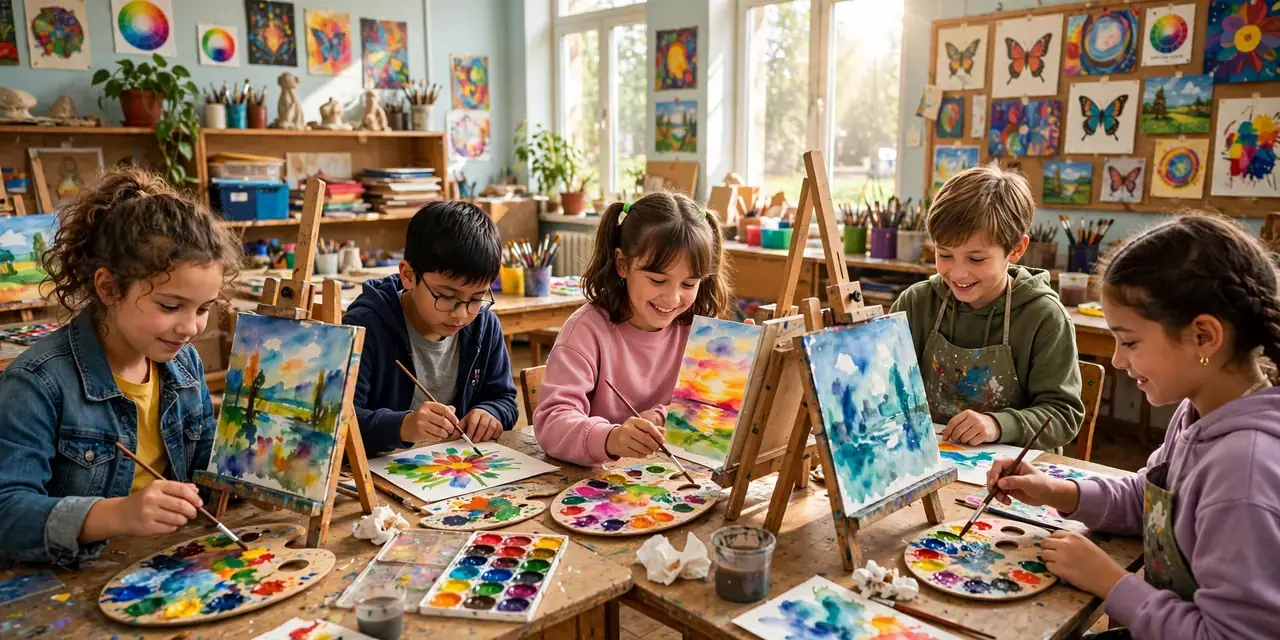
Give children paint, paper, and permission — then step back. What happens next is the reason art belongs at the center of every Children’s Day celebration. While games bring noise and performances bring applause, art brings something quieter and just as precious: the sight of a child completely absorbed, tongue peeking out in concentration, creating something that did not exist that morning.
This guide collects thirty-five children’s day art activities for classrooms, art rooms, and school corridors — painting projects, drawing challenges, collage and mixed-media ideas, printmaking, simple sculpture, and collaborative murals that let whole classes create together. Every project is designed for real school conditions: limited time, shared supplies, mixed ages, and the need for every child to finish with something they are proud to carry home. You will also find a project-picker table organized by age and time, tips for turning the day’s art into an exhibition, a supplies checklist, and answers to common questions.
Why Art Deserves a Headline Slot on Children’s Day
Art is the most democratic celebration activity ever invented. It needs no audition, no athletic ability, no stage confidence. The child who dreads the talent show and loses every race can be the star of the art room. On a day dedicated to honoring every child, that inclusivity matters enormously.
There is also a practical magic to art activities: they produce tangible keepsakes. Long after the sweets are eaten and the songs forgotten, the handprint bouquet sits on a parent’s desk and the painted pot sits on a windowsill. Art turns a single day’s celebration into months of quiet reminders. Schools that display the day’s work in corridors get a free, beautiful exhibition that parents photograph and share — the kind of organic publicity no banner can buy.
Developmentally, the benefits stack up fast. Painting and drawing build fine motor control and hand-eye coordination. Choosing colors and composing scenes exercises decision-making and self-expression. Collaborative murals teach negotiation and shared ownership. And for children who struggle to express big feelings in words, art offers a safe, wordless language. A well-run art session on Children’s Day is not a break from learning — it is learning at its most joyful.
Painting Projects: Color, Mess, and Joy
Painting is the headline act of children’s day art activities. These projects balance creative freedom with just enough structure that every child succeeds.
Blow-Paint Fireworks
Drop watery paint onto paper and let children blow it outward through straws — the paint blooms into firework bursts. Add a second color while the first is wet and watch them swirl. It is science, art, and giggling in one activity, and the results genuinely look like celebration fireworks.
Ages: 5+. Time: 20 minutes. Supplies: watery poster paint, straws, thick paper. Tip: Thin the paint well; thick paint will not blow. Cover tables — this one travels.
Finger-Paint Masterpieces
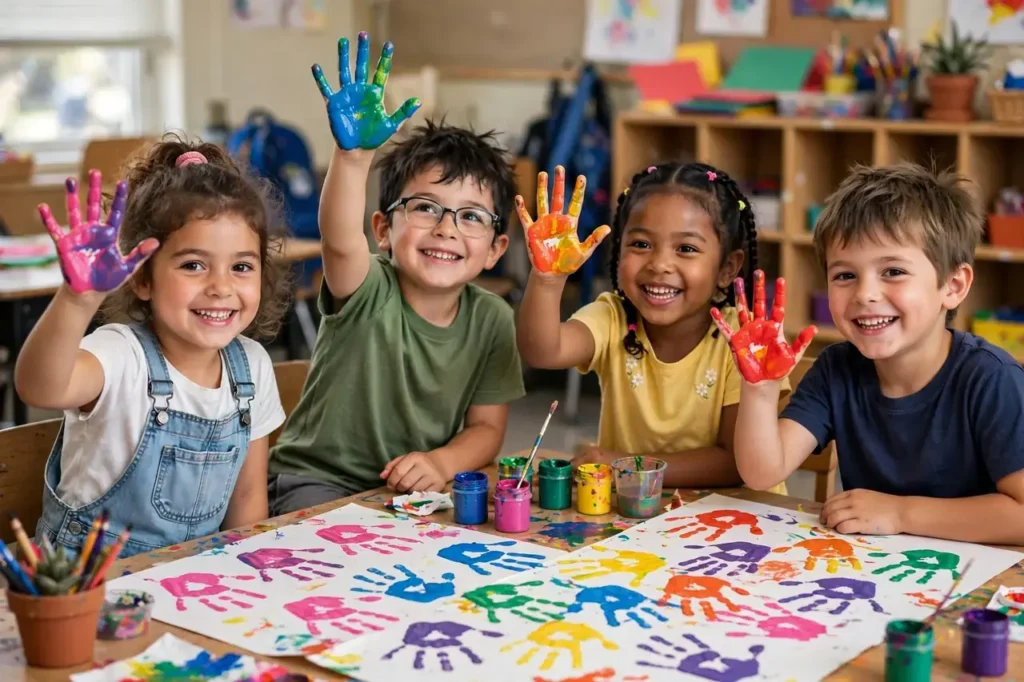
Skip the brushes entirely: children paint with fingers, palms, and thumbs. Suggest starting with a handprint tree (brown trunk, green handprint leaves) or let them go abstract. Finger painting is deeply sensory and wonderfully freeing for perfectionist children who fear “doing it wrong.”
Ages: 3+. Time: 15–20 minutes. Supplies: washable finger paint, large paper, smocks, wet wipes. Tip: Have a “hand-washing parade” to the sink as part of the activity — it becomes a ritual, not a chore.
Watercolor Resist Art
Children draw bold designs with white crayons or oil pastels on white paper — seemingly invisible — then wash watercolor over the top and watch their secret drawings appear. The reveal moment produces genuine gasps, every single time.
Ages: 6+. Time: 25 minutes. Supplies: white crayons, watercolor sets, brushes, thick paper. Tip: Press hard with the crayon; faint lines will not resist the paint.
Sponge-Painted Landscapes
Cut sponges into shapes — clouds, suns, trees, hills — and let children stamp layered landscapes. Dabbing paint with a sponge is easier than brush control for young children, and the textured results look impressively professional.
Ages: 4+. Time: 20 minutes. Supplies: cut sponges, poster paint trays, paper. Tip: Demonstrate “dab, don’t drag” once; dragging smears the shapes.
Marble Rolling Art
Place paper in a shallow tray, drop in paint-coated marbles, and tilt the tray to roll them into swirling tracks. Each piece is unique, the process is mesmerizing, and even the youngest children produce frameable abstract art.
Ages: 3+. Time: 15 minutes. Supplies: trays, marbles, thinned paint, paper. Tip: Marbles are a choking hazard — this is a closely supervised station for under-fives.
Drawing Challenges: Pencils, Crayons, and Imagination
Drawing needs almost no setup, making these children’s day art activities perfect for classrooms without sinks or for the last period of the day.
Exquisite Corpse Drawings
Fold paper into thirds. One child draws a head, folds it over; the next draws a body without seeing the head; the third draws legs. Unfold to reveal gloriously absurd creatures. It is collaborative, hilarious, and teaches children to embrace surprise.
Ages: 7+. Time: 15 minutes. Supplies: paper, pencils, crayons.
Draw-Your-Dream-School
Ask children to draw their dream school — slides instead of stairs, a chocolate library, classrooms in treehouses. Then display the drawings together as a “vision gallery.” Teachers often learn surprising things about what children wish school felt like.
Ages: 5+. Time: 20–30 minutes. Supplies: drawing paper, crayons, markers.
Zentangle-Style Doodle Cards
Older students divide a card into sections and fill each with repeating patterns — dots, waves, spirals. It looks sophisticated, requires no drawing “talent,” and is meditatively calming. The finished cards make beautiful Children’s Day gifts for parents.
Ages: 9+. Time: 25–30 minutes. Supplies: blank cards, fine black pens, optional colored pencils.
Comic Strip: My Children’s Day
Students draw a four-panel comic of their ideal Children’s Day — morning to night. It combines drawing with storytelling and gives teachers a window into what the day means to each child. Bind the best into a class comic book for the library.
Ages: 7+. Time: 30 minutes. Supplies: paper, pencils, markers, rulers for panels.
Drawing-based calm activities also work beautifully as wind-downs after high-energy events — pair them with the quieter options in our screen-free activities for kids collection for a full balanced day.
Collage and Mixed-Media Magic
Collage is wonderfully forgiving — there are no “wrong” compositions, and tearing and gluing build different muscles than drawing. These mixed-media children’s day art activities use inexpensive, often recycled materials.
Torn-Paper Peacock
Children tear colored paper into feather shapes and layer them into a peacock’s fanned tail on a drawn body. Tearing (rather than cutting) gives organic edges that look artistic, and the layered result is genuinely stunning on display.
Ages: 5+. Time: 25 minutes. Supplies: colored paper, glue, peacock body templates.
Magazine Mosaic Self-Portraits
Students cut or tear skin-tone, clothing-color, and background pieces from old magazines and assemble mosaic self-portraits. It is part art, part identity exploration — and the results are fascinatingly varied.
Ages: 8+. Time: 30–40 minutes. Supplies: old magazines, glue, card backing, scissors.
Nature Collage Boards
After a short outdoor collection walk (leaves, petals, twigs, seeds), children arrange their finds into pictures on card — leaf animals, petal mandalas, twig frames. It connects art with nature observation and costs absolutely nothing.
Ages: 4+. Time: 30 minutes including the walk. Supplies: card, glue, collected nature items.
3D Greeting Cards
Folded cards decorated with layered paper shapes, pop-up elements, and textured materials (cotton-ball clouds, sandpaper paths, ribbon rivers). These become the Children’s Day cards students give their parents — art with a purpose.
Ages: 6+. Time: 25 minutes. Supplies: blank cards, colored paper, glue, textured scraps.
Printmaking: Little Artists, Big Techniques
Printmaking feels like real “artist technique” to children, and the repetition of printing is deeply satisfying.
Vegetable Printing
Halved okra, potatoes carved into shapes, and celery stalks become stamps — dip in paint and press. Okra cross-sections print perfect flowers; it never fails to delight. Use washable paint and aprons.
Ages: 4+. Time: 20 minutes.
Handprint and Footprint Art
Beyond the classic handprint flower: footprint cars (heel as body, toes as wheels), handprint peacocks, thumbprint caterpillars. Provide idea cards but let children invent — the invented ones are always the best.
Ages: 3+. Time: 15–20 minutes.
String Pull Paintings
Dip string in paint, lay it in squiggles on paper, fold the paper over, and pull the string out — revealing symmetrical, marbled patterns. It feels like magic and teaches symmetry intuitively.
Ages: 5+. Time: 15 minutes.
Leaf Rubbings and Prints
Place leaves under paper and rub with crayons to reveal vein patterns, or paint leaves and press them as prints. Simple, beautiful, and a lovely bridge between art and science observation.
Ages: 4+. Time: 15 minutes.
Sculpture and 3D Projects
Three-dimensional art adds a wow factor to displays and gives kinesthetic learners their moment. These children’s day art activities build with humble materials.
Paper Cup Animals
Turn paper cups upside down and transform them with paper ears, googly eyes, painted bodies, and yarn tails — lions, penguins, cats. They stand on their own, making them perfect for display shelves.
Ages: 4+. Time: 20–25 minutes. Supplies: paper cups, colored paper, glue, googly eyes, paint.
Newspaper Sculptures
Roll newspaper into tight tubes and tape them into structures — towers, animals, abstract shapes — then paint. It teaches structural thinking (triangles are strong!) and recycles a whole stack of old papers.
Ages: 8+. Time: 30–40 minutes. Supplies: newspaper, masking tape, paint.
Clay Diya Holders and Trinket Dishes
With air-dry clay, children pinch small bowls, coil pots, or animal figures. Even simple pinch pots, painted after drying, become treasured gifts. Clay work is deeply calming — schedule it after lunch when energy needs grounding.
Ages: 5+. Time: 30 minutes plus drying. Supplies: air-dry clay, water pots, paint for later.
Recycled Robot Builders
Boxes, bottle caps, cardboard tubes, and foil become robots with moving arms (split pins) and personality. This is engineering disguised as art, and children — especially those who claim they “can’t draw” — often shine brightest here.
Ages: 6+. Time: 30–40 minutes. Supplies: clean recyclables, tape, glue, split pins, markers.

Collaborative Murals: The Whole Class Creates Together
Collaborative pieces teach children that their contribution matters to something bigger than themselves. They also produce the large-scale display pieces that make corridors spectacular.
Handprint Tree of Friendship
Paint a large tree trunk on a roll of paper; every child adds handprint “leaves” in green paint, signing their name beside their print. It becomes a permanent celebration of that class, that year — many schools keep these for decades.
Mosaic Tile Mural
Draw a large simple design (a sun, a kite, the words “Happy Children’s Day”) on chart paper divided into a grid. Each child colors or collages one square. Assembled, the squares form the whole image — a living metaphor for community.
Wishes Washing Line
Children write or draw one wish for the world on a paper shape (stars, clouds, hearts) and peg them to lines strung across the classroom. Reading each other’s wishes builds empathy; the fluttering display is beautiful.
Kindness Quilt
Each child decorates one paper “quilt square” with something kind they will do this year. Join the squares into a giant quilt display. Revisit it in later months — accountability wrapped in art.
Group creations like these also make wonderful backdrops for class photographs, and they transition naturally into party settings — see our kids birthday party ideas for decor concepts that reuse the same collaborative approach.
Project Picker: Art Activities by Age and Time
Use this table to match projects to your class in seconds.
| Project | Ages | Time Needed | Mess Level | Take-Home? |
|---|---|---|---|---|
| Finger-paint masterpieces | 3+ | 15–20 min | High | Yes |
| Marble rolling art | 3+ | 15 min | Medium | Yes |
| Handprint/footprint art | 3+ | 15–20 min | Medium | Yes |
| Sponge-painted landscapes | 4+ | 20 min | Medium | Yes |
| Vegetable printing | 4+ | 20 min | Medium | Yes |
| Paper cup animals | 4+ | 20–25 min | Low | Yes |
| Blow-paint fireworks | 5+ | 20 min | High | Yes |
| Torn-paper peacock | 5+ | 25 min | Low | Yes |
| 3D greeting cards | 6+ | 25 min | Low | Yes (gift) |
| Watercolor resist art | 6+ | 25 min | Low | Yes |
| Recycled robots | 6+ | 30–40 min | Low | Yes |
| Exquisite corpse drawings | 7+ | 15 min | None | Yes |
| Comic strip: My Children’s Day | 7+ | 30 min | None | Yes |
| Newspaper sculptures | 8+ | 30–40 min | Low | Maybe |
| Zentangle doodle cards | 9+ | 25–30 min | None | Yes (gift) |
| Handprint tree mural | All ages | 30 min | Medium | Display |
| Mosaic tile mural | All ages | 30–40 min | Low | Display |
Watch: Easy Kids’ Art and Craft Ideas
Short video demonstrations are the fastest way to learn a new technique before teaching it. This video shows five easy art and craft projects — glitter butterflies, popcorn flower trees, salt firework art — each adaptable as a Children’s Day classroom activity.
Preview the techniques, gather the materials shown, and try one project yourself first — a teacher who has made the craft once can troubleshoot ten times faster.
Turning the Day’s Art into an Exhibition
Art made is only half the joy; art displayed completes it. End your Children’s Day art session with a gallery:
- The corridor gallery: Hang work at child eye-height along the main corridor with small name labels. Invite other classes to tour it.
- The clothesline show: Peg paintings to strings across the classroom — instant, charming, and easy to take down.
- Artist statements: Ask each child for one sentence about their piece (“My robot protects the school”) and display it alongside. It transforms crafts into an exhibition.
- The voting wall (kind voting only): Give each visitor three star stickers to award to favorite pieces — with the rule that you cannot vote for your own class. Every piece gets stars; children learn their work is valued by others.
- Photograph everything: Before pieces go home, photograph each one. A digital gallery on the school’s page lets parents download memories and gives next year’s teachers inspiration.
Supplies Checklist for Art Day
- Basics: Thick drawing paper, washable poster paints, watercolor sets, crayons, markers, colored pencils, glue sticks, liquid glue, scissors (blunt for young children), smocks or old shirts.
- For texture: Sponges, cotton balls, string, bubble wrap, corrugated card scraps.
- For collage: Colored paper, old magazines, tissue paper, stickers, googly eyes, yarn, ribbon scraps.
- For 3D: Paper cups, cardboard tubes, small boxes, air-dry clay, pipe cleaners.
- Protection: Table covers or old newspapers, floor sheets for paint stations, wet wipes, paper towels, soap at sinks.
- Display: String, pegs, tape, name labels, a camera or phone for documentation.
- Rule of thumb: Prepare 20% more paper and paint than you calculate — art enthusiasm always exceeds estimates, and running out mid-project deflates the room.
For classrooms that want art to flow into the rest of the celebration, our indoor activities for kids guide includes drawing games and quiet creative stations that pair perfectly with these projects.
Matching Art Activities to Age Groups
The same project lands very differently at age four and age fourteen. Here is how to calibrate children’s day art activities across the school.
Ages 3–5: Process Over Product
Preschoolers care about the doing, not the done. Finger painting, marble rolling, sponge stamping, and handprint art are ideal because every attempt looks delightful and there is no “wrong” outcome. Keep sessions to fifteen or twenty minutes, expect glorious mess, and frame everything — parents genuinely treasure a framed handprint. Avoid projects with many steps or drying waits; little ones lose interest while glue dries. One adult per six children keeps the chaos joyful rather than overwhelming.
Ages 6–8: Guided Creativity
Early primary children love learning “real” techniques and showing off new skills. Watercolor resist, blow-paint fireworks, vegetable printing, and paper cup animals hit the sweet spot: structured enough to teach something, open enough for personal flair. This is the golden age for collaborative murals — children are old enough to follow the shared plan and young enough to be thrilled by contributing to something big. Introduce simple artist vocabulary (texture, pattern, symmetry) and watch them use it proudly for weeks.
Ages 9–12: Skill and Self-Expression
Upper primary students crave challenge and meaning. Offer zentangle cards, magazine mosaic portraits, comic strips, and newspaper sculptures — projects with visible skill progression. They also respond to purpose: art with a message (kindness quilts, wishes washing lines, dream-school galleries) engages their growing social awareness. Let them choose between two or three projects; autonomy fuels effort at this age. Display their work prominently — being taken seriously as young artists matters enormously to ten-year-olds.
Ages 13–16: Studio Freedom
Teenagers will disengage from anything that feels babyish, so frame the session as a studio: set out quality materials, propose ambitious prompts (design a mural for the school wall, create art about childhood memories), and step back. Recycled robots become engineering challenges; exquisite corpse becomes surrealist collaboration; comic strips become graphic storytelling. Invite interested teens to mentor younger classes’ art sessions — the responsibility transforms their relationship with the day, and the little ones adore their big-school helpers.
Frequently Asked Questions
What are the best children’s day art activities for a class of 40 students?
Choose low-supervision, high-success projects: blow-paint fireworks, sponge-painted landscapes, exquisite corpse drawings, and zentangle cards all scale beautifully because every child works independently with simple materials. Run collaborative murals as a second station where groups of eight rotate through. Avoid projects needing one-to-one help (like intricate clay work) with very large classes unless you have multiple assistants.
How do we manage paint mess with young children?
Prevention beats cleanup: smocks on every child, tables covered, floors sheeted at paint stations, and paint in shallow trays rather than deep pots (less to spill). Teach the “one dip, dab dab” routine before starting. Keep wet wipes at each table and run a hand-washing parade to the sink as part of the activity’s ending ritual — children treat it as fun, not discipline.
What art activities work when we have no art room or sink?
Drawing challenges (exquisite corpse, dream-school drawings, comics, zentangle cards), collage (torn-paper peacock, magazine mosaics, sticker scenes), and 3D builds (paper cup animals, recycled robots) need no water at all. Save the painting projects for classrooms near washrooms, or use watercolor pencils — color dry, then brush with a barely-damp brush for paint effects with minimal mess.
How long should a Children’s Day art session last?
Forty-five to sixty minutes for one project including setup and cleanup, or ninety minutes for two projects with a break between. Young children (under six) do best with a single twenty-minute project; older students can sustain a forty-minute build like newspaper sculptures. Always budget ten minutes for cleanup within the session — never steal it from the next activity.
Should every child make the same project or choose their own?
Offer two to three choices per session rather than one mandatory project or total free choice. Limited choice prevents decision paralysis while honoring preferences — the painters paint, the builders build. For collaborative pieces (murals, quilts), everyone contributes to the shared design, which elegantly sidesteps the choice question entirely.
How can we display art so every child feels proud?
Display every single piece — no selection, no “best” wall. Hang work at child eye height with name labels, and add one-sentence artist statements. For 3D work, use display shelves or window sills. Photograph everything before it goes home so the digital gallery preserves what the corridor cannot. The rule is simple: if a child made it with effort, it deserves a wall.
What if a child says their art is “bad” or refuses to participate?
Never argue (“No, it’s beautiful!”) — instead, get curious: “Tell me about this part here.” Ask them to teach you their technique, or offer a fresh start with different materials. Often refusal masks fear of judgment; process-focused praise (“You mixed an amazing purple!”) rebuilds confidence faster than product praise. And some children genuinely prefer watching first — let them observe one round, then invite them in.
Can art activities work outdoors for Children’s Day?
Absolutely — chalk art galleries, nature collages, and large-scale ground murals with washable paint are outdoor classics. Outdoors also solves the mess problem entirely. Watch for wind (paper needs weights or clips), sun (hats and water), and drying time (work in shade so paint does not dry mid-project). Sidewalk chalk murals photographed from above make spectacular school social media posts.
How do we include children with disabilities in art activities?
Art is naturally adaptable, which makes inclusion straightforward with small adjustments. Offer chunky brushes and easy-grip tools for children with fine motor difficulties; provide pre-cut shapes so cutting is optional; let children direct a buddy artist (“put the blue handprint here”) when they cannot physically participate — directing is genuine creative authorship. Seat wheelchair users at tables with clearance underneath, keep sensory-sensitive children away from strong smells and loud drying stations, and always offer a choice of materials so every child works in the medium that suits them. The goal is identical for everyone: a finished piece they are proud of.
Art on Children’s Day is really a promise: that every child’s inner world is worth making visible. Set out the supplies, protect the tables, and then do the hardest and most important thing a teacher can do — get out of the way and let them create. Photograph the gallery before pieces go home, share the pictures with families, and keep one collaborative piece — the handprint tree, the mosaic mural — on permanent display as the year’s celebration made visible. The gallery at day’s end will take your breath away. Happy Children’s Day!